What you'll learn
- Use the 하/해 test to pick 되 or 돼 in any sentence.
- Spell eight common forms: 되다, 돼요, 됐어요, 되면, 되고, 돼서, 되는 and 안 돼.
- Explain why 됐 is correct and 됬 is not.
- Fix 되요 and 안되요 in your own writing.
Prerequisites: you can read Hangul and know what a verb ending is. Time: about 25 minutes.
Key facts
- 돼 is a contraction of 되어. Both 되어요 and 돼요 are correct, but 되요 is not.
- If 하 fits the slot, write 되. If 해 fits, write 돼.
- The past of 되다 is 됐 (from 되었), never 됬.
- The polite way to say "not allowed" is 안 돼요, with a space.
Listen to the two forms you will compare through the whole lesson.
The next section explains what 되 and 돼 each stand for.
What Is 되 vs 돼?
되 is the stem of the verb 되다, "to become" or "to be okay", and 돼 is the same verb with the ending 어 already attached. 돼 is a contraction (준말): 되 + 어 shrinks to 돼. A stem is the part of a verb that stays the same, and an ending is the part that changes. So 되 is the bare stem, while 돼 is stem plus ending in one block.
English has the same idea. "Do not" shrinks to "don't", and the apostrophe shows that something was removed. Korean has no apostrophe, so the contraction 돼 simply looks like a different letter. When a writer sees 돼, the hidden 어 is the thing to remember.
| Form | Built from | Meaning in the sentence | Example |
|---|---|---|---|
| 되 | stem of 되다 | the verb stem before a consonant-start ending | 의사가 되고 싶어요. (I want to become a doctor.) |
| 돼 | 되 + 어 | the stem plus the ending 어, used before 요, 서, 도, 야 | 지금 가도 돼요. (You may go now.) |
| 됐 | 되 + 었 | past tense | 숙제가 다 됐어요. (The homework is all done.) |
Most Korean speakers say ㅚ and ㅙ almost alike, close to "we" in the English word "wet", so the ear cannot help. The Korean vowels ㅙ ㅚ ㅞ lesson explains why the three vowel letters merged in sound. Spelling therefore has to come from a rule rather than from hearing.
The next section explains why this pair is hard for English speakers in particular.
Why Do English Speakers Struggle with 되 and 돼?
English speakers look for a difference in sound, and Korean offers none. In English, "its" and "it's" also sound the same, and writers fix that by checking whether "it is" fits. Korean needs the same habit: check whether the hidden ending 어 fits.
Two other habits make the pair harder.
- English verbs rarely hide an ending inside one letter. In Korean the ending is often absorbed, so 돼 contains two parts but looks like one syllable.
- Fast typing can also favour the shorter-looking letter, because 되 looks simpler than 돼.
Korean writers mix up the pair as well, because the sounds are the same for them. The test below works for Korean writers too, which is why it appears here before any grammar terms. The next section shows how it works.
How Does the 하/해 Test Work?
The 하/해 test works because 하다 ("to do") behaves exactly like 되다 in the places where the two letters compete. Put 하 or 해 in the slot. If the sentence still makes grammatical sense with 하, write 되. If it makes sense with 해, write 돼. You only test the form, not the meaning.
Why does this work? 하다 and 되다 take the same endings in the same way. Before consonant-start endings, 하다 stays 하 (하고, 하면). Before the ending 어, 하다 becomes 해 (해요, 해서). 되다 follows the same pattern one-for-one: 되고, 되면, then 돼요, 돼서.
| Slot | With 하/해 | Result | Meaning |
|---|---|---|---|
| 지금 가도 __요? | 지금 가도 해요? | 해 fits, so 돼 | 지금 가도 돼요? (May I go now?) |
| 의사가 __고 싶어요 | 의사가 하고 싶어요 | 하 fits, so 되 | 의사가 되고 싶어요. (I want to become a doctor.) |
| 비가 와도 __요 | 비가 와도 해요 | 해 fits, so 돼 | 비가 와도 돼요. (It is fine if it rains.) |
| 시간이 __면 | 시간이 하면 | 하 fits, so 되 | 시간이 되면 (when you have time) |
Do the test in your head: replace, check, write. The meaning will look odd with 하 or 해, because 하다 means "to do". That does not matter. Only the shape of the ending matters.
Now apply the test to the forms with 되.
Which Forms Use 되?
Forms use 되 when the next sound starts with a consonant or a consonant-like final, so no 어 follows. The test shows 하 in each of these.
| Form | Test with 하 | Meaning | Spoken |
|---|---|---|---|
| 되다 | 하다 | to become, to be okay | [되다] |
| 되고 | 하고 | and becomes | [되고] |
| 되면 | 하면 | if it becomes | [되면] |
| 되지 않아요 | 하지 않아요 | does not become | [되지 아나요] |
| 되는 | 하는 | that becomes | [되는] |
| 된 | 한 | that became | [된] |
| 될 거예요 | 할 거예요 | will become | [될꺼예요] |
| 됩니다 | 합니다 | becomes (formal) | [됨니다] |
| 되세요 | 하세요 | please become (honorific) | [되세요] |
The forms above come from the standard conjugation of 되다: 되다, 되고, 되면, 되는, 된, 될, 됩니다 and 되세요. As a rule of thumb, 되 appears before consonant-start endings (-고, -면, -지, -는, -세요) and with -ㄴ, -ㄹ or -ㅂ attached to the same block (된, 될, 됩니다).
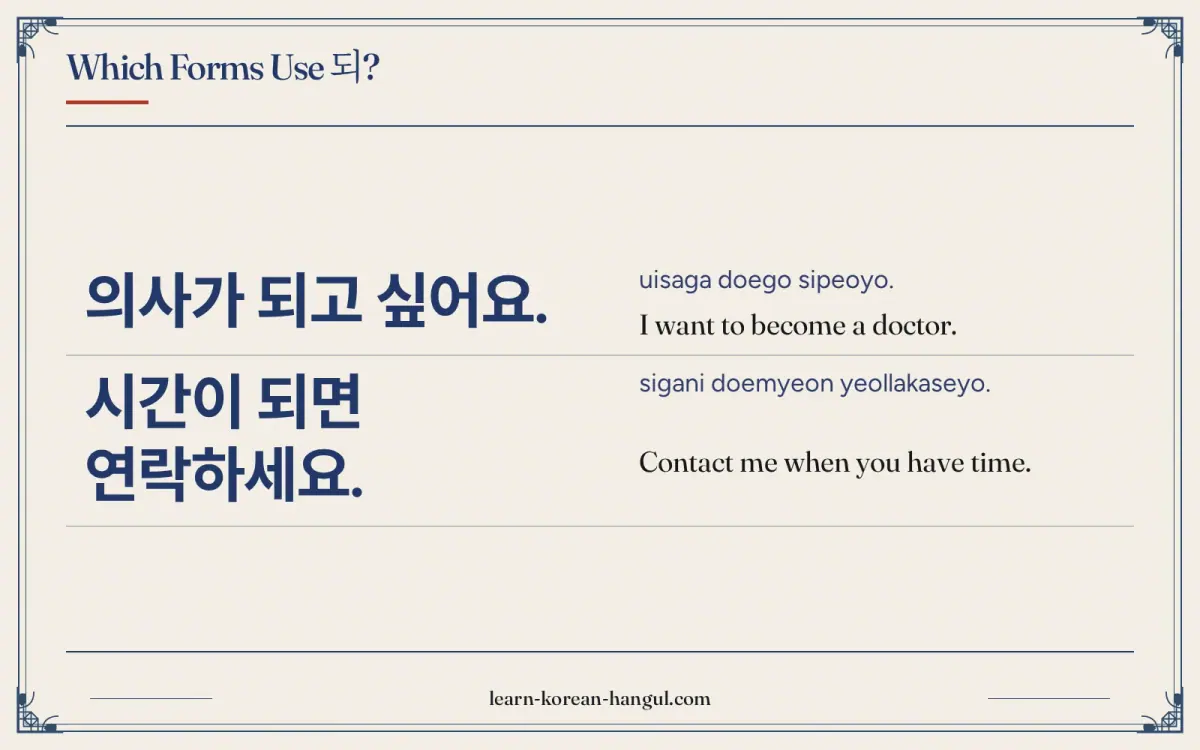
의사가 되고 싶어요.
uisaga doego sipeoyo.
I want to become a doctor.
시간이 되면 연락하세요.
sigani doemyeon yeollakaseyo.
Contact me when you have time.
The next section covers the forms that need 돼.
Which Forms Use 돼?
Forms use 돼 when 어 is attached, which happens before 요, 서, 도 and 야. The test shows 해 in each of these.
| Form | Test with 해 | Meaning | Spoken |
|---|---|---|---|
| 돼요 | 해요 | becomes, is okay (polite) | [돼요] |
| 돼서 | 해서 | because it becomes | [돼서] |
| 돼도 | 해도 | even if it becomes; it is okay to | [돼도] |
| 돼야 | 해야 | only if it becomes; must | [돼야] |
| 돼 | 해 | becomes (casual) | [돼] |
| 안 돼요 | 안 해요 | is not allowed | [안 돼요] |
You can also write the unshortened forms 되어요, 되어서 and 되어도. These are correct but longer, so most writers use 돼요, 돼서 and 돼도. The only wrong choice is to cut the 어 without changing 되 to 돼. That is how 되요 appears.
Two situations are worth memorising because they appear in everyday speech.
- Asking permission. 여기 앉아도 돼요? means "May I sit here?" The pattern -아/어도 되다 uses 돼요 at the end, because 해요 fits. The negative answer is 안 돼요, "No, you may not".
- Saying "must". -아/어야 되다 and -아/어야 하다 both mean "have to". 가야 돼요 and 가야 해요 are both fine. The test again shows the fit: 가야 해요.
여기 앉아도 돼요?
yeogi anjado dwaeyo?
May I sit here?
내일까지 끝내야 돼요.
naeilkkaji kkeunnaeya dwaeyo.
I have to finish by tomorrow.
The grammar behind these patterns has its own pages: Korean can grammar covers permission and possibility, and Korean have to grammar covers obligation. The next section deals with the past tense, where the test needs one more step.
How Do I Handle 됐 and 안 돼?
Write 됐 for the past tense of 되다, and write 안 돼 with a space for "not allowed". 됐 is the contraction of 되었, so it carries the past-tense marker ㅆ inside the block. The test for 됐 is to put 했 in the slot: if 했 fits, write 됐.
| Form | Built from | Test with 했 | Meaning |
|---|---|---|---|
| 됐어요 | 되었어요 | 했어요 | became; it is done |
| 됐습니다 | 되었습니다 | 했습니다 | became (formal) |
| 됐어 | 되었어 | 했어 | it's okay; enough (casual) |
| 됐다 | 되었다 | 했다 | became (plain) |
The past stem 됐 is followed by 어요 in the spelling: 됐어요 is said [돼써요]. The ㅆ moves to the next block when it is spoken, which is a normal sound change and does not change how the word is written. Revised Romanization writes 됐어요 as dwaesseoyo.
Why 됬 is wrong. The letter 됬 keeps the stem vowel ㅚ and adds the past marker ㅆ, but the past of 되다 needs the contracted vowel ㅙ, because 되었 shrinks to 됐. No ending produces 됬, so it never counts as a spelling variant. Write 됐.
Why 안 돼 and not 안 되. 안 is a separate adverb that means "not", so it needs a space after it: 안 돼요. The word after 안 is 돼 because the polite ending 요 follows the stem directly, with the hidden 어. Test it: 안 해요 works, 안 하요 does not.
Note that the dictionary also lists 안되다 as a single word with narrower meanings, for example when business or work is not going well. In everyday writing, keep the spaced form 안 돼요 for "not allowed" and "no good". The next section combines everything into one worked example.
여기서 사진을 찍으면 안 돼요.
yeogiseo sajineul jjigeumyeon an dwaeyo.
You must not take photos here.
숙제가 다 됐어요.
sukjega da dwaesseoyo.
The homework is all done.
Worked Example: 잘돼요?
To spell 잘돼요? ("Is it going well?"), apply the test in four steps.
- Hear the slot. The syllable after 잘 sounds like [돼] or [되], and the ear cannot decide.
- Replace it. Put 하 and then 해 in the slot. 잘하요? is not a grammatical form. 잘해요? is a normal sentence.
- Read the result. 해 fits, so the correct letter is 돼.
- Write it. The final spelling is 잘돼요?, with no space, because 잘되다 ("to go well") is one word in the Standard Korean Language Dictionary (표준국어대사전).
You'll know it worked when you can say aloud why the letter has a ㅐ: because the ending 어 is hidden inside it. Try the same steps on 아침에 일찍 일어나야 돼요 (the final word needs 해야 → 돼야).
The test also works in questions that contain a question word. In 뭐가 안 돼요? ("What is not working?"), the ending 요 follows directly, so the answer is again 돼. The next section lists the mistakes learners make most often.
What Mistakes Do Learners Make with 되 and 돼?
Learners make four predictable mistakes with this pair, and each has a one-step fix.
Learners often assume the shorter letter is a safe default. Actually 되 and 돼 each fit different slots, and neither is a default. Wrong: 지금 가도 되요. Right: 지금 가도 돼요. Fix: run the 하/해 test every time until it becomes automatic.
Learners often assume 되요 is the polite form. Actually 되요 does not exist as a spelling. The polite present is 돼요, or the longer 되어요. Wrong: 안 되요. Right: 안 돼요. Fix: whenever you see 요 right after the stem, switch to 돼.
Learners often write 됬 for the past. Actually the past of 되다 is 됐, from 되었. Wrong: 숙제가 됬어요. Right: 숙제가 됐어요. Fix: test with 했어요.
Learners often join 안 to the verb. Actually 안 is a separate adverb. Wrong: 안돼요. Right: 안 돼요. Fix: leave one space after 안, as in 안 가요 and 안 먹어요.
An honest limit: the test checks the shape of the ending, not the meaning of the sentence. If you pick the wrong verb altogether, such as 되다 where 하다 was needed, the test will not warn you. It also assumes you know whether the word is a form of 되다. For compound words that contain 되, such as 허락되다, check the dictionary form first. Spell checkers catch many of these mistakes, as described in the Korean spell checker guide.
The next section collects the terms used in this lesson.
Key Terms Used in This Lesson
- 어간 (stem): the unchanging part of a verb. For 되다 the stem is 되.
- 어미 (ending): the part attached to the stem. In 돼요, the 어 is the ending that was absorbed into the block.
- 준말 (contracted form): a shortened spelling. 돼 is the short form of 되어, and 됐 is the short form of 되었.
- 한글 맞춤법: the spelling rules published by the National Institute of Korean Language (국립국어원). This lesson follows those rules, with the dictionary 표준국어대사전 as the reference for individual words.
The next section tests the rule on ten sentences.
Practice and Answer Key
Apply the test to ten sentences. Write the missing form in each.
- 지금 가도 __? (되 or 돼)
- 저는 선생님이 __고 싶어요. (되 or 돼)
- 시간이 __면 같이 가요. (되 or 돼)
- 거짓말하면 안 __. (되 or 돼)
- 열 살이 __어요. (되 or 됐)
- 내년에 대학생이 __ 거예요. (write 될 거예요 or 될거예요)
- 어른이 __서 기뻐요. (되 or 돼)
- 여기에 앉으면 안 __요. (되 or 돼)
- 숙제가 다 __어요? (되 or 됐)
- 내일 만나도 __요? (되 or 돼)
Practice · 10
Which is correct? 지금 가도 ___?
Show answer
돼
해 fits (지금 가도 해?), so write 돼.
Which is correct? 저는 선생님이 ___고 싶어요.
Show answer
되
하 fits (하고 싶어요), so write 되.
Which is correct? 시간이 ___면 같이 가요.
Show answer
되
하 fits (하면), so write 되.
Which is correct? 거짓말하면 안 ___.
Show answer
돼
안 해 fits, so write 안 돼.
Which is correct?
Show answer
열 살이 됐어요.
The past of 되다 is 됐 (from 되었). 됬 is never correct.
Which is correct?
Show answer
내년에 대학생이 될 거예요.
할 fits, so write 될. 거 is a separate word, so leave a space.
Which is correct? 어른이 ___서 기뻐요.
Show answer
돼
해서 fits, so write 돼서.
Which is correct?
Show answer
여기에 앉으면 안 돼요.
되요 is not a spelling. The polite form is 안 돼요.
Which is correct? 숙제가 다 ___어요?
Show answer
됐
했어요 fits, so write 됐어요.
Which is correct?
Show answer
내일 만나도 돼요?
해요 fits, so write 돼요. 되요 is not correct.
Answer key
- 돼. 지금 가도 돼? (해 fits.)
- 되. 저는 선생님이 되고 싶어요. (하 fits.)
- 되. 시간이 되면 같이 가요. (하면 fits.)
- 돼. 거짓말하면 안 돼. (안 해 fits.)
- 됐. 열 살이 됐어요. (했 fits.)
- 될. 내년에 대학생이 될 거예요. (할 fits.)
- 돼. 어른이 돼서 기뻐요. (해서 fits.)
- 돼. 여기에 앉으면 안 돼요. (안 해요 fits.)
- 됐. 숙제가 다 됐어요? (했어요 fits.)
- 돼. 내일 만나도 돼요? (해요 fits.)
If you scored 9 or 10, the test is working. If you missed items 5 and 9, review the past-tense section, because 됐 needs 했 as its test word. The next section points to what follows.
Where to Go Next after 되 vs 돼
After 되 vs 돼, continue to 안 vs 않, which uses the same kind of substitution test for a different pair. Both pairs appear in negative sentences, and the two lessons together settle most beginner spelling errors in the polite style.
For the tense behind 됐 and 됐어요, see the Korean past tense section. For the general question of what to check when you write, go back to Korean spelling rules, and for word spacing, such as the space in 안 돼요, see Korean spacing rules.
This lesson covers 되 vs 돼 in the polite and plain styles only. It does not cover literary or archaic spellings, or compound verbs such as 허락되다. About this page. Last updated 2026-10-09. The Korean text, spoken forms and Revised Romanization were reviewed and signed off by Min-ji Park on 15 October 2026. Romanization is shown only as a learning aid.
Frequently Asked Questions
What is the difference between 되 and 돼? 되 is the stem of the verb 되다 and appears before endings such as -고, -면, -지 and -는. 돼 is the short form of 되어 and appears before 요, 서, 도 and 야. A quick check is to swap in 하 or 해. If 하 fits the slot, write 되. If 해 fits, write 돼.
Is 됬 a word? No. 됬 is not correct Korean spelling. The past of 되다 is 됐, which is the contraction of 되었, as in 됐어요 and 됐습니다. The wrong form 됬 appears because the sound of 됐 is easy to confuse, so the check is to say 했 in the slot. If 했 fits, write 됐.
How do I write "it will be okay"? Write 괜찮을 거예요 for "it will be fine", or 잘될 거예요 for "it will work out". The second form uses 될, the future modifier of 되다, because 할 fits the same slot (잘할 거예요). The wrong form 잘될거예요 joins 거 to the verb. Space after 될, since 거 is a separate word.
Why is it 안 돼 and not 안 되? The sentence ends with a bare ending, so the verb takes the contracted form 돼, which is 되어. The test agrees, because 안 해 works and 안 하 does not. The same rule gives 안 돼요 in the polite form. A form such as 안 되 is only possible when another ending follows, for example 안 되면.