What you'll learn
- Attach -ㄹ 테니까 or -을 테니까 to verb, adjective and 이다 stems.
- Tell an intention ("I will") from a guess ("it will probably").
- Follow the first clause with a command, request or suggestion.
- Write 테 as a separate word and use the past form -았/었을 테니까.
- Choose between -(으)ㄹ 테니까, -(으)ㄹ게요 and -(으)니까.
Before you start: you should know the promise ending -(으)ㄹ게요 and the reason ending -(으)니까, because this pattern combines the ideas of both. Audio plays only when you press a button.
What Does -(으)ㄹ 테니까 Grammar Mean?
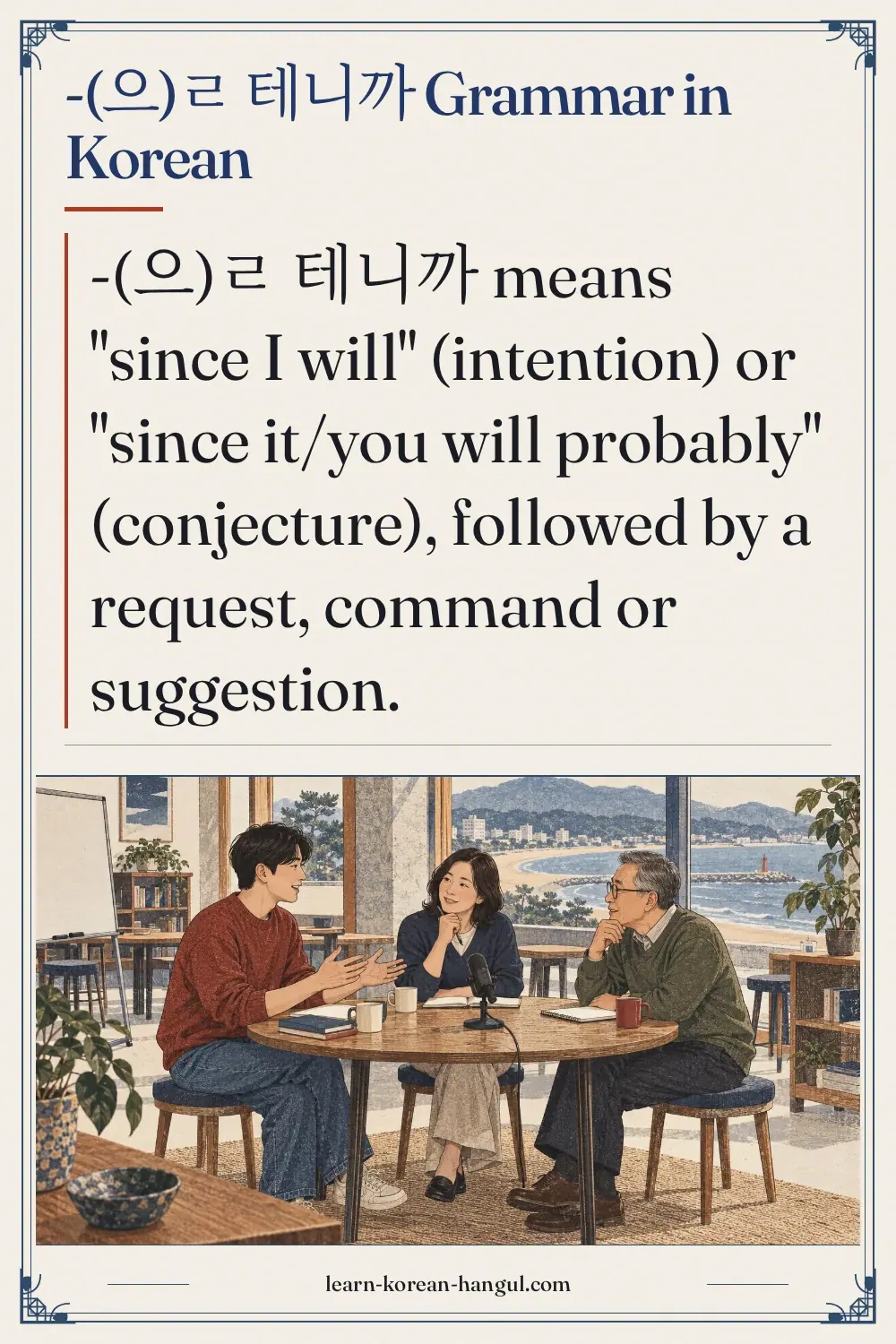
-(으)ㄹ 테니까 grammar means "since I will..." or "since it will probably...", and it leads into a request, a command or a suggestion. The first clause gives the speaker's plan or a likely situation. The second clause tells the listener what to do because of it.
Two examples show the idea.
- 제가 설거지할 테니까 쉬세요. (jega seolgeojihal tenikka swiseyo.) = "I'll do the dishes, so please rest."
- 비가 올 테니까 우산을 가져가세요. (biga ol tenikka usaneul gajyeogaseyo.) [비가 올 테니까 우사늘 가져가세요] = "It will probably rain, so take an umbrella."
In the first sentence the speaker's will is the reason. In the second a prediction is the reason. Both sentences end with a command that the listener can follow at once. The sections below show how to build the ending and what it can follow. First comes the formation rule.
How Do You Form -(으)ㄹ 테니까?
-(으)ㄹ 테니까 is formed by dropping 다 from the dictionary form of a verb or adjective and adding -ㄹ 테니까 or -을 테니까, depending on the last sound of the stem. The word 테 is a contraction of the bound noun 터 ("situation, expectation") and 이, so the full form is -(으)ㄹ 터이니까. Because 테 is a separate word, it is written with a space after -(으)ㄹ.
| Dictionary form | Stem | Ending added | Result | Romanization | Meaning |
|---|---|---|---|---|---|
| 가다 | 가 | -ㄹ 테니까 | 갈 테니까 | gal tenikka | since I will go / you will go |
| 하다 | 하 | -ㄹ 테니까 | 할 테니까 | hal tenikka | since I will do it |
| 먹다 | 먹 | -을 테니까 | 먹을 테니까 | meogeul tenikka | since I will eat |
| 많다 | 많 | -을 테니까 | 많을 테니까 | maneul tenikka | since there will be many |
| 만들다 | 만들 | -ㄹ stays | 만들 테니까 | mandeul tenikka | since I will make it |
| 이다 | (noun) | 일 테니까 | 주말일 테니까 | jumaril tenikka | since it will be the weekend |
The table shows one pattern with two endings. The tense ㄲ in 까 is a real letter, so the Revised Romanization writes tenikka. The next parts take each stem type in turn.
Stems Ending in a Vowel
A vowel stem takes -ㄹ 테니까 directly, and the ㄹ moves onto the last syllable of the stem as its final consonant. So 가 + ㄹ becomes 갈, and 도와주 + ㄹ becomes 도와줄.
- 제가 도와줄 테니까 걱정하지 마세요. (jega dowajul tenikka geokjeonghaji maseyo.) = "I'll help, so don't worry."
- 길이 막힐 테니까 일찍 출발하세요. (giri makil tenikka iljjik chulbalhaseyo.) [기리 마킬 테니까 일찍 출발하세요] = "The road will probably be jammed, so leave early."
The Revised Romanization writes 막힐 as makil, because the ㅎ in a verb stem shows as aspiration (ㄱ plus ㅎ gives k). The pronunciation [마킬] follows the same rule.
Stems Ending in a Consonant
A consonant stem takes -을 테니까. The 을 links the stem to 테니까, and the final consonant of the stem moves to the next syllable when you speak: 먹을 테니까 sounds like [머글 테니까], and 많을 테니까 sounds like [마늘 테니까]. The pronunciation follows the 국립국어원 standard pronunciation rules (표준 발음법), which move a final consonant onto a following vowel and silence the ㅎ of ㄶ before a vowel.
- 먼저 가 있을 테니까 천천히 오세요. (meonjeo ga isseul tenikka cheoncheonhi oseyo.) [먼저 가 이쓸 테니까 천천히 오세요] = "I'll be there first, so come slowly."
- 사람이 많을 테니까 일찍 가세요. (sarami maneul tenikka iljjik gaseyo.) [사라미 마늘 테니까 일찍 가세요] = "There will be many people, so go early."
The word 테니까 itself has no sound change: say [테니까] with a tense 까 as spelled.
Do ㄹ-Stems, Irregular Verbs and Nouns Change?
ㄹ-stems keep their ㄹ and take no 을, because the stem already ends in the sound ㄹ. Other irregular stems change in the same way as before any ending that starts with 으 or 을. Nouns use 이다, which becomes 일 after a consonant or a vowel.
| Type | Dictionary form | Result | Note |
|---|---|---|---|
| ㄹ-stem | 만들다 | 만들 테니까 | ㄹ stays; no 을 added |
| ㄷ-irregular | 듣다 | 들을 테니까 | ㄷ becomes ㄹ before 을 |
| ㅂ-irregular | 춥다 | 추울 테니까 | ㅂ becomes 우 before 을 |
| ㅡ-stem | 바쁘다 | 바쁠 테니까 | ㅡ stays; ㄹ is added |
| 하다 adjective | 피곤하다 | 피곤할 테니까 | regular |
| noun + 이다 | 휴일 | 휴일일 테니까 | 이다 becomes 일 |
| honorific | 기다리다 | 기다리실 테니까 | -(으)시- before -ㄹ |
These forms come from the site's conjugation engine, which follows the standard rules. Two real sentences show the adjective and honorific cases: 오늘은 추울 테니까 따뜻하게 입으세요 (oneureun chuul tenikka ttatteutage ibeuseyo) = "It will be cold today, so dress warmly," and 할머니께서 기다리실 테니까 빨리 가자 (halmeonikkeseo gidarisil tenikka ppalli gaja) = "Grandmother will be waiting, so let's hurry." With the formation clear, one sentence can be built step by step.
Worked Example: Building a Sentence with -(으)ㄹ 테니까
-(으)ㄹ 테니까 grammar works by turning a plain verb into a reason that leads into a request. Follow the steps for the sentence "I'll make the coffee, so please sit down."
- Choose the first verb. The verb is 만들다 (to make). The speaker is the one who will act.
- Drop 다 to find the stem. The stem is 만들. It ends in the sound ㄹ.
- Add the ending. A ㄹ-stem keeps its ㄹ and takes 테니까: 만들 테니까.
- Choose the second verb. The request is 앉다 (to sit), and the polite command is 앉으세요.
- Join the clauses. 제가 커피를 만들 테니까 앉으세요. (jega keopireul mandeul tenikka anjeuseyo.) [제가 커피를 만들 테니까 안즈세요] = "I'll make the coffee, so please sit down."
Sentence
I'll make the coffee, so please sit down.
Show answer
제가 커피를 만들 테니까 앉으세요
You will know it worked when the first clause ends in -(으)ㄹ 테니까 with a space before 테, and the second clause tells the listener what to do. The most common slip is writing 만들테니까 without the space. The next question is when the ending can appear in different tenses and sentence types.
Which Tenses and Sentence Types Work with -(으)ㄹ 테니까?
-(으)ㄹ 테니까 works in the present with a will or a guess, and it takes the past only as a guess. The subject of the first clause decides the meaning, and the second clause usually asks the listener to act.
| First-clause subject | Meaning | Example |
|---|---|---|
| 제가, 내가 (I) | Intention | 제가 할 테니까 쉬세요. (I'll do it, so rest.) |
| 너, 손님 (you) | Guess about the listener | 피곤할 테니까 일찍 주무세요. (You must be tired, so go to bed early.) |
| 비, 길, 사람들 (others) | Guess about a situation | 비가 올 테니까 우산을 가져가세요. (It will probably rain, so take an umbrella.) |
| past stem -았/었 | Guess about the past | 벌써 갔을 테니까 전화해 보세요. (They have probably left, so try calling.) |
Several second clauses are possible. The most common are a command (-(으)세요), a casual command (-아/어), a suggestion (-자 or -(으)ㄹ까요?), and a plain statement of advice. A command works here, unlike with -아/어서: 비가 와서 우산을 가져가세요 is wrong, but 비가 올 테니까 우산을 가져가세요 is correct.
Do not add -겠- inside the pattern. 가겠을 테니까 is wrong, because 테 already carries the sense of will or guess. For intonation, the first clause is said in a flowing, level tone, and the second clause carries the final fall of the command or the rise of a yes/no question. The pattern has close neighbours that learners confuse with it.
How Is -(으)ㄹ 테니까 Different from -(으)ㄹ게요 and -(으)니까?
-(으)ㄹ 테니까 gives a will or a guess as the reason for an instruction, -(으)ㄹ게요 only promises, and -(으)니까 gives a known reason. All three can sit near a command, but they do different work.
| Point | -(으)ㄹ 테니까 | -(으)ㄹ게요 | -(으)니까 |
|---|---|---|---|
| Meaning | since I will / you will probably | I will (promise) | because, since |
| Reason type | will or guess | none; a promise | known or present fact |
| Second clause | request, command, suggestion | none | command, suggestion, statement |
| Subject | I, you, others | I only | any |
| Example | 제가 할 테니까 쉬세요. | 제가 할게요. | 피곤하니까 쉬세요. |
Compare two reasons for the same advice. 비가 오니까 우산을 가져가세요 says "It is raining, so take an umbrella," and the rain is a fact that both speakers can see. 비가 올 테니까 우산을 가져가세요 says "It will probably rain," and the rain is a prediction. The full contrast is covered in -(으)ㄹ게요 and -(으)니까. These contrasts lead to a few variations in how the ending is used.
Variations and Edge Cases of -(으)ㄹ 테니까
-(으)ㄹ 테니까 has four common variations: a shorter form, casual speech, a background form and a noun guess. Each one shows how real speakers use it.
- Shorter form. Drop 까 to get -(으)ㄹ 테니, which is common in writing and in a slightly firmer tone: 비가 올 테니 우산을 챙기세요 ("It will probably rain, so bring an umbrella").
- Casual speech. Use a casual ending in the second clause: 내가 할 테니까 쉬어 (naega hal tenikka swieo) = "I'll do it, so rest."
- Background form. -(으)ㄹ 텐데 gives a likely situation and leaves the result open: 비가 올 텐데 우산이 있어요? ("It will probably rain, but do you have an umbrella?"). It does not need a command after it.
- After a noun. Use 일: 주말일 테니까 사람이 많을 거예요 (jumaril tenikka sarami maneul geoyeyo) [주마릴 테니까 사라미 마늘꺼예요] = "It will be the weekend, so there will be many people." The second clause here is a statement, not a command.
This lesson covers the reason-plus-request pattern, not the whole 테 family. For the wider picture, see Korean Speech Levels and the page on honorific -(으)시-. The mistakes below are the ones that appear most often.
What Mistakes Do Learners Make with -(으)ㄹ 테니까?
Learners most often confuse the spacing, the connector and the subject. Four mistakes appear again and again.
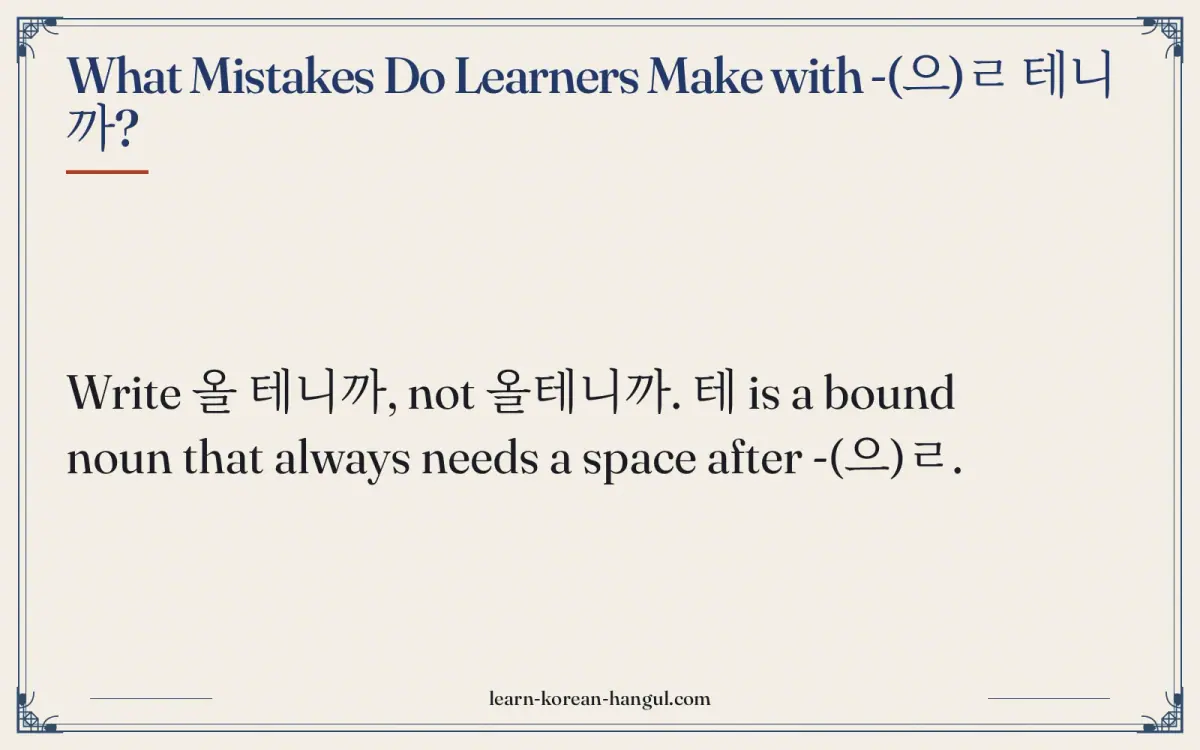
- Writing 테 without a space. 올테니까 is wrong. 테 is a bound noun and is written as a separate word: 올 테니까.
- Using -아/어서 before a command. 비가 와서 우산을 가져가세요 is wrong. Use 비가 올 테니까 or 비가 오니까.
- Adding -겠-. 가겠을 테니까 is wrong. The meaning of will or guess is already in the pattern.
- Using the past guess for a known fact. 어제 비가 왔을 테니까 means "it probably rained yesterday, so...", which is a guess. If you know it rained, use -(으)니까 with a past stem: 어제 비가 왔으니까.
A quick check: Is the reason a will or a guess? Does the second clause ask the listener to act? Is 테 written as a separate word? If all three answers are yes, the sentence is sound.
The practice set below tests these points directly.
Practice and Answers
Try the four items before you read the answer key. Cover the answers with your hand.
- Choose the form. Complete: 제가 ___ 쉬세요. (설거지할 테니까 / 설거지하는 테니까)
- Fix the error. A learner writes 많을테니까 for "since there will be many." Correct it.
- Translate. "It will be cold today, so dress warmly." Use 춥다 and 입다.
- Choose the connector. The rain has already started, and both of you can see it. Do you say 비가 올 테니까 or 비가 오니까? Explain why.
Practice · 5
Which sentence is correct for "It will probably rain, so take an umbrella"?
Show answer
비가 올 테니까 우산을 가져가세요.
-아/어서 cannot be followed by a command. 테 is a separate word, so write 올 테니까 with a space, and do not add -겠- inside.
What does 제가 설거지할 테니까 쉬세요 mean?
Show answer
I'll do the dishes, so please rest.
With 제가 ("I") the first clause states the speaker's will, and the second clause asks the listener to act.
Which is the correct form of 춥다 ("to be cold") with -(으)ㄹ 테니까?
Show answer
추울 테니까
춥다 is ㅂ-irregular: ㅂ becomes 우 before a vowel or 으/을, so 춥 + 을 gives 추울.
Which sentence is most natural for "You must be tired, so go to bed early"?
Show answer
피곤할 테니까 일찍 주무세요.
The first clause is a guess about the listener, and the second is a command. 주무세요 is the honorific polite command of 자다.
How is 테 written in -(으)ㄹ 테니까?
Show answer
As a separate word after a space: 올 테니까
테 is a bound noun (터 + 이), so it is written as its own word after -(으)ㄹ: 올 테니까.
Answer key
- 설거지할 테니까. The stem 설거지하 ends in a vowel, so the ending is -ㄹ 테니까: 제가 설거지할 테니까 쉬세요.
- 많을 테니까. 테 is a separate word.
- 오늘은 추울 테니까 따뜻하게 입으세요. 춥다 is ㅂ-irregular, so 춥 + 을 gives 추울.
- 비가 오니까. The rain is a fact, so -(으)니까 fits. 올 테니까 is for a prediction.
If you can complete items 1 to 3 without the key, you can use -(으)ㄹ 테니까 in everyday speech. The final section points to the next lessons.
What Should You Learn Next after -(으)ㄹ 테니까 Grammar?
After -(으)ㄹ 테니까 grammar, learn the connectors that give reasons and backgrounds. This lesson teaches the reason-plus-request pattern and does not cover the full reason system, the 텐데 family or the formal written style in depth. Those live on separate pages.
- Learn -(으)니까, the connector for known reasons and discoveries.
- Review -(으)ㄹ게요 if the promise meaning still feels unclear.
- Read Suggestions and Requests for every suggestion and request ending in one place.
- Return to the Intermediate Grammar list for the other patterns at this level.
TOPIK is the official Korean proficiency test, and the level shown here is an editorial estimate; the official descriptions are on topik.go.kr. With these steps, the choice becomes automatic: use -(으)ㄹ 테니까 when your will or a prediction is the reason, and -(으)니까 when the reason is a fact.
Frequently Asked Questions
What does -(으)ㄹ 테니까 mean?
-(으)ㄹ 테니까 gives a reason that is a will or a likely situation: "since I will..." or "since it will probably...". The second clause then asks the listener to act. 제가 설거지할 테니까 쉬세요 means "I'll do the dishes, so please rest." 비가 올 테니까 우산을 가져가세요 means "It will probably rain, so take an umbrella."
How do I attach -(으)ㄹ 테니까 to a verb or adjective?
Drop 다 from the verb or adjective. After a vowel stem or a ㄹ-stem add -ㄹ 테니까 to the stem: 가다 becomes 갈 테니까, and 만들다 becomes 만들 테니까. After a consonant stem add -을 테니까: 먹다 becomes 먹을 테니까. Irregular stems change first: 추울 테니까 and 들을 테니까. Write 테 as its own word.
Can -(으)ㄹ 테니까 be used in the past tense?
Yes, as a guess about the past. Add -았/었 before -을: 벌써 갔을 테니까 전화해 보세요 means "They have probably left already, so try calling." The past form is always conjecture, not a will, because you cannot intend something that already happened. The second clause still looks forward.
Is -(으)ㄹ 테니까 used in speech or only in writing?
It is common in speech, in polite and casual forms alike: 제가 할 테니까 쉬세요 to a colleague, or 내가 할 테니까 쉬어 to a friend. In writing, the shorter 테니 is also used: 비가 올 테니 우산을 챙기세요. The pattern sounds caring, because it pairs the speaker's action with advice or a request.
What is the difference between -(으)ㄹ 테니까 and -(으)ㄹ게요?
-(으)ㄹ게요 only states the speaker's promise: 제가 설거지할게요 means "I'll do the dishes." -(으)ㄹ 테니까 adds a second clause that asks the listener to do something in return: 제가 설거지할 테니까 쉬세요. It can also express a guess about someone else, which -(으)ㄹ게요 never does.