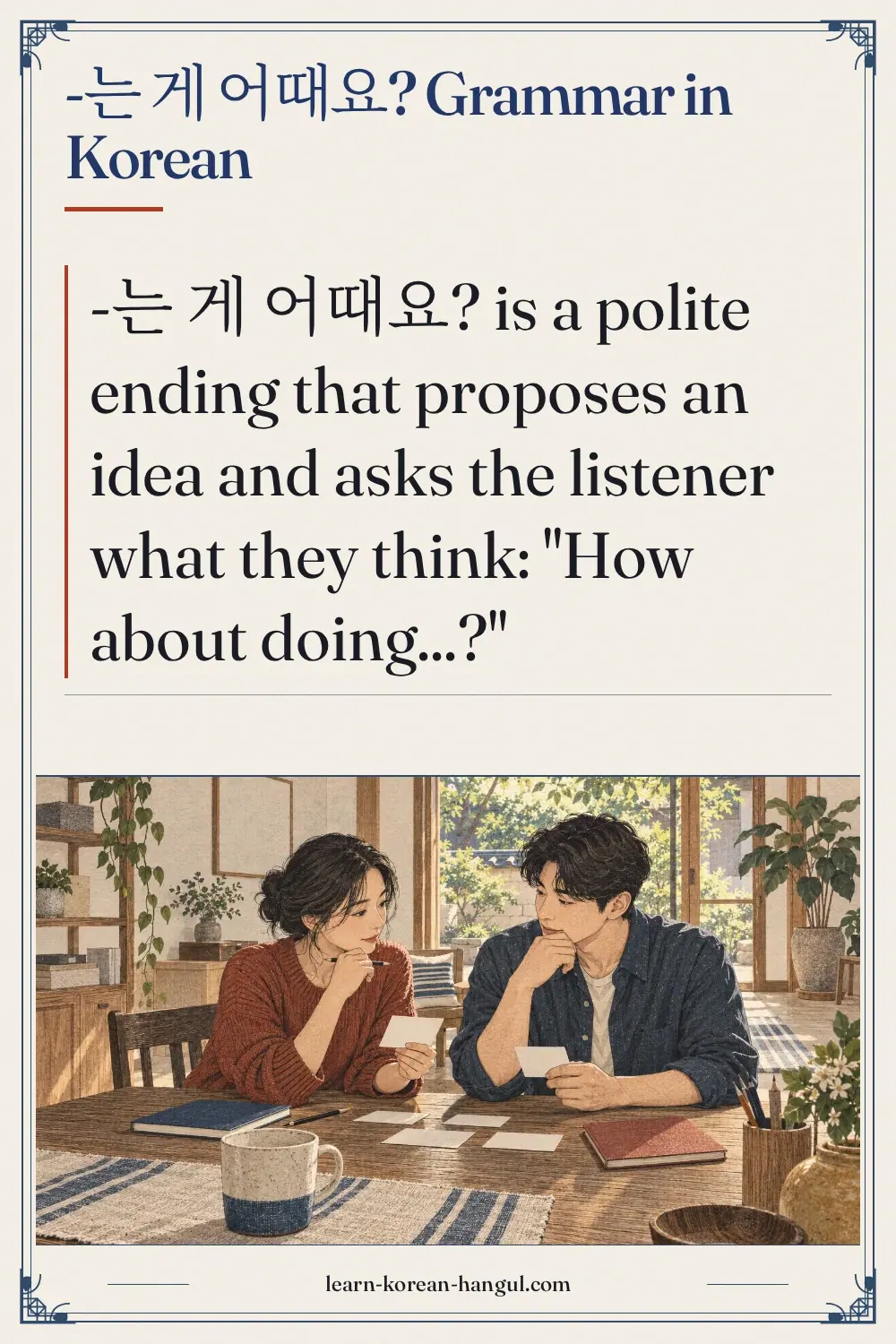
What you'll learn
- Attach -는 게 어때요? to vowel stems, consonant stems and ㄹ-stems.
- Make suggestions and advice sound polite, casual, formal and honorific.
- Tell the suggestion meaning from the plain question "What is it like to do...?"
- Choose between -는 게 어때요?, -(으)ㄹ까요? and -는 게 좋다.
Before you start: you should know the polite ending -아요/어요 and how to read a basic verb stem. Time: about 30 minutes. This site places the pattern at level B1, which is an editorial estimate. The official TOPIK information is published at topik.go.kr.
What Does -는 게 어때요? Grammar Mean?
-는 게 어때요? puts an idea on the table and invites the listener to react. The English match is "How about doing...?" or "Why don't you...?" It is softer than a command and softer than "You should". The speaker offers a possibility, and the listener is free to say no.
The pattern has four small parts, and each one is an ordinary piece of Korean grammar.
| Part | Form | Job |
|---|---|---|
| Verb stem | 보 (from 보다) | The action being proposed |
| Modifier ending | -는 | Turns the verb into a noun phrase: "the act of watching" |
| Dependent noun | 게 | Short for 것이: "the thing", used as the subject |
| Question | 어때요? | "How is it?" from 어떻다 |
Put together, 보는 게 어때요? is literally "How is the act of watching?" In real conversation, that literal question becomes a polite suggestion. The same thing happens in English when you say "How about a walk?"
A First Example
Listen to each sentence at normal speed, then slowly.
1. 같이 영화를 보는 게 어때요? (gachi yeonghwareul boneun ge eottaeyo?) "How about watching a movie together?"
Pronunciation: [가치 영화를 보는 게 어때요]. 같이 is read [가치] because the ㅌ meets 이 and changes to 치. Nothing else changes.
2. 조금 쉬는 게 어때요? (jogeum swineun ge eottaeyo?) "How about resting a bit?"
Pronunciation: [조금 쉬는 게 어때요]. It is read as spelled. The 게 is a separate small word, so it gets a space in writing.
Both sentences invite an answer. A natural reply is 좋아요 (joayo, "Sounds good") or 글쎄요 (geulsseyo, "Hmm, I am not sure").
How Do You Form -는 게 어때요?
Take the dictionary form, remove 다 to get the stem, then add -는 게 어때요? There is one core rule and one exception.
- Core rule: stem + 는 + 게 어때요. The ending is the same for vowel stems and consonant stems. This is easier than -아요/어요, because you never look at the vowel.
- Exception: if the stem ends in ㄹ, the ㄹ drops before 는. 살다 becomes 사는, not 살는.
| Dictionary form | Stem | With -는 게 어때요? | Meaning |
|---|---|---|---|
| 보다 (to see) | 보 | 보는 게 어때요? | How about watching? |
| 쉬다 (to rest) | 쉬 | 쉬는 게 어때요? | How about resting? |
| 먹다 (to eat) | 먹 | 먹는 게 어때요? | How about eating? |
| 읽다 (to read) | 읽 | 읽는 게 어때요? | How about reading? |
| 놀다 (to play, hang out) | 놀 | 노는 게 어때요? | How about hanging out? |
| 만들다 (to make) | 만들 | 만드는 게 어때요? | How about making it? |
| 하다 (to do) | 하 | 하는 게 어때요? | How about doing it? |
Stems Ending in a Vowel
A vowel stem takes 는 directly. There is no ㄴ and no contraction, unlike the past tense.
운동을 하는 게 어때요? (undongeul haneun ge eottaeyo?) "How about exercising?"
Pronunciation: [운동을 하는 게 어때요]. All syllables are pronounced as written.
한번 먹어 보는 게 어때요? (hanbeon meogeo boneun ge eottaeyo?) "How about trying it?" The helper 보다 ("to try") sits after -아/어 and takes 는 like any vowel stem.
Pronunciation: [한번 머거 보는 게 어때요]. The ㄱ of 먹 moves onto the next syllable, so 먹어 sounds like [머거].
Stems Ending in a Consonant
A consonant stem also takes 는. The final consonant of the stem sometimes changes sound because the next letter is ㄴ.
집에 있는 게 어때요? (jibe inneun ge eottaeyo?) "How about staying home?"
Pronunciation: [지베 인는 게 어때요]. The final ㅆ of 있 is read as [ㄷ] and then becomes [ㄴ] before the ㄴ of 는. This is why the Revised Romanization shows inneun.
책을 읽는 게 어때요? (chaegeul ingneun ge eottaeyo?) "How about reading a book?"
Pronunciation: [채글 잉는 게 어때요]. The ㄱ at the end of 읽 turns into [ㅇ] before ㄴ, and the ㄹ is silent in this word. Romanization follows the sound: ingneun.
Do Irregular Verbs and Nouns Change?
Only the ㄹ rule matters, because -는 starts with a consonant. The other irregular groups change only before a vowel, so they stay regular here.
| Type | Example | With -는 게 어때요? | Note |
|---|---|---|---|
| ㄹ-stem | 놀다 | 노는 게 어때요? | ㄹ drops: [노는] |
| ㅂ-irregular | 돕다 | 돕는 게 어때요? | Keeps ㅂ: [돔는], domneun |
| ㄷ-irregular | 듣다 | 듣는 게 어때요? | Keeps ㄷ: [든는], deunneun |
| 하다 verb | 운동하다 | 운동하는 게 어때요? | Regular: stem 운동하 + 는 |
| Adjective | 예쁘다 | not used | You cannot suggest a state |
| 이다 (to be) | 학생이다 | not used | Needs an action to propose |
Adjectives and 이다 do not fit here, because you cannot propose to "be tall" or "be a student". The pattern wants an action verb, or 있다 for staying somewhere.
Worked Example: Building a Sentence with -는 게 어때요?
Goal: say "How about making kimchi stew together this weekend?"
- Choose the verb. 만들다 (to make). The stem is 만들.
- Apply the ㄹ rule. Drop ㄹ before 는: 만드는.
- Add the dependent noun and question. 만드는 게 어때요?
- Add the object. 김치찌개를 (kimchi stew, with the object particle 를).
- Add the time and company. 이번 주말에 같이.
Result: 이번 주말에 같이 김치찌개를 만드는 게 어때요? (ibeon jumare gachi gimchijjigaereul mandeuneun ge eottaeyo?) "How about making kimchi stew together this weekend?"
Pronunciation: [이번 주마레 가치 김치찌개를 만드는 게 어때요]. 주말에 is read [주마레] because the ㄹ moves onto 에, and 같이 is [가치].
Sentence
Show answer
이번 주말에 같이 김치찌개를 만드는 게 어때요
Which Tenses and Sentence Types Work with -는 게 어때요?
The suggestion meaning needs the present form of 어때요. You change the politeness level by changing the last word, 어때요, and the verb before it never changes. The table uses 가다 (to go).
| Style | Form | Meaning |
|---|---|---|
| Polite | 가는 게 어때요? | How about going? |
| Casual (banmal) | 가는 게 어때? | How about going? (to a friend) |
| Honorific | 가시는 게 어떠세요? | How about going? (to an elder) |
| Formal | 가는 게 어떻습니까? | How about going? (meeting, business) |
| Softer, wondering | 가는 게 어떨까요? | I wonder if going would be OK. |
| Negative | 안 가는 게 어때요? | How about not going? |
| Negative, written style | 가지 않는 게 어때요? | How about not going? |
Here are two of these in sentences.
- 선생님도 같이 가시는 게 어떠세요? (seonsaengnimdo gachi gasineun ge eotteoseyo?) = "Teacher, how about coming along too?" The honorific -(으)시- raises the person you are speaking to. See honorific -(으)시- for the full rule.
- 비가 오니까 안 가는 게 어때요? (biga onikka an ganeun ge eottaeyo?) = "Since it is raining, how about not going?"
Pronunciation: [선생님도 가치 가시는 게 어떠세요] and [비가 오니까 안 가는 게 어때요]. Only 같이 changes, to [가치].
The past form 어땠어요? is different. It asks "How was it?", so it cannot make a suggestion. In casual talk 는 게 often becomes 는 거, and 는 건 (from 는 것은) adds a "what about this one, then?" feeling, often after another idea was turned down: 같이 가는 건 어때요? (gachi ganeun geon eottaeyo?) "Then how about going together?" For the full list of style endings, read about Korean speech levels.
How Is -는 게 어때요? Different from -(으)ㄹ까요?
Both patterns can start a suggestion, and learners often swap them. The difference is who is involved and how open the question is.
| -는 게 어때요? | -(으)ㄹ까요? | |
|---|---|---|
| Core meaning | How about doing...? | Shall we...? / Shall I...? / I wonder |
| Who does the action | You, we or a third person | Mostly "we" or "I" |
| Works as advice to one person | Yes | No, it does not give advice |
| Sounds like | An idea to consider | A joint decision or an offer |
| Example | 병원에 가 보는 게 어때요? | 같이 병원에 갈까요? |
The first example is advice to one listener: 병원에 가 보는 게 어때요? (byeongwone ga boneun ge eottaeyo?) "How about going to see a doctor?" The second includes the speaker: 같이 병원에 갈까요? (gachi byeongwone galkkayo?) "Shall we go to the hospital together?" Pronunciation: [병워네 가 보는 게 어때요] and [가치 병워네 갈까요]. With -(으)ㄹ까요?, the speaker is part of the action or the offer. The lesson on -(으)ㄹ까요? shows its three uses.
A second neighbour is -는 게 좋다. It does not ask for an opinion. It gives a plain judgement: 일찍 자는 게 좋아요 means "It is good to go to bed early." Use -는 게 어때요? to invite, and -는 게 좋다 to advise.
Variations and Edge Cases of -는 게 어때요?
The same words can ask a plain question. The pattern is not only a suggestion. When the verb describes a general experience, 어때요? asks "What is it like?"
한국에서 사는 게 어때요? (hangugeseo saneun ge eottaeyo?) "What is it like to live in Korea?" This is not a proposal. The speaker is curious about the experience. Pronunciation: [한구게서 사는 게 어때요].
Context tells you which meaning is used. A suggestion usually names a plan: 같이, 이번 주말에, 한번. A plain question names a general experience: 한국에서 사는 게, 혼자 여행하는 게.
Stack a helper to soften the idea. Adding -아/어 보다 ("try") makes the suggestion gentler: 한번 해 보는 게 어때요? (hanbeon hae boneun ge eottaeyo?) "How about giving it a try?"
Fixed phrases. 그냥 집에서 쉬는 게 어때요? (geunyang jibeseo swineun ge eottaeyo?) "How about just resting at home?" The word 그냥 ("just") lowers the effort of the idea. Pronunciation: [그냥 지베서 쉬는 게 어때요].
Why 게 is spaced. 게 is short for 것이, and 것 is a dependent noun. Under the National Institute of Korean Language (국립국어원) spelling rules, dependent nouns are written as separate words, so write 하는 게 with a space and not 하는게.
What Mistakes Do Learners Make with -는 게 어때요?

- Putting -(으)ㄴ before 게 on a verb. 먹은 게 어때요 uses the past modifier and asks about something already eaten. Use 먹는 게 어때요 to propose eating.
- Keeping the ㄹ. 살는 게 and 놀는 게 are wrong. Drop the ㄹ: 사는 게, 노는 게.
- Using it with an adjective. 예쁘는 게 어때요 is wrong, and 예쁜 게 어때요 would mean "How about the pretty one?" Use an action verb when you want to propose something.
- Using the polite form to an elder. 어때요 is polite, but for a teacher or boss use 어떠세요 with 가시는, and 어떠십니까 in formal settings.
- Rising sharply at the end. Wh-questions such as this one usually end with a gentle fall or a rise-fall, not a sharp rise. A sharp rise can make the idea sound like a challenge.
- Confusing it with -(으)ㄹ까요? If you mean "Shall we?" or "Shall I?", use -(으)ㄹ까요? The pattern in this lesson offers an idea about what someone could do.
Practice and Answers
Try all four items before you read the answers. Each answer has audio.
Practice · 5
Which sentence correctly means "How about eating out?"
Show answer
외식하는 게 어때요?
A suggestion uses the present modifier -는 and the present 어때요.
What is the correct form of 놀다 before 는 게 어때요?
Show answer
노는
The ㄹ of an ㄹ-stem drops before 는.
You mean "Shall we go?" or "Shall I go?". Which pattern fits?
Show answer
-(으)ㄹ까요?
For "Shall we?" or "Shall I?" use -(으)ㄹ까요?. -는 게 어때요? offers an idea for the listener to consider.
How do you ask a teacher politely, "How about coming too?"
Show answer
오시는 게 어떠세요?
Use the honorific -(으)시- and 어떠세요 for someone older.
Which sentence proposes eating?
Show answer
먹는 게 어때요?
A suggestion needs the present modifier -는 and the present 어때요. 먹은 게 어때요 asks about food already eaten.
- Choose the form. "How about eating out?" 외식하는 게 어때요? or 외식한 게 어때요?
- Fix the error. 주말에 공원에서 놀는 게 어때요?
- Translate. "How about taking a walk?"
- Write your own. Write one suggestion to a friend about this evening, using 먹다 (to eat) or 자다 (to sleep).
Answer Key
- 외식하는 게 어때요? (oesikaneun ge eottaeyo?) Pronunciation: [외시카는 게 어때요]. The suggestion needs the present modifier -는, and 하다 verbs show the aspirated sound in the romanization.
- 주말에 공원에서 노는 게 어때요? (jumare gongwoneseo noneun ge eottaeyo?) Pronunciation: [주마레 공워네서 노는 게 어때요]. The ㄹ of 놀 drops before 는.
- 산책하는 게 어때요? (sanchaekaneun ge eottaeyo?) Pronunciation: [산채카는 게 어때요]. The noun 산책 keeps its ㄱ and ㅎ, but the verb form 산책하는 is spoken with an aspirated [카].
- Sample answer: 일찍 자는 게 어때요? (iljjik janeun ge eottaeyo?) "How about going to bed early?" Pronunciation: [일찍 자는 게 어때요]. Any action verb with the correct -는 form is right.
If a sentence went wrong, check three things: the verb must be an action, the modifier must be -는 for a present suggestion, and an ㄹ-stem loses its ㄹ.
What Should You Learn Next?
The closest partner is -는 게 좋다, which gives gentle advice instead of asking for an opinion. For the joint "shall we" suggestion, study -(으)ㄹ까요?. Both belong to the set of Suggestions and Requests, and the full list of B1 patterns is on the Intermediate Grammar page.
This page uses Revised Romanization only as a learning aid. The Hangul is the reference. To remember the idea in one line: take the stem, drop ㄹ if there is one, add 는 게 어때요?, and you have a polite "How about doing it?"
Frequently Asked Questions
What Does -는 게 어때요? Mean in Korean?
-는 게 어때요? means "How about doing...?" It proposes an idea politely and asks the listener for an opinion, as in 같이 영화를 보는 게 어때요? ("How about watching a movie together?"). It is softer than a command and softer than "You should".
How Do I Form -는 게 어때요?
Remove 다 from the dictionary form and add 는 게 어때요?, as in 쉬다 to 쉬는 게 어때요?. Vowel stems and consonant stems take the same ending. A stem ending in ㄹ drops the ㄹ first, so 놀다 becomes 노는 게 어때요?, not 놀는 게 어때요?.
Can I Use -는 게 어때요? with Adjectives?
No. The pattern proposes an action, so it needs an action verb or 있다. An adjective such as 예쁘다 describes a state, and 예쁜 게 어때요? would mean "How about the pretty one?", which is a question about a thing and not a suggestion.
How Is -는 게 어때요? Different from -(으)ㄹ까요?
-(으)ㄹ까요? means "Shall we?" or "Shall I?" and includes the speaker in the action or the offer. -는 게 어때요? puts an idea on the table and can advise one listener alone, as in 병원에 가 보는 게 어때요? ("How about seeing a doctor?").
How Do I Say -는 게 어때요? to an Older Person?
Use the honorific -(으)시- on the verb and change 어때요 to 어떠세요: 선생님도 같이 가시는 게 어떠세요?. In a formal setting, 어떠십니까 is the usual choice. The casual form 어때? is for close friends only.
Is 어때요? Here Always a Suggestion?
No. The same words can ask what an experience is like, as in 한국에서 사는 게 어때요? ("What is it like to live in Korea?"). Cue words such as 같이, 이번 주말에 and 한번 point to a suggestion, and a general topic points to a plain question.