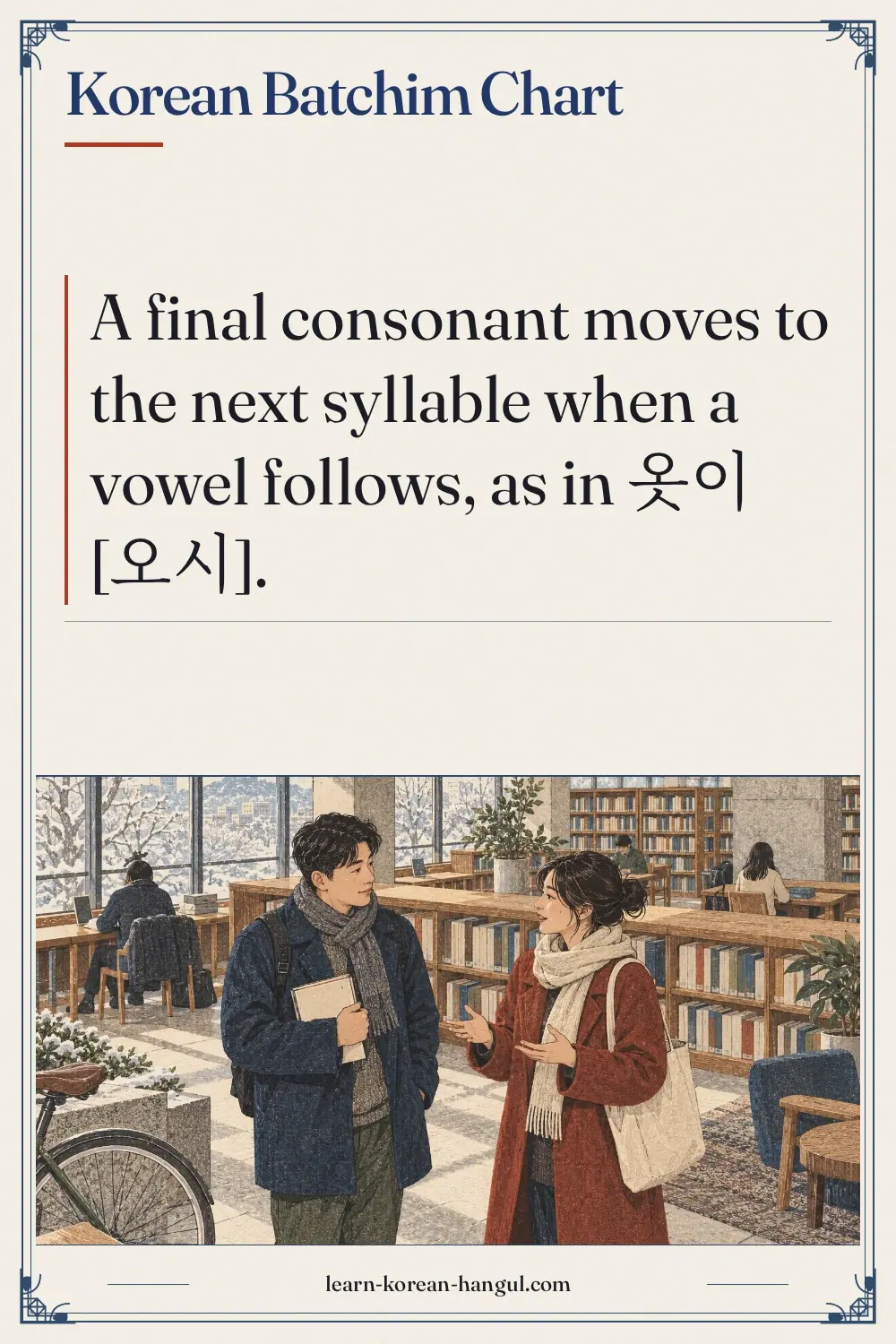
Before you start
- What it covers: 16 single and doubled finals, 11 clusters, 3 letters that are never final, and one example word per row.
- You'll be able to: give the pronounced final sound of any batchim with one example word.
- Prerequisites: you can read basic syllable blocks with a consonant, a vowel and a final.
- Time: 15 minutes to read; keep the printable version for reference.
- Standard used: 국립국어원 표준 발음법 (Standard Pronunciation Rules, 1988), Articles 8–12.
Korean Batchim Chart: Final Sounds
The Korean batchim chart below groups every single final consonant by the sound it is pronounced as. A batchim (받침, "support") is the consonant written at the bottom of a syllable block, like ㄱ in 국. Each group carries a text label (K, N, T, L, M, P, NG), so the chart works without colour.
| Korean | Name | Romanization | Family | Final |
|---|---|---|---|---|
| ㄱ | 기역 (giyeok) | g / k | plain | [k] |
| ㄴ | 니은 (nieun) | n / n | other | [n] |
| ㄷ | 디귿 (digeut) | d / t | plain | [t] |
| ㄹ | 리을 (rieul) | r / l | other | [l] |
| ㅁ | 미음 (mieum) | m / m | other | [m] |
| ㅂ | 비읍 (bieup) | b / p | plain | [p] |
| ㅅ | 시옷 (siot) | s / t | plain | [t] |
| ㅇ | 이응 (ieung) | none / ng | other | [ŋ], ng in "sing" |
| ㅈ | 지읒 (jieut) | j / t | plain | [t] |
| ㅊ | 치읓 (chieut) | ch / t | aspirated | [t] |
| ㅋ | 키읔 (kieuk) | k / k | aspirated | [k] |
| ㅌ | 티읕 (tieut) | t / t | aspirated | [t] |
| ㅍ | 피읖 (pieup) | p / p | aspirated | [p] |
| ㅎ | 히읗 (hieut) | h / t | other | [t], rare and usually merges with the next sound |
| ㄲ | 쌍기역 (ssanggiyeok) | kk / k | tense | [k] |
| ㄸ | 쌍디귿 (ssangdigeut) | tt / none | tense | never final |
| ㅃ | 쌍비읍 (ssangbieup) | pp / none | tense | never final |
| ㅆ | 쌍시옷 (ssangsiot) | ss / t | tense | [t] |
| ㅉ | 쌍지읒 (ssangjieut) | jj / none | tense | never final |
| Sound group | Pronounced final | Written batchim | Example (said) | Meaning |
|---|---|---|---|---|
| K | [k] (ㄱ) | ㄱ | 국 [국] | soup |
| K | [k] (ㄱ) | ㄲ | 밖 [박] | outside |
| K | [k] (ㄱ) | ㅋ | 부엌 [부억] | kitchen |
| N | [n] (ㄴ) | ㄴ | 산 [산] | mountain |
| T | [t] (ㄷ) | ㄷ | 곧 [곧] | soon |
| T | [t] (ㄷ) | ㅅ | 옷 [옫] | clothes |
| T | [t] (ㄷ) | ㅆ | 있다 [읻따] | to exist, to have |
| T | [t] (ㄷ) | ㅈ | 낮 [낟] | daytime |
| T | [t] (ㄷ) | ㅊ | 꽃 [꼳] | flower |
| T | [t] (ㄷ) | ㅌ | 밭 [받] | field |
| T | [t] (ㄷ), see note | ㅎ | 히읗 [히읃] | the letter name of ㅎ |
| L | [l] (ㄹ) | ㄹ | 달 [달] | moon |
| M | [m] (ㅁ) | ㅁ | 밤 [밤] | night |
| P | [p] (ㅂ) | ㅂ | 밥 [밥] | rice, meal |
| P | [p] (ㅂ) | ㅍ | 앞 [압] | front |
| NG | [ŋ] (ㅇ) | ㅇ | 강 [강] | river |
Note on ㅎ: a final ㅎ is usually combined with the next sound rather than said as [t]. The [t] value applies when ㅎ ends the word, as in the letter name 히읗. The FAQ below explains its other behaviours.
Hangul Chart PDF (includes the batchim chart)
How to write these finals inside a block is taught in batchim in syllable blocks. The rest of this page explains how to read the table and why it works.
How Do You Read the Batchim Chart?
Read the chart from right to left: find the written batchim in the third column, then look left to see the sound group and the pronounced final. The example column gives a real word with that batchim, and the bracket shows how it is said.
- Find the batchim. Look at the bottom consonant of the block, for example ㅊ in 꽃.
- Find its row. ㅊ is in the T group.
- Read the pronounced final. The T group is pronounced [t], written in Korean as [ㄷ].
- Check the example. 꽃 is said [꼳]. Play the audio to confirm.
- Check what follows. If the next syllable starts with a vowel, the rule changes; see the section on liaison below.
The brackets follow the convention of the Standard Pronunciation Rules: [꼳] is the spoken form, written in Hangul. When you see a bracket that differs from the spelling, the difference is the sound change. Revised Romanization follows the spoken final in most cases, so 꽃 is romanized kkot, and the romanization chart shows every final's spelling in Latin letters.
The chart has 16 rows but only seven groups. The next section explains that reduction.
Why Do All Batchim Reduce to Seven Sounds?
All batchim reduce to seven sounds because Korean does not release a consonant at the end of a syllable. The tongue or lips close and stay closed, so the features that separate similar consonants, such as a puff of air (ㅋ, ㅌ, ㅍ, ㅊ), throat tension (ㄲ, ㅆ) or a hiss (ㅅ, ㅈ), never become audible. Only the place where the mouth closes, plus whether air goes through the nose, survives.
This leaves exactly seven possibilities, which are the 7 final sounds:
- [k]: closed at the back of the tongue (ㄱ ㄲ ㅋ).
- [t]: closed at the tongue tip (ㄷ ㅅ ㅆ ㅈ ㅊ ㅌ, and ㅎ in some positions).
- [p]: closed at the lips (ㅂ ㅍ).
- [ŋ]: back of the tongue, air through the nose (ㅇ).
- [n]: tongue tip, air through the nose (ㄴ).
- [m]: lips, air through the nose (ㅁ).
- [l]: tongue tip, air around the sides (ㄹ).
Linguists call this coda neutralisation: differences in the coda (the final position) are neutralised. The practical result is clear in the set 낫 (sickle), 낮 (daytime) and 낯 (face): three spellings, one pronunciation, [낟]. The spelling keeps the original consonant because it comes back as soon as a vowel follows, and because it shows which word is meant. The single finals above are only part of the picture; the next section adds the doubled and clustered ones.
Which Consonants Can Never Be Batchim?
ㄸ, ㅃ and ㅉ can never be batchim. No standard Korean word ends a syllable with these three tense letters, so they appear only at the start of a syllable, as in 딸, 빵 and 짜다. The other two tense letters, ㄲ and ㅆ, do appear as finals: 밖 (outside) and 있다 (to exist).
Double Batchim and Clusters
Korean has two kinds of two-letter batchim. Double batchim (쌍받침) is the same letter written twice: only ㄲ and ㅆ are used. Cluster batchim (겹받침) combines two different consonants, and there are 11 of them. When said alone or before a consonant, a cluster is pronounced as only one of its two letters.
| Cluster | Pronounced as | Example (said) | Meaning | Which letter |
|---|---|---|---|---|
| ㄳ | [k] | 넋 [넉] | soul | first |
| ㄵ | [n] | 앉다 [안따] | to sit | first |
| ㄶ | [n] | 많다 [만타] | to be many | first; ㅎ aspirates the next consonant |
| ㄺ | [k] | 닭 [닥] | chicken | second |
| ㄻ | [m] | 삶 [삼] | life | second |
| ㄼ | [l] | 여덟 [여덜] | eight | first (exceptions below) |
| ㄽ | [l] | 외곬 [외골] | one way only | first |
| ㄾ | [l] | 핥다 [할따] | to lick | first |
| ㄿ | [p] | 읊다 [읍따] | to recite | second |
| ㅀ | [l] | 싫다 [실타] | to dislike | first; ㅎ aspirates the next consonant |
| ㅄ | [p] | 값 [갑] | price | first |
Many of these clusters are rare. ㄽ, ㄾ and ㄿ appear in only a handful of words, while ㄺ, ㄶ, ㅄ and ㄵ appear in very common words such as 읽다 (to read), 많다, 없다 (to not exist) and 앉다. Learn the common four first.
Which Letter of a Cluster Is Pronounced?
The first letter is pronounced in most clusters, and the second letter in three: ㄺ, ㄻ and ㄿ. A simple memory aid: when the cluster starts with ㄹ and the second letter is ㄱ, ㅁ or ㅍ, say the second letter. Otherwise, say the first. Standard Pronunciation Rules Articles 10 and 11 state these rules.
The rules have well-known exceptions, which the full double batchim lesson covers:
- ㄼ in 밟다: the verb 밟다 (to step on) uses [p], not [l]: [밥따]. So does 넓죽하다 (to be broad and flat), [넙쭈카다].
- ㄺ before ㄱ: in verbs, ㄺ is said [l] before an ending that starts with ㄱ: 읽고 [일꼬], 맑게 [말께]. Elsewhere it is [k]: 읽다 [익따], 닭 [닥].
- ㄶ and ㅀ: the ㅎ is never said as [t]. It aspirates a following ㄱ, ㄷ or ㅈ (많다 [만타]) and disappears before a vowel (많아 [마나]).
Everything in these tables describes a batchim said alone or before a consonant. The picture changes when a vowel comes next.
What Happens When a Vowel Follows?
When the next syllable starts with a vowel (that is, with the silent ㅇ), the batchim moves forward and is pronounced at the start of that syllable with its full original sound. This is called liaison (연음). The seven-sound reduction does not apply, because the consonant is no longer at the end of a syllable.
| Word | Batchim | Alone | With a vowel ending | Said |
|---|---|---|---|---|
| 옷 | ㅅ | [옫] | 옷이 | [오시] |
| 꽃 | ㅊ | [꼳] | 꽃이 | [꼬치] |
| 부엌 | ㅋ | [부억] | 부엌에 | [부어케] |
| 닭 | ㄺ | [닥] | 닭이 | [달기] |
| 값 | ㅄ | [갑] | 값이 | [갑씨] |
With a cluster, both letters are heard: the first stays as the final of its own syllable, and the second moves forward. That is why 닭이 is [달기] and 값이 is [갑씨], where the moved ㅅ also becomes tense. Two finals never move: ㅇ stays in place (고양이 [고양이]), and ㅎ disappears (좋아 [조아]). These moving consonants are easiest to understand in a full worked example.
Worked Example: 닭, 읽다, 앉아
Three common words show every step of using the chart: a cluster said alone, a cluster before a consonant, and a cluster before a vowel.
- 닭 (chicken). The batchim is the cluster ㄺ. The cluster table says ㄺ is pronounced with its second letter, ㄱ, so the final sound is [k]. The word is said [닥]. Romanized dak.
- 읽다 (to read). The batchim of 읽 is ㄺ again, and the next syllable starts with ㄷ, a consonant. ㄺ is [k] here, and a final [k] makes the next plain consonant tense, so ㄷ becomes [ㄸ]. The word is said [익따].
- 앉아 (sit, informal). The batchim of 앉 is ㄵ, and the next syllable starts with the silent ㅇ. Because a vowel follows, liaison applies: ㄴ stays in the first syllable and ㅈ moves forward. The word is said [안자].
Notice that the chart alone gives you steps 1 and the first half of step 2. The tensing in 읽다 and the movement in 앉아 come from the rules that operate across syllables. Knowing where the chart stops prevents most of the mistakes in the next section.
Common Mistakes with the Korean Batchim Chart
Five mistakes come up again and again when learners use a batchim chart.
- Applying the seven-sound rule before a vowel. Learners say 옷이 as [오디] because the chart says ㅅ is [t]. Actually the chart describes finals said alone or before a consonant; before a vowel, ㅅ moves forward and stays [s]: [오시].
- Releasing the final consonant. Saying 밥 as "ba-puh" adds a vowel. Every final in the chart is unreleased: close the mouth and stop.
- Pronouncing both letters of a cluster before a consonant. 닭 is not "dalk". Only one letter is heard unless a vowel follows.
- Expecting ㄸ, ㅃ or ㅉ as finals. These three never appear at the bottom of a block, so a block that seems to show one is a misreading.
- Treating the chart as the whole of pronunciation. Further changes happen across syllables: 국물 is [궁물] by nasalization, and 학교 is [학꾜] by tensification. The chart gives the starting point for those rules, not the final result.
A useful rule of thumb: when a word ends in a batchim you are unsure about, say it once alone using the chart, then add a vowel ending such as 이 or 에 and listen to the original consonant return. Hearing both forms of the same word fixes the spelling and the sound in memory together. That habit is what the practice set below builds.
Practice with the Chart
Use the chart to answer each question, then check the answers at the end of this section.
- Sound group. Which of the seven sounds is the final in each word: 밭, 부엌, 앞, 있다?
- Clusters. How are 값, 삶 and 핥다 pronounced?
- Liaison. How are 꽃이 and 닭이 pronounced?
- Never final. Which of these letters can be batchim: ㄲ, ㄸ, ㅆ, ㅉ?
Answers
- 밭: [t] ([받]). 부엌: [k] ([부억]). 앞: [p] ([압]). 있다: [t] ([읻따]).
- 값 is [갑]. 삶 is [삼]. 핥다 is [할따].
- 꽃이 is [꼬치]. 닭이 is [달기].
- ㄲ and ㅆ can be batchim. ㄸ and ㅉ cannot.
For longer drills with audio, continue with Korean batchim practice, which turns these rows into listening and reading exercises.
What to Learn Next
The Korean batchim chart is one of all Hangul charts on this site. Next, open the romanization chart to see how each final is spelled in Latin letters, since romanization usually follows the pronounced final (밭 is bat).
To learn the rules behind this chart properly, study the 7 final sounds lesson, then the double batchim lesson for the cluster exceptions, then liaison. For handwriting practice of blocks with finals, print grids from the Hangul worksheets.
What this chart does not cover: sound changes across syllables beyond liaison, such as nasalization (국물 [궁물]), tensification (학교 [학꾜]) and aspiration across words. It also shows standard pronunciation; regional and casual speech can differ, especially for the clusters ㄼ and ㄺ.
Frequently Asked Questions
Why does 꽃 sound like 꼳? 꽃 (flower) ends in ㅊ, and ㅊ at the end of a syllable is pronounced as the representative sound [ㄷ], an unreleased t. So 꽃 alone is [꼳]. The ㅊ is not lost, though: when a vowel follows, it returns, and 꽃이 (flower + subject particle) is said [꼬치], with a clear ch sound.
Do Koreans always follow cluster rules? Mostly, but not perfectly. Standard pronunciation for clusters is set by the National Institute of Korean Language, and some words are commonly said in non-standard ways. For example, many speakers say 밟다 or 넓다 differently from the standard forms. Learn the standard [밥따] and [널따] first, and treat variation as something to recognise, not copy.
Is ㅎ batchim ever pronounced? ㅎ as a final is rarely heard as h. Before a plain consonant it combines with it to make an aspirated sound, so 좋고 is [조코]. Before a vowel it disappears, so 좋아 is [조아]. Before ㄴ it becomes [ㄴ], so 놓는 is [논는]. Said alone, as in the letter name 히읗, it is [ㄷ].
Can I download the batchim chart? Yes. The printable version of this Korean batchim chart is part of the free Hangul chart PDF, which you can download from the card on this page. It is built from the same data as the table above, so the finals, clusters and example words match. Print it and keep it next to your reading practice.
What is the difference between batchim and final sound? Batchim is the written consonant at the bottom of a syllable block; the final sound is what you actually pronounce. 27 different spellings can appear as batchim, but they produce only seven final sounds. 낫, 낮 and 낯 have three different batchim but one final sound, [t], when said alone.