
What you'll learn
- Place a batchim correctly in all three block types: 각, 곡 and 곽.
- List the 27 final-consonant forms and name the three letters that can never be batchim.
- Predict the basic sound of any batchim from the 7 representative sounds.
- Read words such as 꽃, 부엌 and 옷 where the spelling and the sound differ.
Before you start: you can build blocks without a final consonant, such as 가, 고 and 과; if not, start with the six block shapes. Time: about 40 minutes, including practice.
What Is Batchim?
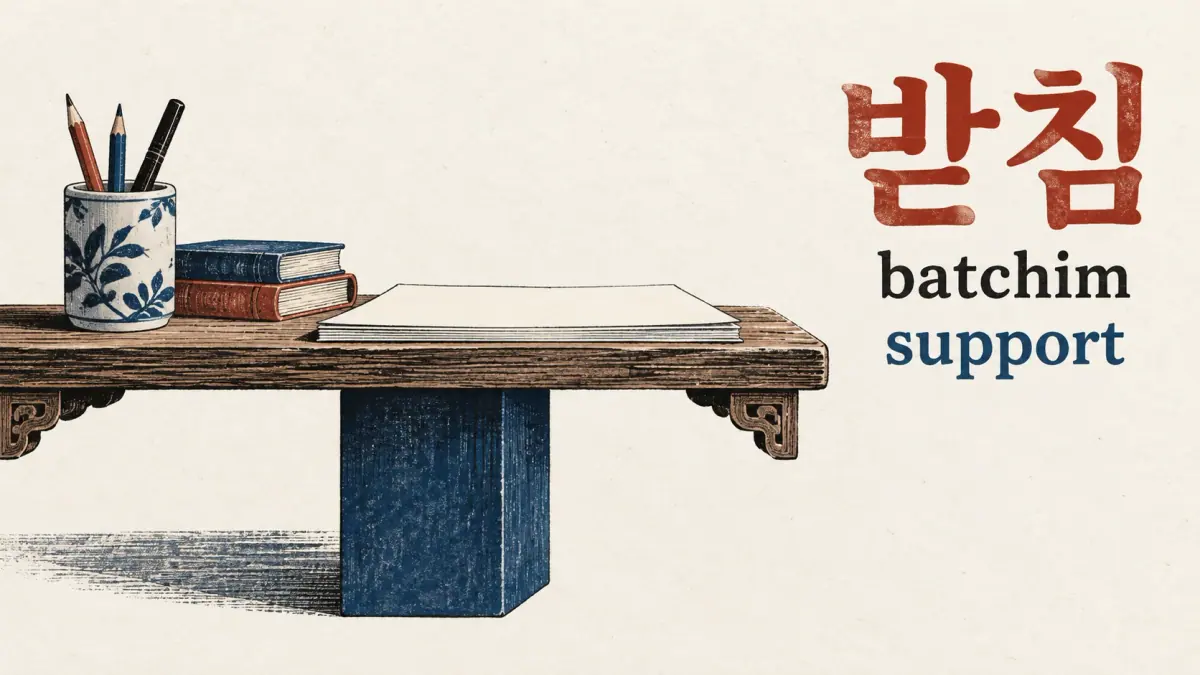
Batchim is the final consonant of a Korean syllable, written in the bottom slot of its block. Every block has an initial consonant and a vowel; some also have a batchim. In 한, ㅎ is the initial, ㅏ is the vowel and ㄴ is the batchim, so the block reads han.
Compare two blocks to see the difference a batchim makes:
- 가 (ga): initial ㄱ + vowel ㅏ. No batchim.
- 각 (gak): initial ㄱ + vowel ㅏ + batchim ㄱ.
The same letter, ㄱ, can be an initial and a batchim in one block. Position, not the letter, makes it a batchim. For a short definition to cite, see the glossary definition of batchim.
Why Is It Called 받침?
The word 받침 (batchim) means "prop" or "support" in Korean, from the verb 받치다, "to hold up from below". The final consonant sits under the rest of the block as if holding it up. That picture is a useful memory aid: the batchim is always the floor of the block, never a wall.
With the idea clear, the next step is placing it in each block shape.
Where Does Batchim Go in Each Block Shape?
Batchim always goes at the bottom of the block, centred under everything above it, in all three block shapes. What changes is how the top part shrinks to make room.
| Block shape | Without batchim | With batchim | What changes |
|---|---|---|---|
| Vertical vowel | 가 | 각 | Consonant and vowel move up and get shorter; batchim fills the bottom |
| Horizontal vowel | 고 | 곡 | Consonant and vowel stack in the top part; batchim becomes a third row |
| Mixed vowel | 과 | 곽 | Wrapped vowel shrinks into the top part; batchim spans the full width below |
How to Add a Batchim in 3 Steps
- Write the top part as a smaller version of the open block. For 각, write 가 in the upper half to two-thirds of the square. You'll know it worked when there is clear space underneath.
- Write the batchim in the bottom space, centred. Make it wide and flat rather than tall. Common mistake: tucking the batchim under the consonant only, on the left; it belongs under the whole block.
- Check the square. The block should be about the same size as its neighbours. If 각 looks taller than 가 next to it, shrink the top part.
You can practise this step in the Hangul Syllable Builder, which gives instant feedback when you add a final consonant.
Practice
Placement is the same for every batchim. Which letters may go there is a separate question.
Which Consonants Can Be Batchim?
Twenty-seven final-consonant forms can be batchim: 16 single or doubled letters and 11 two-letter clusters. Three letters, ㄸ, ㅃ and ㅉ, never appear in the batchim slot in standard spelling.
| Type | Letters | Count | Example |
|---|---|---|---|
| Basic consonants | ㄱ ㄴ ㄷ ㄹ ㅁ ㅂ ㅅ ㅇ ㅈ ㅊ ㅋ ㅌ ㅍ ㅎ | 14 | 각, 산, 낟, 물, 밤, 밥, 옷, 강, 낮, 꽃, 부엌, 밭, 앞, 좋 |
| Doubled consonants | ㄲ ㅆ | 2 | 밖, 있 |
| Two-letter clusters | ㄳ ㄵ ㄶ ㄺ ㄻ ㄼ ㄽ ㄾ ㄿ ㅀ ㅄ | 11 | 닭, 앉, 값 |
| Never batchim | ㄸ ㅃ ㅉ | 0 | none |
Two details are worth knowing early. First, a few batchim are rare: ㅋ appears in only a handful of words such as 부엌 ("kitchen"), and ㅎ appears mainly in verb stems such as 좋다 ("to be good"). Second, ㅇ as a batchim is not silent. At the bottom it is the ng sound in "sing", so 강 is gang.
Twenty-seven written forms might sound like a lot to learn. The good news is that they share only seven sounds.
How Batchim Sounds: the 7 Representative Sounds
Every batchim, when a syllable is said alone or before a consonant, is pronounced as one of seven sounds: [ㄱ], [ㄴ], [ㄷ], [ㄹ], [ㅁ], [ㅂ] or [ㅇ]. The Standard Pronunciation Rules of the National Institute of Korean Language (표준 발음법, Article 8) list these as the only final sounds. The reason is physical: a Korean final consonant is not released with a puff of air, so differences such as ㄷ, ㅅ and ㅈ disappear.
| Sound | Batchim letters with this sound | Example |
|---|---|---|
| [ㄱ] (k) | ㄱ ㄲ ㅋ, and clusters ㄳ ㄺ (mostly) | 밖 [박], 부엌 [부억] |
| [ㄴ] (n) | ㄴ, and clusters ㄵ ㄶ | 산 [산] |
| [ㄷ] (t) | ㄷ ㅅ ㅆ ㅈ ㅊ ㅌ ㅎ | 옷 [옫], 꽃 [꼳] |
| [ㄹ] (l) | ㄹ, and clusters ㄼ ㄽ ㄾ ㅀ (mostly) | 물 [물] |
| [ㅁ] (m) | ㅁ, and cluster ㄻ | 밤 [밤] |
| [ㅂ] (p) | ㅂ ㅍ, and clusters ㅄ ㄿ | 앞 [압] |
| [ㅇ] (ng) | ㅇ | 강 [강] |
The table is a summary. Cluster exceptions, such as 밟다 pronounced [밥따], and the full rules with audio are in the 7 final consonant sounds lesson.
Expert insight: the seven sounds explain why Korean has so many words that sound alike but are spelled differently. 낮 ("daytime"), 낫 ("sickle") and 낟 ("grain, kernel") all end in [ㄷ] when said alone. The spelling keeps them apart on paper, and the sound returns when a vowel follows. A worked example shows how to read this in practice.
Worked Example: Reading 꽃, 부엌 and 밥
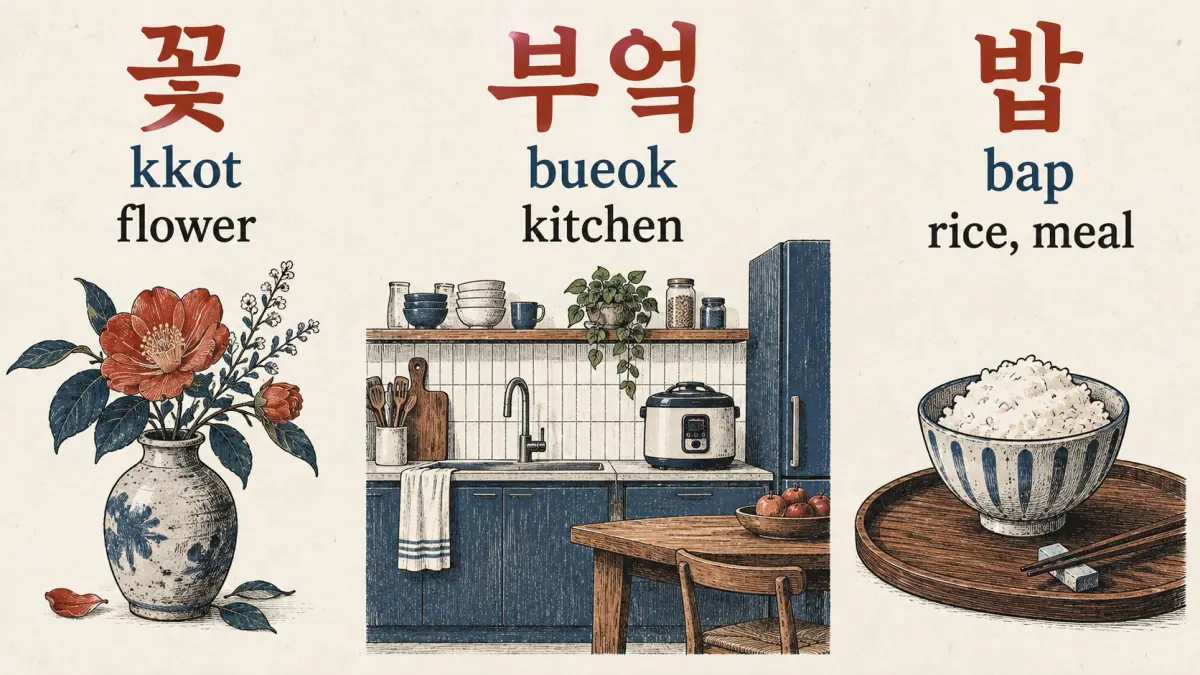
Read three words step by step: find the batchim, look up its sound, then say the block.
- 꽃 ("flower"). Initial ㄲ (tense k), vowel ㅗ, batchim ㅊ. ㅊ belongs to the [ㄷ] group, so the word is pronounced [꼳], romanized kkot.
- 부엌 ("kitchen"). Two blocks. 부 has no batchim. 엌 has silent initial ㅇ, vowel ㅓ and batchim ㅋ. ㅋ belongs to the [ㄱ] group, so the word is [부억], romanized bueok.
- 밥 ("rice, meal"). Initial ㅂ, vowel ㅏ, batchim ㅂ. ㅂ is its own sound, so [밥], bap. Here spelling and sound match.
You'll know you have the method when you can say an unfamiliar word like 숲 ("forest") as [숩] without help. These three words were said alone. Add a vowel after them and the batchim behaves differently.
What Happens When the Next Block Starts with ㅇ?
When the next block starts with silent ㅇ, the batchim is pronounced at the start of that next block, keeping its full sound. This is called liaison (linking sounds). The spelling does not change; only the sound moves. Two batchim behave differently: ㅇ stays where it is (강아지 [강아지]), and ㅎ goes silent (좋아 [조아]).
- 꽃 is [꼳], but 꽃이 ("the flower", subject) is [꼬치]. The ㅊ comes back.
- 옷 is [옫], but 옷이 ("the clothes", subject) is [오시]. The ㅅ comes back.
This is why Korean spells words by their base form. The batchim 꽃 keeps its ㅊ because the ㅊ is heard whenever a vowel follows. Everything about how batchim is pronounced in words lives in our guide to how batchim is pronounced. Some blocks have not one batchim letter but two.
Double and Cluster Batchim
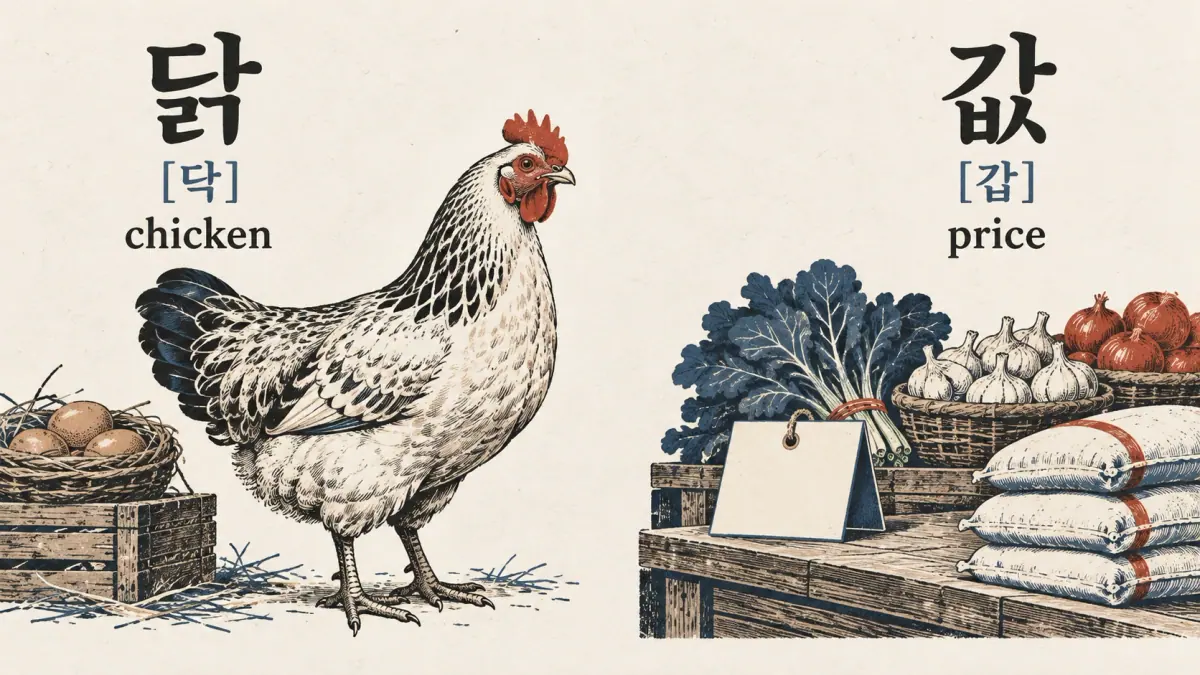
Some blocks have two letters in the batchim slot: either a doubled consonant (ㄲ, ㅆ) or one of 11 two-letter clusters such as ㄺ in 닭 ("chicken") or ㅄ in 값 ("price"). The two letters sit side by side in the bottom row, each about half the width. When the word is said alone, usually only one of the two letters is heard: 닭 is [닥], 값 is [갑].
Blocks with two final letters, such as 닭, are taught in double and cluster batchim. That lesson shows how to write all 11 clusters inside blocks and which letter you hear in 10 common words. Clusters are where most learners slip, but simpler batchim cause a few predictable mistakes too.
What Do Learners Get Wrong about Batchim?
Learners get batchim wrong in four predictable ways, and each has a simple fix.
- "ㅇ at the bottom is silent." Learners often assume this because ㅇ is silent at the top. Actually, at the bottom it is [ng]: 강 is gang, not ga.
- "Write it under the consonant only." The batchim sits under the whole block, centred, even in vertical layouts like 각.
- "Every batchim keeps its letter sound." When a word is said alone, 27 forms reduce to 7 sounds: 옷 ends in [ㄷ], not s.
- "The sound change means the spelling is wrong." Korean spelling keeps the base letter because the full sound returns before a vowel, as in 옷이 [오시].
Expert insight: when reading aloud, look at the next block before you say the batchim. If the next block starts with ㅇ, carry the batchim over; if not, use the seven-sound table. That one glance prevents most errors. Now test yourself.
Practice: Write and Read 20 Batchim Words
Part A: build five blocks. Combine the letters into one block each.
- ㄱ + ㅏ + ㅁ
- ㅅ + ㅗ + ㄴ
- ㄱ + ㅘ + ㅇ
- ㅁ + ㅜ + ㄹ
- ㄷ + ㅏ + ㄺ
Part B: say each word alone. Write the pronunciation in brackets using the seven sounds.
- 밥 2. 집 3. 꽃 4. 옷 5. 낮 6. 부엌 7. 밖 8. 앞 9. 끝 10. 숲 11. 빛 12. 맛 13. 강 14. 산 15. 물 16. 밤 17. 책 18. 낫 19. 솥 20. 팥
Practice · 8
Where is a batchim written in a syllable block?
Show answer
At the bottom, centred under the whole block
Batchim always sits at the bottom of the block, centred under everything above it, in every block shape.
Which letter can never be a batchim?
Show answer
ㅃ
ㄸ, ㅃ and ㅉ never appear in the batchim slot; ㄲ, ㅆ and ㅋ can.
How is 꽃 (flower) pronounced when said alone?
Show answer
[꼳]
ㅊ belongs to the [ㄷ] group of the seven sounds, so 꽃 alone is [꼳].
How is 옷이 (the clothes, subject) pronounced?
Show answer
[오시]
When the next block starts with silent ㅇ, the batchim moves over with its full sound: [오시].
How many sounds does a batchim have when a syllable is said alone?
Show answer
7
The 27 written final forms reduce to seven sounds: [ㄱ], [ㄴ], [ㄷ], [ㄹ], [ㅁ], [ㅂ] and [ㅇ].
How is 강 read?
Show answer
gang, with ㅇ as ng
ㅇ is silent at the top of a block but is the ng sound as a batchim, so 강 is gang.
Which block is ㄱ + ㅏ + ㅁ?
Show answer
감
ㄱ and ㅏ sit in the top part and ㅁ fills the bottom: 감.
How is 부엌 (kitchen) pronounced?
Show answer
[부억]
Batchim ㅋ belongs to the [ㄱ] group, so 부엌 is said [부억].
Answers, Part A: 1 감, 2 손, 3 광, 4 물, 5 닭.
Answers, Part B: 1 [밥], 2 [집], 3 [꼳], 4 [옫], 5 [낟], 6 [부억], 7 [박], 8 [압], 9 [끋], 10 [숩], 11 [빋], 12 [맏], 13 [강], 14 [산], 15 [물], 16 [밤], 17 [책], 18 [낟], 19 [솓], 20 [팓].
If you missed items 3, 4, 5, 9, 11, 12, 18, 19 or 20, review the [ㄷ] row of the seven-sound table; that group holds seven letters and causes most errors. For timed drills with audio, use the step-by-step Korean batchim practice lesson; this page is the starting point that routes "batchim" to its lessons.
Where Should You Start with Batchim?
Start with the lesson that matches the problem you have right now. Five common situations point to five different next steps.
| Your situation | Where to go | Why |
|---|---|---|
| You cannot yet build 가, 고 or 과 | the six block shapes | Batchim adds a row to these shapes, so they come first |
| You can place one batchim but not two letters | double and cluster batchim | Covers 닭, 값, 앉다 and all 11 clusters |
| You read 옷 as "os" or 강 as "ga" | the 7 final consonant sounds | Drills each sound group with audio |
| You stumble on 옷이 or 꽃이 | liaison (linking sounds) | Explains why the batchim moves to the next block |
| You know the rules but read slowly | Korean batchim practice | Timed reading with feedback builds speed |
A rule of thumb for planning: writing and placement take one session; the seven sounds take a few short sessions; liaison and the other sound changes are a longer project that runs alongside vocabulary study. If you are unsure, do the 20-word practice above first. Your mistakes in Part A point to the block-shape lessons, and your mistakes in Part B point to the pronunciation lessons.
What to Learn Next after Batchim
Next, learn double and cluster batchim, then move to the pronunciation lessons on the seven final sounds and liaison. Print the Korean batchim chart for quick reference, practise writing with the Hangul worksheets, and return to Korean syllable blocks for the overview.
This lesson covers writing and recognising batchim and its basic sounds. It does not cover nasalization, tensification or other sound changes caused by batchim; those live in the pronunciation section.
Frequently Asked Questions
Is batchim the same as jongseong? Almost. Jongseong (종성) is the linguist's term for the final sound position of a syllable, one of three positions with choseong and jungseong. Batchim (받침) is the everyday term for the letter written in that bottom slot. Teachers and textbooks use batchim; grammar books and Unicode documents often use jongseong.
Do all syllables have batchim? No. Batchim is optional. Many common syllables have none, such as 가, 나, 오 and 미, while others do, such as 각, 난, 옷 and 밤. In a typical Korean sentence you will see both kinds side by side, so a reader learns to look for the bottom slot in every block.
Is batchim hard to learn? Writing batchim is easy: one rule puts it at the bottom of every block. Pronouncing it takes longer, because 27 written forms reduce to 7 sounds and some batchim move to the next syllable in speech. Most learners can place batchim correctly within one study session and master the sounds over several weeks.
Does batchim change in romanization? Yes. Revised Romanization spells batchim by its sound, not its letter. 꽃, pronounced [꼳], is kkot; 부엌, pronounced [부억], is bueok; and ㄱ, ㄷ, ㅂ at the end of a syllable become k, t, p. This is one reason romanization is a poor guide to Hangul spelling.
How do I type batchim on a Korean keyboard? Type the letters in order and the keyboard places the batchim for you. For 한, type ㅎ, ㅏ, ㄴ. If you then type a vowel, the software moves the ㄴ to start a new block, so ㅎ ㅏ ㄴ ㅏ gives 하나. To keep a batchim, type the next consonant before the vowel.
Batchim in One Paragraph
Batchim is the final consonant at the bottom of a Korean syllable block. It always sits centred under the rest of the block, it can be any of 27 forms except ㄸ, ㅃ and ㅉ, and alone it sounds like one of seven sounds. Before a silent ㅇ, the batchim carries its full sound into the next block.