What Is Hangul Day?
Hangul Day is South Korea's national day for its alphabet, held every year on 9 October to commemorate the day in 1446 when King Sejong proclaimed the new script to the public in a book called the Hunminjeongeum (훈민정음, "the correct sounds for instructing the people"). It is both a national day (국경일, gukgyeongil) and a public holiday (공휴일, gonghyuil).
The name is pronounced [한글랄] (Hangeullal), not "Hangeul-nal": when ㄴ follows ㄹ, it turns into ㄹ, a sound change called liquidization. The Revised Romanization follows the pronunciation, so the official romanized form is Hangeullal.
The day honours King Sejong, who created the script in 1443, and the idea behind it: a writing system that ordinary people could learn quickly. Each year's Hangul Day is numbered from 1446, so 9 October 2026 is the 580th Hangul Day anniversary (제580돌 한글날).
| Fact | Detail |
|---|---|
| Korean name | 한글날 [한글랄], Hangeullal |
| Date | 9 October, every year |
| Country | South Korea (North Korea: 15 January) |
| Commemorates | Promulgation of Hunminjeongeum, 1446 |
| Status | National day and public holiday |
| First held | 1926, as Gagyanal (가갸날) |
Hangul Day Dates for 2026 to 2030
Hangul Day is always 9 October, but the weekday changes, and that decides whether a substitute day off is added. The anniversary number counts from 1446.
| Year | Weekday of 9 October | Anniversary | Day off |
|---|---|---|---|
| 2026 | Friday | 580th (제580돌) | 9 October, giving a three-day weekend |
| 2027 | Saturday | 581st | Substitute holiday expected on Monday 11 October |
| 2028 | Monday | 582nd | 9 October |
| 2029 | Tuesday | 583rd | 9 October |
| 2030 | Wednesday | 584th | 9 October |
The weekdays are fixed by the calendar; the 2027 substitute day follows the current rule and is confirmed by the government each year. Before the date itself, it helps to know why an alphabet gets a national holiday at all.
Why Does Korea Celebrate an Alphabet?
Korea celebrates its alphabet because Hangul gave ordinary Koreans a way to write their own language for the first time. Before 1443, Korean was written with Chinese characters (한자, Hanja), which took years to learn and did not fit Korean grammar. Educated men of the yangban class could write; most farmers, women and servants could not.
Earlier Koreans had tried to bend Chinese characters to fit Korean, using systems such as idu (이두) for official documents and gugyeol (구결) for reading Chinese texts. These systems still needed a large stock of characters, so they never became a script for everyone. The page on how Korean was written before Hangul explains each system with examples.
King Sejong's preface to the Hunminjeongeum states the problem directly. In plain English, it says that the speech of Korea differs from that of China and does not fit Chinese characters, so many common people cannot write what they want to say; the king therefore made 28 new letters that anyone could learn easily and use every day. Of those 28 letters, 24 are still used; the four that dropped out are covered in obsolete Hangul letters.
The design is also part of the celebration. Consonant shapes picture the mouth when it makes each sound, and vowels are built from three symbols for heaven, earth and human. The full story of that design is in how Hangul was created. Hangul Day honours both the idea and the engineering, and it does so on a date with a history of its own.
The fixed date of 9 October looks simple, but it was the result of several changes of calendar and evidence.
Why Is Hangul Day on 9 October?
Hangul Day is on 9 October because that is the modern solar-calendar equivalent of the promulgation date written in the 1446 Hunminjeongeum Haerye. The book's postscript, by the scholar Jeong In-ji, dates its completion to the first ten days of the ninth lunar month of 1446 (정통 11년 9월 상한). Taking the last of those ten days, the 10th day of the 9th lunar month, and converting it to the solar calendar gives 9 October. Korean sources usually describe this as a conversion to the Julian calendar, the solar calendar in use in Europe in 1446; a conversion to the modern Gregorian calendar would give a date about nine days later.
That conversion could only be made after 1940, when a copy of the Haerye edition was found in Andong. Before then, celebrations used a date taken from a different source, the royal annals, which recorded the book's completion in the ninth month of 1446 without a precise day.
How Did the Date Change since 1926?
The date of Hangul Day changed several times before settling on 9 October:
| Year | Name | Date used | Reason |
|---|---|---|---|
| 1926 | 가갸날 (Gagyanal) | 29th day of the 9th lunar month | Chosen by the Korean Language Research Society (조선어연구회) from the annals' record of the ninth month |
| 1928 | renamed 한글날 | same lunar date | The new name 한글 had spread |
| early 1930s–1944 | 한글날 | solar 29 October at first, then 28 October from 1934 | Conversion of the lunar date to the solar calendar, then a revised conversion |
| 1945 | 한글날 | 9 October | Recalculated from the Haerye's postscript after its 1940 discovery |
The first name, 가갸날, comes from the traditional way children practised Hangul by chanting the syllable rows 가, 갸, 거, 겨. The Korean Language Research Society later became the Korean Language Society (한글학회), which still exists. The day began as a commemoration under Japanese colonial rule, when promoting Korean was an act of cultural identity. The next question is whether Koreans actually get the day off.
Is Hangul Day a Public Holiday?
Yes. Hangul Day is a public holiday in South Korea, so government offices, schools, banks and many companies close on 9 October. Its holiday status has changed twice:
- 1949: Hangul Day was designated a public holiday by the government's regulations on public-office holidays.
- 1991: it was removed from the public holiday list, along with Armed Forces Day, mainly because businesses argued there were too many holidays. It remained a commemoration day.
- 2005: a law made Hangul Day a national day (국경일), raising its status without making it a day off.
- 2013: after public campaigns, it became a public holiday again, starting from 9 October 2013.
Since 2021 South Korea's substitute-holiday rule also covers Hangul Day: when 9 October falls on a Saturday or Sunday, the following weekday is normally a day off. Check the official calendar for a given year, because substitute days are confirmed annually.
What is open on Hangul Day? Public offices and banks are closed. Most shops, restaurants, cafes, cinemas and department stores stay open, and public transport runs normally, often with holiday timetables. Many museums are open; some, including the National Hangeul Museum, hold special programmes. Hours vary, so check each venue before you go. Knowing what stays open leads naturally to what people do with the day.
How Koreans Celebrate Hangul Day
Koreans celebrate Hangul Day with official ceremonies, exhibitions and writing events rather than family customs. Typical activities fall into four groups:
- Official ceremony: the government holds a national Hangul Day ceremony every year, and the President or Prime Minister usually gives an address.
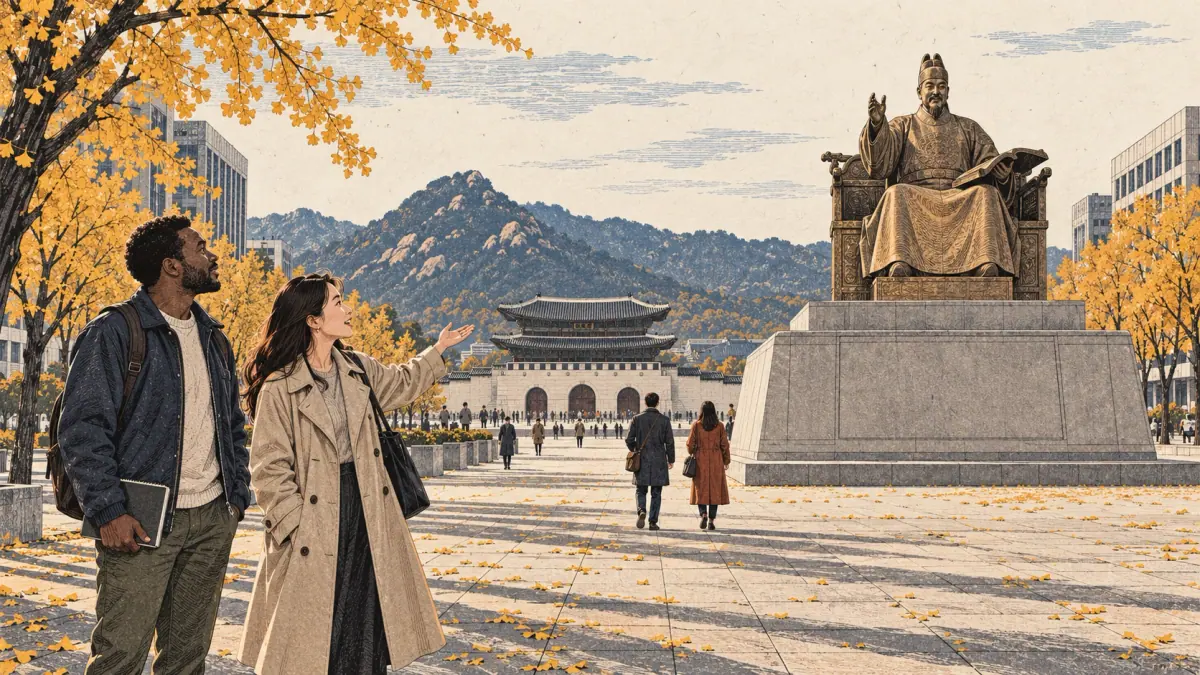
- Gwanghwamun Square in Seoul: the large statue of King Sejong (unveiled in 2009) stands here, with an exhibition hall about Sejong beneath the square. Outdoor events and Hangul-themed displays are often held nearby.
- National Hangeul Museum (국립한글박물관): the museum in Yongsan, Seoul, opened on Hangul Day in 2014, explains the history of the script and runs family programmes around the holiday.
- Language campaigns and contests: broadcasters, newspapers and schools run quizzes, spelling contests, calligraphy (서예) workshops and campaigns about replacing unnecessary foreign words with Korean ones.
Places Linked to Hangul Day
Three places in South Korea are closely tied to Hangul Day, and each suits a different kind of visit.
| Place | Location | What you see | Best for |
|---|---|---|---|
| Gwanghwamun Square (광화문광장) | central Seoul | King Sejong statue; underground exhibition on Sejong's life and inventions | a short visit combined with Gyeongbokgung Palace |
| National Hangeul Museum (국립한글박물관) | Yongsan, Seoul, next to the National Museum of Korea | the history of the script, old printed books, hands-on displays | learners who want the full story in one place |
| Yeongneung (영릉) | Yeoju, Gyeonggi Province | the royal tomb of King Sejong and Queen Soheon | a half-day trip outside Seoul |
Opening hours, closures and special events change from year to year, so check the official site of each place before a holiday visit.
For most families, Hangul Day is a quiet autumn day off, often used for outings, since early October usually brings clear weather. There is no special food, greeting or gift tradition, which makes Hangul Day different from holidays such as Chuseok. Related lessons on festivals and their vocabulary sit in Korean holidays. North of the border, the alphabet has its own day and a different date.
Hangul Day in North Korea: 15 January
North Korea celebrates its alphabet on 15 January, a day called 조선글날 (Chosŏn'gŭl Day). The difference comes from two choices: North Korea commemorates the creation of the script rather than its promulgation, and it calls the script Chosŏn'gŭl (조선글) rather than Hangul.
The royal annals record the completion of the script in the 12th lunar month of Sejong's 25th year, which corresponds to late 1443 and early 1444 in the solar calendar. North Korea's 15 January date is based on a conversion of that creation record, though sources differ on exactly how the day was fixed.
| Feature | South Korea | North Korea |
|---|---|---|
| Name of the day | 한글날 (Hangul Day) | 조선글날 (Chosŏn'gŭl Day) |
| Date | 9 October | 15 January |
| Event commemorated | Promulgation, 1446 | Creation, 1443–1444 |
| Name of the script | 한글 (Hangul) | 조선글 (Chosŏn'gŭl) |
| Public holiday | Yes (since 2013, again) | Commemoration day |
Both Koreas use the same 24 basic letters, but spelling standards and dictionary order differ in a few places, and North Korea dropped Chinese characters from general use earlier. For learners, the practical point is simple: if you follow South Korean textbooks, 9 October is the date that matters. That is also the day to learn some vocabulary.
Hangul Day Vocabulary for Learners
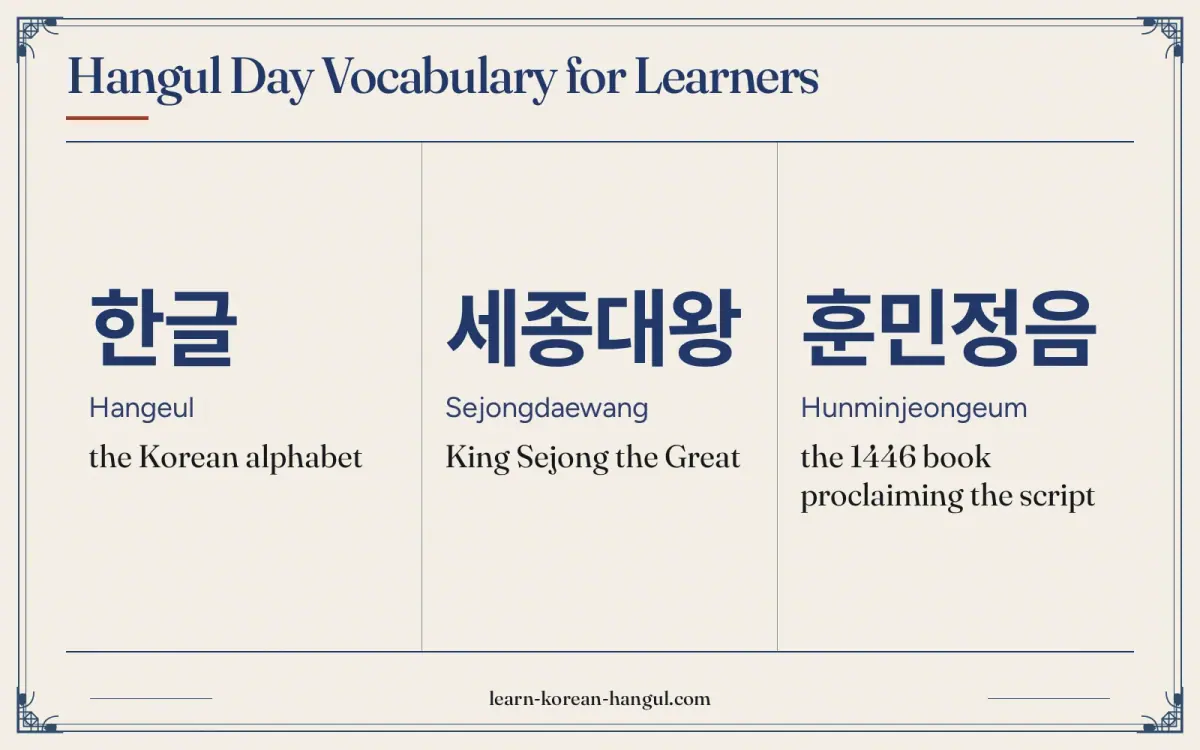
These ten words cover most conversations about Hangul Day. Tap each one to hear it.
| Korean | Romanization | Meaning | Audio |
|---|---|---|---|
| 한글 | Hangeul | the Korean alphabet | |
| 한글날 | Hangeullal [한글랄] | Hangul Day | |
| 세종대왕 | Sejongdaewang | King Sejong the Great | |
| 훈민정음 | Hunminjeongeum | the 1446 book proclaiming the script | |
| 자음 | jaeum | consonant | |
| 모음 | moeum | vowel | |
| 글자 | geulja [글짜] | letter, written character | |
| 공휴일 | gonghyuil | public holiday | |
| 국경일 | gukgyeongil [국꼉일] | national day | |
| 가갸날 | Gagyanal | the 1926 name of Hangul Day |
Three short sentences let you use the words:
- 오늘은 한글날이에요. (Oneureun Hangeullarieyo.) "Today is Hangul Day."
- 한글날이 언제예요? (Hangeullari eonjeyeyo?) "When is Hangul Day?"
- 10월 9일이에요. (Siwol gu-irieyo.) "It's October 9."
Is There a Hangul Day Greeting?
No fixed greeting exists for Hangul Day, unlike 새해 복 많이 받으세요 for the Lunar New Year. Koreans may still use the general holiday pattern "즐거운 ... 보내세요" ("have a pleasant ..."), so a polite message to a teacher or friend could be 즐거운 한글날 보내세요 (Jeulgeoun Hangeullal bonaeseyo), "Have a pleasant Hangul Day". Writing it by hand in Hangul is the most fitting way to send it.
Pronunciation note: in 한글날이에요 the final ㄹ of 날 links to the next vowel (liaison), so you hear [한글라리에요]. In 10월 the number is read 시월 (siwol), an irregular form: the expected 십월 drops its ㅂ. Vocabulary is a start; the challenge below turns it into practice.
A 15-Minute Hangul Day Challenge
The Hangul Day challenge is a short routine for learners: in 15 minutes you read, write and test the alphabet the day celebrates. Do the steps in order.
- Minutes 0–3: learn the first vowel. Open the first Hangul lesson and learn ㅏ, the vowel built from the "human" line plus the "heaven" stroke. You'll know it worked when you can write ㅏ and say "a".
- Minutes 3–6: read the holiday's name. Split 한글날 into its blocks: 한 (ㅎ+ㅏ+ㄴ), 글 (ㄱ+ㅡ+ㄹ), 날 (ㄴ+ㅏ+ㄹ). Say each block, then the word with the [한글랄] sound change.
- Minutes 6–9: chant like 1926. Read the row 가 갸 거 겨 고 교 구 규 그 기 aloud, the traditional practice that gave Gagyanal its name.
- Minutes 9–12: write a message. Copy 오늘은 한글날이에요 by hand, one block at a time.
- Minutes 12–15: test yourself. End your Hangul Day challenge with a Hangul quiz.
Common mistake: trying to learn all 24 letters in one sitting. The challenge works because it is small; a single correct block is a real result. Repeat it on any day of the year, not only on 9 October.
Common Misconceptions about Hangul Day
Five mistaken ideas about Hangul Day appear often in English-language sources.
"Hangul was invented on 9 October." Hangul was created in 1443; 9 October marks its promulgation in 1446, the release of the Hunminjeongeum book that explained the letters to the public.
"Hangul Day has always been a day off." Between 1991 and 2012, Hangul Day was a commemoration day but not a public holiday, so offices and schools stayed open.
"Hangul Day celebrates the Korean language." Hangul Day celebrates the writing system. The Korean language is far older than Hangul; Koreans spoke it for many centuries while writing in Chinese characters.
"Hangul became the official script in 1446." Hangul (then called 국문, "national script") was declared the basis of government documents only in 1894, more than 400 years after its promulgation. The page on when Hangul became official tells that story.
"Hangul Day is King Sejong's birthday." Hangul Day marks the promulgation of the script, not Sejong's birth. Sejong's birthday is linked to a different South Korean observance: Teachers' Day (스승의 날) on 15 May was set on the date of his birth, honouring him as a model teacher of the nation. Teachers' Day is not a public holiday.
A useful rule of thumb: 1443 is the creation, 1446 is the announcement, 1894 is official status, and 1926 is the first Hangul Day. With the dates straight, the last step is choosing what to read next.
What to Read Next
For the full story, see the history of Hangul, which places Hangul Day in a timeline from 1443 to today. Then learn the whole Korean alphabet from our hub, starting with the vowels.
Honest limits of this page: event details change every year, so this guide describes typical activities rather than a schedule; check official announcements for the current year's ceremony and museum programmes. Several historical details, such as the exact conversion steps in the 1930s and the basis of North Korea's date, are reported differently across sources. The core facts are stable: Hangul Day is 9 October in South Korea, it marks the 1446 promulgation, and it has been a public holiday again since 2013.
Frequently Asked Questions
Is Hangul Day the same as Korean Language Day?
In everyday English the names are used loosely, but Hangul Day celebrates the writing system, not the spoken language. Its Korean name, 한글날, literally means "Hangul day". Some English sources call it Korean Alphabet Day or Hangeul Day; all of these refer to the same 9 October holiday in South Korea.
Do Koreans give gifts on Hangul Day?
No, gift-giving is not a Hangul Day custom. The day is marked by official ceremonies, exhibitions, calligraphy and writing events, and public campaigns about correct Korean. For most people it is simply a day off work or school. Learners sometimes mark it by writing a short message in Hangul instead.
Is Hangul Day celebrated outside Korea?
Yes, on a smaller scale. Korean Cultural Centres, King Sejong Institutes and Korean community schools in many countries hold events around 9 October, such as writing contests and calligraphy workshops. These are organised locally, so check the nearest Korean cultural centre for the current year's programme rather than expecting a fixed schedule.
What year will be Hangul's 600th anniversary?
Counting from the 1446 promulgation, which is what Hangul Day commemorates, the 600th Hangul Day falls on 9 October 2046. Counting from the 1443 creation, the 600th anniversary falls in 2043. Korean anniversaries are usually written with 돌, so 2046 will be 600돌 한글날.