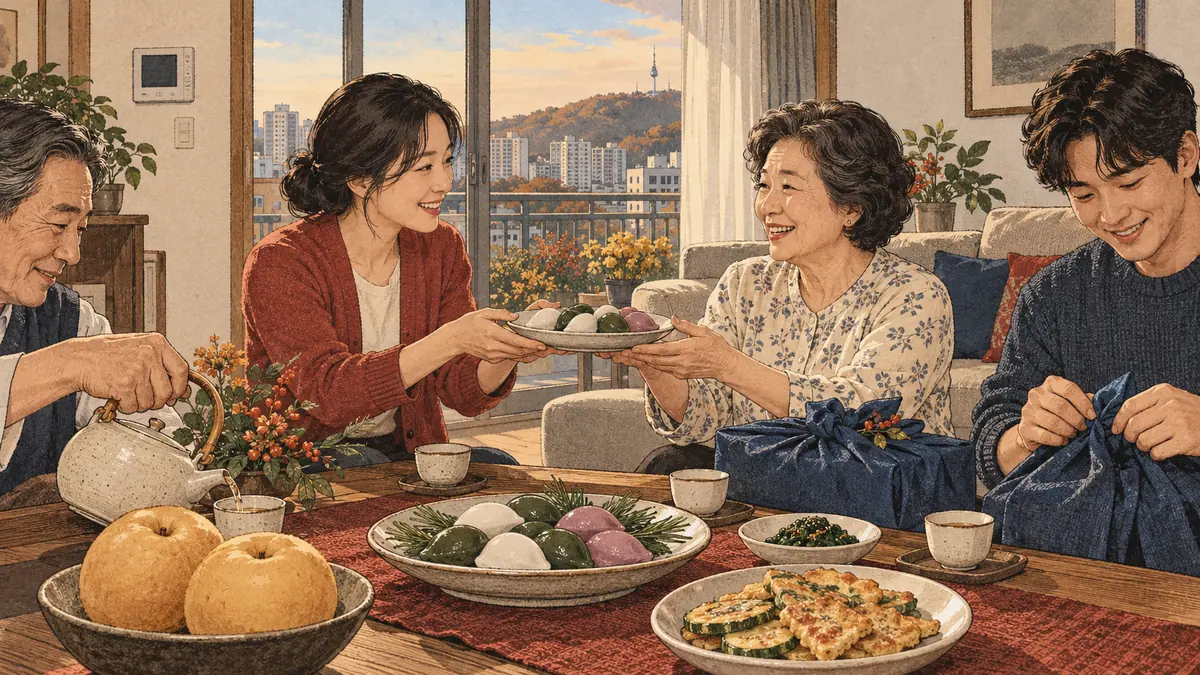
Korean Holidays at a Glance
Korean holidays vocabulary is the set of words for days that Koreans celebrate, from a personal 생일 to national days like 한글날. Some holidays follow the solar calendar and have a fixed date, such as 어린이날 on 5 May. Others follow the lunar calendar, such as 설날 and 추석, so their dates move each year. This page holds 40 words in six groups.
| Group | Words | Use |
|---|---|---|
| Birthdays and personal celebrations | 8 | Congratulating people and talking about parties |
| Lunar New Year (설날) | 6 | The words around the biggest winter holiday |
| Chuseok (추석) | 5 | The autumn harvest holiday |
| National holidays | 11 | Reading a Korean calendar |
| Seasonal days (동지, 단오) | 5 | Older days tied to the seasons |
| Western holidays | 5 | Christmas, Valentine's Day, White Day and Pepero Day |
The list is part of Korean Culture Words. The two biggest holidays also have their own list, Seollal and Chuseok Vocabulary. The next section ranks the groups.
Which Holiday Words Should You Learn First?
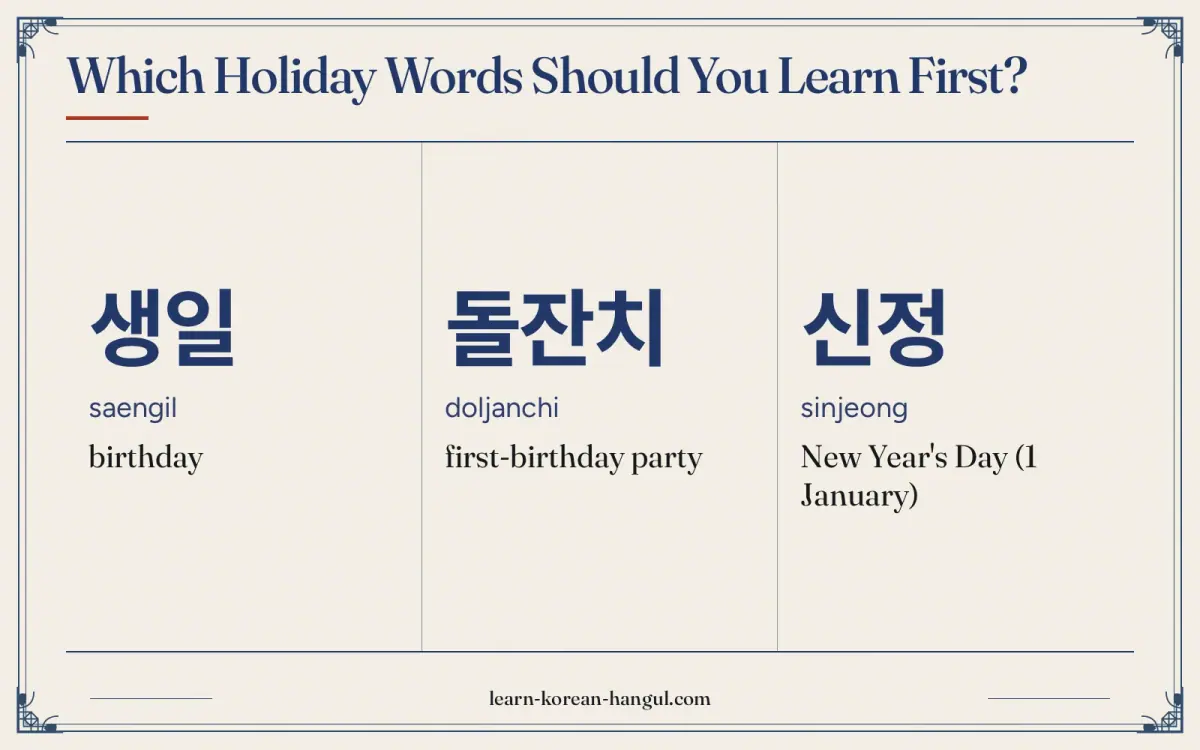
Learn 생일, 축하, 공휴일 and 휴일 first, then the holidays you will meet in the next few months. A birthday word is the one you need almost at once, because 생일 축하해요 is one of the first things a Korean friend will ask you to say.
- Day one. 생일, 축하, 파티, 공휴일, 휴일 and 기념일.
- Day two. 설날, 추석 and the national holidays on your calendar.
- Day three. The Seollal and Chuseok food and ritual words.
- Day four. Seasonal days and the Western holidays.
At 8 to 10 words a day, the list takes four to five days plus review. This scene puts eight of the words on one picture.
Word · 8
- 1
생일
saengil
birthday
- 2
돌잔치
doljanchi
first-birthday party
- 3
신정
sinjeong
New Year's Day (1 January)
- 4
한가위
hangawi
Chuseok (older native name)
- 5
휴일
hyuil
day off; holiday
- 6
현충일
hyeonchungil
Memorial Day (6 June)
- 7
동지
dongji
winter solstice
- 8
크리스마스
keuriseumaseu
Christmas
One word in eight is a loanword, mostly in the last group. The origin column in each table marks them. The first group is the one you use every month.
Birthdays and Personal Celebrations
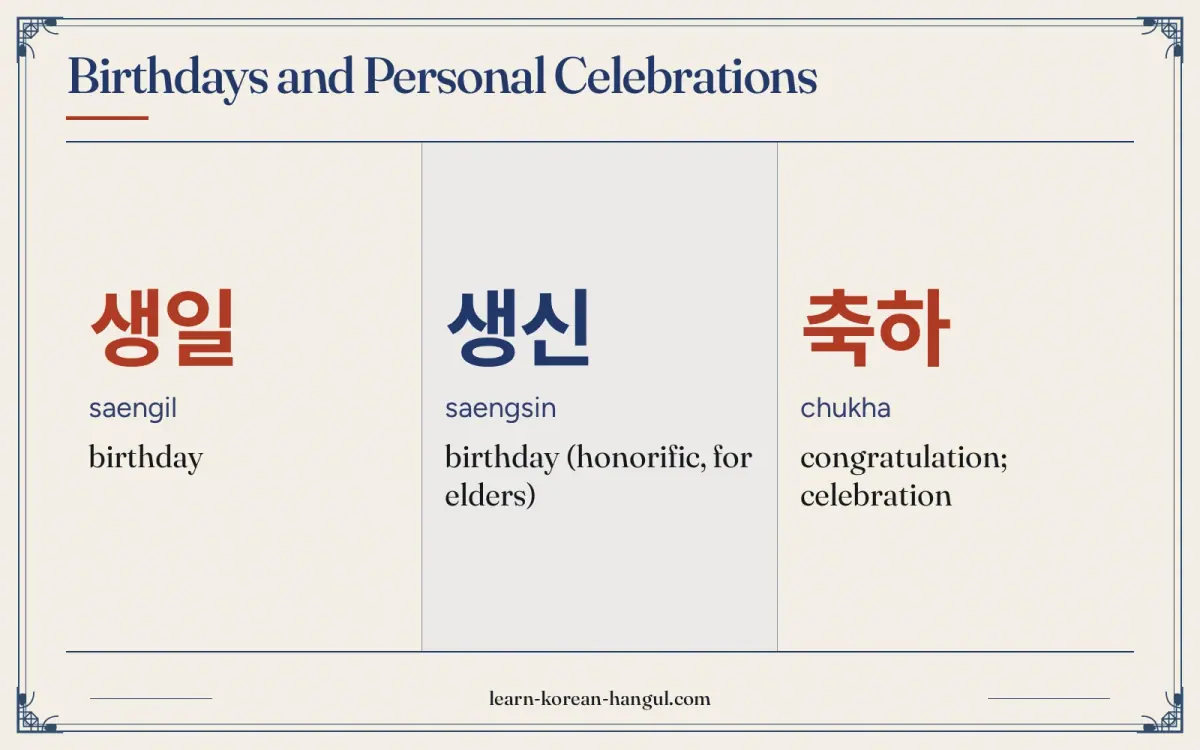
Say 생일 축하해요 to wish someone a happy birthday, and use 생신 for an older person's birthday, as in 할머니 생신. 생일 is a Sino-Korean word, and 생신 is its honorific form. The group also holds the words for a wedding, a graduation and an anniversary.
| No. | Hangul | Revised Romanization | Origin | Meaning | Example sentence | Audio assetId |
|---|---|---|---|---|---|---|
| 1 | 생일 | saengil | Sino-Korean | birthday | 오늘은 제 생일이에요. (Today is my birthday.) | au-pg-vocabulary-culture-holidays-1; example: au-pg-vocabulary-culture-holidays-41 |
| 2 | 생신 | saengsin | Sino-Korean | birthday (honorific, for elders) | 할머니 생신이에요. (It is my grandmother's birthday.) | au-pg-vocabulary-culture-holidays-2; example: au-pg-vocabulary-culture-holidays-42 |
| 3 | 축하 | chukha | Sino-Korean | congratulation; celebration | 생일 축하해요! (Happy birthday!) | au-pg-vocabulary-culture-holidays-3; example: au-pg-vocabulary-culture-holidays-43 |
| 4 | 파티 | pati | loanword | party | 파티에 가요. (I go to the party.) | au-pg-vocabulary-culture-holidays-4; example: au-pg-vocabulary-culture-holidays-44 |
| 5 | 결혼식 | gyeolhonsik | Sino-Korean | wedding | 주말에 결혼식이 있어요. (There is a wedding this weekend.) | au-pg-vocabulary-culture-holidays-5; example: au-pg-vocabulary-culture-holidays-45 |
| 6 | 돌잔치 | doljanchi | native | first-birthday party | 조카의 돌잔치에 가요. (I am going to my niece's or nephew's first-birthday party.) | au-pg-vocabulary-culture-holidays-6; example: au-pg-vocabulary-culture-holidays-46 |
| 7 | 졸업식 | joreopsik | Sino-Korean | graduation ceremony | 졸업식이 오늘이에요. (The graduation ceremony is today.) | au-pg-vocabulary-culture-holidays-7; example: au-pg-vocabulary-culture-holidays-47 |
| 8 | 기념일 | ginyeomil | Sino-Korean | anniversary; commemoration day | 오늘은 우리 기념일이에요. (Today is our anniversary.) | au-pg-vocabulary-culture-holidays-8; example: au-pg-vocabulary-culture-holidays-48 |
The 돌잔치 is a first-birthday party, and it is one of the most distinctive Korean celebrations: the baby is seated before objects, and the choice is said to hint at the future. This is a custom and not a claim about the future. In Korea a person's birthday meal is often 미역국 (seaweed soup), which you can learn in the food lists.
Example Sentences
Each example is a short polite sentence. Most follow the pattern noun + 이에요 / 예요 (it is) or noun + 에 가요 (go to). Say each sentence aloud and swap the noun. Replace 생일 in 오늘은 제 생일이에요 with 기념일 and you get 오늘은 제 기념일이에요, which is natural. Use 이에요 after a final consonant and 예요 after a vowel.
The next group moves to the first big holiday of the year.
Lunar New Year (설날)
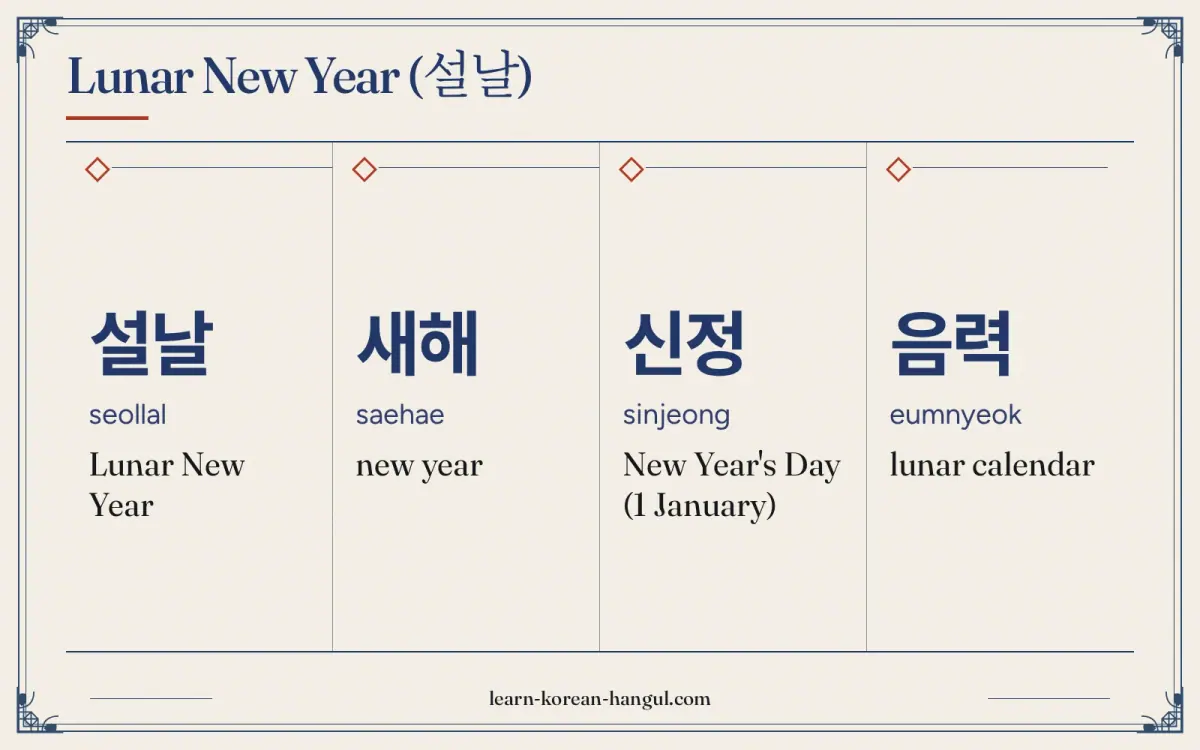
Lunar New Year is 설날, and it falls on the first day of the first lunar month. 새해 is the general word for new year, and 신정 is 1 January. 음력 is the lunar calendar that sets the date. On the morning of 설날 people make a 세배 and eat 떡국.
| No. | Hangul | Revised Romanization | Origin | Meaning | Example sentence | Audio assetId |
|---|---|---|---|---|---|---|
| 9 | 설날 | seollal | native | Lunar New Year | 설날에는 가족을 만나요. (On Seollal we meet our family.) | au-pg-vocabulary-culture-holidays-9; example: au-pg-vocabulary-culture-holidays-49 |
| 10 | 새해 | saehae | native | new year | 새해가 시작돼요. (The new year begins.) | au-pg-vocabulary-culture-holidays-10; example: au-pg-vocabulary-culture-holidays-50 |
| 11 | 신정 | sinjeong | Sino-Korean | New Year's Day (1 January) | 신정에는 쉬어요. (I rest on New Year's Day.) | au-pg-vocabulary-culture-holidays-11; example: au-pg-vocabulary-culture-holidays-51 |
| 12 | 음력 | eumnyeok | Sino-Korean | lunar calendar | 제 생일은 음력이에요. (My birthday follows the lunar calendar.) | au-pg-vocabulary-culture-holidays-12; example: au-pg-vocabulary-culture-holidays-52 |
| 13 | 세배 | sebae | Sino-Korean | New Year bow to elders | 부모님께 세배를 드려요. (I make the New Year bow to my parents.) | au-pg-vocabulary-culture-holidays-13; example: au-pg-vocabulary-culture-holidays-53 |
| 14 | 떡국 | tteokguk | native | rice-cake soup, eaten on Seollal | 설날 아침에 떡국을 먹어요. (I eat tteokguk on Seollal morning.) | au-pg-vocabulary-culture-holidays-14; example: au-pg-vocabulary-culture-holidays-54 |
Koreans mark two new years: 신정 on 1 January and 설날 on the lunar date. 설날 and 추석 are each three-day holidays, while 신정 is a single day. The full Seollal word list, with the ritual and food vocabulary, is on the Seollal and Chuseok Vocabulary page.
How Do You Say Chuseok (추석) in Korean?
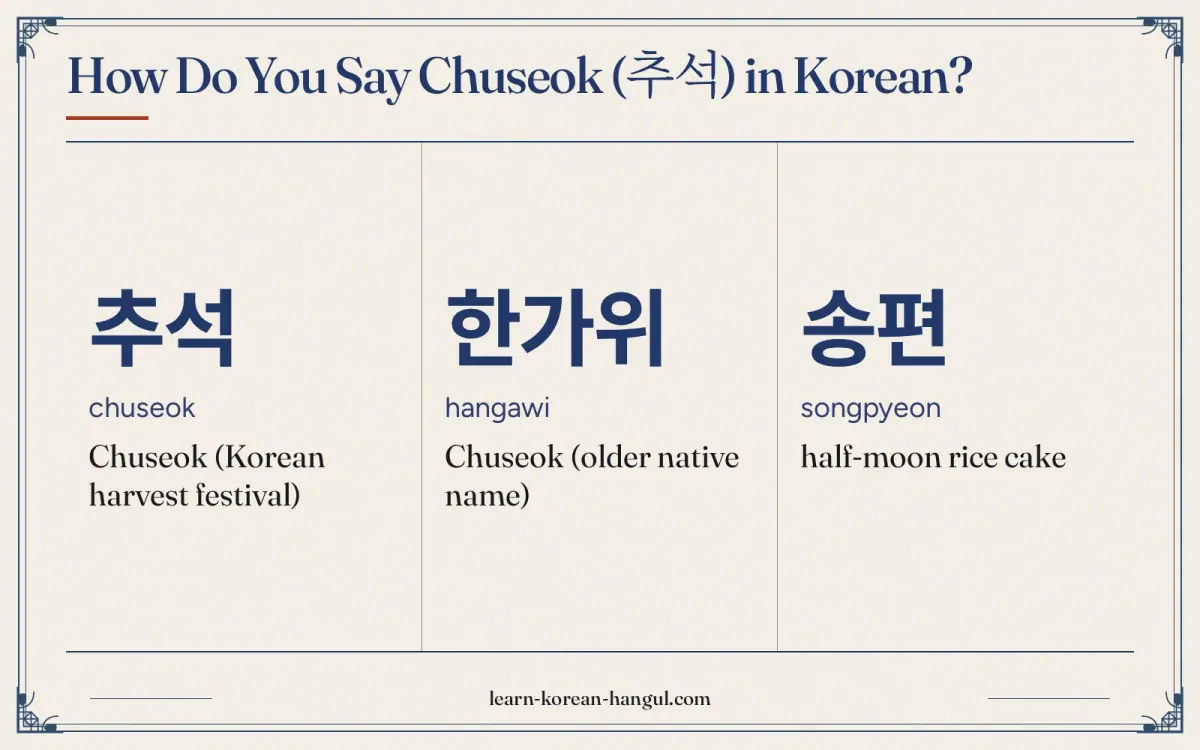
Chuseok is 추석, and the older native name is 한가위. It falls on the fifteenth day of the eighth lunar month, when the full moon (보름달) is brightest. The traditional foods are 송편, and the traditional custom is 성묘, the visit to the family graves.
| No. | Hangul | Revised Romanization | Origin | Meaning | Example sentence | Audio assetId |
|---|---|---|---|---|---|---|
| 15 | 추석 | chuseok | Sino-Korean | Chuseok (Korean harvest festival) | 추석은 가을 명절이에요. (Chuseok is an autumn holiday.) | au-pg-vocabulary-culture-holidays-15; example: au-pg-vocabulary-culture-holidays-55 |
| 16 | 한가위 | hangawi | native | Chuseok (older native name) | 즐거운 한가위 보내세요. (Have a happy Hangawi.) | au-pg-vocabulary-culture-holidays-16; example: au-pg-vocabulary-culture-holidays-56 |
| 17 | 송편 | songpyeon | mixed | half-moon rice cake | 송편을 빚어요. (We shape songpyeon.) | au-pg-vocabulary-culture-holidays-17; example: au-pg-vocabulary-culture-holidays-57 |
| 18 | 성묘 | seongmyo | Sino-Korean | visiting ancestors' graves | 아버지와 성묘를 가요. (I go to visit the graves with my father.) | au-pg-vocabulary-culture-holidays-18; example: au-pg-vocabulary-culture-holidays-58 |
| 19 | 보름달 | boreumdal | native | full moon | 추석에는 보름달이 떠요. (The full moon rises at Chuseok.) | au-pg-vocabulary-culture-holidays-19; example: au-pg-vocabulary-culture-holidays-59 |
Chuseok is a three-day holiday, and it is one of the busiest travel periods of the year. The words for the trip home, such as 귀성, are on the Seollal and Chuseok Vocabulary page, which also compares Seollal and Chuseok in one table.
National Holidays
The word for a public holiday is 공휴일, and 휴일 is a general day off. The table below has these two general words and nine named days, seven of them days off. Among Korea's public holidays, three follow the lunar calendar (설날, 추석 and 부처님오신날), and the rest have fixed solar dates. A substitute holiday, 대체공휴일, applies to some of them when they fall on a weekend.
| No. | Hangul | Revised Romanization | Origin | Meaning | Example sentence | Audio assetId |
|---|---|---|---|---|---|---|
| 20 | 공휴일 | gonghyuil | Sino-Korean | public holiday | 내일은 공휴일이에요. (Tomorrow is a public holiday.) | au-pg-vocabulary-culture-holidays-20; example: au-pg-vocabulary-culture-holidays-60 |
| 21 | 휴일 | hyuil | Sino-Korean | day off; holiday | 휴일에는 집에서 쉬어요. (I rest at home on days off.) | au-pg-vocabulary-culture-holidays-21; example: au-pg-vocabulary-culture-holidays-61 |
| 22 | 삼일절 | samiljeol | Sino-Korean | Independence Movement Day (1 March) | 삼일절은 3월 1일이에요. (Samiljeol is on 1 March.) | au-pg-vocabulary-culture-holidays-22; example: au-pg-vocabulary-culture-holidays-62 |
| 23 | 어린이날 | eorininal | native | Children's Day (5 May) | 어린이날에 놀이공원에 가요. (We go to an amusement park on Children's Day.) | au-pg-vocabulary-culture-holidays-23; example: au-pg-vocabulary-culture-holidays-63 |
| 24 | 어버이날 | eobeoinal | native | Parents' Day (8 May) | 어버이날에 카네이션을 드려요. (We give carnations on Parents' Day.) | au-pg-vocabulary-culture-holidays-24; example: au-pg-vocabulary-culture-holidays-64 |
| 25 | 스승의 날 | seuseungui nal | native | Teachers' Day (15 May) | 스승의 날에 선생님께 편지를 써요. (I write a letter to my teacher on Teachers' Day.) | au-pg-vocabulary-culture-holidays-25; example: au-pg-vocabulary-culture-holidays-65 |
| 26 | 현충일 | hyeonchungil | Sino-Korean | Memorial Day (6 June) | 현충일은 6월 6일이에요. (Memorial Day is on 6 June.) | au-pg-vocabulary-culture-holidays-26; example: au-pg-vocabulary-culture-holidays-66 |
| 27 | 광복절 | gwangbokjeol | Sino-Korean | Liberation Day (15 August) | 광복절은 8월 15일이에요. (Liberation Day is on 15 August.) | au-pg-vocabulary-culture-holidays-27; example: au-pg-vocabulary-culture-holidays-67 |
| 28 | 개천절 | gaecheonjeol | Sino-Korean | National Foundation Day (3 October) | 개천절은 10월 3일이에요. (National Foundation Day is on 3 October.) | au-pg-vocabulary-culture-holidays-28; example: au-pg-vocabulary-culture-holidays-68 |
| 29 | 한글날 | hangeullal | native | Hangul Day (9 October) | 한글날에는 한글을 기념해요. (On Hangul Day we celebrate Hangul.) | au-pg-vocabulary-culture-holidays-29; example: au-pg-vocabulary-culture-holidays-69 |
| 30 | 부처님오신날 | bucheonim osinnal | mixed | Buddha's Birthday | 부처님오신날에 절에 가요. (I go to a temple on Buddha's Birthday.) | au-pg-vocabulary-culture-holidays-30; example: au-pg-vocabulary-culture-holidays-70 |
The calendar table shows the date rule for each holiday and whether it is a day off. Each date is a rule, and the actual day changes, so check the official calendar each year. Parents' Day and Teachers' Day are marked days, not days off.
| Holiday | Hangul | Date rule | Day off? |
|---|---|---|---|
| New Year's Day | 신정 | 1 January | Yes |
| Lunar New Year | 설날 | 1st day of 1st lunar month, plus the day before and after | Yes |
| Independence Movement Day | 삼일절 | 1 March | Yes |
| Children's Day | 어린이날 | 5 May | Yes |
| Buddha's Birthday | 부처님오신날 | 8th day of 4th lunar month | Yes |
| Parents' Day | 어버이날 | 8 May | No |
| Teachers' Day | 스승의 날 | 15 May | No |
| Memorial Day | 현충일 | 6 June | Yes |
| Liberation Day | 광복절 | 15 August | Yes |
| Chuseok | 추석 | 15th day of 8th lunar month, plus the day before and after | Yes |
| National Foundation Day | 개천절 | 3 October | Yes |
| Hangul Day | 한글날 | 9 October | Yes |
| Christmas Day | 성탄절 | 25 December | Yes |
Hangul Day commemorates the publication of the Hunminjeongeum, and it was restored as a public holiday in 2013. The Hangul Day page tells the story. The Korean names with 날 (day) are native-based, and the names with 절 (festival day) are Sino-Korean. Notice that most of the national holiday words end in 절 or 일. The next group is the older calendar.
How Do You Say Seasonal Days (동지, 단오) in Korean?
Seasonal days are traditional days tied to the lunar calendar and the seasons. 동지 is the winter solstice, when people eat 팥죽. 단오 falls on the fifth day of the fifth lunar month. 정월 대보름 is the first full moon of the year, and 한식 is a spring day in early April.
| No. | Hangul | Revised Romanization | Origin | Meaning | Example sentence | Audio assetId |
|---|---|---|---|---|---|---|
| 31 | 동지 | dongji | Sino-Korean | winter solstice | 동지는 일 년 중 밤이 가장 길어요. (On the winter solstice the night is the longest of the year.) | au-pg-vocabulary-culture-holidays-31; example: au-pg-vocabulary-culture-holidays-71 |
| 32 | 단오 | dano | Sino-Korean | Dano (5th day of the 5th lunar month) | 단오는 음력 5월 5일이에요. (Dano is on the fifth day of the fifth lunar month.) | au-pg-vocabulary-culture-holidays-32; example: au-pg-vocabulary-culture-holidays-72 |
| 33 | 정월 대보름 | jeongwol daeboreum | mixed | first full moon of the lunar year | 정월 대보름에는 보름달을 봐요. (On Jeongwol Daeboreum we look at the full moon.) | au-pg-vocabulary-culture-holidays-33; example: au-pg-vocabulary-culture-holidays-73 |
| 34 | 한식 | hansik | Sino-Korean | Hansik (cold food day, early April) | 한식은 4월 초예요. (Hansik is in early April.) | au-pg-vocabulary-culture-holidays-34; example: au-pg-vocabulary-culture-holidays-74 |
| 35 | 팥죽 | patjuk | native | red bean porridge | 동지에는 팥죽을 먹어요. (We eat red bean porridge on the winter solstice.) | au-pg-vocabulary-culture-holidays-35; example: au-pg-vocabulary-culture-holidays-75 |
Learners should note that 한식 has a second meaning. Written 한식 as Korean food (韓食), it is a very common word on restaurant signs. The cold food day (寒食) is spelled the same way, so context decides. These seasonal days are less visible in daily life than the national holidays, but they appear on calendars and in the news.
Western Holidays (크리스마스, 밸런타인데이)
Christmas is 크리스마스, and its official name is 성탄절. It is a public holiday. Valentine's Day and White Day have their own Korean customs: on 14 February women give chocolate, and on 14 March men give candy in return. 11 November is Pepero Day, named after a chocolate-covered biscuit stick.
| No. | Hangul | Revised Romanization | Origin | Meaning | Example sentence | Audio assetId |
|---|---|---|---|---|---|---|
| 36 | 크리스마스 | keuriseumaseu | loanword | Christmas | 크리스마스에 눈이 와요. (It snows at Christmas.) | au-pg-vocabulary-culture-holidays-36; example: au-pg-vocabulary-culture-holidays-76 |
| 37 | 성탄절 | seongtanjeol | Sino-Korean | Christmas Day (official name) | 성탄절은 공휴일이에요. (Christmas Day is a public holiday.) | au-pg-vocabulary-culture-holidays-37; example: au-pg-vocabulary-culture-holidays-77 |
| 38 | 밸런타인데이 | baelleontaindei | loanword | Valentine's Day (14 February) | 밸런타인데이에 초콜릿을 줘요. (I give chocolate on Valentine's Day.) | au-pg-vocabulary-culture-holidays-38; example: au-pg-vocabulary-culture-holidays-78 |
| 39 | 화이트데이 | hwaiteudei | loanword | White Day (14 March) | 화이트데이에 사탕을 줘요. (I give candy on White Day.) | au-pg-vocabulary-culture-holidays-39; example: au-pg-vocabulary-culture-holidays-79 |
| 40 | 빼빼로데이 | ppaeppaerodei | loanword | Pepero Day (11 November) | 빼빼로데이에 친구에게 빼빼로를 줘요. (I give my friend Pepero on Pepero Day.) | au-pg-vocabulary-culture-holidays-40; example: au-pg-vocabulary-culture-holidays-80 |
These imported days are mostly commercial events, and customs vary by age and couple. Use them as vocabulary and not as rules. The standard Korean spelling of Valentine's Day is 밸런타인데이, and you will also see 발렌타인데이 in shops.
How Do You Pronounce These Words?
Most of these words follow the spelling, but several undergo sound changes that learners often miss. The table shows six of them.
| Spelling | Pronunciation | What happens |
|---|---|---|
| 어린이날 | [어리니날] | The final ㄴ of 어린 moves to the vowel 이, so the word sounds like 어리니날 |
| 설날 | [설랄] | ㄴ after ㄹ becomes ㄹ, so the two syllables share the sound ㄹㄹ |
| 한글날 | [한글랄] | ㄴ after ㄹ becomes ㄹ |
| 졸업식 | [조럽씩] | The final ㅂ links to the next vowel, and ㅅ after ㅂ becomes tense |
| 광복절 | [광복쩔] | ㅈ after a final ㄱ becomes tense |
| 보름달 | [보름딸] | The ㄷ of 달 is said as a tense ㄸ |
The rules come from the Standard Pronunciation rules (표준 발음법) of the 국립국어원. The audio is generated with text-to-speech and checked by a Korean teacher before publication.
Audio and Slow Playback
Each word has a normal clip, and 5 key words also have a slow clip at 0.8 times the speed: 생일, 어린이날, 한글날, 크리스마스 and 공휴일. Nothing plays until you press a button.
Listen to 어린이날 first. You should hear four even syllables, [어-리-니-날], with a clear n on the third.
What Mistakes Do Learners Make with Holiday Words?
- Treating all holidays as fixed dates. 설날, 추석 and 부처님오신날 move every year because they follow the lunar calendar.
- Saying 생일 for an older person. Use 생신, and add the honorific 께서 when you speak about them.
- Reading 어린이날 as eo-rin-i-nal. The spoken form is [어리니날].
- Assuming 어버이날 and 스승의 날 are days off. They are marked days, but work and school continue.
- Mixing up the two meanings of 한식, Korean food and the cold food day.
The first mistake changes plans, and the second changes politeness. The next section turns the list into practice.
Practice: Flashcards and Worksheet
Drill these words with the vocabulary flashcard decks. A printable worksheet for these words (word list, matching, writing practice, fill-in-the-blank exercises and answer key) is available in A4 and US Letter from the download card on this page. Progress in the decks is saved only in your browser.
Korean Holidays Worksheet
Try this five-question check, then say the 40 words aloud once more.
Practice · 5
What does 생일 mean?
Show answer
birthday
생일 (saengil) means birthday.
What does 새해 mean?
Show answer
new year
새해 (saehae) means new year.
What does 보름달 mean?
Show answer
full moon
보름달 (boreumdal) means full moon.
What does 스승의 날 mean?
Show answer
Teachers' Day (15 May)
스승의 날 (seuseungui nal) means Teachers' Day (15 May).
What does 한식 mean?
Show answer
Hansik (cold food day, early April)
한식 (hansik) means Hansik (cold food day, early April).
For greetings to say on each holiday, see the celebration phrases page.
Where to Go Next
This list sits inside Korean Culture Words. After Korean holidays, many learners move on to K-Pop Words or K-Drama Words, where birthdays and holidays often appear as plot points. The deeper Seollal and Chuseok list is next in this section.
Pages in This Section
One page sits below Holidays and Celebrations.
- Seollal and Chuseok Vocabulary: 35 words in six groups, with a table that compares the two holidays by date, food, customs and greetings. It covers the ritual words 차례, 세배 and 성묘, the foods 떡국 and 송편, and the travel words 귀성 and 귀경. Level A2.
Frequently Asked Questions
How Do You Say Birthday in Korean?
Birthday is 생일 (saengil). To wish someone a happy birthday, say 생일 축하해요 (saengil chukahaeyo). For an older person, use the honorific 생신 and the phrase 생신 축하드립니다, which is more formal. The two syllables are said with an even rhythm, and the second ends in a light ㄹ.
How Do You Pronounce 어린이날 (eorininal)?
어린이날 is said [어리니날], eo-ri-ni-nal. The final ㄴ of 어린 moves to the next syllable, which starts with a vowel, so you hear four syllables of even length. The last syllable ends in a light ㄹ. The holiday is 5 May. Press the audio button to compare.
How Many Holiday Words Should I Learn First?
Learn about 12 first: 생일, 축하, 공휴일, 휴일, 설날, 추석, 어린이날, 한글날, 크리스마스, 새해, 기념일 and 파티. That is one to two days at 8 to 10 words a day. Add the seasonal days and the food and ritual words later.
Where Can I Practise Holiday Words with Flashcards?
Use the vocabulary flashcard decks, which list every deck with audio. A deck for these words is planned. Progress stays in your browser. The Seollal and Chuseok page has a second list that overlaps with this one, so review the two lists together for the best result.
Is the Romanization on This Page Official?
It follows the Revised Romanization of Korean, which South Korea officially adopted on 7 July 2000 and whose rules the National Institute of Korean Language (국립국어원) publishes. It is a learning aid that does not mark every sound change, so learn the Hangul and use the audio to hear the real sound.
Is There a Printable Worksheet for Holiday Words?
A printable worksheet for these words (word list, matching, writing practice, fill-in-the-blank exercises and answer key) is available in A4 and US Letter from the download card on this page. For practice, copy the tables above by hand: write the Hangul, cover the English column, and check your answers against the page.