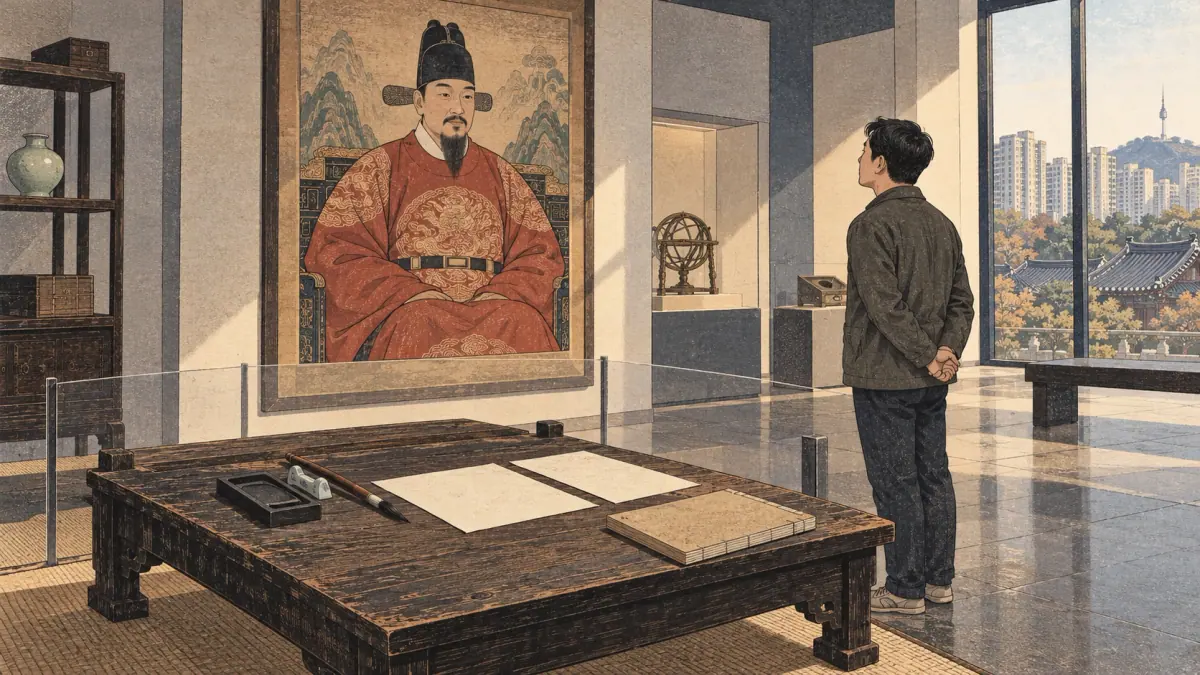
Who Invented Hangul?
King Sejong (세종, reigned 1418–1450) invented Hangul. The main court record, the Annals of the Joseon Dynasty, says that in the 12th lunar month of 1443 "the king personally created 28 letters of eonmun". Eonmun (언문) was the period name for the new script. That entry is the earliest written evidence and the basis of the standard answer.
The full answer to "who invented Hangul" has three parts, because three different jobs were done:
- Designing the letters: credited to Sejong by the Annals and by the 1446 book that announced them.
- Explaining the letters: done by eight court scholars, most of them from the Jiphyeonjeon, who wrote the Haerye ("explanations and examples") in 1446.
- Putting the letters to use: done by Sejong, his sons and court scholars, who printed the first Hangul books in the 1440s.
Keeping those three jobs apart answers most of the follow-up questions on this page. The first follow-up is simply who Sejong was.
Which King Created the Korean Alphabet?
The king who created the Korean alphabet was Sejong, the fourth king of the Joseon dynasty, which ruled Korea from 1392 to 1897. His personal name was Yi Do (이도). "Sejong" is the temple name given to him after death, and Koreans usually call him 세종대왕 (Sejong Daewang), "Sejong the Great".
Sejong was born in 1397 and became king in 1418, at about 21, after his father King Taejong passed over two older sons. His 32-year reign is remembered for state-backed science and scholarship. He supported work on astronomy, timekeeping, farming, music and medicine, and he expanded the royal research institute that gave him his scholars.
Sejong was a king, not an emperor. Joseon rulers used the title 왕 (wang, "king"). Korea's rulers only took the title of emperor in 1897, more than 400 years later. With the person identified, the next question is the timing.
When Was Hangul Invented?
Hangul was invented by the end of 1443 and published in 1446. The 1443 date marks the completion of the 28 letters, recorded in the Annals in the 12th lunar month of Sejong's 25th year. The 1446 date marks the official announcement: the book Hunminjeongeum was completed in the 9th lunar month of 1446, with a postface dated to the first ten days of that month.
South Korea's Hangul Day, 9 October, comes from that 1446 postface date converted to the modern calendar. North Korea marks its own day for the script on 15 January, based on the 1443 record.
Dates at a Glance
| Date | Event | Source |
|---|---|---|
| 1397 | Sejong is born | Annals |
| 1418 | Sejong becomes king | Annals |
| 1420 | The Jiphyeonjeon is expanded as a royal research institute | Annals |
| 1443, 12th lunar month | 28 letters recorded as created by the king | Annals (Sejong year 25) |
| 1444, 2nd lunar month | Choe Malli and colleagues submit a memorial opposing the script | Annals |
| 1446, 9th lunar month | Hunminjeongeum with the Haerye completed and published | Annals; Haerye postface |
| 1450 | Sejong dies | Annals |
The name of that 1446 book is itself a statement of purpose.
What Does Hunminjeongeum Mean?
Hunminjeongeum (훈민정음) means "the correct sounds for instructing the people". The name has four Sino-Korean parts: 훈 (hun, "teach"), 민 (min, "people"), 정 (jeong, "correct") and 음 (eum, "sound"). It is both the original name of the script and the title of the 1446 book that announced it.
Two versions of the text exist. The short version, Yeuibon (예의본, "examples and meaning"), contains Sejong's preface and a brief description of each letter. The long version, the Haerye edition (해례본), adds a detailed explanation of how the letters were designed and used, with example words. An original copy of the Haerye edition turned up only in 1940, in Andong. Before that, scholars had no first-hand source for the design principles.
For more on the document, read our glossary entry on the Hunminjeongeum. The word "people" in the title points straight at the reason for the invention.
Why Was Hangul Created?
Hangul was created so that ordinary Koreans could write their own language. Before 1443, Koreans wrote in Classical Chinese or in adapted systems such as Idu (이두), which used Chinese characters for Korean sounds and endings. Both took years of study. Farmers, servants, merchants and most women never had that time.
Sejong's own preface states the problem directly, and we translate it here in plain English:
The sounds of our country's speech differ from those of China and do not fit Chinese characters. So among the simple people there are many who have something to say but in the end cannot put their thoughts into writing. Feeling sorry for this, I have newly made 28 letters, wishing only that everyone may learn them easily and use them conveniently every day.
The Preface in Practical Terms
The preface names three goals: fit the Korean sound system, give ordinary people a voice in writing, and be easy to learn. A practical example from the period shows why this mattered. A farmer who wanted to report an unfair official to the authorities needed someone literate in Chinese to write the complaint. With Hangul, the farmer could write it himself.
The Haerye postface by Jeong In-ji makes the ease-of-learning claim concrete: a clever person can learn the letters before a morning is over, and a slow learner within ten days. You can see what writing looked like before this change in writing Korean before Hangul. Ease of learning was the goal, but who actually reached it is the big open question.
Did King Sejong Invent Hangul by Himself?
Historians disagree on whether King Sejong invented Hangul by himself, and the question is still open. Both main views agree that Sejong led the project and that the Jiphyeonjeon scholars wrote the explanation. They differ on who designed the letter shapes and the system behind them.
The Case for Sejong as Sole Designer
- The Annals entry for 1443 says the king "personally created" (親制) the letters.
- Jeong In-ji's 1446 postface credits the king and says the script "did not follow any predecessor".
- The 1444 memorial against the script addresses the king as its author, and Sejong defends it in person in his reply.
- Sejong had trained for years in phonology, the study of speech sounds, through Chinese rhyme books.
The Case for a Team Effort
- Kings of the period often received credit for work done under their orders.
- Scholars such as Sin Suk-ju and Seong Sam-mun travelled to consult a Chinese phonologist in Liaodong in the 1440s. Some historians link those trips to the Hangul project; others link them to later projects on Chinese pronunciation.
- A system this carefully based on sound analysis looks, to some historians, like the product of a group.
Expert insight: the two views are less far apart than they sound. Even scholars who stress teamwork agree that the core idea, a letter for each sound shaped after the speech organs, came from or through the king. The real disagreement is about how much detail his scholars added. The institute behind those scholars needs its own explanation.
What Was the Jiphyeonjeon?
The Jiphyeonjeon (집현전), usually translated "Hall of Worthies", was a royal research institute inside the palace. It existed in earlier periods, but in 1420 Sejong expanded it into a body of young scholars who studied classics, history, law and language and advised the king. Its members wrote and edited many of the major books of Sejong's reign.
The name is pronounced [지편전] in standard Korean, because ㅂ followed by ㅎ merges into an aspirated ㅍ sound. Not every member supported Hangul. Choe Malli, who led the opposition in 1444, was the institute's deputy head. The Jiphyeonjeon was closed in 1456 by King Sejo, after several of its former members joined a failed plot to restore his nephew to the throne.
You can read a short definition in the glossary entry Jiphyeonjeon (Hall of Worthies). Most of the eight scholars who put their names to the book that explained Hangul came from it.
Who Wrote the Hunminjeongeum Haerye?
Eight court scholars, most of them from the Jiphyeonjeon, wrote the Hunminjeongeum Haerye in 1446, led by Jeong In-ji (정인지), who also wrote its postface. The Haerye explains how each letter was shaped, how letters combine into syllables, and how the system relates to Neo-Confucian ideas of heaven, earth and humankind.
The Eight Scholars
| Korean | Romanized name | Later known for |
|---|---|---|
| 정인지 | Jeong In-ji | Leader of the group; author of the postface; later a chief state councillor |
| 최항 | Choe Hang | Later a chief state councillor |
| 박팽년 | Bak Paeng-nyeon | One of the six martyred ministers executed in 1456 |
| 신숙주 | Sin Suk-ju | Diplomat and phonologist; later a chief state councillor |
| 성삼문 | Seong Sam-mun | Phonologist; one of the six martyred ministers |
| 강희안 | Gang Hui-an | Scholar, painter and calligrapher; usually listed as holding a post outside the Jiphyeonjeon |
| 이개 | Yi Gae | One of the six martyred ministers |
| 이선로 | Yi Seon-ro | Scholar of the Jiphyeonjeon |
The list shows why the authorship debate exists. These men were trained phonologists working directly under the king, and their book is the reason modern readers know how Hangul was meant to work. Not every scholar at court welcomed their work, though.
Who Opposed Hangul?
The best-known opponent of Hangul was Choe Malli (최만리), deputy head of the Jiphyeonjeon, who led a group of scholars in a written protest to the king in the 2nd lunar month of 1444. The protest, called a memorial, is preserved in the Annals.
Choe Malli's Main Arguments
- Relations with China. Only peoples outside Chinese civilisation, such as the Mongols, Jurchens and Japanese, had their own scripts, and Korea should not join them.
- Learning. An easy script would lead people away from studying the Confucian classics.
- Idu already existed. Officials could already write Korean words with Chinese characters.
- Haste. The king was pushing the project too fast, even while ill.
Sejong argued back in person and briefly detained the protesters. The episode shows that Hangul was controversial at court from the start, which helps explain the centuries of resistance before it became the official script. It also raises a practical question: how long had the king been working on it?
How Long Did It Take to Create Hangul?
Nobody knows exactly how long it took to create Hangul, because no court record mentions the project before the finished letters appear in late 1443. The Annals are detailed for Sejong's reign, so the silence suggests the work was done quietly, by the king and a small circle.
What the record does show is that the full project ran for at least three years: letters by late 1443, objections in early 1444, test texts and the Haerye by late 1446. The Annals also record that Sejong suffered from eye problems in these years and visited hot springs, including Chojeong near Cheongju in 1444, for treatment. Some writers say he took the Hangul work with him; the records support the illness and the trips, but the details of the work done there are less certain. The design itself raises a different question: did Sejong start from scratch?
Was Hangul Based on Another Alphabet?
Hangul was not copied from another alphabet, but scholars debate whether earlier scripts gave Sejong ideas. The Haerye says the basic consonants copy the shape of the mouth and tongue when making each sound. For example, ㄱ shows the back of the tongue touching the soft palate, and ㅁ shows the shape of the closed mouth. You can try that first letter in the lesson on the first Korean consonant ㄱ.
Two outside-influence ideas come up often:
- Ancient seal script. The 1443 Annals entry says the letters "imitate the ancient seal characters". Most historians read this as a remark about the letters' simple, square look, not their source.
- The 'Phags-pa script. The linguist Gari Ledyard argued in 1966 that a few consonant shapes may echo the 'Phags-pa script of the Mongol Yuan dynasty. This view is contested and, even if true, explains only a few shapes, not the system.
The design system itself is covered step by step in how Hangul was designed. That system is the main reason Sejong is still honoured today.
King Sejong's Legacy Today
King Sejong's legacy is visible across modern Korea. His image is on the 10,000 won banknote, his statue has stood in Gwanghwamun Square in Seoul since 2009, and Korea's administrative city, Sejong, is named after him. Hangul Day on 9 October is a public holiday in South Korea.
Outside Korea, the King Sejong Institute (세종학당) runs Korean language courses in many countries. Our page on King Sejong Institute Korean explains its courses and levels in full. UNESCO's King Sejong Literacy Prize, first awarded in 1990, honours literacy work worldwide, and the Haerye is on UNESCO's Memory of the World Register.
Sejong's Other Projects at a Glance
| Project | Approximate date | What it did |
|---|---|---|
| Nongsa jikseol, a farming manual | 1429 | Recorded farming methods suited to Korean soil and climate |
| Self-striking water clock (자격루) | 1434 | Kept official time; built by the engineer Jang Yeong-sil |
| Hemispherical sundial (앙부일구) | 1434 | Public timekeeping |
| Rain gauge (측우기) | 1441 | Measured rainfall in a standard way across the provinces |
| Hangul | 1443–1446 | A script for writing Korean |
The table shows that Hangul fits a pattern: Sejong's government applied careful measurement to practical problems. Popular stories about him do not always respect that care.
Common Myths about the Invention of Hangul
Five myths about the invention of Hangul are common online. Each fails against the sources.
- "Hangul was invented in a single day." The letters appear complete in the record of 1443, and the explanation took about three more years.
- "Hangul is based on Chinese characters." Hangul letters stand for single sounds and are shaped after the speech organs; Chinese characters stand for whole syllables with meanings.
- "Sejong was Emperor Sejong." Joseon rulers were kings. The title of emperor was first used in 1897.
- "Princess Jeongui solved the hardest problems." This story comes from a much later family record, not from the Annals; treat it as legend.
- "Everyone welcomed the script." The 1444 memorial shows strong opposition inside the court itself.
Expert insight: when you read a claim about Hangul's invention, ask which source it comes from. If the answer is not the Annals, the Hunminjeongeum itself or a named historian, treat it as a story, not a fact.
What to Read Next
This page is part of our history of Hangul series. The next question most readers have is how the letters actually work, which is explained letter by letter in how Hangul was designed. If you would rather start reading Korean straight away, the first lesson teaches the consonant ㄱ.
This page does not cover the design principles of each letter, the later history of the script after 1446, or the Hunminjeongeum text line by line. Those topics have their own pages, linked above.
The Bottom Line
King Sejong invented Hangul: the Annals credit him with creating the 28 letters by late 1443, and the script was published in 1446 as the Hunminjeongeum. Eight court scholars led by Jeong In-ji wrote the official explanation, and historians still debate how much of the design they shared. Whatever the split, the stated purpose is clear from Sejong's own preface: a script easy enough for everyone to learn. That answers who invented Hangul, and why.
Frequently Asked Questions
Is King Sejong's face on Korean money? Yes. King Sejong appears on the front of the South Korean 10,000 won note, one of the most widely used banknotes, together with a Joseon folding screen and lines from the Yongbieocheonga, an early Hangul text. His image has been on the 10,000 won note since the note was first issued in 1973.
What is the King Sejong Institute? The King Sejong Institute (세종학당, Sejong Hakdang) is a network of Korean language schools for foreigners, run by a foundation under South Korea's Ministry of Culture, Sports and Tourism. It is named after Sejong because he created Hangul. Classes, levels and fees differ by branch and country.
How old was Sejong when he made Hangul? Sejong was born in 1397, so he was about 46 when the Annals record the new letters at the end of 1443 and about 49 when the Hunminjeongeum was promulgated in 1446. He had been king for roughly 25 years and died four years later, in 1450.
Was Hangul a secret project? The court records say nothing about the letters until the 12th lunar month of 1443, when the finished set of 28 letters is announced. Because no earlier mention survives, most historians describe the work as quiet or private. Calling it a secret plot goes further than the sources allow.
Where can I see the original Hunminjeongeum? The best-known original copy of the Hunminjeongeum Haerye, found in 1940, is kept by the Kansong Art Museum in Seoul and is a South Korean National Treasure (formerly numbered No. 70). UNESCO added it to the Memory of the World Register in 1997. The National Hangeul Museum in Seoul explains it in its permanent exhibition.