What Is a Syllable Block in Korean?
A syllable block is the smallest unit you can read aloud in Hangul. It follows one rule: each block has exactly one vowel, and it starts with a consonant slot. When a syllable begins with a vowel sound, the silent consonant ㅇ fills the first slot, so the sound "ah" is written 아. The Korean term 음절 means "syllable".
Count the blocks in a word to count its syllables. 대한민국 ("Republic of Korea") has four blocks, 대, 한, 민 and 국, and four spoken syllables.
How Is a Syllable Block Structured?
A syllable block has up to three parts: an initial consonant (초성, choseong), a vowel (중성, jungseong), and an optional final consonant (종성, jongseong). The first two are required. Korean linguists use these Korean names, and the three-part model is the base for every block shape.
| Shape | Parts | Example | Letters |
|---|---|---|---|
| CV | initial + vowel | 가 | ㄱ + ㅏ |
| V with silent ㅇ | ㅇ + vowel | 아 | ㅇ + ㅏ |
| CVC | initial + vowel + final | 강 | ㄱ + ㅏ + ㅇ |
| CVCC | initial + vowel + two finals | 닭 | ㄷ + ㅏ + ㄹ + ㄱ |
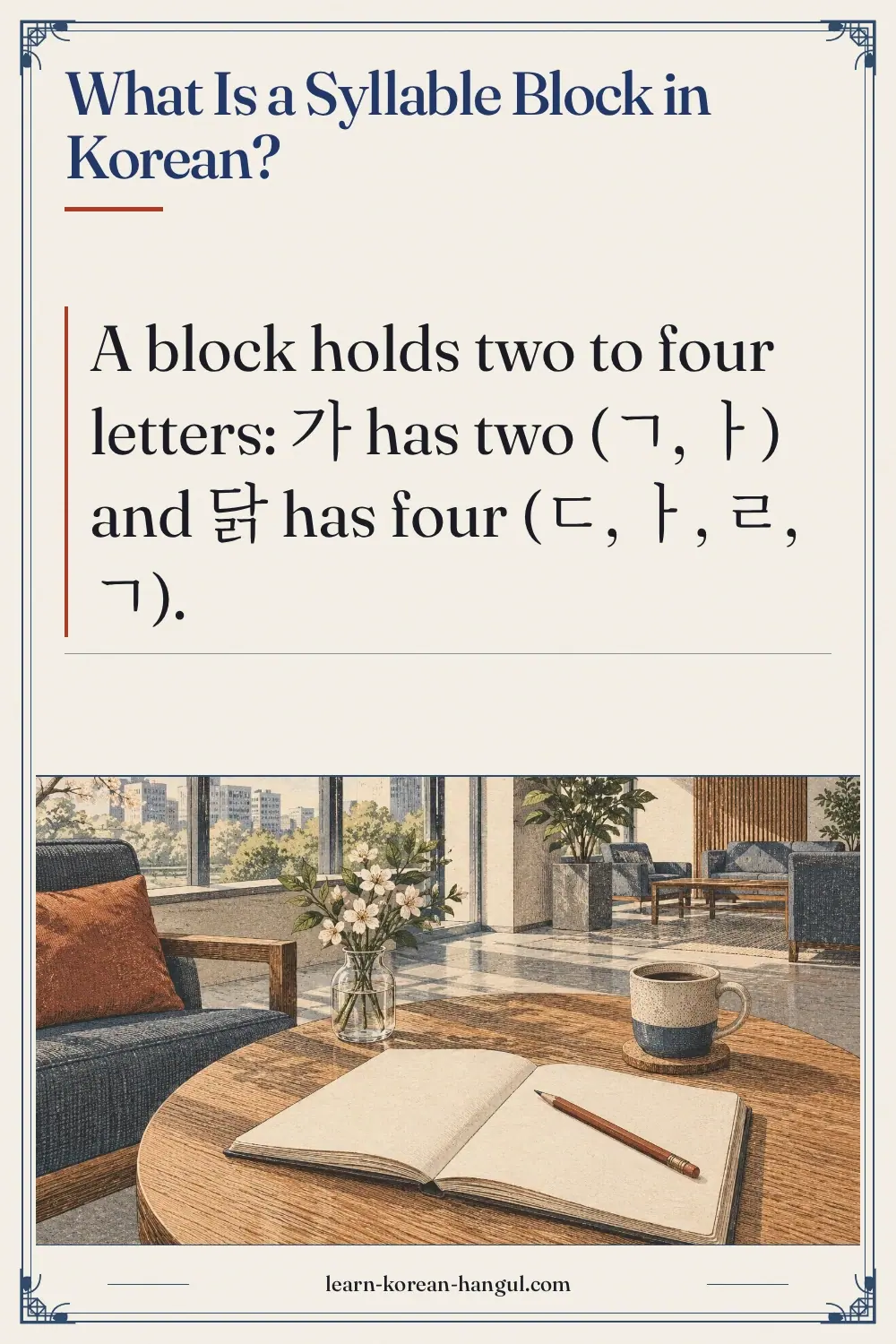
A block holds two to four letters in ordinary words, counting a compound vowel such as ㅘ or a doubled consonant such as ㄲ as one letter each. The block 닭 ("chicken") is the maximum shape, CVCC. It is spoken as [닥], one syllable.
The vowel decides the layout: vertical vowels sit to the right of the consonant, and horizontal vowels sit under it. See block shapes for all six layouts.
How Many Syllable Blocks Exist?
There are 11,172 possible modern Hangul syllable blocks, and only a few thousand are common in real text. The number comes from multiplying 19 initial consonants, 21 vowels and 28 final options (27 finals plus none). The Unicode Standard stores all 11,172 as separate characters. The older Korean standard KS X 1001 included just 2,350 of the most common blocks.
Why Does Korean Group Letters into Blocks?
Korean groups letters into blocks because the 1446 Hunminjeongeum required letters to be combined into syllables. Blocks make syllable boundaries easy to see, and their square shape fits beside Chinese characters, which Korean texts mixed with Hangul for centuries.
Syllable Block vs Syllabary Character
A syllable block is not the same as a syllabary character. A syllabary, such as Japanese kana, gives each syllable its own symbol that cannot be taken apart. A block is built from alphabet letters that you can take apart. Hangul is therefore an alphabet that is written in syllable-shaped groups, and not a syllabary.
| Feature | Hangul syllable block | Japanese kana character |
|---|---|---|
| Parts you can separate | yes: ㅅ + ㅏ in 사 | no: さ is one symbol |
| Writing system type | featural alphabet in blocks | syllabary |
The letters themselves are called jamo, and Hangul is described as a featural alphabet, because letter shapes encode sound features, such as the extra stroke that turns ㄱ into ㅋ.
Examples of Korean Syllable Blocks
Three blocks show the main shapes: 가 (ga), 강 (gang, "river") and 닭 (dak, "chicken"). 가 is the simplest shape, CV. 강 adds a final ㅇ, which sounds like "ng". 닭 has two final consonants. Every beginner block can be found in the syllable chart.
Is Every Korean Block One Word?
No. A block is one syllable, while a word can be one or many syllables. Learners often assume each block is a word, as with a Chinese character, but spaces in Korean separate words, not blocks. The word 나 "I" is one block, but 아버지 "father" is three blocks.
Related Hangul Terms
- Korean syllable blocks lesson: start the practice here.
- jamo: the letters inside each block.
- featural alphabet: why Hangul is not a syllabary.
- the six block shapes: the next step.
- the Hangul terms glossary: all related definitions.
Frequently Asked Questions
Do Koreans say 'syllable block'? No. "Syllable block" is a teaching term used in English. Koreans say 음절 (eumjeol) for the spoken unit and 글자 (geulja) for a written character. In everyday life, a character limit counts 글자, so one block is usually one 글자. English-language guides use "block" to describe how the letters are arranged.
Is 닭 one syllable? Yes. 닭 is one block and one syllable, even though it has four letters (ㄷ, ㅏ, ㄹ, ㄱ). It is pronounced [닥] when it stands alone, because the ㄹ of the final cluster ㄺ goes silent; before a vowel both are heard, as in 닭이 [달기]. One vowel always means one syllable, whatever the number of consonants around it.
Are syllable blocks the same as Chinese characters? No. A Chinese character stands for a morpheme, often a whole word or word part, and cannot be split into sounds. A Hangul block stands for one syllable and splits into letters for individual sounds. Blocks look similar in size, but they work as alphabet writing, not as logographic (word-based) writing.
Why are some blocks wide and others tall? The vowel decides the shape. Vertical vowels such as ㅏ put the consonant on the left, making the block wide, as in 가. Horizontal vowels such as ㅗ put the consonant on top, making it tall, as in 고. Final consonants add a bottom row. Fonts then scale every block into the same square.