
What Is Korean Syllable Structure?
Korean syllable structure is a fixed pattern in which each syllable has a vowel at its centre, with an optional consonant before it and an optional consonant after it. In spoken Korean, a syllable can be as small as one vowel (아) or as large as consonant, vowel and consonant (강). The written block adds one rule: the first slot is always filled.
Every written block has three slots:
- Initial consonant. The sound before the vowel. It is always written.
- Vowel. The core of the syllable. It is never missing.
- Final consonant (batchim). The sound after the vowel. It is optional.
For example, 강 (river) has ㄱ as the initial, ㅏ as the vowel and ㅇ as the final. The block 가 has only the first two. Linguists call these parts the onset, the nucleus and the coda.
The Initial Slot Is Never Empty
The initial slot is never empty in writing, because Hangul uses the silent consonant ㅇ as a placeholder. When a syllable starts with a vowel sound, the writer puts ㅇ in the first position so that every block has the same shape. So 아 is written ㅇ + ㅏ, and it sounds like "a". The same ㅇ at the bottom of a block sounds like "ng", as in 강.
The size of the full system follows from the slots: 19 initial consonants × 21 vowels × 28 final options (including none) give 11,172 possible blocks. You do not memorise them. You learn the six shapes. The next section shows them side by side.
The Six Block Shapes at a Glance
The six block shapes come from two choices: the orientation of the vowel (vertical, horizontal or mixed) and whether the block has a final consonant. This table is the quick reference.
| # | Shape | Vowel position | Example | Sound |
|---|---|---|---|---|
| 1 | Vertical vowel, no final | vowel to the right of the consonant | 가 | ga |
| 2 | Horizontal vowel, no final | vowel below the consonant | 고 | go |
| 3 | Mixed vowel, no final | vowel parts below and to the right | 과 | gwa |
| 4 | Vertical vowel + final | vowel right, final at the bottom | 각 | gak |
| 5 | Horizontal vowel + final | vowel below, final under it | 곡 | gok |
| 6 | Mixed vowel + final | vowel parts below and right, final at the bottom | 광 | gwang |
Every vowel belongs to exactly one group. Vertical vowels are ㅏ ㅐ ㅑ ㅒ ㅓ ㅔ ㅕ ㅖ ㅣ. Horizontal vowels are ㅗ ㅛ ㅜ ㅠ ㅡ. Mixed vowels are ㅘ ㅙ ㅚ ㅝ ㅞ ㅟ ㅢ. That makes 9, 5 and 7, which together are the 21 vowels. The three lessons below take each group in turn, and the Korean syllable blocks hub shows how this page fits into the larger course.
Vertical-Vowel Blocks
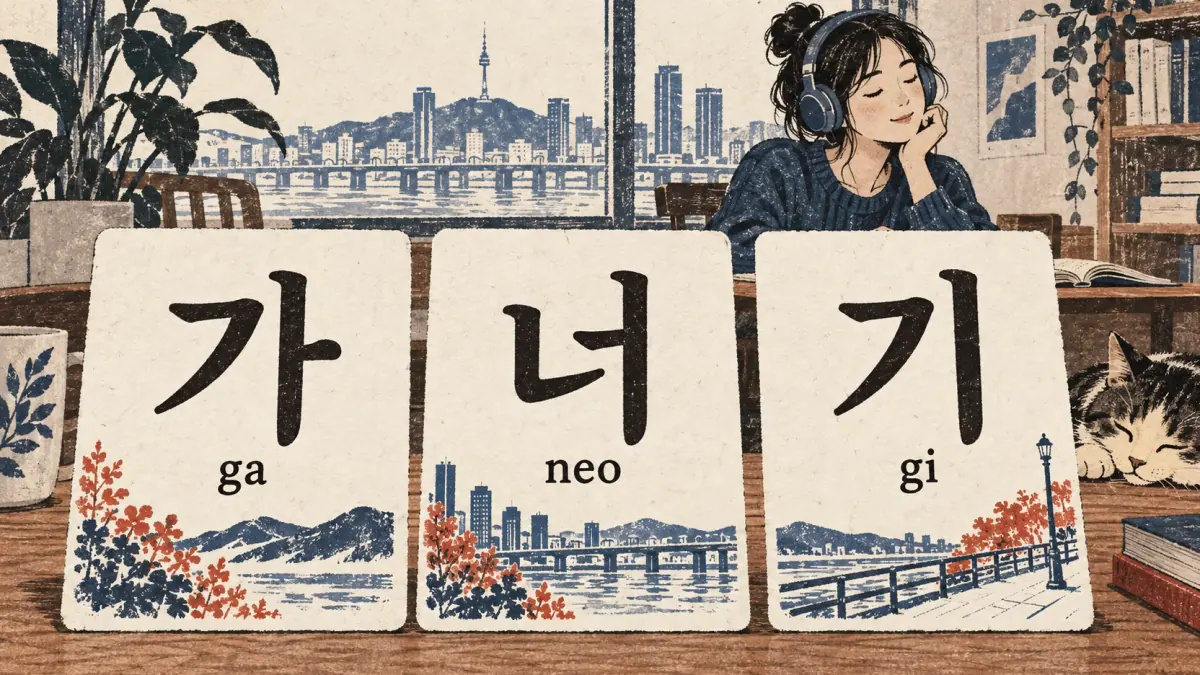
Vertical-vowel blocks put the vowel to the right of the initial consonant, as in 가 (ga), 너 (neo) and 기 (gi). The vowel is drawn as a tall vertical line, so the consonant takes the left side and is drawn tall and narrow. Nine of the 21 vowels are vertical, the largest of the three groups. The lesson on vertical-vowel blocks covers the nine vertical vowels and their stroke order.
Horizontal-Vowel Blocks

Horizontal-vowel blocks put the vowel below the initial consonant, as in 고 (go), 누 (nu) and 그 (geu). The vowel is drawn as a flat horizontal line, so the consonant sits on top and is drawn wide and short. The lesson on horizontal-vowel blocks covers the five horizontal vowels and how a final consonant fits underneath.
Mixed-Vowel Blocks

Mixed-vowel blocks use a vowel made of both a horizontal and a vertical part, as in 과 (gwa), 워 (wo) and 의 (ui). The horizontal part goes under the consonant, and the vertical part goes to the right. The lesson on mixed-vowel blocks covers the seven mixed vowels, including ㅢ.
Mixed vowels need their own layout because they cannot fit in either of the first two. ㅢ is ㅡ + ㅣ, so ㅡ goes under the consonant and ㅣ goes to the right. ㅘ is ㅗ + ㅏ with the same arrangement. Writers keep the whole block roughly square, so the three parts share the space.
Where Does the Final Consonant Go?
The final consonant always goes at the bottom of the block, under the vowel parts. It is called batchim (받침, "support") because it supports the block from below. The block 각 has ㄱ at the top left, ㅏ on the right and another ㄱ at the bottom. The same bottom slot appears in all three vowel types.
Two details matter:
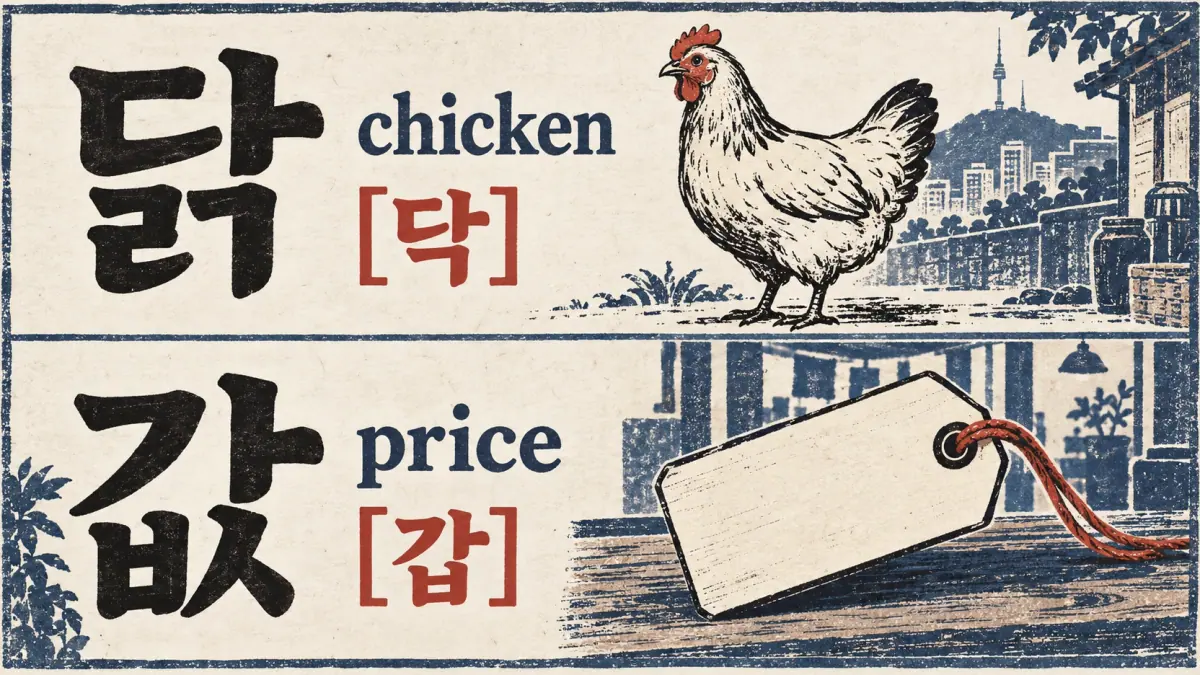
- The bottom slot can hold two letters. Spelling allows a pair of consonants in the final slot, as in 닭 (chicken) and 값 (price). Spoken Korean does not: 닭 is read [닥] and 값 is read [갑]. Spelling and speech are two layers.
- The final slot has its own limits. Of the 19 consonants, 16 can sit at the bottom (ㄸ, ㅃ and ㅉ never do), and all of them are said as one of seven sounds. The full list is in final consonants (batchim).
Once you know where the parts go, the next question is why they change their shape.
Why Do Letters Change Shape inside a Block?
Letters change shape inside a block because each one must fit the space left by the other parts while the block stays roughly square. A consonant before a vertical vowel is drawn tall and narrow. The same consonant before a horizontal vowel is drawn wide and short. When a final consonant is added, every part shrinks vertically to make room.
Take ㄱ as an example:
| Block | Layout | How ㄱ looks |
|---|---|---|
| 가 | vertical vowel | tall and narrow, on the left |
| 고 | horizontal vowel | wide and flat, on top |
| 각 | vertical vowel + final | shorter, with a second ㄱ below |
The letter is the same, and only the proportions change. Perfect proportions are not required for reading. If the right parts sit in the right places in a rough square, the block is readable. For stroke-by-stroke practice, see writing whole syllable blocks. With the shapes understood, the next step is to choose where to practise first.
Which Layout Should You Practise First?
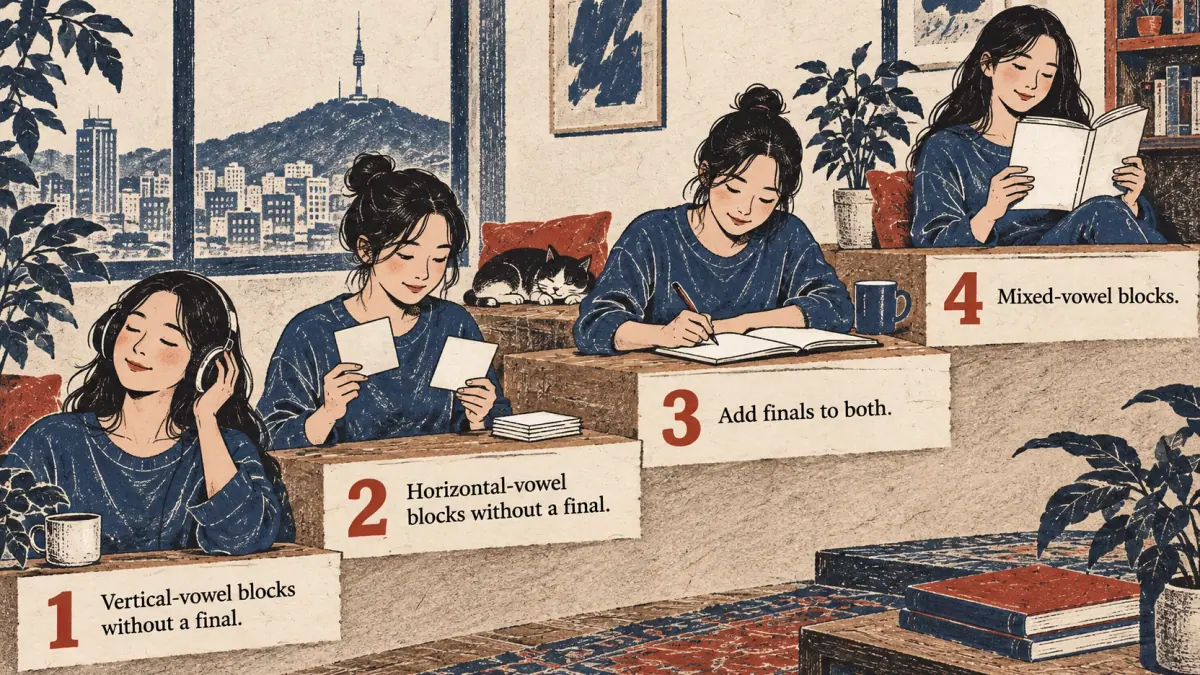
Practise vertical-vowel blocks first, then horizontal-vowel blocks, then mixed-vowel blocks, and add final consonants to each one as you go. This order starts with the largest vowel group and adds one new idea at each step.
- Vertical-vowel blocks without a final. Start with 가, 나, 다 and 마. The layout is the simplest.
- Horizontal-vowel blocks without a final. Move to 고, 노, 도 and 무.
- Add finals to both. Try 각, 간, 곡 and 곰.
- Mixed-vowel blocks. Finish with 과, 워 and 의 after the others feel easy.
The Hangul Syllable Builder gives instant feedback, and the Hangul worksheets have writing grids for paper practice.
Practice
Diagnostic: Sort 12 Blocks into the Six Shapes
Test yourself with this 12-block quiz. For each block, decide which of the six shapes it is, then check the answers. A score of 10 or more means you have the system.
Blocks: 1. 가 2. 소 3. 의 4. 각 5. 곰 6. 원 7. 기 8. 쉬 9. 눈 10. 밥 11. 으 12. 괜
Answers
| # | Block | Shape |
|---|---|---|
| 1 | 가 | vertical vowel, no final |
| 2 | 소 | horizontal vowel, no final |
| 3 | 의 | mixed vowel, no final |
| 4 | 각 | vertical vowel + final |
| 5 | 곰 | horizontal vowel + final |
| 6 | 원 | mixed vowel + final (ㅝ) |
| 7 | 기 | vertical vowel, no final |
| 8 | 쉬 | mixed vowel, no final (ㅟ) |
| 9 | 눈 | horizontal vowel + final |
| 10 | 밥 | vertical vowel + final |
| 11 | 으 | horizontal vowel, no final (ㅡ) |
| 12 | 괜 | mixed vowel + final (ㅙ) |
Common mistake: calling ㅡ a "no vowel" block because it looks like a flat line. It is a horizontal vowel, so 으 sits in shape 2.
Scope note: this page teaches the shapes and how they fit together. It does not teach the sounds of the final consonants or sound changes between blocks, which come next in the final consonants lesson. If you can name the six Korean syllable structure shapes and sort a new block into one of them, you have what you need for the child lessons.
Frequently Asked Questions
Is Korean Syllable Structure the Same as English?
No. English allows clusters of consonants at the start and end of a syllable, as in "strengths". Korean allows one consonant before the vowel and one after it. Longer English clusters are broken up with extra vowels when written in Hangul, which is why "stress" is written 스트레스 with four blocks.
Can a Block Have No Vowel?
No. Every Hangul block has a vowel, because the vowel is the core of a syllable. If a sound starts with a vowel, the block begins with the silent consonant ㅇ and then the vowel, as in 아. The consonant slot is always filled, and the vowel slot is never empty.
Why Do Some Blocks Look Taller than Others?
Blocks with a final consonant have three parts to fit, so each part is drawn smaller and the block can look taller or denser. Fonts balance the shapes to keep every block roughly square, but handwriting shows the difference more clearly, especially when a block has two consonants at the bottom.
Do I Need Perfect Proportions?
No. Readable proportions are enough: the right parts in the right places, in a roughly square block. Neat handwriting improves with practice, and reading does not depend on it. Focus first on putting each letter in the correct position, then on size and spacing, which come naturally with repetition.
Is ㅢ Vertical or Horizontal?
ㅢ is a mixed vowel. It combines the horizontal ㅡ and the vertical ㅣ, so ㅡ goes under the consonant and ㅣ goes to the right, as in 의. This is the same logic as 과, where ㅗ goes under the consonant and ㅏ goes to the right, and it is why mixed vowels need their own layout.