
What Are Korean Syllable Blocks?

Korean syllable blocks are groups of two to four Hangul letters written together in an imaginary square, with one block for each syllable. The word 한국 ("Korea") has two blocks. The first, 한, is built from ㅎ (h) + ㅏ (a) + ㄴ (n). The second, 국, is ㄱ (g) + ㅜ (u) + ㄱ (k).
A block is not a separate kind of character. It is ordinary letters, called jamo, arranged in a fixed pattern. Once you know the letters and the pattern, you can read any block, including ones you have never seen.
Why Does Hangul Group Letters into Blocks?
Hangul groups letters into blocks because King Sejong's 1446 design said letters must combine to make a syllable. Writing by syllable is often explained as a way to make Hangul sit evenly beside Chinese characters, which also fill a square. It also helps readers: each block is one syllable, so a reader sees syllable boundaries at a glance. For learners, the practical result is that every block has the same three slots.
The Three Parts of Every Block
Every Korean syllable block has three slots, filled in this order:
- Initial consonant (top or left): always present. Example: ㅎ in 한.
- Vowel (right of or below the initial): always present. Example: ㅏ in 한.
- Final consonant (bottom): optional. Example: ㄴ in 한. Korean calls it 받침 (batchim), "support".
Linguists call these three positions choseong, jungseong and jongseong: first sound, middle sound and final sound. In English phonetics they match onset, nucleus and coda.
What Fills the Empty First Position?
The silent letter ㅇ fills the first position when a syllable starts with a vowel. A vowel cannot stand alone in a block, so 아 (a) is written ㅇ + ㅏ, and 오 (o) is ㅇ + ㅗ. The letter ㅇ has a second job: at the bottom of a block it sounds like the ng in "sing", as in 강 (gang).
With three slots defined, the next question is where they go on the page, and that depends on the vowel.
Block Shapes: Vertical, Horizontal and Mixed
Block shape is set by the vowel. Vertical vowels, which have a long upright stroke such as ㅏ or ㅣ, sit to the right of the initial consonant: 가. Horizontal vowels, with a long flat stroke such as ㅗ or ㅡ, sit below it: 고. Mixed vowels combine both, wrapping below and to the right: 과.
The six syllable block shapes are taught one layout at a time in their own section, which teaches you to classify any block and write it with the right proportions. It has three lessons:
- Vertical-vowel blocks such as 가, 너 and 기: consonant left, vowel right. You read and write 20 of these syllables.
- Horizontal-vowel blocks such as 고, 누 and 그: consonant on top, vowel underneath.
- Mixed-vowel blocks such as 과, 워 and 의: the vowel wraps around the consonant.
Each of those three shapes can also take a consonant at the bottom, which doubles the count to six.
Final Consonants (batchim) in Blocks
A final consonant, or batchim, always sits at the bottom of the block, under everything else. 가 becomes 각, 고 becomes 곡, and 과 becomes 곽. The top part shrinks to make room, but the order of the letters never changes.
Adding a bottom consonant is covered in batchim (final consonants) in blocks, which shows which letters can go there and why 16 written finals collapse into just 7 sounds. Its follow-up lesson on double and cluster batchim covers blocks with two final letters, such as 읽 and 닭. Why a final consonant moves to the next block in speech is explained in Korean liaison. Whatever the layout, the reading order is fixed.
Reading Order inside a Block
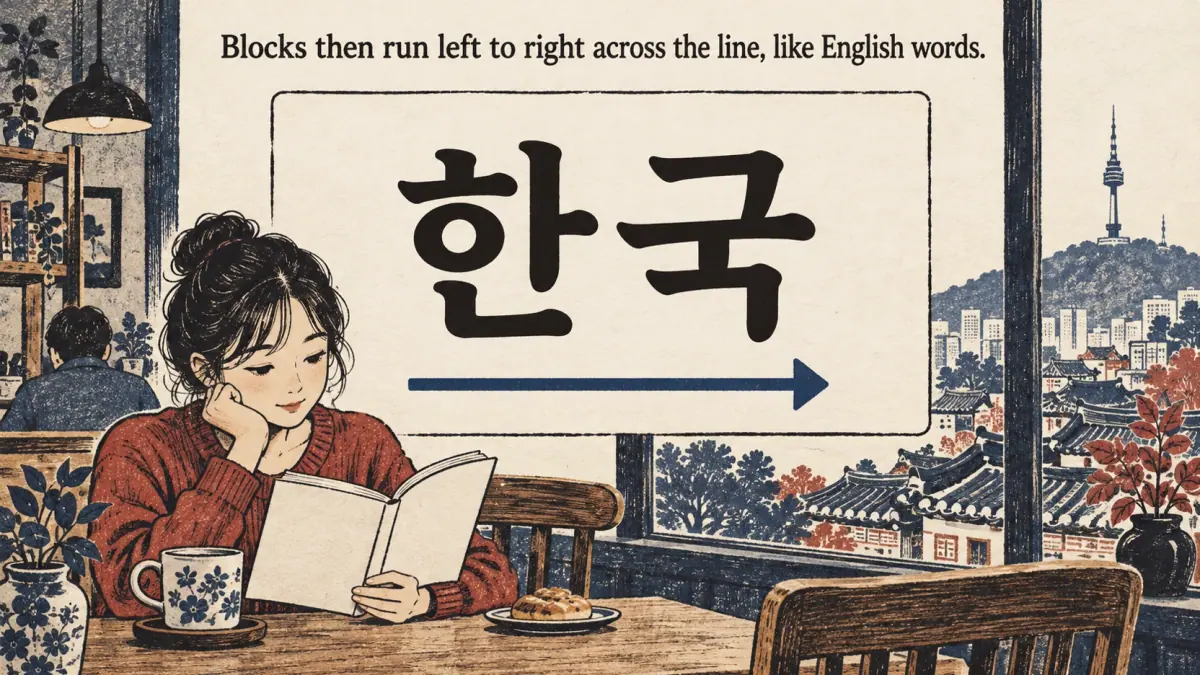
Read each block in the order it was built: initial consonant, then vowel, then final consonant. In practice that means left to right, then top to bottom.
- Find the initial consonant at the top or top left: ㄱ in 곽.
- Read the vowel to its right, below it or both: ㅘ (wa).
- Read the final consonant at the bottom: ㄱ (k). Result: gwak.
Blocks then run left to right across the line, like English words. The order of reading never depends on size: in a cramped block like 뷁, the same three steps still work. The bigger number to keep in mind is how many blocks this system can make.
How Many Syllable Blocks Exist?
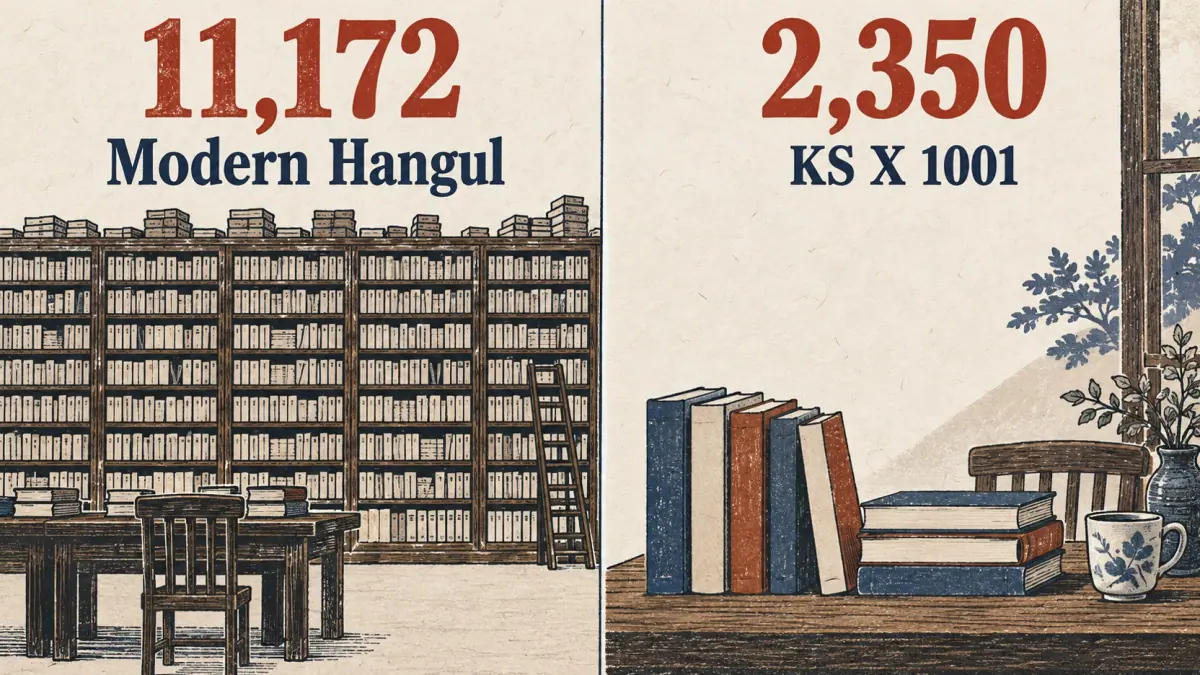
Modern Hangul can form 11,172 syllable blocks, the number Unicode encodes: 19 initial consonants × 21 vowels × 28 final options (27 final consonants plus "no final"). The figure comes from how Hangul is encoded in Unicode, which stores every possible modern block as a single character.
Real Korean uses far fewer. The South Korean standard character set KS X 1001 includes 2,350 common blocks, and everyday text uses a smaller set still. You never memorise blocks one by one. You learn about 40 letters and six layouts, and the 11,172 blocks follow from them.
Where Should You Start with Syllable Blocks?
Start with the block shapes, then add final consonants. The right first step depends on what you already know.
- You know no Hangul letters yet. Learn a few consonants and vowels first from the Korean alphabet hub, then come back.
- You know the letters but cannot combine them. Start with the six syllable block shapes, beginning with vertical vowels.
- You can read 가 and 고 but not 각 or 곡. Go straight to batchim in blocks.
- You can read blocks but say them wrongly in words. The issue is sound change, not blocks; see Korean liaison.
- You want hands-on practice now. Build blocks in the Hangul Syllable Builder, which gives instant feedback, and review with the Hangul flashcard decks.
Practice
The Six Layouts Compared
| Layout | Vowel type | Final consonant | Example | Where the letters sit |
|---|---|---|---|---|
| 1 | Vertical | None | 가 (ga) | Consonant left, vowel right |
| 2 | Horizontal | None | 고 (go) | Consonant top, vowel below |
| 3 | Mixed | None | 과 (gwa) | Consonant top left, vowel below and right |
| 4 | Vertical | Yes | 각 (gak) | Layout 1 on top, final below |
| 5 | Horizontal | Yes | 곡 (gok) | Layout 2 on top, final below |
| 6 | Mixed | Yes | 곽 (gwak) | Layout 3 on top, final below |
Practice: Take Five Blocks Apart
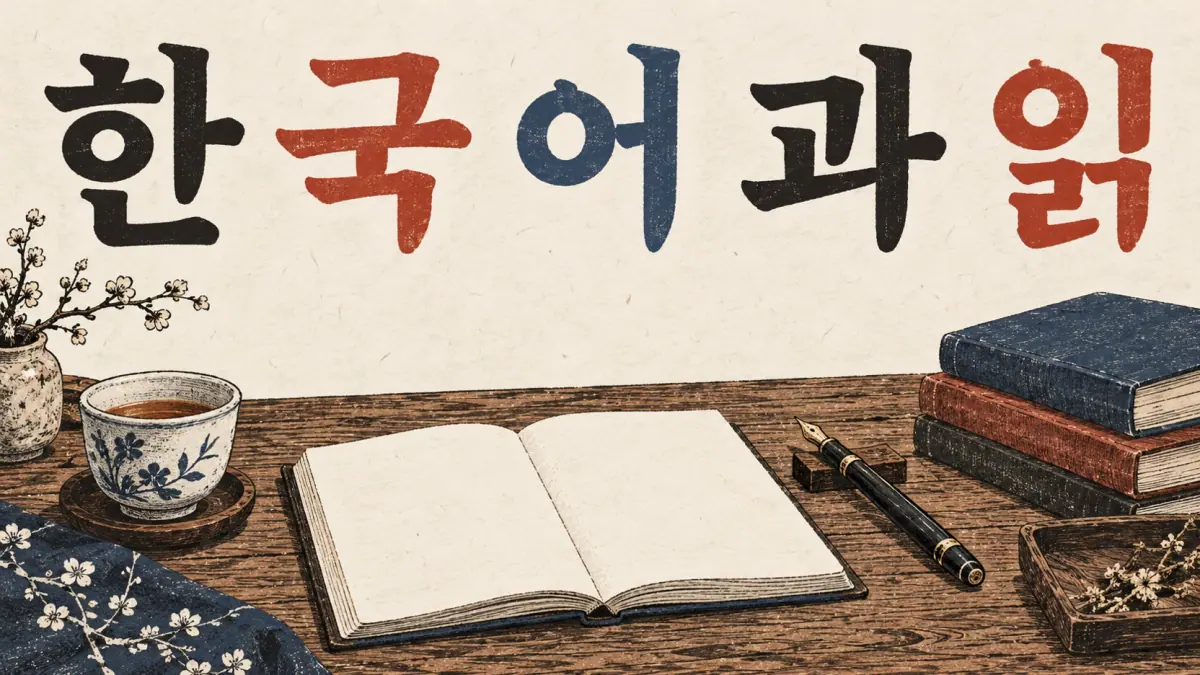
Split each block into its letters and name the layout. Answers follow.
- 한
- 국
- 어
- 과
- 읽
Answers: 1 ㅎ + ㅏ + ㄴ, layout 4. 2 ㄱ + ㅜ + ㄱ, layout 5. 3 ㅇ (silent) + ㅓ, layout 1. 4 ㄱ + ㅘ, layout 3. 5 ㅇ (silent) + ㅣ + ㄺ (a two-letter final), layout 4.
This hub covers how Korean syllable blocks are built and read. It does not teach how blocks change sound when they meet in words; that belongs to the pronunciation lessons.
Frequently Asked Questions
Can a block have two vowels? A block has one vowel slot, but that slot can hold a combined vowel made of two basic vowel shapes, such as ㅘ (ㅗ + ㅏ) in 과 or ㅝ (ㅜ + ㅓ) in 워. Korean treats each combined vowel as one vowel sound. Two separate vowel sounds always need two blocks, as in 아이 (ai, child).
Is Korean written left to right? Modern Korean is written left to right in horizontal lines, block after block, like English. Inside each block you also read left to right, then top to bottom. Older books and some signs use vertical columns read top to bottom, right to left, but the blocks themselves are built the same way.
Do all 11,172 blocks appear in real words? No. The 11,172 figure counts every mathematically possible modern combination. Many, such as 뷁, almost never appear in real words. The South Korean standard character set KS X 1001 includes 2,350 common blocks, and everyday text uses a smaller set still. You learn the system, not a list of blocks.
Is every block one beat when spoken? Each block is one written syllable and is usually one beat in speech. The boundaries can shift, though. In 음악 (music), the final ㅁ of the first block is pronounced at the start of the second, giving [으막]. This sound change is called liaison and is taught with pronunciation.
Can I build blocks on a keyboard automatically? Yes. Korean keyboards and phone keypads assemble blocks for you. On the standard two-set layout you type the letters in order, for example ㅎ, ㅏ, ㄴ, and the software combines them into 한. If the next letter is a vowel, the software moves the last consonant to start a new block.
Korean Syllable Blocks in One Sentence
Korean syllable blocks put an initial consonant, a vowel and an optional final consonant into one square, in one of six layouts set by the vowel's shape. Learn the shapes first, then batchim, and every one of the 11,172 blocks becomes readable.