여보세요? / 여보세요? 현우 씨, 저 수아예요. 지금 통화 괜찮아요? / 아, 수아 씨! 네, 괜찮아요. 무슨 일이에요? / 내일 시간 있어요? / 내일 오후에는 시간이 있어요. 왜요? / 같이 영화 볼까요? / 좋아요. 몇 시에 만날까요? / 그럼 일곱 시에 만나요. 극장 앞에서요. / 알겠어요. 일곱 시요, 극장 앞이요. 그때 봐요. / 네, 내일 봐요. 끊을게요.
What you'll learn
- State the day, the time and the plan after hearing the call.
- Know why 여보세요 is used only on the phone.
- Hear 일곱 시에 and 몇 시에 with their tense ㅅ.
- Suggest a plan with -ㄹ까요? and end a call with 끊을게요.
Before you start: you need to read Hangul and know the native numbers up to ten. Time: about 20 minutes. Level: A2. The transcript stays hidden until you have listened once.
Key facts
- The call ends with a short polite goodbye: 내일 봐요, 끊을게요.
What Is a Korean Phone Call Dialogue?
A Korean phone call dialogue is a spoken exchange between two people who cannot see each other, written out with questions that check what you understood. This one is a friendly call that ends with a plan, so it holds a greeting, a request, a suggestion and a confirmation.
The listening goal is different from face-to-face practice. On the phone you have no gestures, so you must catch the times and places by ear, and speakers repeat them back to be sure. The phrases are in Korean phone phrases, and the clock words are in telling time in Korean.
First, see what makes a phone call hard to follow by ear.
What Makes This Dialogue Hard to Follow by Ear?
On a phone, a weak signal clips the short words first, and numbers and times are the most likely to be lost. In Korean the time word 시 also changes its sound, so 일곱 시 and 몇 시 sound like a single string. That is why Hyeonu repeats 일곱 시요 in line 9.
| What you see | What you hear | Where learners slip |
|---|---|---|
| 괜찮아요 | [괜차나요] | The ㅎ in ㄶ is silent before a vowel |
| 몇 시에 | [멷씨에] | ㅊ is said as ㄷ, and the ㅅ of 시 is tense |
| 일곱 시에 | [일곱씨에] | The ㅅ of 시 is tense after the stop ㅂ |
| 끊을게요 | [끄늘께요] | ㅎ is silent and ㄴ links to the next block |
The first and fourth rows are liaison (연음) with silent ㅎ, and the second and third are tensification (된소리되기) after a stop. All are covered by the standard pronunciation rules (표준 발음법) of the National Institute of Korean Language (국립국어원). The fifth thing to notice is the added ㄴ in 무슨 일이에요, which is heard as [무슨 니리에요].
Next is the routine.
How Does the Dialogue Practice Work?
Two listens come before any reading.
- Listen once at normal speed. Do not pause. Write the day and the time as digits.
- Listen again slowly. Replay any line you missed up to three times.
- Open the transcript. Compare it with your notes.
- Replay the marked lines. Then play the whole dialogue once more.
You will know it worked when you can say the plan in English without looking: tomorrow, seven o'clock, a film. The usual mistake is to catch the question 몇 시에 and miss the answer 일곱 시에. If a clip is too fast even when slow, understand spoken Korean shows how to find your bottleneck.
Begin with the gist.
First Listen: the Gist
Play the audio once. Answer in English.
- Why does Sua call Hyeonu?
- Do they agree on a plan?
Gist means the overall outcome. Replay the clip if you are not sure, then move on.
The second listen focuses on the details.
Second Listen: the Details
Play the slow version and answer.
- When is Hyeonu free?
- What time do they agree to meet?
- Where do they meet?
- What does Sua say to end the call?
여보세요? / 여보세요? 현우 씨, 저 수아예요. 지금 통화 괜찮아요? / 아, 수아 씨! 네, 괜찮아요. 무슨 일이에요? / 내일 시간 있어요? / 내일 오후에는 시간이 있어요. 왜요? / 같이 영화 볼까요? / 좋아요. 몇 시에 만날까요? / 그럼 일곱 시에 만나요. 극장 앞에서요. / 알겠어요. 일곱 시요, 극장 앞이요. 그때 봐요. / 네, 내일 봐요. 끊을게요.
If question 4 was hard, listen for 일곱 in lines 8 and 9. Hyeonu repeats it to confirm.
Transcript, Translation and Key
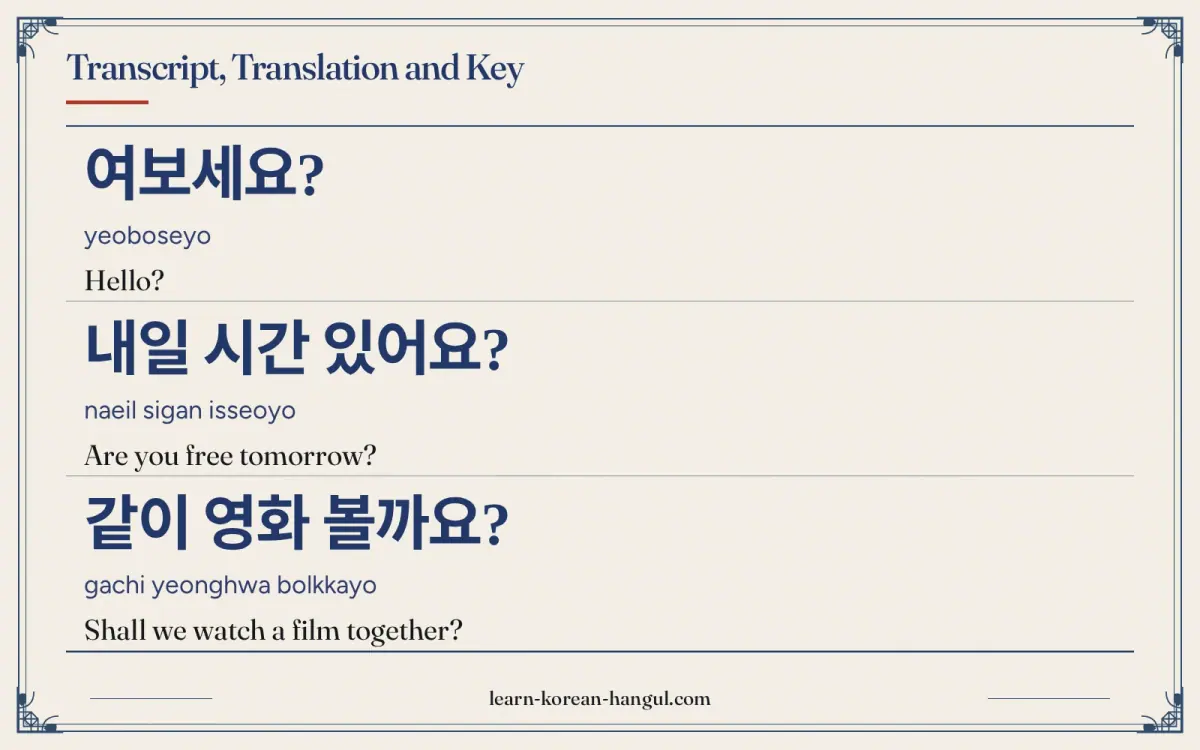
Read the transcript after both listens. Each line has its own clip.
A Phone Call to Arrange a Film
Hyeonu
여보세요?
yeoboseyo
Hello?
Sua
여보세요? 현우 씨, 저 수아예요. 지금 통화 괜찮아요?
yeoboseyo? Hyeonu ssi, jeo Suayeyo. jigeum tonghwa gwaenchanayo
Hello? Hyeonu, it is Sua. Is it all right to talk now?
Hyeonu
아, 수아 씨! 네, 괜찮아요. 무슨 일이에요?
a, Sua ssi! ne, gwaenchanayo. museun irieyo
Oh, Sua! Yes, it is fine. What is it?
Sua
내일 시간 있어요?
naeil sigan isseoyo
Are you free tomorrow?
Hyeonu
내일 오후에는 시간이 있어요. 왜요?
naeil ohueneun sigani isseoyo. waeyo
I am free tomorrow afternoon. Why?
Sua
같이 영화 볼까요?
gachi yeonghwa bolkkayo
Shall we watch a film together?
Hyeonu
좋아요. 몇 시에 만날까요?
joayo. myeot sie mannalkkayo
Sounds good. What time shall we meet?
Sua
그럼 일곱 시에 만나요. 극장 앞에서요.
geureom ilgop sie mannayo. geukjang apeseoyo
Then let us meet at seven. In front of the cinema.
Hyeonu
알겠어요. 일곱 시요, 극장 앞이요. 그때 봐요.
algesseoyo. ilgop siyo, geukjang apiyo. geuttae bwayo
Got it. Seven o'clock, in front of the cinema. See you then.
Sua
네, 내일 봐요. 끊을게요.
ne, naeil bwayo. kkeuneulgeyo
Yes, see you tomorrow. I will hang up now.
Answer key
- To ask whether Hyeonu is free tomorrow (and to suggest a film).
- Yes. They agree to meet and watch a film.
- Tomorrow afternoon (내일 오후).
- Seven o'clock (일곱 시).
- In front of the cinema (극장 앞).
- 내일 봐요 and 끊을게요, "See you tomorrow" and "I will hang up now".
Line-by-Line Notes
- Line 1, 여보세요? The word to answer the phone. It carries a rising question tone because the speaker is checking that the line works.
- Line 2, 저 수아예요. 저 is the humble "I" and 예요 is the polite "am". It is the usual way to say who is calling.
- Line 2, 통화. A "phone call". 지금 통화 괜찮아요? asks if this is a good time to talk.
- Line 3, 무슨 일이에요? Literally "what matter is it?". It is a polite way to ask why someone called.
- Line 6, 볼까요? 보다 plus -ㄹ까요 makes a suggestion: "shall we watch?".
- Line 10, 끊을게요. 끊다 means to cut or hang up. -ㄹ게요 is a promise: "I will hang up".
The sound changes in these lines are next.
Which Sound Changes Are Hidden in the Dialogue?
Four written forms sound different from their spelling, and 무슨 일이에요 has one more. Play each one alone.
In 몇 시에 the final ㅊ is said as ㄷ, and the ㅅ that follows is tense, so you hear [멷씨에], not [며 시에]. In 괜찮아요 and 끊을게요 the ㅎ falls silent before a vowel, and the other consonant links to the next block. In 무슨 일이에요, a ㄴ is added before 일 and joins the ㄴ of 슨, so you hear [무슨 니리에요]. These rules are regular, so they help even with new words.
Next, the opener of the call gets a worked example.
Worked Example: 여보세요?
여보세요 is the first word of almost every phone call, and it has a job that 안녕하세요 does not have.
여보세요?
yeoboseyo
Hello? (on the phone)
- Answer with 여보세요. The person who picks up says it first. The caller says it back.
- Name yourself. The caller adds 저 수아예요, "It is Sua".
- Check the moment. 지금 통화 괜찮아요? shows courtesy before the real topic.
Compare it with the usual greeting.
안녕하세요 is the all-purpose greeting for meeting someone. On a personal call, 여보세요 is the opener that signals "I can hear you; are you there?". Now hear the request itself.
내일 시간 있어요?
naeil sigan isseoyo
Are you free tomorrow?
- Name the day. 내일 is "tomorrow".
- Ask about time. 시간 있어요? is literally "do you have time?". A yes/no question like this usually ends with a rise.
The next step is to ask when.
몇 시에 만날까요?
myeot sie mannalkkayo
What time shall we meet?
- Pick the question word. 몇 시 is "what time?". With the question word, the pitch is not a sharp rise.
- Add the suggestion. 만날까요 is 만나다 plus -ㄹ까요, "shall we meet?".
Finally, confirm what you heard.
일곱 시요, 극장 앞이요.
ilgop siyo, geukjang apiyo
Seven o'clock, in front of the cinema.
- Repeat with 요. Adding 요 to each noun repeats the key facts back politely. It is the best habit on a poor line.
Learners often skip that last step, so the next section lists the usual slips.
What Mistakes Do Learners Make Here?
Learners often assume that 여보세요 is just "hello" for any situation. Actually, it belongs to the phone, and it can sound sharp if you use it to call out to someone in person. Four slips are common.
- Using 여보세요 face to face. Use 안녕하세요 to greet someone you meet. In person, 여보세요 sounds like a sharp call for attention.
- Hearing 몇 시 as [며 시]. The ㅊ becomes a ㄷ sound and the 시 is tense: [멷씨].
- Using native and Sino-Korean numbers the wrong way. Clock hours use native numbers (일곱 시), while minutes use Sino-Korean numbers (오 분).
- Not confirming the time. On the phone, repeat the time and place with 요, as in line 9.
Test these in the practice set below.
Practice and Answer Key
- What do you say when you pick up the phone?
- How do you ask "Are you free tomorrow?"
- Write the sentence "Let us meet at eight".
- What does 끊을게요 tell the other person?
Answers
- 여보세요.
- 내일 시간 있어요?
- 여덟 시에 만나요.
- That you are about to hang up.
Where to Go Next
Play the dialogue again tomorrow, hide the transcript and write the plan. When it feels easy, continue with Korean restaurant dialogue audio, which moves from a plan to a table. The suggestion ending is explained in Korean let's grammar. All dialogues are listed in Korean audio dialogues.
What this page does not cover. It does not cover formal business calls, voicemail or text messages. Close friends often drop the 요 endings, and the two speakers here keep them.
Return to this Korean phone call dialogue when you want to check that you still hear the time word clearly.
Frequently Asked Questions
When do I say 여보세요?
Say 여보세요 (yeoboseyo) when you answer a phone call or start one. It means "hello" on the phone only. When you meet someone in person, use 안녕하세요 instead, because 여보세요 face to face sounds like a sharp call for attention. Business lines often start with the company name and 안녕하세요.
How does the caller fix the time in the call?
The caller asks the question 몇 시에 만날까요? (what time shall we meet?) or proposes a time with 일곱 시에 만나요. The listener then repeats it with 요, as in 일곱 시요, to confirm. Clock hours use native numbers (일곱 = seven) and 시, and a place follows with 에서 or 앞에서.
What does 그럼 mean?
그럼 (geureom) means "then" or "in that case". Speakers use it to move from what was just said to a decision, as in 그럼 일곱 시에 만나요, "Then let us meet at seven". It is short for 그러면, and both are common in speech.
How do I end a call politely?
Say the plan once more, then a closing line such as 내일 봐요 (see you tomorrow) and 끊을게요 (I will hang up). On a formal call, add 안녕히 계세요. Between friends, you can also say 들어가세요 or just 그럼 끊을게요. Say goodbye before you hang up.