
At a glance
- Hour: native number + 시 (한 시, 두 시, 세 시).
- Minute: Sino-Korean number + 분 (오 분, 십오 분, 삼십 분).
- AM and PM: 오전 and 오후 go before the time.
- Half past is 반. Exactly on the hour is 정각.
- Duration uses 시간, not 시. See the time counters section.
Telling Time in Korean: the Essentials
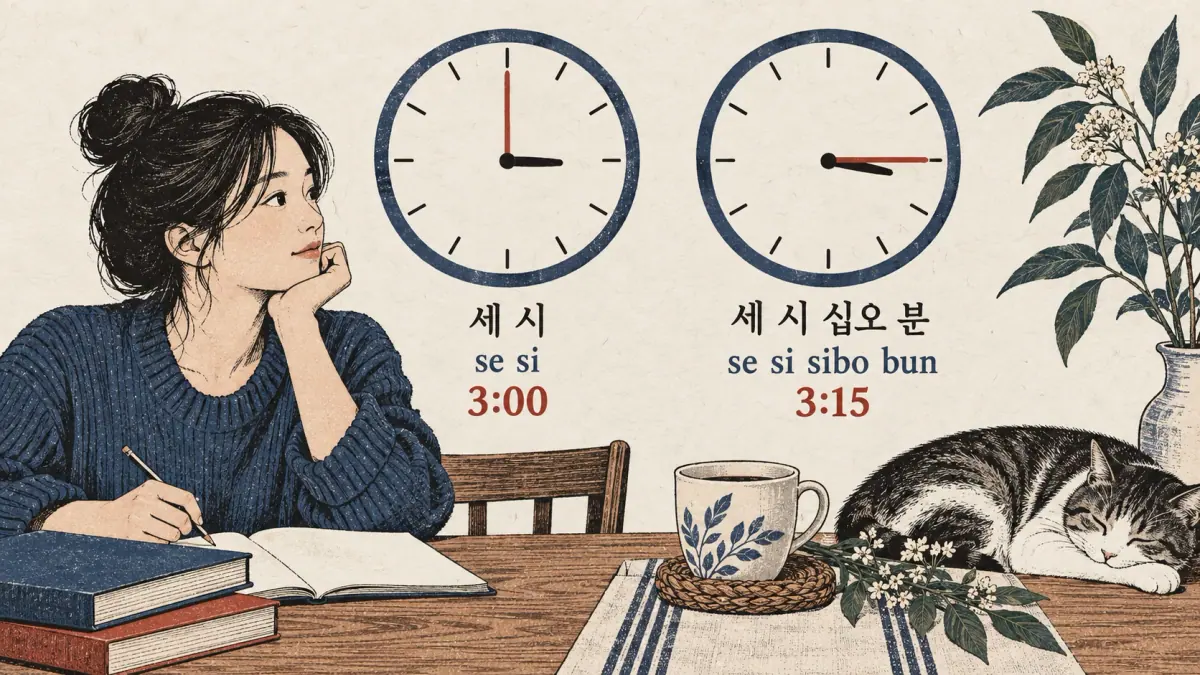
Telling time in Korean follows one formula: native number + 시 + Sino-Korean number + 분. The word 시 (si) names the hour, and the word 분 (bun) names the minute. Both are counters, short words that attach to a number and say what the number measures.
| Clock time | Formula | Korean | Reading aid |
|---|---|---|---|
| 3:00 | hour only | 세 시 | se si |
| 3:15 | hour + minute | 세 시 십오 분 | se si sibo bun |
| 3:30 | hour + 반 | 세 시 반 | se si ban |
| 3:45 | hour + minute | 세 시 사십오 분 | se si sasibo bun |
| 3:00 sharp | hour + 정각 | 세 시 정각 | se si jeonggak |
| 3:15 PM | day part first | 오후 세 시 십오 분 | ohu se si sibo bun |
Here is the example from the table at normal speed.
The hour uses the short native forms 한, 두, 세, 네 and then 다섯 up to 열두. The minutes use the Sino-Korean numbers you will find in the Sino-Korean numbers 1-100 list. If the idea of two number systems is new, read Sino vs native Korean numbers first, then come back here.
The rest of this page shows you which lesson to open next, starting with the question that every beginner asks.
What English Phrases Map to Korean?

Most English clock phrases have a direct Korean match, and only "quarter" has no special word. Use this map when you know the English phrase and need the Korean one.
| English | Korean | Note |
|---|---|---|
| It's 3 o'clock | 세 시예요 | 시 + 예요 after a vowel |
| 3 o'clock sharp | 세 시 정각이에요 | 정각 means exactly on the hour |
| Half past three | 세 시 반이에요 | 반 means half |
| Quarter past three | 세 시 십오 분이에요 | no word for quarter, so use 15 minutes |
| Five to three | 세 시 오 분 전이에요 | 전 means before |
| About three | 세 시쯤이에요 | 쯤 means about |
| 3 PM | 오후 세 시예요 | 오후 goes before the hour |
| 9 AM | 오전 아홉 시예요 | 오전 goes before the hour |
Notice that AM and PM come first in Korean, while English puts them last. The pattern is the same for every row: the day part leads, then the hour, then the minute. With the map in your head, the next question is which lesson teaches each part.
What Pages Are in This Section?

This section has four lessons and one phrase page. Each card below says what the page teaches and what you can do afterwards.
Core How-To
How to Tell Time in Korean: Hours and Minutes in 4 Steps is the page to open first. It teaches the full method in four steps: say the hour, add the minutes, mark AM or PM, and say "at" with 에. After it you can say any clock time, such as 3:15 or 11:45, and answer 지금 몇 시예요? (What time is it now?).
Hours, Minutes, AM/PM
Korean Counter Si (시): Saying the Hour With Native Numbers lists all 12 hours with audio, including the shortened forms in 열한 시 and 열두 시. It also separates 시 (a point on the clock) from 시간 (a length of time).
Minutes Counter in Korean: 분 (bun) and 초 (cho) Explained teaches 5, 10, 15, 30 and 45 minutes with Sino-Korean numbers, then seconds with 초, and how to say how long something takes.
How to Say PM in Korean: 오후, 오전, 반 and 정각 covers the day parts (아침, 낮, 저녁, 밤), noon, midnight, half past, and the words 전 and 후 for before and after.
Asking the Time
The phrase page on what time is it in Korean teaches the question 지금 몇 시예요? and its polite and casual variants. The how-to lesson above also practises the question inside a short dialogue.
The five pages cover every part of the formula. Next, a suggested order makes the path clear.
In What Order Should You Learn Telling Time?
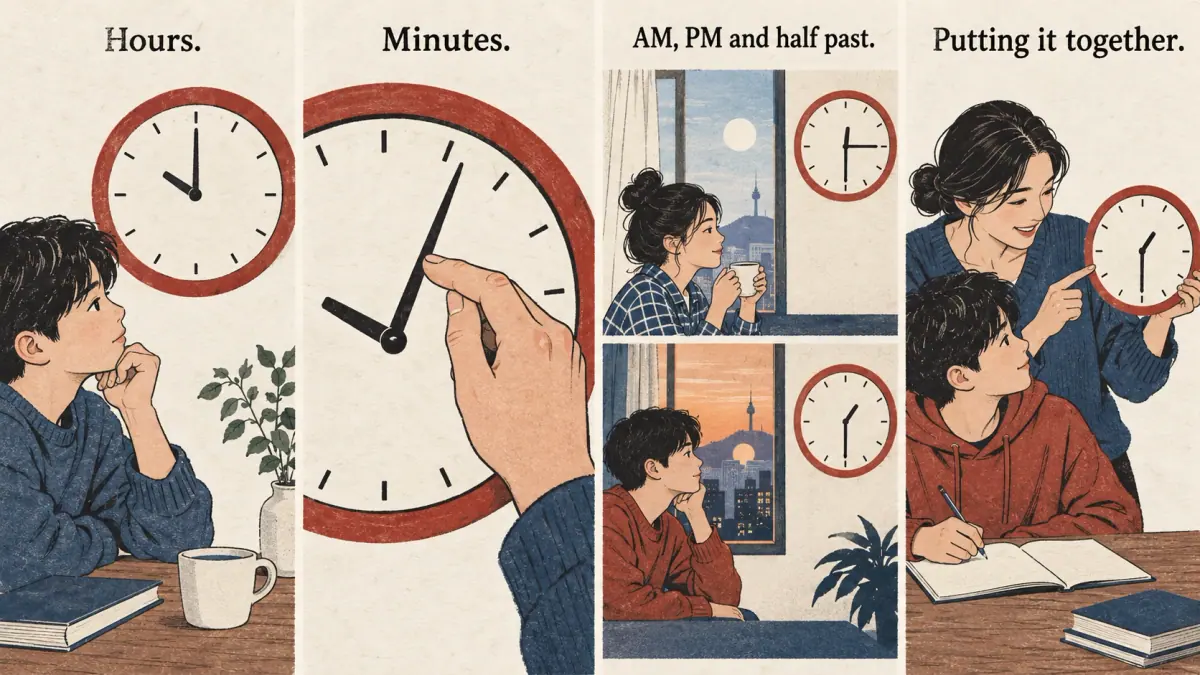
Learn telling time in five steps, moving from the most common pattern to the least common. The order below follows how often each skill appears in real conversations.
- Hours. Learn 한 시 to 열두 시 in the hour lesson. These twelve phrases carry most of what you will say.
- Minutes. Learn 십 분, 십오 분, 삼십 분 and 사십오 분 in the minutes lesson.
- AM, PM and half past. Add 오전, 오후 and 반 from the AM and PM lesson.
- Putting it together. Practise full times and the 에 particle in the four-step how-to.
- Durations. Move to the 시간 counter to say "two hours" instead of "two o'clock".
If you already know native numbers 1 to 12 and Sino-Korean numbers up to 60, start at step 4. Otherwise, begin at step 1. The how-to lesson ties steps 1 to 3 together.
The order above handles the clock. Some time topics sit elsewhere on the site, and the next section lists them.
What Is Not Covered Here?
This section covers clock time and the words that go with it: hours, minutes, seconds, AM, PM, half past and asking the time. It does not cover everything about time in Korean. Use these pages for the other topics:
- Durations such as two hours or three days are in Time Counters, starting with the 시간 counter.
- Dates, days of the month and years are in Dates in Korean.
- Words such as today, tomorrow and now are in Korean time expressions.
- The 24-hour clock read aloud is not taught here, because daily speech uses the 12-hour clock with 오전 and 오후.
Honest limit: the lessons teach standard spoken Korean as it is usually taught to learners. Real speakers shorten phrases in casual talk, for example by dropping 오전 or 오후 when the context is clear, and regional habits vary. A Korean teacher or the audio on each page will show you the natural rhythm.
Your next move depends on how much you already know. If you want the whole method in one sitting, open the how-to lesson. If you want to drill the hours, open the 시 lesson. Either path teaches you telling time in Korean in small, testable steps.
Frequently Asked Questions
Why are two number systems used in one time phrase?
Korean treats the hour and the minute as two different kinds of number. The hour counts a position on the clock face with native numbers and 시, while the minute labels a measured unit with Sino-Korean numbers and 분. So 3:15 is 세 시 십오 분, with one number from each system.
How do I say 12 o'clock in Korean?
Say 열두 시 (yeoldu si) for 12 o'clock. To avoid confusion between noon and midnight, add a day part: 낮 열두 시 or 정오 for noon, and 밤 열두 시 or 자정 for midnight. The lesson on AM, PM and half past explains when each choice sounds natural.
Do Koreans use 24-hour time?
In everyday speech Koreans almost always use the 12-hour clock with 오전 or 오후, as in 오후 세 시. Written timetables, tickets and some schedules show 24-hour times such as 15:00. This section teaches the spoken 12-hour system first because it covers nearly every conversation.
How do I say quarter past in Korean?
Korean has no common word for quarter, so say the minutes: 세 시 십오 분 for quarter past three and 세 시 사십오 분 for quarter to four. Half past has its own word, 반, as in 세 시 반. Learn 십오 분, 삼십 분 and 사십오 분 first.
Can I use native numbers for minutes?
No. Minutes always take Sino-Korean numbers with 분: 십 분, 이십 분, 삼십 분. Saying 열 분 or 세 분 sounds wrong, and 세 분 means three respected people. Keep native numbers for the hour only, and use Sino-Korean numbers for everything after 시.