What you will learn
- Spell at least 26 of 30 common final-consonant words from audio.
- Use the suffix test to find the real final letter.
- Tell 낫, 낮 and 낯 apart in writing.
- Write double finals such as 읽 and 밖 correctly.
Before you start: finish Korean Syllable Dictation and read about the seven final sounds. Time: about 30 minutes with audio.
Key Facts
- The set has 30 words, and 26 correct is the target.
- Every final consonant is spoken as one of seven sounds: [ㄱ ㄴ ㄷ ㄹ ㅁ ㅂ ㅇ].
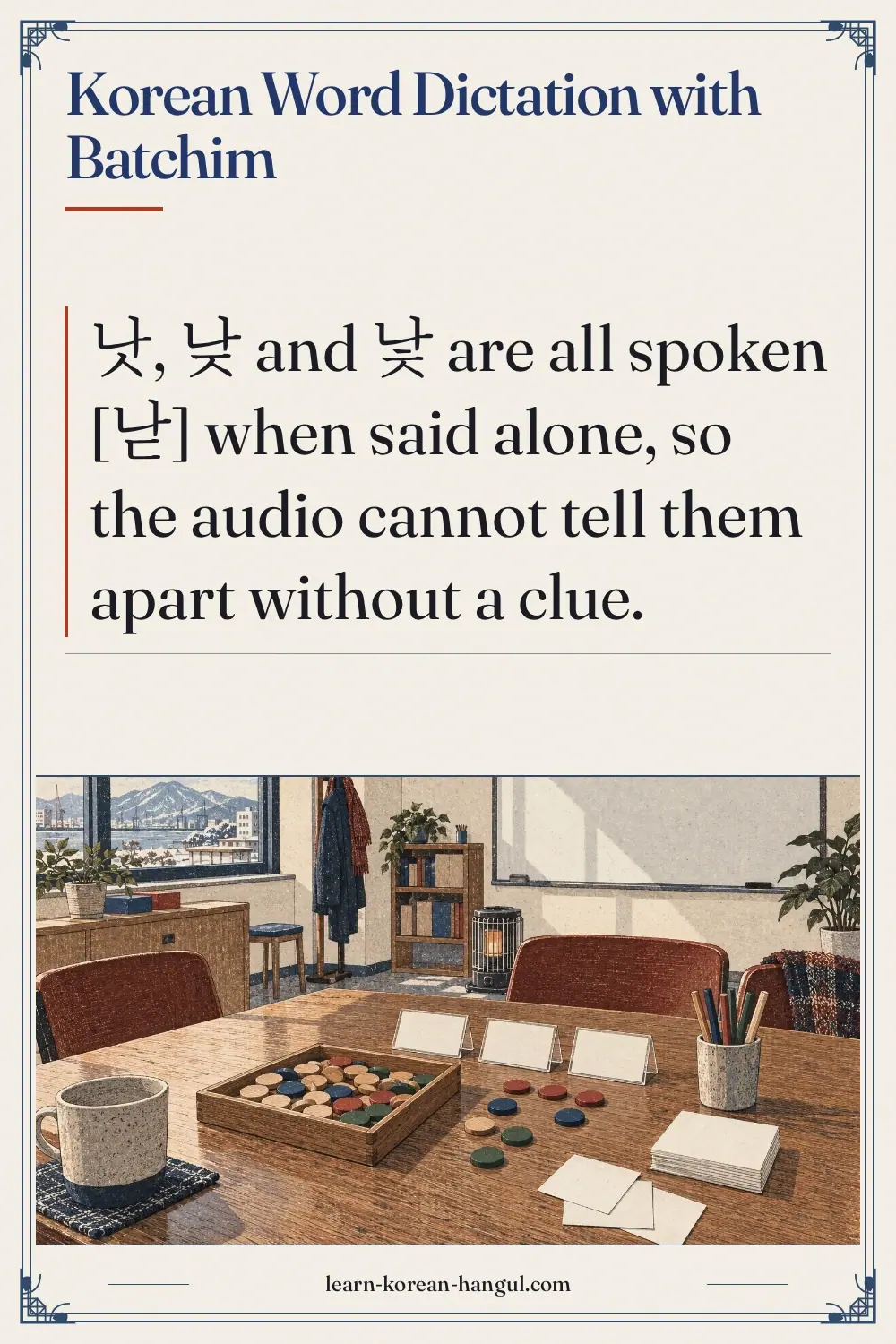
- 낫, 낮 and 낯 are all spoken [낟] when said alone, so the audio cannot tell them apart without a clue.
- Adding the particle 이 reveals the real final: 꽃이 is [꼬치], so the letter is ㅊ.
- 읽 has two final letters, and 밖 has a doubled ㄲ.
Last updated: 2026-10-09. The Korean text, romanization and audio scripts on this page are generated drafts that still await review by a Korean specialist.
What Is Korean Word Dictation with Batchim?
Korean word dictation with batchim is spelling practice for words whose last block has a final consonant. A batchim (받침, "support") is the consonant written under the vowel in a block, such as ㅊ in 꽃 (flower). Korean spells final consonants with 16 single letters (including ㄲ and ㅆ) and 11 two-letter clusters, yet only seven sounds are spoken there.
That gap is the whole difficulty. Several letters share one sound, so the ear cannot always choose the right letter. The National Institute of Korean Language (국립국어원) sets the sound rule in the Standard Pronunciation Rules (표준 발음법), and the Hangul Orthography (한글 맞춤법) sets the spelling. The next section explains why this surprises English speakers.
Why Is This Hard for English Speakers?
English speakers expect each final letter to sound different, and they also expect to hear a release. English "cat" and "cab" end with different sounds. Korean finals are not released, and ㅅ, ㅈ, ㅊ and ㅌ all close the mouth in the same way, as [ㄷ].
The consequence is a guessing game. Hearing [꼳], you could write 꼳, 꼿 or 꽃, and only one is the word. There are two safe methods: the suffix test below, and learning each word with its spelling. The set uses common words so that both methods work. First, see how the task runs.
How Does the Set Work?
The set follows the guess-then-check habit, and it takes about 25 minutes.
- Play the word once without writing, and read the English clue.
- Play it again and write your best guess in Hangul.
- If the final could be more than one letter, add 이 in your head and say the word again.
- Write your final answer and move on.
- After item 30, open the key and mark each word.
Practice · Read
Show answer
책
Item 1 (clue: book): final [ㄱ]
Show answer
부엌
Item 2 (clue: kitchen): ㅋ final spoken [억]
Show answer
밖
Item 3 (clue: outside): doubled ㄲ final, spoken [박]
Show answer
닭
Item 4 (clue: chicken): double batchim ㄺ, spoken [닥]
Show answer
낫
Item 5 (clue: sickle, a tool for cutting grass): final ㅅ, spoken [낟]
Show answer
낮
Item 6 (clue: daytime): final ㅈ, spoken [낟]
Show answer
낯
Item 7 (clue: face, as in a familiar face): final ㅊ, spoken [낟]
Show answer
꽃
Item 8 (clue: flower): final ㅊ, spoken [꼳]
Show answer
옷
Item 9 (clue: clothes): final ㅅ, spoken [옫]
Show answer
밭
Item 10 (clue: field): final ㅌ, spoken [받]
Show answer
끝
Item 11 (clue: end): final ㅌ, spoken [끋]
Show answer
빛
Item 12 (clue: light): final ㅊ, spoken [빋]
Show answer
이웃
Item 13 (clue: neighbour): final ㅅ, spoken [이욷]
Show answer
있다
Item 14 (clue: to exist, to have): final ㅆ, spoken [읻따]
Show answer
앞
Item 15 (clue: front): final ㅍ, spoken [압]
Show answer
숲
Item 16 (clue: forest): final ㅍ, spoken [숩]
Show answer
잎
Item 17 (clue: leaf): final ㅍ, spoken [입]
Show answer
무릎
Item 18 (clue: knee): final ㅍ, spoken [무릅]
Show answer
값
Item 19 (clue: price): double batchim ㅄ, spoken [갑]
Show answer
없다
Item 20 (clue: to not exist): double batchim ㅄ, spoken [업따]
Show answer
집
Item 21 (clue: house): final ㅂ
Show answer
산
Item 22 (clue: mountain): final ㄴ
Show answer
강
Item 23 (clue: river): final ㅇ
Show answer
봄
Item 24 (clue: spring): final ㅁ
Show answer
말
Item 25 (clue: word, or horse): final ㄹ
Show answer
삶
Item 26 (clue: life): double batchim ㄻ, spoken [삼]
Show answer
앉다
Item 27 (clue: to sit): double batchim ㄵ, spoken [안따]
Show answer
많다
Item 28 (clue: to be many): double batchim ㄶ, spoken [만타]
Show answer
넓다
Item 29 (clue: to be wide): double batchim ㄼ, spoken [널따]
Show answer
읽다
Item 30 (clue: to read): double batchim ㄺ, spoken [익따]
Show answer
꽃
Worked example, slow then normal speed: bare word spoken [꼳]
Show answer
꽃이
Worked example, with the particle 이: spoken [꼬치]
Words 1 to 15 come first.
Listen: Items 1 to 15
Each clip is one word. The English clue helps with words you do not know yet.
Words 16 to 30 include the double finals.
Listen: Items 16 to 30
Items 19, 20 and 26 to 30 end in a double batchim (item 4, 닭, was the first), where one of the two letters is silent.
Write all 30 before you open the key.
Answer Key and Scoring
Mark a word correct only if every letter matches. The Spoken column shows the word alone; the final group is the one you review for any miss. Revised Romanization (RR) follows the sound.
| Item | Write | Spoken | RR | Meaning | Final group |
|---|---|---|---|---|---|
| 1 | 책 | [책] | chaek | book | ㄱ |
| 2 | 부엌 | [부억] | bueok | kitchen | ㄱ |
| 3 | 밖 | [박] | bak | outside | ㄱ |
| 4 | 닭 | [닥] | dak | chicken | ㄱ |
| 5 | 낫 | [낟] | nat | sickle | ㄷ |
| 6 | 낮 | [낟] | nat | daytime | ㄷ |
| 7 | 낯 | [낟] | nat | face | ㄷ |
| 8 | 꽃 | [꼳] | kkot | flower | ㄷ |
| 9 | 옷 | [옫] | ot | clothes | ㄷ |
| 10 | 밭 | [받] | bat | field | ㄷ |
| 11 | 끝 | [끋] | kkeut | end | ㄷ |
| 12 | 빛 | [빋] | bit | light | ㄷ |
| 13 | 이웃 | [이욷] | iut | neighbour | ㄷ |
| 14 | 있다 | [읻따] | itda | to exist | ㄷ |
| 15 | 앞 | [압] | ap | front | ㅂ |
| 16 | 숲 | [숩] | sup | forest | ㅂ |
| 17 | 잎 | [입] | ip | leaf | ㅂ |
| 18 | 무릎 | [무릅] | mureup | knee | ㅂ |
| 19 | 값 | [갑] | gap | price | ㅂ |
| 20 | 없다 | [업따] | eopda | to not exist | ㅂ |
| 21 | 집 | [집] | jip | house | ㅂ |
| 22 | 산 | [산] | san | mountain | ㄴ |
| 23 | 강 | [강] | gang | river | ㅇ |
| 24 | 봄 | [봄] | bom | spring | ㅁ |
| 25 | 말 | [말] | mal | word, horse | ㄹ |
| 26 | 삶 | [삼] | sam | life | ㅁ |
| 27 | 앉다 | [안따] | anda | to sit | ㄴ |
| 28 | 많다 | [만타] | manta | to be many | ㄴ |
| 29 | 넓다 | [널따] | neolda | to be wide | ㄹ |
| 30 | 읽다 | [익따] | ikda | to read | ㄱ |
Items 5 to 7 are the same sound, so give yourself a point if you chose the right letter from the clue.
| Score | Meaning | Next action |
|---|---|---|
| 28 to 30 | Secure | Go to number dictation |
| 26 to 27 | On target | Fix the missed group |
| 21 to 25 | Close | Read the seven final sounds, then repeat after one day |
| 0 to 20 | Needs another pass | Redo syllable dictation first |
These bands are this lesson's own guide, not a standard scale. The score matters less than the pattern of misses, which the next section helps you read.
What Should I Do after a Low Score?
After a low score, sort the wrong words by final group: [ㄱ] (items 1 to 4, 30), [ㄷ] (5 to 14), [ㅂ] (15 to 21), nasals and liquids (22 to 29). The largest group is the one to study first.
If most misses are in the [ㄷ] group, you have met the main trap: five different letters (ㅅ, ㅈ, ㅊ, ㅌ, ㅆ) share one final sound. Copy each missed word five times while saying it aloud, then add the particle 이 and say it again. If the misses are double finals, read the double batchim page. Repeat the set after one day. The suffix test in the next section is the quickest way to check a final letter.
How Can I Find the Real Final Letter?
The suffix test finds the real final letter by adding a particle that starts with a vowel. The particle 이 (subject marker) or the ending -아요/-어요 moves the final consonant onto the vowel, where it is spoken in full. This is liaison (연음), the rule from Articles 13 and 14 of the Standard Pronunciation Rules.
| Alone | + 이 | Final letter |
|---|---|---|
| 낫 [낟] | 낫이 [나시] | ㅅ |
| 낮 [낟] | 낮이 [나지] | ㅈ |
| 낯 [낟] | 낯이 [나치] | ㅊ |
| 꽃 [꼳] | 꽃이 [꼬치] | ㅊ |
| 숲 [숩] | 숲이 [수피] | ㅍ |
| 밭 [받] | 밭이 [바치] | ㅌ |
Note that 밭이 is [바치], not [바티]. A final ㅌ before the particle 이 turns into [ㅊ] (palatalization, Article 17), and a final ㄷ turns into [ㅈ] the same way, so the test shows the sound after the change. Use the table as a hint, and then confirm against the word. The worked example uses the best-known case.
Worked Example: 꽃
The word 꽃 (flower) is one block with the final ㅊ, and it is spoken [꼳]. Follow the steps.
- Hear the sound: [꼳]. The mouth closes at the end with no release.
- List the candidates: the final could be ㄷ, ㅅ, ㅈ, ㅊ, ㅌ or ㅆ, since all are spoken [ㄷ] at the end.
- Add 이: say the flower as a subject, 꽃이. You hear [꼬치], and the sound before 이 is [ㅊ].
- Choose the letter: [치] points to ㅊ. A final ㅌ would also give [치] before 이 (see 밭이 above), but 꽅 is not a word, so the block is 꽃.
- Check: compare with the spelling 꽃 in a dictionary or word list.
You will know it worked when the clip with 이 clearly shows the ㅊ sound. A few mistakes keep returning, so the next section lists them.
What Mistakes Do Learners Make Here?
Learners often spell the final by ear alone. The mistakes below follow.
- Mistake 1: 꼳 for 꽃. Learners often write ㄷ because the ear hears [ㄷ]. Actually the spelling uses the letter heard before a vowel, ㅊ.
- Mistake 2: 낟 for any of 낫, 낮, 낯. Learners often use one spelling for all three. Actually they are three different words, so use the clue or the context.
- Mistake 3: 박 for 밖. Learners often write a single ㄱ. Actually 밖 uses a doubled ㄲ, so check the meaning "outside".
- Mistake 4: 익다 for 읽다. Learners often write one final letter. Actually 읽 has two, ㄹ and ㄱ, although only ㄱ is heard before a consonant.
- Mistake 5: 업다 for 없다. Learners often drop the ㅅ. Actually 없 is a double batchim with ㅂ and ㅅ, and the ㅅ comes back in 없어요 [업써요].
Expert tip: learn a word with its 이 form, such as 꽃 / 꽃이, and the hidden letter stays with you. Test yourself now.
Practice and Answer Key
Write the spelling for each word, using the suffix test where needed.
- [꼬치] (flower, with 이)
- [나지] (daytime, with 이)
- [수피] (forest, with 이)
- [바치] (field, with 이)
- [이욷] (neighbour, bare word)
Answer key
- 꽃이
- 낮이
- 숲이
- 밭이
- 이웃 (the ㅅ is only heard before a vowel, as in 이웃이 [이우시])
Four or five correct means the test works for you. The final section shows where to continue.
Where to Go Next
After Korean word dictation with batchim, continue with Korean Number Dictation, where you write numbers by ear. To strengthen the sound side, return to the seven final sounds. For the spelling side, read about Korean spelling rules, and when you want to compare similar sounds, use Korean minimal pairs. The full list of sets is in the Korean Dictation hub.
This set covers 30 words in standard Seoul pronunciation. It does not cover every double batchim, words with inserted sounds or the full spelling system.
Frequently Asked Questions
How do I know whether to write ㅅ or ㅈ at the end? You cannot know from the bare sound, because ㅅ, ㅈ, ㅊ, ㅌ and ㅆ all end in [ㄷ]. Use the suffix test: add the particle 이 and listen. 낫이 is [나시] and 낮이 is [나지], so the letter appears. Otherwise learn the spelling with the word.
Why is 꽃 said [꼳]? Korean allows only seven sounds at the end of a syllable. The letter ㅊ is a legal final letter, but when nothing follows, it is spoken as the closest of those seven, which is [ㄷ]. With a vowel after it, as in 꽃이 [꼬치], the real ㅊ sound returns. The rule is Article 9 of the standard pronunciation rules.
Do I write 읽 with two letters? Yes. 읽 ends with the double batchim ㄺ, so the final block holds ㄹ and ㄱ together. In 읽다 only the ㄱ is heard, giving [익따], but the spelling keeps both letters. Check the double batchim page for all eleven pairs, because the sound hides one of the two letters.
What is the suffix test? The suffix test adds a vowel-initial particle to a word to uncover its final letter. Add 이 and say it: 꽃이 [꼬치], 숲이 [수피], 낮이 [나지]. The hidden final consonant moves onto the vowel and becomes audible. One catch: a final ㅌ sounds [ㅊ] before 이 (밭이 [바치]). Verbs can use -아요 or -어요 instead.
How many words should I get right? Twenty-six out of thirty is the target. That target is this lesson's own guide, not an official score. Count your misses by final sound group in the key. Two misses in the same group mean you should review the seven final sounds, then repeat the set after one day, not at once.