What you'll learn
- Write 17 of 20 heard numbers correctly, in Hangul, digits or both.
- Choose the Sino-Korean or the native system from the unit that follows.
- Hear 십육 as [심뉵] and write 유월, not 육월, for June.
- Score digit answers and Hangul answers separately to find your weak spot.
Before you start: you need both number systems up to 100 and the numbers 만, 천 and 백. Time: about 25 minutes. Level: A1. Audio plays only when you press a button, and each item can be replayed three times.
Key facts
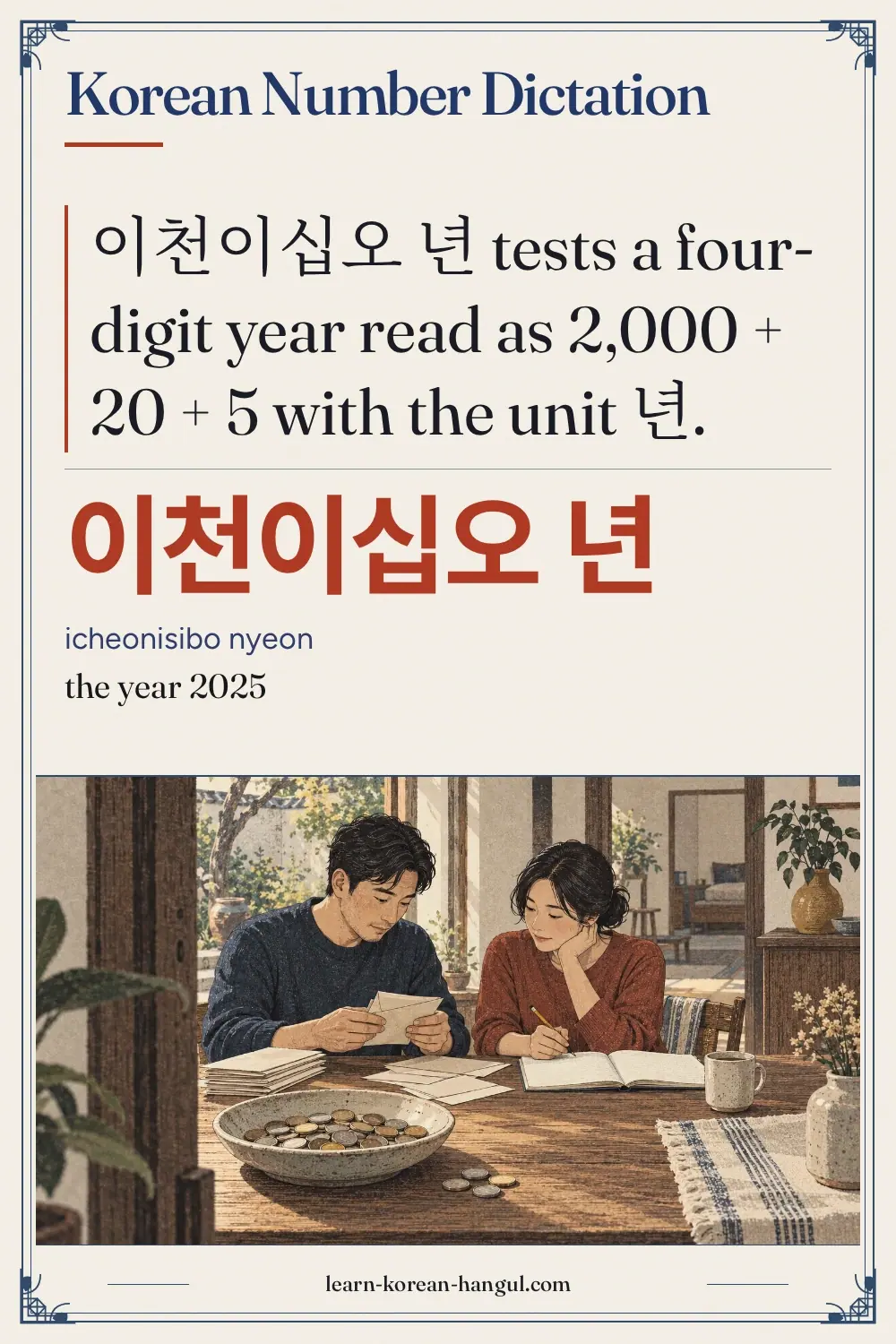
- 이천이십오 년 tests a four-digit year, read as 2,000 + 20 + 5 with the Sino-Korean unit 년.
- 스물다섯 살 tests native numbers for age, where 스물 is 20 and 다섯 is 5.
What Is Korean Number Dictation?
Korean number dictation is the task of hearing a number in Korean and writing it down, either in Hangul or in digits. It trains two skills together: recognising the sounds of the number words and choosing the correct number system for what is being counted.
In this set, each item is a number plus its unit, such as 십육 번 or 스물다섯 살, because the unit decides the system. Numbers heard alone are ambiguous, since 3 can be 삼 or 셋. With a unit, there is one correct answer, and you can check yourself against the key.
This page builds on Sino-Korean numbers and native Korean numbers. The sounds themselves are trained in Korean numbers listening practice, where you only choose among written options.
The next section explains why numbers are harder to write than to understand.
Why Is This Hard for English Speakers?
Korean has two number systems, and the unit chooses between them. English has one, so the choice happens automatically in your own language but not in Korean. Large numbers are also grouped by 만 (10,000), not by thousands.
| Counting or naming | System | Example | Digits |
|---|---|---|---|
| Money, years, dates, minutes | Sino-Korean | 오만 원 | 50,000원 |
| Age (spoken), hours, items, people | Native | 스물다섯 살 | 25살 |
| Phone numbers, floors, scores | Sino-Korean | 이십오 층 | 25층 |
A rule of thumb helps: if you can ask "how many?" about things or people, use native numbers, and if you read a price, a date or a label, use Sino-Korean. Native numbers shorten before a counter: 하나 becomes 한, 둘 becomes 두, 셋 becomes 세, 넷 becomes 네 and 스물 becomes 스무 (only for exactly 20, so 21 is 스물한).
Knowing the split, you can now follow the set's rules.
How Does the Set Work?
The set has 20 items in two halves. Follow these steps.
- Play an item. Press the button and listen. You may replay it up to three times.
- Write the answer. Write it in Hangul, digits or both. Spaces are ignored in the checker.
- Check after item 10. Open the key for items 1 to 10, then do items 11 to 20.
- Score yourself. Count Hangul answers and digit answers separately.
You will know it worked when you score 17 or more on at least one answer type. A common mistake is to guess the unit. Write the unit you hear, such as 번, 층, 원 or 살, because it often tells you the system. Digit answers are scored with the unit attached, for example 16번.
Start with the first half.
Listen: Items 1 to 10
These items cover Sino-Korean numbers with units and prices.
Practice · Read
Show answer
십육 번
16번
Show answer
이십오 층
25층
Show answer
구십칠 점
97점
Show answer
백이십 센티미터
120센티미터
Show answer
삼백오십 그램
350그램
Show answer
천오백 원
1,500원
Show answer
이천오백 원
2,500원
Show answer
만 이천 원
12,000원
Show answer
오만 원
50,000원
Show answer
십만 원
100,000원
Take your time on 6 and 7: the sounds [처노백] and [이처노백] hide the 천. When you finish, move to items 11 to 20.
Listen: Items 11 to 20
These items add years, dates, ages, times and counted things.
Practice · Read
Show answer
이천이십오 년
2025년
Show answer
유월
6월
Show answer
십이월 십오 일
12월 15일
Show answer
스물다섯 살
25살
Show answer
세 시 반
3시 반
Show answer
열두 시 십 분
12시 10분
Show answer
사과 세 개
사과 3개
Show answer
학생 열 명
학생 10명
Show answer
책 두 권
책 2권
Show answer
공일공 일이삼사 오육칠팔
010-1234-5678
Check the key to score your answers.
Answer Key and Scoring
Mark one point for each correct answer. Hangul and digit versions are shown in the key table.
| No. | Hangul answer (what you hear) | Digits | Note |
|---|---|---|---|
| 1 | 십육 번 | 16번 | bus or room number; heard [심뉵뻔] |
| 2 | 이십오 층 | 25층 | floors use Sino-Korean numbers |
| 3 | 구십칠 점 | 97점 | scores use Sino-Korean numbers |
| 4 | 백이십 센티미터 | 120센티미터 | no 일 before 백 |
| 5 | 삼백오십 그램 | 350그램 | measurements use Sino-Korean numbers |
| 6 | 천오백 원 | 1,500원 | no 일 before 천; heard [처노배권] when said without a pause |
| 7 | 이천오백 원 | 2,500원 | heard [이처노배권] when said without a pause |
| 8 | 만 이천 원 | 12,000원 | space after the 만 unit |
| 9 | 오만 원 | 50,000원 | the 50,000-won note |
| 10 | 십만 원 | 100,000원 | heard [심마눤] when said without a pause |
| 11 | 이천이십오 년 | 2025년 | years use Sino-Korean numbers; heard [이처니시보 년] |
| 12 | 유월 | 6월 | the standard spelling is 유월, not 육월 |
| 13 | 십이월 십오 일 | 12월 15일 | dates use Sino-Korean numbers; heard [시비월 시보일] |
| 14 | 스물다섯 살 | 25살 | age uses native numbers |
| 15 | 세 시 반 | 3시 반 | hour is native (세), 반 means half |
| 16 | 열두 시 십 분 | 12시 10분 | hour native, minutes Sino-Korean; heard [십뿐] |
| 17 | 사과 세 개 | 사과 3개 | counted things use native numbers |
| 18 | 학생 열 명 | 학생 10명 | people use native numbers with 명 |
| 19 | 책 두 권 | 책 2권 | books use native numbers with 권 |
| 20 | 공일공 일이삼사 오육칠팔 | 010-1234-5678 | phone digits are Sino-Korean, with 0 read 공; 일이 heard [이리] |
Scoring. Count Hangul answers out of 20 and digit answers out of 20. 17 or more on either means you have reached the goal for this set. If your Hangul score is lower than your digit score, the weak spot is spelling the number words. If your digit score is lower, the weak spot is hearing them.
Spacing in the Hangul answers follows the rule in the Hangul orthography (한글 맞춤법) that large numbers are spaced by 만 units, which is why 만 이천 원 has a space after 만 but 이천오백 원 has none inside the number. The unit word, such as 원, is spaced from the number in Hangul and may be attached to digits.
What to Do after a Low Score?
Look for the pattern in your errors before replaying anything.
- Wrong system, such as 이십오 살 for 25 years old. Review the situation table above, then redo items 14 to 19.
- Missing 천 or 만. Listen again to items 6 to 10 slowly. These are listening errors, not spelling errors.
- Right sounds, wrong spelling. Compare your Hangul with the key, character by character.
- Sound changes missed. Hear 십육 and 유월 once more below.
Repeat the whole set after one day and compare the two scores. A rise shows that the errors you sorted are fixed. Next, a single item gets a full walk-through.
Worked Example: 이천이십오 년
The year 2025 is read as three Sino-Korean parts followed by 년.
이천이십오 년
icheonisibo nyeon
the year 2025
- Hear the sound. You hear [이처니시보 년].
- Split it. 이천 (2,000) + 이십 (20) + 오 (5) + 년 (year).
- Write the digits. 2025년.
- Write the Hangul. 이천이십오 년, with no space inside the number and a space before 년.
Notice that the ㄴ of 천 and the ㅂ of 십 move into the next block, which is why you hear [처니시보]. A common mistake follows when learners write what they hear.
What Mistakes Do Learners Make Here?
Learners often assume that the number they hear is the number they write. Four slips are common.
- Writing 육월 for June. The standard spelling is 유월, and October is 시월, not 십월. Months 6 and 10 are spelled as they sound.
- Using native numbers for money. 열 원 is not a price. The system for money is Sino-Korean, so 10 won is 십 원.
- Adding 일 before 천 or 백. Korean says 천오백 원, not 일천오백 원, for 1,500 won.
- Reading 3 as 삼 for the hour. The hour in 세 시 반 is native 세, even though minutes are Sino-Korean.
If a pattern repeats, use the practice below to isolate it.
Practice and Answer Key
- Write 35,000 won in Hangul.
- Which system is used for 스물다섯 살: Sino-Korean or native?
- How is the phone prefix 010 read?
- Which unit follows the hour in 세 시 반?
Answers
- 삼만 오천 원, with a space after 만.
- Native.
- 공일공. The digit 0 is read 공 in phone numbers.
- 시. The hour takes native 세, then 시, then 반.
Where to Go Next
Try the set again tomorrow and compare your two scores. Then continue with Korean sentence dictation for beginners, where you write full sentences, or review words with final consonants in Korean word dictation with batchim. Other sets are listed in Korean dictation practice. To tell similar number sounds apart, see Korean minimal pairs.
What this page does not cover. It does not cover numbers above one million, fractions or the ordinal forms, and it uses text-to-speech voices, so natural speed may differ.
Redo this Korean number dictation after a week, with a second set of numbers, to see whether the system choice is now automatic.
Frequently Asked Questions
Do I write digits or Hangul?
Both are fine in this set. Digits with the unit, such as 16번 or 12,000원, are the quickest. Hangul, such as 십육 번 or 만 이천 원, is the harder test because it needs spelling. Score the two separately. In everyday Korean life, digits are normal on tags and screens, and Hangul numbers appear in formal documents.
How is a year read?
A year is read as an ordinary Sino-Korean number followed by 년, so 2025 is 이천이십오 년. Speech normally reads the full year, not a two-digit form. Read the thousands, the hundreds, the tens and the ones in order. The hundreds are skipped when the digit is zero, as in 이천이십오.
Where do spaces go in a long number?
In Hangul, large numbers are spaced by 만 units. So 12,000 is 만 이천, 35,000 is 삼만 오천 and 123,000 is 십이만 삼천. Inside each group there is no space, as in 이천오백. The unit word 원 is spaced off. This follows the spacing rules in the Hangul orthography.
Why is 6월 written 유월?
The standard spelling of June is 유월, not 육월, and October is 시월, not 십월. Both follow the orthography rule that a sound which has changed in common speech is written as it sounds. Other months follow the plain pattern, such as 오월 for May and 칠월 for July.