What you will learn
- Write 27 of 30 syllable blocks correctly, including vowel and final.
- Tell the vowel pairs ㅓ/ㅗ and ㅡ/ㅜ apart by ear.
- Decide when a block needs the silent ㅇ.
- Find out whether your misses sit in the consonant, the vowel or the final.
Before you start: know the basic consonants and vowels, and how letters stack into blocks in Korean syllable blocks. Time: about 15 minutes with audio.
Key Facts
- The set has 30 single syllables, and 27 correct blocks is the target.
- Syllables are ordered by block shape: vertical vowel, horizontal vowel, then blocks with a final.
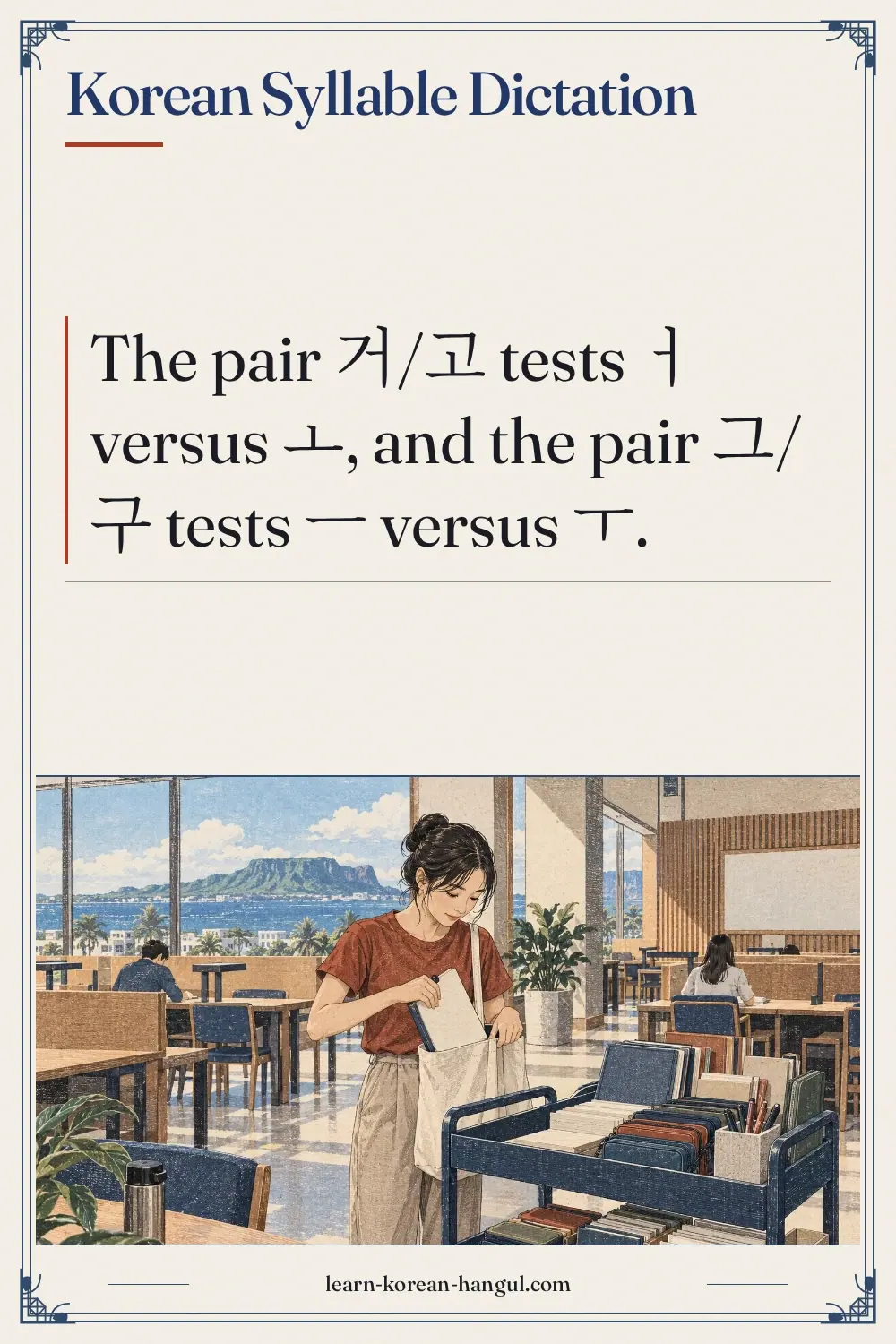
- The pair 거/고 tests ㅓ versus ㅗ, and the pair 그/구 tests ㅡ versus ㅜ.
- Silent ㅇ items such as 아, 어, 이, 오 and 우 are included, because a vowel-only syllable still needs the ㅇ block.
- Each syllable is a real part of a common word, listed in the key.
*Last updated: 2026-10-09. The Korean text, romanization and audio on this page are AI-assisted drafts.
What Is Korean Syllable Dictation?
Korean syllable dictation is the smallest dictation task: you hear one syllable and write one block. A syllable block (음절, eumjeol) is a group of two to four letters stacked into a square, such as 가 (ㄱ + ㅏ) or 감 (ㄱ + ㅏ + ㅁ). Dictation trains the ear and the hand together.
Each block has up to three slots: the initial consonant, the vowel and the final consonant. The initial slot is always filled, and when the syllable begins with a vowel sound, it holds a silent ㅇ. The Hangul Orthography (한글 맞춤법) governs how these blocks are written. Single syllables remove every other difficulty, such as word meaning and particles, so any error points to one sound. The next section explains why it is harder than it looks.
Why Is This Hard for English Speakers?
English speakers find single syllables hard because Korean splits vowel space differently. English does not mark the ㅓ/ㅗ and ㅡ/ㅜ contrasts the way Korean does, so the ear has no habit for them. In Korean, each pair changes the block you must write.
Another source of error is the silent ㅇ. An English speaker hears just "a" for 아 and may write only ㅏ, which is not a legal block. Finals add a third difficulty, because 감 and 강 differ by lip closure versus a back-of-the-tongue closure. Finally, the plain consonants ㄱ, ㄷ and ㅂ sit between English g/k, d/t and b/p, so either English letter may seem right. The set uses only plain consonants, so you can concentrate on vowels and finals. Next, here is how the set works.
How Does the Set Work?
The set follows a hear, write, check cycle for each syllable. It takes about 15 minutes.
- Hear it once without writing. Play the clip, then pause.
- Decide the slots. Ask yourself: what is the consonant, the vowel, is there a final?
- Write the block in Hangul by hand or by typing it on a Korean keyboard layout.
- Play it again if you are unsure, and compare the vowel before you change it.
- Check the key only after all 30 are written.
Practice · Read
Show answer
아
Item 1 (vertical vowel): 아 (a), found in 아이
Show answer
가
Item 2 (vertical vowel): 가 (ga), found in 가방
Show answer
나
Item 3 (vertical vowel): 나 (na), found in 나무
Show answer
마
Item 4 (vertical vowel): 마 (ma), found in 마음
Show answer
사
Item 5 (vertical vowel): 사 (sa), found in 사과
Show answer
어
Item 6 (vertical vowel): 어 (eo), found in 어머니
Show answer
거
Item 7 (vertical vowel): 거 (geo), found in 거울
Show answer
너
Item 8 (vertical vowel): 너 (neo), found in 너무
Show answer
이
Item 9 (vertical vowel): 이 (i), found in 이름
Show answer
시
Item 10 (vertical vowel): 시 (si), found in 시간
Show answer
오
Item 11 (horizontal vowel): 오 (o), found in 오늘
Show answer
고
Item 12 (horizontal vowel): 고 (go), found in 고기
Show answer
노
Item 13 (horizontal vowel): 노 (no), found in 노래
Show answer
모
Item 14 (horizontal vowel): 모 (mo), found in 모자
Show answer
소
Item 15 (horizontal vowel): 소 (so), found in 소금
Show answer
우
Item 16 (horizontal vowel): 우 (u), found in 우유
Show answer
구
Item 17 (horizontal vowel): 구 (gu), found in 구두
Show answer
두
Item 18 (horizontal vowel): 두 (du), found in 두부
Show answer
그
Item 19 (horizontal vowel): 그 (geu), found in 그림
Show answer
느
Item 20 (horizontal vowel): 느 (neu), found in 느낌
Show answer
감
Item 21 (vertical vowel with final): 감 (gam), found in 감
Show answer
각
Item 22 (vertical vowel with final): 각 (gak), found in 생각
Show answer
간
Item 23 (vertical vowel with final): 간 (gan), found in 간장
Show answer
강
Item 24 (vertical vowel with final): 강 (gang), found in 강
Show answer
달
Item 25 (vertical vowel with final): 달 (dal), found in 달
Show answer
밥
Item 26 (vertical vowel with final): 밥 (bap), found in 밥
Show answer
곰
Item 27 (horizontal vowel with final): 곰 (gom), found in 곰
Show answer
공
Item 28 (horizontal vowel with final): 공 (gong), found in 공
Show answer
국
Item 29 (horizontal vowel with final): 국 (guk), found in 국
Show answer
문
Item 30 (horizontal vowel with final): 문 (mun), found in 문
Show answer
가
Worked example, normal speed: the syllable 가 (ga)
Show answer
가
Worked example, slow speed: the syllable 가 (ga)
Show answer
거
Confusable pair, first member: 거 (geo)
Show answer
고
Confusable pair, second member: 고 (go)
Show answer
그
Confusable pair, first member: 그 (geu)
Show answer
구
Confusable pair, second member: 구 (gu)
You can type or handwrite your answers. Typing practice uses the same blocks, and the Korean keyboard layout page shows which keys make each letter. The items follow, grouped by block shape.
Listen: Items 1 to 15
Items 1 to 10 have a vertical vowel (ㅏ, ㅓ, ㅣ) beside the consonant. Items 11 to 15 begin the horizontal-vowel group (ㅗ, ㅜ, ㅡ), where the vowel sits under the consonant. Each clip is one syllable.
Items 16 to 30 continue the set.
Listen: Items 16 to 30
Items 16 to 20 finish the horizontal-vowel group. Items 21 to 26 add a final consonant under a vertical vowel, and items 27 to 30 add a final under a horizontal vowel. Write all three slots for these.
Write all 30 blocks before you open the key.
Answer Key and Scoring
Mark a block correct only if every slot matches. The Parts column shows the letters, and the last two columns give a real word that contains the syllable. Revised Romanization (RR) follows the letters.
Vertical vowel, no final (items 1 to 10)
| # | Write | RR | Parts | Word it appears in | Meaning |
|---|---|---|---|---|---|
| 1 | 아 | a | ㅇ (silent) + ㅏ | 아이 | child |
| 2 | 가 | ga | ㄱ + ㅏ | 가방 | bag |
| 3 | 나 | na | ㄴ + ㅏ | 나무 | tree |
| 4 | 마 | ma | ㅁ + ㅏ | 마음 | heart, mind |
| 5 | 사 | sa | ㅅ + ㅏ | 사과 | apple |
| 6 | 어 | eo | ㅇ (silent) + ㅓ | 어머니 | mother |
| 7 | 거 | geo | ㄱ + ㅓ | 거울 | mirror |
| 8 | 너 | neo | ㄴ + ㅓ | 너무 | too, very |
| 9 | 이 | i | ㅇ (silent) + ㅣ | 이름 | name |
| 10 | 시 | si | ㅅ + ㅣ | 시간 | time |
Horizontal vowel, no final (items 11 to 20)
| # | Write | RR | Parts | Word it appears in | Meaning |
|---|---|---|---|---|---|
| 11 | 오 | o | ㅇ (silent) + ㅗ | 오늘 | today |
| 12 | 고 | go | ㄱ + ㅗ | 고기 | meat |
| 13 | 노 | no | ㄴ + ㅗ | 노래 | song |
| 14 | 모 | mo | ㅁ + ㅗ | 모자 | hat |
| 15 | 소 | so | ㅅ + ㅗ | 소금 | salt |
| 16 | 우 | u | ㅇ (silent) + ㅜ | 우유 | milk |
| 17 | 구 | gu | ㄱ + ㅜ | 구두 | shoes |
| 18 | 두 | du | ㄷ + ㅜ | 두부 | tofu |
| 19 | 그 | geu | ㄱ + ㅡ | 그림 | picture |
| 20 | 느 | neu | ㄴ + ㅡ | 느낌 | feeling |
Vertical vowel with a final (items 21 to 26)
| # | Write | RR | Parts | Word it appears in | Meaning |
|---|---|---|---|---|---|
| 21 | 감 | gam | ㄱ + ㅏ + ㅁ | 감 | persimmon |
| 22 | 각 | gak | ㄱ + ㅏ + ㄱ | 생각 | thought |
| 23 | 간 | gan | ㄱ + ㅏ + ㄴ | 간장 | soy sauce |
| 24 | 강 | gang | ㄱ + ㅏ + ㅇ | 강 | river |
| 25 | 달 | dal | ㄷ + ㅏ + ㄹ | 달 | moon |
| 26 | 밥 | bap | ㅂ + ㅏ + ㅂ | 밥 | rice, meal |
Horizontal vowel with a final (items 27 to 30)
| # | Write | RR | Parts | Word it appears in | Meaning |
|---|---|---|---|---|---|
| 27 | 곰 | gom | ㄱ + ㅗ + ㅁ | 곰 | bear |
| 28 | 공 | gong | ㄱ + ㅗ + ㅇ | 공 | ball |
| 29 | 국 | guk | ㄱ + ㅜ + ㄱ | 국 | soup |
| 30 | 문 | mun | ㅁ + ㅜ + ㄴ | 문 | door |
Then score the three slots separately, as in the table below, because the pattern of misses matters more than the total. For each wrong block, put one tick in the column of the slot that was wrong.
| Slot | Checked in | Many ticks here means | Review |
|---|---|---|---|
| Initial consonant (including silent ㅇ) | Items 1 to 30 | You miss the silent ㅇ or confuse similar consonants | Korean syllable blocks |
| Vowel | Items 1 to 30 | ㅓ/ㅗ or ㅡ/ㅜ are still blurred | Korean vowel pronunciation |
| Final consonant | Items 21 to 30 | ㅁ/ㅇ or ㄴ/ㅇ are still blurred | The seven final sounds |
The bands below are this lesson's own guide, not a standard scale.
| Score (blocks fully correct) | Meaning | Next action |
|---|---|---|
| 28 to 30 | Secure | Go to word dictation with batchim |
| 27 | On target | Fix the one missed slot |
| 22 to 26 | Close | Review the slot with the most ticks, then repeat after one day |
| 0 to 21 | Needs another pass | Replay items slowly and review block shapes |
Reading your ticks leads to the next question.
What Should I Do after a Low Score?
After a low score, count the ticks in each slot and fix the slot with the most ticks first. A low score nearly always has one cause, not three.
- Mostly vowel ticks: drill the pairs 거/고 and 그/구 with the pair clips below, then rewrite items 6 to 8 and 11 to 20 from audio.
- Mostly initial-consonant ticks: check whether you forgot the silent ㅇ in items 1, 6, 9, 11 and 16.
- Mostly final ticks: compare 감/강/간, which end in ㅁ, ㅇ and ㄴ, then read the seven final sounds.
Repeat the set after one day, not at once. The next section trains the two vowel pairs that block most learners.
How Can I Tell 거 from 고 and 그 from 구?
Tell 거 from 고 by the lips: ㅓ keeps the lips relaxed and the mouth open, while ㅗ rounds the lips. The same lip test separates ㅡ from ㅜ: ㅡ is spread and flat, and ㅜ is rounded. Listen to each pair, then say them yourself.
If you cannot hear a difference, look in a mirror while you say the pair. Rounded lips mean ㅗ or ㅜ. The Korean vowel pronunciation lesson explains the mouth positions, and the word pairs behind this practice are in Korean minimal pairs. The worked example shows the full routine on one block.
Worked Example: 가
The block 가 (ga) shows the full routine on a simple open syllable. Follow the steps.
- Hear it: [가]. The sound begins with a plain g or k sound and ends in an open "ah".
- Initial slot: a consonant is heard, so no silent ㅇ is needed. The plain consonant is ㄱ.
- Vowel slot: the mouth is wide open, and the vowel is a vertical one: ㅏ.
- Final slot: the sound ends in the vowel, so there is no final.
- Write and check: 가 = ㄱ + ㅏ, as in 가방 (bag).
You will know it worked when you can name all three slots before you write. Note that 가 is also the subject particle, but in this set it is only a block. Several errors recur, so the next section lists them.
What Mistakes Do Learners Make Here?
Learners often write what they hear in English letters instead of building a block. These mistakes repeat across the set.
- Mistake 1: swapping ㅓ and ㅗ. Learners often write 고 for 거. Actually the lips make the difference, so listen for rounding.
- Mistake 2: swapping ㅡ and ㅜ. Learners often write 구 for 그. Actually ㅡ is spread and flat, and ㅜ is rounded.
- Mistake 3: leaving out the silent ㅇ. Learners often write ㅏ alone for 아. Actually a vowel needs the ㅇ placeholder to form a block.
- Mistake 4: adding a final that is not there. Learners often write 강 for 가 because the vowel rings on. Actually the sound ends in the vowel, so no final is written.
- Mistake 5: swapping ㅁ and ㅇ. Learners often write 감 for 강. Actually ㅁ closes the lips, and ㅇ closes at the back of the tongue.
Expert tip: say each syllable yourself before you write it. Your own lips and tongue tell you whether there is a final and whether the vowel is rounded. Test yourself now.
Practice and Answer Key
Write the block for each description.
- A vowel-only sound "o", as in 오늘 (today).
- The consonant ㄱ with the vowel ㅓ.
- The consonant ㅁ, the vowel ㅏ and the final ㅇ.
- The consonant ㄱ with the vowel ㅜ and the final ㄱ.
Answer key
- 오 (the silent ㅇ plus ㅗ)
- 거
- 망 (ㅁ + ㅏ + ㅇ)
- 국
Item 3 is not in the set, but it uses the same slots. Four correct means you can build blocks from sounds. The final section shows where to continue.
Where to Go Next
After Korean syllable dictation, continue with Korean Word Dictation with Batchim, where you write whole words with final consonants. To strengthen the sound side, review Korean syllable blocks and Korean vowel pronunciation. For habits that carry over to longer audio, see listening strategies, and compare similar sounds with Korean minimal pairs. The full list of sets is in the Korean Dictation hub.
This set covers 30 syllables with plain consonants in standard Seoul pronunciation. It does not cover aspirated or tense consonants, compound vowels such as ㅘ, double finals or whole words.
Frequently Asked Questions
Do I write the silent ㅇ? Yes. A syllable that starts with a vowel sound needs ㅇ in the first position, so 아 is ㅇ + ㅏ, never ㅏ alone. The ㅇ is silent at the start of a block and has no sound there. At the end of a block it is the ng sound, so 강 ends in ㅇ.
Why do 거 and 고 sound alike to me? English has no clear ㅓ/ㅗ contrast, so the ear merges them. Listen for the lips: ㅗ rounds them, and ㅓ leaves them relaxed. Use the pair clips in this lesson, slow them down, and say each syllable in a mirror. The same method works for 그 and 구.
Can I type the answers? Yes. Typing works as well as handwriting for this set, as long as you switch your keyboard to Korean. Each key makes one letter, and the computer joins the letters into blocks as you type. The Korean keyboard layout page shows the key for each consonant and vowel.
What is a block shape? A block shape is the way letters stack in a syllable. A vertical vowel such as ㅏ sits to the right of the consonant, as in 가. A horizontal vowel such as ㅗ sits below it, as in 고. A final consonant adds a third layer at the bottom, as in 감 or 곰.