
At a glance
- 은/는 marks the topic, what the sentence is about. 이/가 marks the subject, who or what does or is something.
- 께서 is the respectful form of 이/가 for people you honour.
- The set has 6 lessons, from A1 to B1.
What Are Korean Topic and Subject Particles?
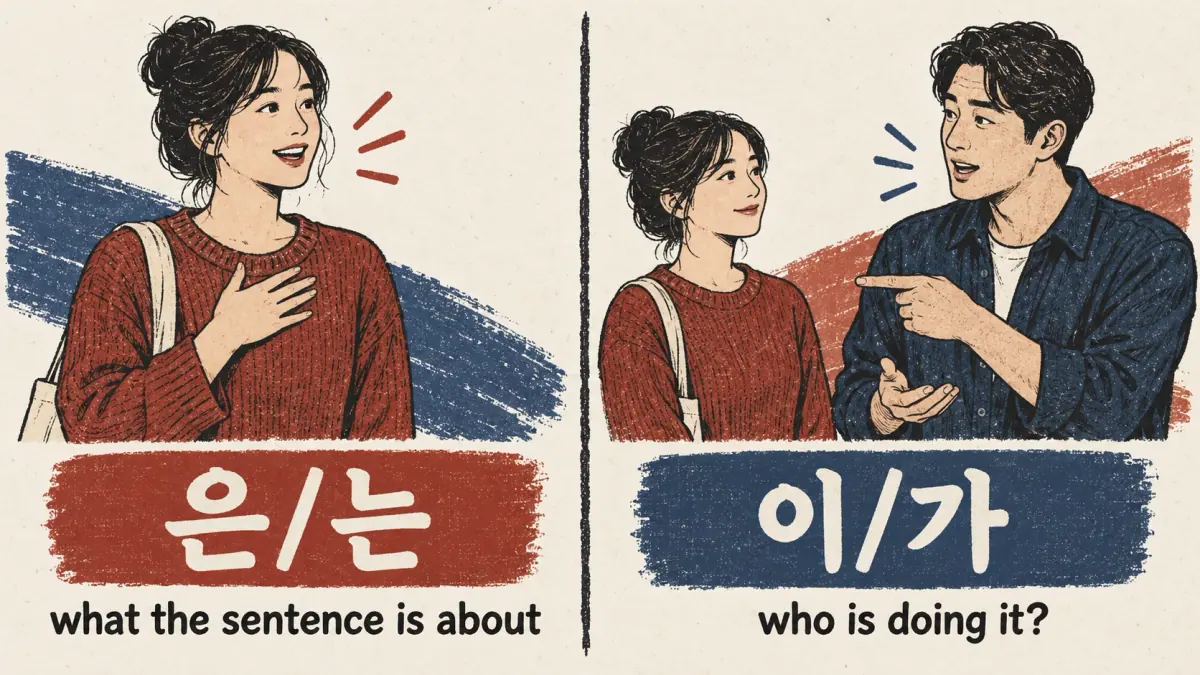
A particle (조사, josa) is a short word attached to a noun that shows the noun's job in the sentence. Korean topic and subject particles are the particles that answer two questions: what is this sentence about, and who is doing it? The first job belongs to the topic particle 은/는, and the second to the subject particle 이/가. The honorific 께서 is a respectful version of the subject particle.
Here is one sentence with the topic particle. Listen first, then read the lessons.
저는 학생이에요. (jeoneun haksaengieyo) "I am a student." Pronounced [저는 학쌩이에요].
Each particle has two spellings, chosen by the last sound of the noun: 은 and 이 after a consonant, 는 and 가 after a vowel. English has no equivalent, which is why learners spend extra time here. The lessons below separate the ideas one at a time.
Where Should You Start with Korean Topic and Subject Particles?
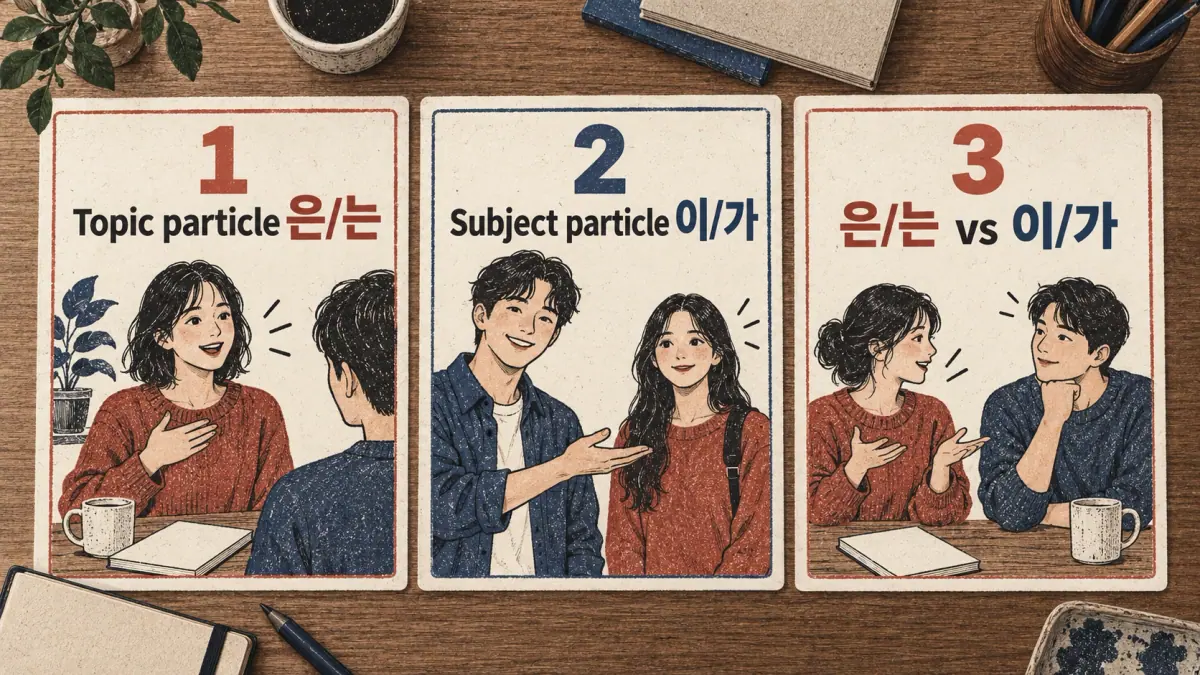
Start with 은/는, then 이/가, then the lesson that compares them. This order keeps each new idea small and makes the comparison lesson easy to follow.
- Topic particle 은/는: the first particle, for what the sentence is about.
- Subject particle 이/가: who or what does the action.
- 은/는 vs 이/가: how to choose between them for the same noun.
- Honorific subject particle 께서: the respectful subject marker.
- Double subject construction in Korean: sentences with two marked nouns.
- Omitting particles in Korean: when speakers leave the particles out.
Once the order is set, the next section gives each lesson its own summary.
Browse by Topic

Each lesson below has one example sentence.
Topic Particle 은/는
Topic particle 은/는 explains how 은/는 marks what a sentence is about and how it can contrast one thing with another. Example: 저는 학생이에요 (jeoneun haksaengieyo), "I am a student." Level A1.
Subject Particle 이/가
Subject particle 이/가 covers the particle that names the doer or the thing described, especially in answers to 누가 ("who"). Example: 비가 와요 (biga wayo), "It is raining." Level A1.
은/는 vs 이/가
은/는 vs 이/가 puts both particles on the same nouns and shows how the meaning changes. Example: 저는 학생이에요 ("As for me, I'm a student") versus 제가 학생이에요 ("I'm the one who is a student"). Level A1.
Honorific Subject Particle 께서
Honorific subject particle 께서 shows how to mark a respected person as the subject and why the verb gains the ending -시-. Example: 선생님께서 오셨어요 (seonsaengnimkkeseo osyeosseoyo), "The teacher came." Level B1.
Double Subject Construction in Korean
Double subject construction in Korean explains sentences such as 저는 머리가 아파요 (jeoneun meoriga apayo), "I have a headache," where one marked noun is about the person and the other names the part. Level A2.
Omitting Particles in Korean
Omitting particles in Korean lists which particles can disappear in casual speech and which must stay. Example: 밥 먹었어요? (bap meogeosseoyo), "Did you eat?" Level A2.
Which Lesson Fits Your Sentence?

Use this table to open the lesson that matches your question.
| Your situation | Open this lesson |
|---|---|
| I want to say "as for me" or "as for this" | Topic particle 은/는 |
| I need to say who did something | Subject particle 이/가 |
| I cannot decide between 는 and 가 | 은/는 vs 이/가 |
| I am talking about a teacher, grandparent or customer | Honorific subject particle 께서 |
| My sentence has two marked nouns, like 저는 머리가 아파요 | Double subject construction |
| Native speakers skip the particles I learned | Omitting particles in Korean |
How Do 은/는 and 이/가 Differ?
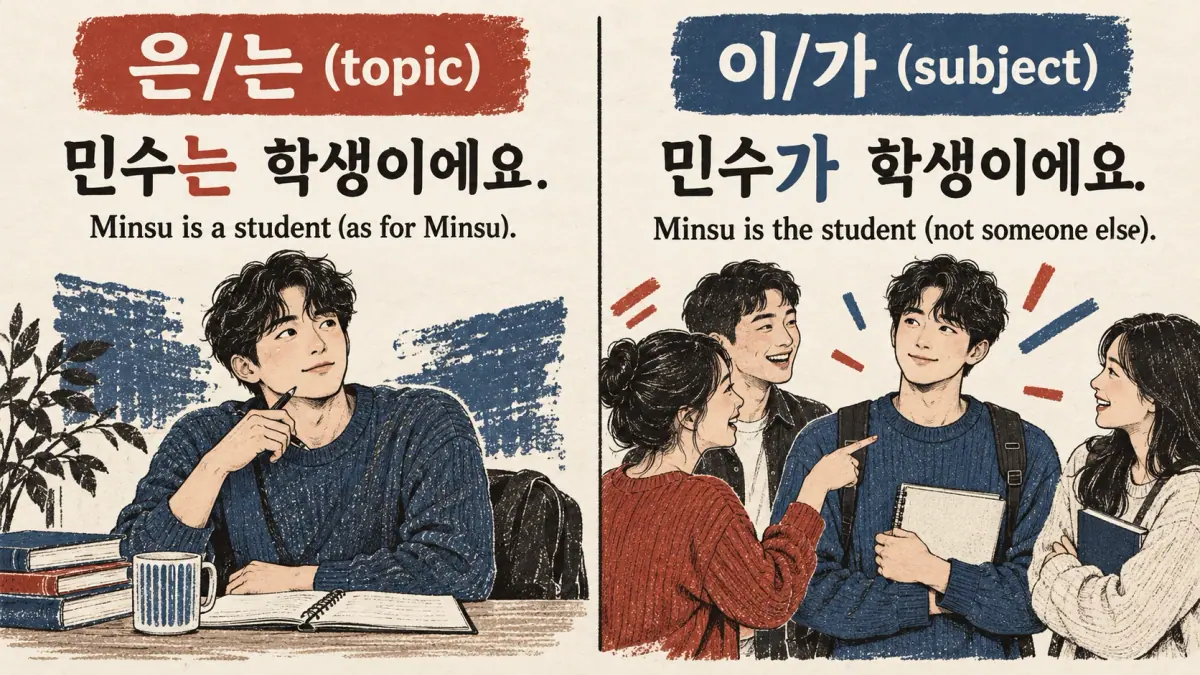
은/는 and 이/가 label different jobs, so the same noun can take either one and the meaning changes. The snapshot below uses the same words.
| 은/는 (topic) | 이/가 (subject) | |
|---|---|---|
| Main job | what the sentence is about, or a contrast | who or what does or is something |
| Question it answers | 민수는요? (what about Minsu?) | 누가 학생이에요? (who is the student?) |
| Example | 민수는 학생이에요. | 민수가 학생이에요. |
| Meaning | Minsu is a student (as for Minsu). | Minsu is the student (not someone else). |
| Forms | 은 after a consonant, 는 after a vowel | 이 after a consonant, 가 after a vowel |
The most common first mistake in this set is putting 은/는 on the word that answers a question. A who-question uses 이/가: 누가 왔어요? ("Who came?"), not 누구는 왔어요?. For a full explanation, read 은/는 vs 이/가.
How Do You Practise This Set?
Practise in three ways. First, finish the practice set at the end of each lesson; every answer has audio at normal and slow speed. Second, use the grammar quizzes to check your particle choices without looking at the table. Third, review the forms with the grammar flashcard decks. To check the verb endings in the examples, use the Korean verb conjugator.
The set of Korean topic and subject particles sits inside Korean particles. Next to it, many learners read the Korean object particles and the Korean location particles. Plan on about 25 minutes per lesson, which is roughly two to three hours for the whole set (a typical estimate, not a promise).
What this set does not cover: object, location and linking particles have their own sets, and verb endings belong to the conjugation lessons. The set is also written for English speakers who can read Hangul.
Frequently Asked Questions
Which Is the Topic Particle in Korean?
The topic particle is 은/는. Use 은 after a noun that ends in a consonant and 는 after a noun that ends in a vowel. It marks what the sentence is about, as in 저는 학생이에요 (as for me, I am a student). It also sets up a contrast between two things.
When Do I Use 께서?
Use 께서 in place of 이/가 when the person doing the action deserves respect, such as a teacher, a grandparent or a customer. The verb then carries the honorific -시-: 선생님께서 오셨어요 (the teacher came). It is a polite subject marker, so it appears mostly in respectful or formal speech.
How Do I Choose: 은/는 vs 이/가?
Ask what the sentence does. Use 이/가 to name who did something or to answer a question like 누가 (who). Use 은/는 to say what you are talking about or to contrast one thing with another. Neither is a fixed translation of English "the" or "a"; the choice depends on the context.
Which Lesson in Topic and Subject Particles Should I Read First?
Start with the topic particle 은/는 and then the subject particle 이/가, since the third lesson compares them. Read 께서 only after you are comfortable with 이/가, because it adds honorific verb endings. The double subject and particle dropping lessons come last, as they assume you know the basic particles.
Do I Have to Use These Particles in Speech?
In careful speech and writing, yes. In casual conversation Koreans often drop 은/는 and 이/가 when the meaning is clear, so 저 학생이에요 is common. Learn the particles first so that you know exactly what is being dropped, then practise leaving them out.