What you will learn
- Identify the final sound in 20 items and sort each into stops (ㄱ, ㄷ, ㅂ) or nasals (ㄴ, ㅁ, ㅇ).
- Hear that a stop ending is cut off without a puff of air.
- Recognise three spelling groups that sound identical, such as 낮 / 낫 / 낯.
Before you start: you should know the seven final sounds. Time: about 20 minutes. Audio plays only when you press a button.
Key Facts
- 밥/밤/방 differ only by ㅂ, ㅁ and ㅇ at the end.
- 박/밭/밥 differ only by the stop ending, and 밭 is spoken [받].
- 간/감/강 and 산/삼/상 give nasal triples.
- Stop endings are unreleased, so no puff of air follows.
- Items 1 to 10 drill stops and items 11 to 20 drill nasals, so a miss isolates the weak group.
Last updated: 2026-10-09.
What Is Korean Batchim Listening Practice?
Korean batchim listening practice is a discrimination task on final consonants: you hear a word and choose which ending it had. A batchim (받침) is a consonant written at the bottom of a Hangul block. At the end of a word, Korean allows only seven sounds there: ㄱ, ㄴ, ㄷ, ㄹ, ㅁ, ㅂ and ㅇ. This set uses six of them, split into stops (ㄱ, ㄷ, ㅂ) and nasals (ㄴ, ㅁ, ㅇ).
Listen to the stop set first. 밥 means cooked rice, 밭 means field and 박 means gourd.
Revised Romanization (RR), the official Latin-letter system, writes them as bap, bat and bak. RR is a learning aid on this page, and the Hangul and the audio are the reference. The next section explains why these endings are hard to hear.
Why Is This Hard for English Speakers?
English speakers find final consonants hard because English often releases its final stops, while Korean holds them closed. In a careful English "cap", the lips open at the end and a small puff follows. In Korean 밥 the lips close and stay closed, so the word ends in silence. A learner who adds the release makes the stops sound alike, or adds an extra vowel, as in "bap-eu".
Nasals bring a different problem. English has the same three sounds at the end of words (the finals of "sun", "sum" and "sung"), but learners often hear only two of them. The sound of final ㅁ before a pause is easily heard as ㄴ, so 감 can sound like 간.
| Group | Letters | Sound ends | Cue to listen for |
|---|---|---|---|
| Stops | ㄱ, ㄷ, ㅂ | in silence | the vowel is cut off, no hum, no puff |
| Nasals | ㄴ, ㅁ, ㅇ | in a hum | the sound keeps going through the nose |
Spelling adds a third trap. Several letters give the same final sound, so 밭 is spoken [받], and the spelling does not tell you the sound. Items 8 to 10 test exactly this. Next, how the set works.
How Does the Set Work?
The set works in three steps: listen, choose, then check the key. Every item plays one word, and you choose among two or three printed options.
- Press play on an item and listen once at normal speed.
- Ask first: did the sound stop in silence, or did it hum? That sorts the ending into a stop or a nasal.
- Choose the exact option, then replay at slow speed only if you are unsure.
- After item 20, open the answer key and score each half separately.
Items 1 to 10 contain stops, including three items where the spelling differs but the sound is identical. Items 11 to 20 contain nasals. You will know the method works when you decide stop or nasal before you read the options. The stops come first.
Listen: Items 1 to 10
Items 1 to 7 compare stop endings. Items 8 to 10 are same-sound items: the choices are different spellings, and the correct answer may be "same". For each item, press play, then choose one option.
Practice · Read
Show answer
밥
bap
cooked rice (slow)
Show answer
밤
bam
night (slow)
Show answer
방
bang
room (slow)
| Item | Choose one | Meanings | Group |
|---|---|---|---|
| 1 | 밥 / 박 | cooked rice / gourd | stops |
| 2 | 밭 [받] / 밥 | field / cooked rice | stops |
| 3 | 옷 [옫] / 옥 | clothes / jade | stops |
| 4 | 꽃 [꼳] / 꼭 | flower / without fail | stops |
| 5 | 북 / 붓 [붇] | drum / writing brush | stops |
| 6 | 목 / 못 [몯] | neck / nail | stops |
| 7 | 숲 [숩] / 숯 [숟] | forest / charcoal | stops |
| 8 | 낮 / 낫 | daytime / sickle | same-sound |
| 9 | 빛 / 빗 / 빚 | light / comb / debt | same-sound |
| 10 | 입 / 잎 | mouth / leaf | same-sound |
For items 8 to 10, the choices are spellings. The question is whether you can tell them apart by ear, and the key explains the result. The nasal half follows.
Listen: Items 11 to 20
Items 11 to 20 compare nasal endings. Pay attention to where the mouth closes: the lips for ㅁ, the tongue tip for ㄴ and the tongue back for ㅇ. Hear the model triple 산, 삼 and 상 first.
Practice · Read
Show answer
밥
bap
cooked rice (slow)
Show answer
밤
bam
night (slow)
Show answer
방
bang
room (slow)
| Item | Choose one | Meanings | Group |
|---|---|---|---|
| 11 | 산 / 삼 / 상 | mountain / three / prize | nasals |
| 12 | 간 / 감 / 강 | liver / persimmon / river | nasals |
| 13 | 반 / 밤 / 방 | half / night / room | nasals |
| 14 | 잔 / 잠 / 장 | cup / sleep / chapter, or market | nasals |
| 15 | 천 / 참 / 창 | cloth / truly / window | nasals |
| 16 | 단 / 담 | bundle / wall | nasals |
| 17 | 곰 / 공 | bear / ball | nasals |
| 18 | 김 / 긴 | dried seaweed / long | nasals |
| 19 | 신 / 심 | shoes / core | nasals |
| 20 | 남 / 난 | other people / orchid | nasals |
When both halves are done, use the key.
Answer Key and Scoring
The answer key lists the word played in each item with a cue. The interactive set reveals it only after you submit. Count one point per correct choice at the first listen.
| Item | Played | Cue |
|---|---|---|
| 1 | 박 | tongue back closes, silence |
| 2 | 밭 [받] | tongue tip closes, silence |
| 3 | 옷 [옫] | tongue tip closes, silence |
| 4 | 꼭 | tongue back closes, silence |
| 5 | 붓 [붇] | tongue tip closes, silence |
| 6 | 목 | tongue back closes, silence |
| 7 | 숯 [숟] | tongue tip closes, silence |
| 8 | same | 낮 and 낫 are both [낟] |
| 9 | same | 빛, 빗 and 빚 are all [빋] |
| 10 | same | 입 and 잎 are both [입] |
| 11 | 삼 | lips closed, hum |
| 12 | 강 | tongue back raised, hum at the back |
| 13 | 반 | tongue tip, hum behind the teeth |
| 14 | 잠 | lips closed, hum |
| 15 | 창 | tongue back raised, hum at the back |
| 16 | 단 | tongue tip, hum |
| 17 | 공 | tongue back raised |
| 18 | 김 | lips closed |
| 19 | 신 | tongue tip |
| 20 | 남 | lips closed |
Items 8 to 10 count as correct when you choose "same". Score each half on its own.
| Half | Score out of 10 | Next action |
|---|---|---|
| Stops (1 to 10) | 8 to 10 | Stops are stable |
| Stops (1 to 10) | 0 to 7 | Review the stop endings, then retest |
| Nasals (11 to 20) | 8 to 10 | Nasals are stable |
| Nasals (11 to 20) | 0 to 7 | Review the nasal endings, then retest |
A total of 16 or more out of 20 is a sensible target. The score is a self-check and does not judge your pronunciation. If one half is clearly lower, that half is your weak group.
What to Do after a Low Score?
After a low score, practise the weaker half only, and use the mouth-closure cue. Compare your two half-scores first.
- Stops weak: say 밥 and keep the lips shut after the vowel. The word should end in silence with no puff. Then do the same for 밭 with the tongue tip up and 박 with the tongue back up.
- Nasals weak: hum the end of 삼, 산 and 상 in turn and feel where the hum sits: lips, behind the teeth, then the back of the mouth.
- Same-sound items weak: learn the spoken form from the spelling lesson, not by ear alone. Spelling is checked in dictation, not in listening.
For the full rules, see batchim pronunciation, and for reading the same words, see Korean batchim reading practice. Retest after a day. The worked example takes one set through the whole routine.
Worked Example: 밥 / 밤 / 방
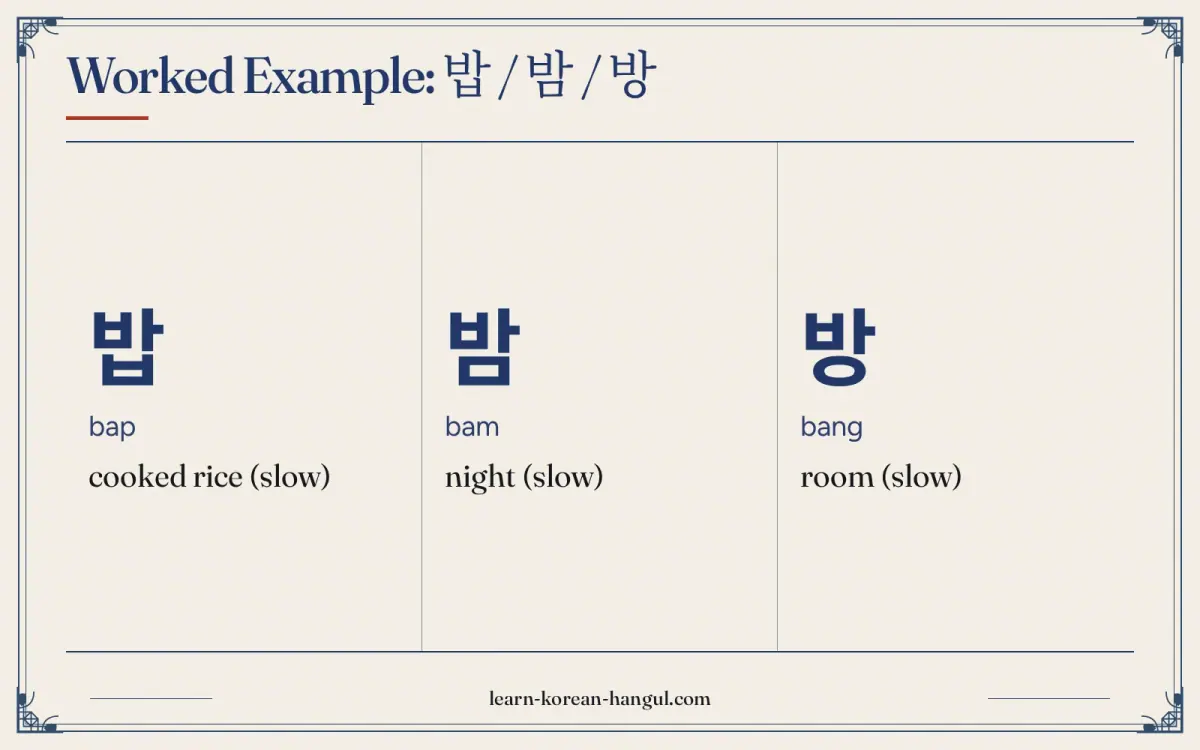
The worked example takes one triple that mixes a stop with two nasals.
- Listen. Play the three slow clips in order.
밥
bap
cooked rice (slow)
밤
bam
night (slow)
방
bang
room (slow)
- Ask the first question. Did the sound stop in silence or hum? 밥 stops, while 밤 and 방 hum.
- Name the closure. For 밥 and 밤 the lips close. For 방 the tongue back rises and the lips stay open.
- Choose between the two nasals. If the lips closed, it is 밤. If the lips stayed open, it is 방.
- Say it. Say 밥 and hold the lips shut, then 밤 and hum, then 방 and hum with open lips.
After the three words, repeat the questions on 산 / 삼 / 상. The mistakes to avoid come next.
What Mistakes Do Learners Make Here?
The most common mistake is to listen for a burst of air at the end of a stop, and the second is to confuse ㅁ with ㄴ.
- Learners often assume the final stop has a release. Actually Korean leaves it closed, so 밥 ends in silence, and listening for a puff finds nothing.
- Learners often assume ㅁ and ㄴ are interchangeable at the end of a word. Actually the lips close for ㅁ and stay open for ㄴ, so 감 and 간 are different words.
- Learners often assume the spelling shows the final sound. Actually 낮, 낫 and 낯 are all [낟], so the sound cannot tell you which spelling to write.
Hearing final ㅁ as ㄴ before a pause is a common learner error, and it is more likely when a word is said quickly. Replay at slow speed to check the lips. The written check is next.
Practice and Answer Key
Use this written check after the audio set. For each spoken form, choose the spelling.
- [받]: 밥, 밭 or 박?
- [꼳]: 꽃 or 꼭?
- [삼]: 산, 삼 or 상?
- [강]: 간, 감 or 강?
- [붇]: 북 or 붓?
- [빋]: 빛 or 빗 or 빚? Explain.
Answer key: 1. 밭. 2. 꽃. 3. 삼. 4. 강. 5. 붓. 6. Any of the three; the sound is the same, and only context or a dictation hint shows the spelling.
As a speaking task, say each of 밥, 밤 and 방 twice and record yourself. Check that 밥 ends in silence and the other two hum. The word pairs behind this set are explained in Korean minimal pairs. Before this lesson, review Korean Vowel Listening Practice.
Where to Go Next
The Korean batchim listening practice above covers six single final sounds in 20 items. It does not cover the ㄹ final, two-letter endings such as 닭 or 값, or how an ending changes before a vowel. It does not judge how you speak. Combine it with the listening strategies for better results.
Next: Korean Numbers Listening Practice. To return to all the drills, see Sound Discrimination.
Frequently Asked Questions
Why don't final ㄱ, ㄷ and ㅂ have a release? In standard Korean the mouth closes and stays closed at the end of a word. The 표준 발음법 (standard pronunciation rules, Articles 8 and 9) allows only seven sounds at the end of a syllable, and descriptions of Korean pronunciation treat the three stops as unreleased. Listen for a word that ends in silence, not a puff of air.
How do I hear ㅁ versus ㅇ? Look at the lips. For ㅁ the lips close, as in 삼. For ㅇ the lips stay open and the tongue back rises, as in 상. Both hum through the nose. Replay at slow speed and say each word aloud, and the difference becomes easy to feel.
Why does 밭 sound like 밥? It does not sound exactly alike, but both end in a closed stop, and learners hear only the closure. 밭 is spoken [받] with the tongue tip up, and 밥 closes the lips. Replay both slow clips and ask where the sound was cut off.
Can I tell the ending from the next word's start? Not always. When a vowel follows, the ending moves to the next syllable, so 밭이 sounds like [바치]. This set uses single words said alone, so no linking occurs. Linking is taught in the sound-change lessons, and you should expect it in real speech.