What you will learn
- Identify the number heard in at least 18 of 20 items.
- Choose the right number system for age, hours, counting, prices and phone numbers.
- Tell 십오 (15) from 오십 (50), and 세 (three) from 네 (four), by ear.
Before you start: you should know Sino-Korean numbers and native Korean numbers. Time: about 20 minutes. Audio plays only when you press a button.
Key Facts
- 스물세 살 uses native numbers for age.
- 삼천오백 원 uses Sino-Korean numbers for money.
- 십오 and 오십 test word order inside a number.
- 열두 시 uses a native number for the hour.
- One item uses 만 (ten thousand) for large-number practice.
Last updated: 2026-10-09.
What Is Korean Numbers Listening Practice?
Korean numbers listening practice is a discrimination task on spoken numbers: you hear a phrase and choose which of two numbers was said. Korean has two number systems. Sino-Korean numbers (일, 이, 삼) come from Chinese and are used for prices, dates and phone numbers. Native Korean numbers (하나, 둘, 셋) are used for age, hours and counting things. The system also tells you the context, so choosing it is part of listening.
Listen to the first pair. 십오 means 15 and 오십 means 50.
Revised Romanization (RR), the official Latin-letter system, writes them as sibo and osip. RR is a learning aid on this page, and the Hangul and the audio are the reference. The next section explains why numbers by ear are hard.
Why Is This Hard for English Speakers?
English speakers find Korean numbers hard by ear because the order of tens and units is different, and two systems share one language. In English, "fifteen" and "fifty" differ by stress and a final sound. In Korean, 십오 and 오십 use the same two syllables in reverse order, so the order of syllables is the whole difference.
| Problem | Example | What to listen for |
|---|---|---|
| Same syllables, reversed | 십오 (15) / 오십 (50) | whether 십 (ten) comes first or last |
| Two systems | 스물세 살 vs 이십삼 | the context word: 살 (years of age) takes native numbers |
| Short forms before counters | 세 개, 네 개 | 세 (3) and 네 (4) differ only in the first consonant |
| Large numbers | 이만 오천 원 | 만 (ten thousand) is the unit, not 천 |
Typical trouble spots for beginners are the teens and tens, 세 and 네, and the way 만 groups numbers in fours of zeros instead of threes. These are common patterns, not measured rates. Listen to four more phrases before the set starts.
Next, how the set works.
How Does the Set Work?
The set works in three steps: listen, choose, then check the key. Every item plays one phrase, and you choose between two printed options that differ by one feature.
- Press play and listen once at normal speed.
- Look at the context word first (살, 시, 원, 개, 번). It tells you the number system.
- Choose the number you heard. Replay at slow speed only if you are unsure.
- After item 20, open the answer key and score yourself.
Items mix both systems on purpose, so the system you choose is part of the answer. You will know the method works when you pick the system before you decide the number. The first ten items come first.
Listen: Items 1 to 10
Items 1 to 10 mix tens and units, ages, hours, prices and counters. For each item, press play, then choose one option.
Practice · Read
Show answer
십오
sibo
15 (slow)
Show answer
오십
osip
50 (slow)
| Item | Choose one | Meaning | Tests |
|---|---|---|---|
| 1 | 십오 / 오십 | 15 / 50 | order of ten |
| 2 | 십육 / 육십 | 16 / 60 | order of ten |
| 3 | 이십 / 십이 | 20 / 12 | order of ten |
| 4 | 스물세 살 / 서른세 살 | 23 years old / 33 years old | native tens |
| 5 | 열두 시 / 두 시 | 12 o'clock / 2 o'clock | native hours |
| 6 | 삼천오백 원 / 오천삼백 원 | 3,500 won / 5,300 won | Sino-Korean prices |
| 7 | 만 원 / 천 원 | 10,000 won / 1,000 won | 만 versus 천 |
| 8 | 이만 오천 원 / 오만 이천 원 | 25,000 won / 52,000 won | 만 grouping |
| 9 | 세 개 / 네 개 | 3 items / 4 items | 세 versus 네 |
| 10 | 한 명 / 두 명 | 1 person / 2 people | short native forms |
Items 4, 5, 9 and 10 use native numbers, and items 6 to 8 use Sino-Korean numbers. The remaining items continue.
Listen: Items 11 to 20
Items 11 to 20 add digits, years, phone numbers and more ages. Items 11, 12 and 14 to 17 use Sino-Korean numbers outside prices, and the other items use native numbers.
Practice · Read
Show answer
십오
sibo
15 (slow)
Show answer
오십
osip
50 (slow)
| Item | Choose one | Meaning | Tests |
|---|---|---|---|
| 11 | 칠 / 팔 | 7 / 8 | Sino-Korean digits |
| 12 | 육십 / 육백 | 60 / 600 | tens versus hundreds |
| 13 | 아홉 개 / 여덟 개 | 9 items / 8 items | native digits |
| 14 | 이천십육 년 / 이천육십 년 | year 2016 / year 2060 | year order |
| 15 | 백오십 / 오백십 | 150 / 510 | hundreds order |
| 16 | 삼 번 / 사 번 | number 3 / number 4 | 삼 versus 사 |
| 17 | 공일공 / 공이공 | 010 / 020 (phone digits) | digit-by-digit reading |
| 18 | 서른 살 / 마흔 살 | 30 years old / 40 years old | native tens |
| 19 | 일곱 살 / 열 살 | 7 years old / 10 years old | native 7 versus 10 |
| 20 | 스무 살 / 스물한 살 | 20 years old / 21 years old | 스무 versus 스물 |
Use the key in the next section.
Answer Key and Scoring
The answer key lists the phrase played in each item with a cue. The interactive set reveals it only after you submit. Count one point per correct choice at the first listen.
| Item | Played | Cue |
|---|---|---|
| 1 | 오십 | 오 first, then 십: 50 |
| 2 | 십육 | 십 first: 16 |
| 3 | 십이 | 십 first: 12 |
| 4 | 서른세 살 | 서른 is 30 |
| 5 | 열두 시 | 열 is 10, 두 is 2: 12 |
| 6 | 삼천오백 원 | 삼 (3) before 천 (1,000) |
| 7 | 만 원 | 만 is 10,000 |
| 8 | 오만 이천 원 | 오만 is 50,000 |
| 9 | 네 개 | 네 is 4 |
| 10 | 한 명 | 한 is 1 |
| 11 | 팔 | 8 |
| 12 | 육백 | 백 is 100: 600 |
| 13 | 여덟 개 | 여덟 is 8 |
| 14 | 이천십육 년 | 십육 is 16: 2016 |
| 15 | 오백십 | 오백 is 500, 십 is 10: 510 |
| 16 | 사 번 | 사 is 4 |
| 17 | 공일공 | 공 is 0, 일 is 1 |
| 18 | 마흔 살 | 마흔 is 40 |
| 19 | 열 살 | 열 is 10 |
| 20 | 스물한 살 | 스물 plus 한: 21 |
| Score out of 20 | Meaning | Next action |
|---|---|---|
| 18 to 20 | At or above 90 percent | Continue to time listening |
| 13 to 17 | Most numbers are stable | Repeat the missed category: tens, 만, or counters |
| 0 to 12 | Numbers by ear are not yet stable | Review both number systems, then retest |
The score is a self-check and does not judge your pronunciation. Where you missed items shows the next step.
What to Do after a Low Score?
After a low score, sort your misses into three categories: order, system and size. Fix one category at a time.
- Order misses (1 to 3, 14, 15): say each number slowly while writing the digits. Say 십오 as "ten-five" and 오십 as "five-ten" in your head.
- System misses (4, 5, 13, 18 to 20): use the context word. 살 (age) and 시 (hour) call for native numbers, and 원 (won) calls for Sino-Korean numbers. Read native Korean numbers again.
- Size misses (6 to 8, 12): practise 만. Say 만 원 aloud first, then 이만 원, then 오만 원.
For the number words, see Sino-Korean numbers, and for prices see Korean money numbers. Retest after a day. The worked example shows the full routine for 십오 / 오십.
Worked Example: 십오 / 오십
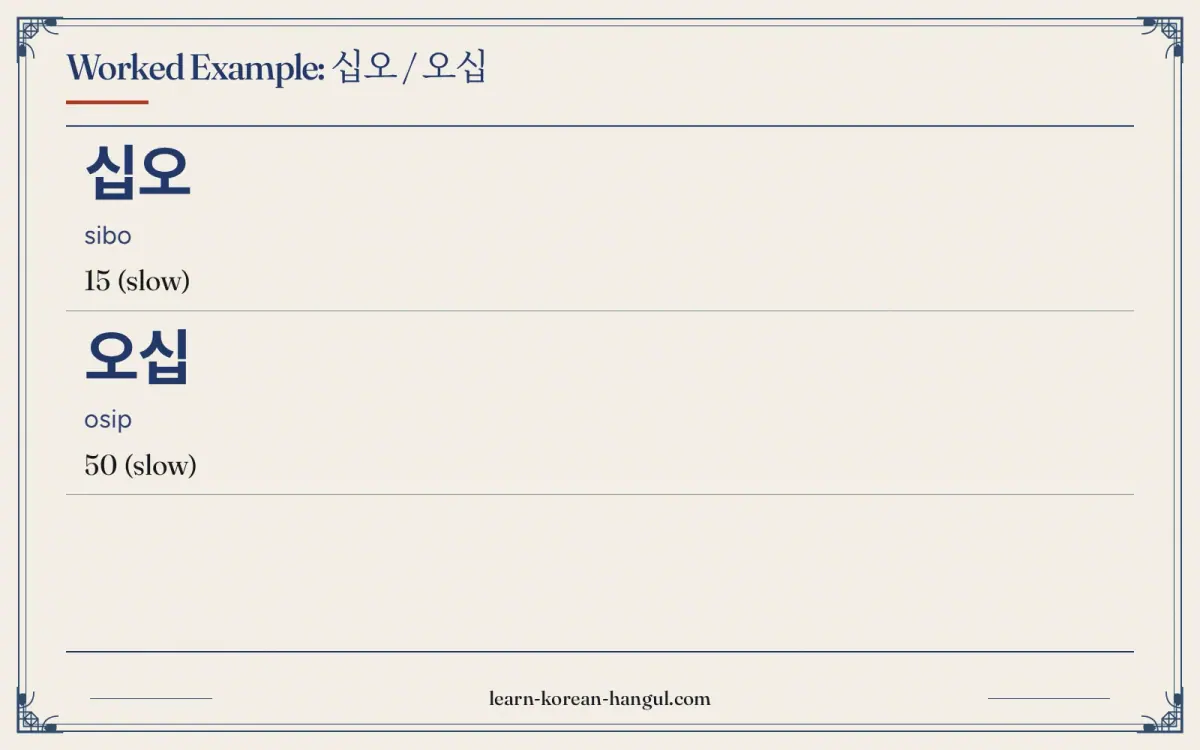
The worked example takes the most common confusion through the whole task.
- Listen. Play the two slow clips.
십오
sibo
15 (slow)
오십
osip
50 (slow)
- Find the ten. 십 means 10. Does it come first or last?
- Read the order. If 십 is first, the number is 10 plus the unit: 십오 is 10 + 5 = 15. If 십 is last, the number is the unit times 10: 오십 is 5 × 10 = 50.
- Check the sound. 십오 is spoken [시보], because the final ㅂ moves to the next syllable. 오십 ends in the closed sound [십].
- Write it. Write 15 or 50, and say it aloud once.
Apply the same order test to 십육 / 육십. The mistakes to avoid are next.
What Mistakes Do Learners Make Here?
The most common mistake is to choose the system from the number, not from the context word. The second is to translate "fifteen" and "fifty" directly.
- Learners often assume Korean has one number system. Actually it has two, so 스물세 살 (age) and 이십삼 (a count in dates or prices) use different words for 23.
- Learners often assume 십오 and 오십 are the same up to word order. Actually the order is the meaning, so 십 first means 10 plus, and 십 last means times 10.
- Learners often assume numbers group in thousands, as in English. Actually Korean groups in ten-thousands (만), so 25,000 is 이만 오천, "two ten-thousands and five thousand".
Native numbers change shape before counters: 하나 becomes 한, 둘 becomes 두, 셋 becomes 세, 넷 becomes 네 and 스물 becomes 스무. Listen for the short form. Test yourself with the written check below.
Practice and Answer Key
Use this written check after the audio set. Write the number.
- 오십 원
- 열다섯 살
- 오만 원
- 세 시 (hour)
- 공일일
Answer key: 1. 50 won. 2. 15 years old (native 열다섯). 3. 50,000 won. 4. 3 o'clock. 5. 011.
As a speaking task, read a phone number or a price from a receipt aloud, then record it. For more on the number words, see Korean money numbers. The word pairs behind this set are explained in Korean minimal pairs. Before this lesson, review Korean Batchim Listening Practice.
Where to Go Next
The Korean numbers listening practice above covers numbers up to the tens of thousands in 20 items. It does not cover numbers above 100,000, decimals, counters other than 개, 명, 살, 시 and 번, or full sentences. It does not judge how you speak. Combine it with the listening strategies for better results.
Next: Korean Time Listening Practice. To return to all the drills, see Sound Discrimination.
Frequently Asked Questions
How do I tell 십오 from 오십? Listen for the order of the syllables. In 십오 (15) the syllable 십 comes first, and in 오십 (50) it comes last. Say them slowly in your head as "ten-five" and "five-ten". The first syllable carries the meaning, so concentrate on what you hear before the pause.
Which system is used for age? Native Korean numbers are used for age with 살: 스물세 살 is 23 years old. Sino-Korean numbers appear with 세 in formal writing, as in 이십삼 세. In everyday speech, use the native number with 살, because it is the form you will hear most.
Why is the hour a native number? The counter 시 (o'clock) takes native numbers, as in 열두 시 (12 o'clock), while 분 (minutes) takes Sino-Korean numbers. This is a fixed convention of the language, not a rule that can be derived. The time listening practice drills the combination.
How are prices said in Korean? Prices use Sino-Korean numbers followed by 원 (won): 삼천오백 원 is 3,500 won. Large prices count in 만 (ten thousand), so 25,000 won is 이만 오천 원. Listen for 천 (thousand), 만 (ten thousand) and the digit before each, then write the digits in order.