What you will learn
- Identify the vowel in each of 20 items.
- Name the mouth cue for each pair: lip rounding for ㅓ/ㅗ and ㅡ/ㅜ, and tongue height for ㅐ/ㅔ.
- Say which of the three pairs is your weakest, and which lesson to open next.
Before you start: you should know the ten basic vowels in Korean vowels. Time: about 20 minutes. Audio plays only when you press a button.
Key Facts
- The set has 20 items: 7 for ㅓ/ㅗ, 7 for ㅡ/ㅜ and 6 for ㅐ/ㅔ.
- ㅓ/ㅗ items include 서/소 (west, cow), and ㅡ/ㅜ items include 그/구 (that, nine).
- ㅐ/ㅔ items include 개/게 (dog, crab).
- Most Seoul speakers today pronounce ㅐ and ㅔ the same, so those six items are marked as optional.
- The score is split by pair, so a miss shows which lesson to open.
Last updated: 2026-10-09.
What Is Korean Vowel Listening Practice?
Korean vowel listening practice is a discrimination task: you hear a short word or a single syllable and choose which of two vowels it contained. Each pair differs in one mouth feature, such as lip rounding. A syllable is one block of Hangul, such as 거. A wrong choice names a different syllable or word, so the task shows exactly which vowels you merge.
Listen to the first pair. 거 is a casual word for "thing", and 고 is a practice syllable with ㅗ.
Revised Romanization (RR), the official Latin-letter system, writes them as geo and go. RR is a learning aid on this page, and the Hangul and the audio are the reference. The next section explains why these vowels trip up English speakers.
Why Is This Hard for English Speakers?
English speakers find these pairs hard because English has no close match for ㅓ and ㅡ, and it uses lip rounding differently. English "uh" in "cut" sounds a little like ㅓ, but ㅓ is more open and further back. ㅡ has no English twin at all: the lips stay spread and the tongue sits high at the back.
| Pair | Main cue | Mouth position | Common English substitution |
|---|---|---|---|
| ㅓ / ㅗ | lip rounding and jaw | ㅓ: jaw open, lips relaxed. ㅗ: lips rounded, jaw less open | "uh" for ㅓ, "oh" for both |
| ㅡ / ㅜ | lip rounding | ㅡ: lips spread. ㅜ: lips pushed forward | "oo" for both |
| ㅐ / ㅔ | tongue height | ㅔ is slightly higher than ㅐ | "eh" for both |
The rounding cue is the key. Place a finger in front of your lips and say 구, then 그. The finger should feel the lips move forward for 구 but not for 그. Mouth cues like these help hearing as well as saying, because the shape of the lips changes the sound that comes out. Listen to one pair from each contrast before the set starts.
Each pair differs in one vowel only. Next, how the set is organised.
How Does the Set Work?
The set works in three steps: listen, choose, then check the key. Each item plays one syllable or word, and the options show two choices.
- Press play on an item and listen once at normal speed.
- Choose the option you heard before you read the meanings.
- Replay at slow speed only if you are unsure, and note which item needed it.
- After item 20, open the answer key and count misses for each pair.
The items are grouped by pair: items 1 to 7 are ㅓ/ㅗ, items 8 to 14 are ㅡ/ㅜ, and items 15 to 20 are ㅐ/ㅔ. Single syllables are marked, because some of them are practice syllables and not everyday words. You will know it is working when you can name the pair before reading the choices. Items 1 to 10 come first.
Listen: Items 1 to 10
Items 1 to 10 cover all seven ㅓ/ㅗ items and the first three ㅡ/ㅜ items. For each item, press play, then choose one option.
Practice · Read
Show answer
거
geo
thing, casual (slow)
Show answer
고
go
practice syllable (slow)
| Item | Choose one | Meanings | Pair |
|---|---|---|---|
| 1 | 거 / 고 | thing (casual) / practice syllable | ㅓ/ㅗ |
| 2 | 서 / 소 | west, as in 서쪽 / cow | ㅓ/ㅗ |
| 3 | 점 / 좀 | dot / a little | ㅓ/ㅗ |
| 4 | 벌 / 볼 | bee / cheek | ㅓ/ㅗ |
| 5 | 선 / 손 | line / hand | ㅓ/ㅗ |
| 6 | 멀다 / 몰다 | to be far / to drive | ㅓ/ㅗ |
| 7 | 정 / 종 | affection / bell | ㅓ/ㅗ |
| 8 | 그 / 구 | that / nine | ㅡ/ㅜ |
| 9 | 글 / 굴 | writing / oyster | ㅡ/ㅜ |
| 10 | 은 / 운 | silver / luck | ㅡ/ㅜ |
Items 1 to 7 should be easier if you watch the jaw: ㅓ opens it, ㅗ rounds the lips. The remaining items continue.
Listen: Items 11 to 20
Items 11 to 14 finish the ㅡ/ㅜ pair, and items 15 to 20 are the optional ㅐ/ㅔ items. The standard pronunciation rules still list ㅐ and ㅔ as two vowels, but most Seoul speakers today pronounce them the same, so a low score on items 15 to 20 is common and does not count against you.
Practice · Read
Show answer
거
geo
thing, casual (slow)
Show answer
고
go
practice syllable (slow)
| Item | Choose one | Meanings | Pair |
|---|---|---|---|
| 11 | 근 / 군 | a unit of weight / army or county | ㅡ/ㅜ |
| 12 | 므 / 무 | practice syllable / radish | ㅡ/ㅜ |
| 13 | 스 / 수 | practice syllable / number | ㅡ/ㅜ |
| 14 | 드 / 두 | practice syllable / two | ㅡ/ㅜ |
| 15 | 개 / 게 | dog / crab | ㅐ/ㅔ (optional) |
| 16 | 새 / 세 | bird / three, before a counter | ㅐ/ㅔ (optional) |
| 17 | 내 / 네 | my / your, or yes | ㅐ/ㅔ (optional) |
| 18 | 배 / 베 | pear, or ship / hemp cloth | ㅐ/ㅔ (optional) |
| 19 | 재 / 제 | ash / my, humble form | ㅐ/ㅔ (optional) |
| 20 | 대 / 데 | stalk, or big / place or situation | ㅐ/ㅔ (optional) |
Check your answers in the next section.
Answer Key and Scoring
The answer key lists the word played in each item and the cue to listen for. The interactive set reveals it only after you submit. Count one point per correct choice at the first listen.
| Item | Played | Cue |
|---|---|---|
| 1 | 고 | lips rounded |
| 2 | 서 | jaw open, lips relaxed |
| 3 | 좀 | lips rounded |
| 4 | 벌 | jaw open |
| 5 | 손 | lips rounded |
| 6 | 멀다 | jaw open |
| 7 | 종 | lips rounded |
| 8 | 구 | lips pushed forward |
| 9 | 글 | lips spread |
| 10 | 운 | lips pushed forward |
| 11 | 근 | lips spread |
| 12 | 무 | lips pushed forward |
| 13 | 스 | lips spread |
| 14 | 두 | lips pushed forward |
| 15 to 20 | 개, 세, 네, 배, 재, 대 | ㅐ is slightly lower; most Seoul speakers do not make the difference |
Score the core pairs separately from the optional pair.
| Score | Meaning | Next action |
|---|---|---|
| 12 to 14 out of 14 on ㅓ/ㅗ and ㅡ/ㅜ | At or above 85 percent | Move on to final consonants |
| 8 to 11 out of 14 | Pairs are partly stable | Open the weakest pair's lesson and repeat |
| 0 to 7 out of 14 | The vowel pairs are not yet stable | Review Korean vowel pronunciation first |
Report ㅐ/ㅔ as a separate score out of 6, and use it for information only. The pair with the most misses is your weakest pair.
What to Do after a Low Score?
After a low score, work on the weakest pair only, using its mouth cue. The count of misses per pair tells you where to start.
- ㅓ/ㅗ weakest: say 서 and 소 in front of a mirror. For 소 the lips make a circle, and for 서 they do not.
- ㅡ/ㅜ weakest: say 그 and 구 with a finger near the lips, and feel the lips move forward only for 구.
- ㅐ/ㅔ weakest: do nothing special. If you cannot hear the difference, you sound like most Seoul speakers, and context tells listeners which word you meant.
Replay the missed items at slow speed, then retest after a day. For letters and sounds, see the Korean vowels lessons and Korean vowel pronunciation. The worked example now takes one pair through the whole task.
Worked Example: 거 / 고
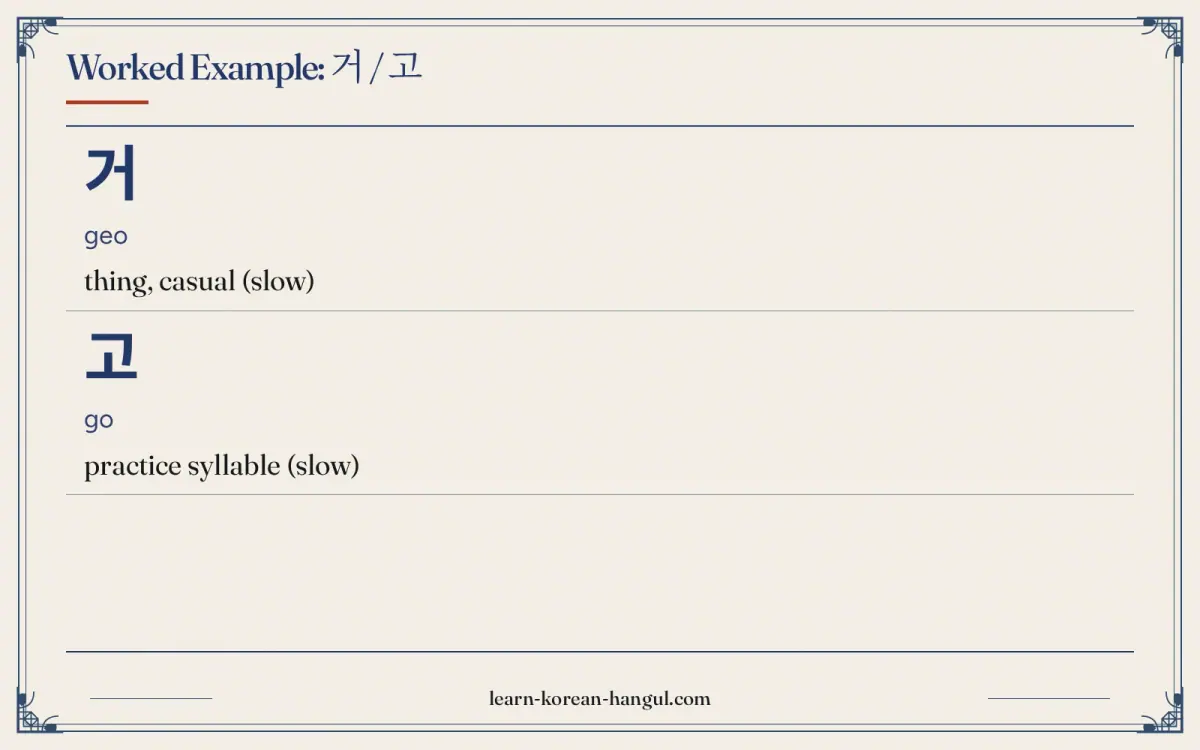
The worked example takes the pair 거 / 고 through the whole task.
- Listen. Play the slow clips in order.
거
geo
thing, casual (slow)
고
go
practice syllable (slow)
- Ask the lip question. Did the lips make a circle at the end? Only 고 does that.
- Ask the jaw question. Did the jaw drop open? That is 거.
- Choose. Replay item 1 of the set and choose the one you heard.
- Say it. Say 거, then 고. In the second word, feel the lips round.
Now repeat the routine with 그 / 구 and 개 / 게. The next section lists the mistakes to avoid.
What Mistakes Do Learners Make Here?
The most common mistake is to hear ㅓ as an English "o", and the second is to treat ㅡ as "oo".
- Learners often assume ㅓ is the "o" sound. Actually ㅓ is an open vowel with relaxed lips, close to the "uh" in "cut" but further back, so 서 and 소 differ in lip shape.
- Learners often assume ㅡ and ㅜ are both "oo". Actually ㅡ has spread lips and ㅜ has pushed-forward lips, so 그 and 구 differ in rounding.
- Learners often assume every vowel pair must be heard. Actually the standard pronunciation rules (표준 발음법, Article 4) still list ㅐ and ㅔ as two vowels, but most Seoul speakers today pronounce them the same, so context decides.
Vowel quality also varies by speaker and region, and the cues above describe typical careful speech. The written check is next.
Practice and Answer Key
Use this written check after the audio set. Each line gives Revised Romanization. Choose the Hangul.
- seo or so for "cow"?
- geul or gul for "oyster"?
- un or eun for "silver"?
- gae or ge for "crab"?
- son or seon for "hand"?
Answer key: 1. so, 소. 2. gul, 굴. 3. eun, 은. 4. ge, 게. 5. son, 손.
As a speaking task, say 그 and 구 five times each and watch your lips in a mirror. The word pairs behind this set are explained in Korean minimal pairs. Before this lesson, review Plain Tense Aspirated Listening Practice.
Where to Go Next
The Korean vowel listening practice above covers three vowel pairs in 20 items. It does not cover diphthongs such as ㅘ or ㅢ, final consonants, or sentences, and it does not judge your pronunciation. Combine it with the listening strategies for better results.
Next: Korean Batchim Listening Practice. To return to all the drills, see Sound Discrimination.
Frequently Asked Questions
Why can't I hear ㅐ versus ㅔ? Most Seoul speakers today pronounce them the same, although the standard pronunciation rules still list two vowels. If you cannot hear a difference, you are in good company. Treat items 15 to 20 as optional, and rely on context to tell 개 (dog) from 게 (crab).
Are ㅓ and ㅗ very different in Korean? Yes, in lip shape and jaw opening. ㅓ is open with relaxed lips, and ㅗ rounds the lips into a circle. English speakers merge them because English "o" and "uh" are used loosely. Say 서 and 소 in a mirror to see and feel the difference.
How is ㅡ made compared with ㅜ? Both are high back vowels, with the tongue raised toward the back. For ㅡ the lips stay spread, as if smiling slightly. For ㅜ the lips push forward and round. The lips are the whole difference, so watch them in a mirror when you say 그 and 구.
Do native speakers confuse these pairs? Korean speakers keep ㅓ/ㅗ and ㅡ/ㅜ clearly apart, because many words differ only in these vowels. The ㅐ/ㅔ pair is the exception: most Seoul speakers merge it. So practise the first two pairs for accuracy, and treat the third as a recognition skill for reading.