What you will learn
- Pick the right word from a plain, tense and aspirated triple in at least 16 of 20 items.
- Name the cue that separates the three sounds: puff of air, tight throat, or neither.
- Find out whether your weak spot is ㄱ, ㄷ, ㅂ, ㅈ or ㅅ.
Before you start: you should know the letters ㄱ ㄲ ㅋ, ㄷ ㄸ ㅌ, ㅂ ㅃ ㅍ, ㅈ ㅉ ㅊ and ㅅ ㅆ. Time: about 20 minutes. Audio plays only when you press a button.
Key Facts
- The set has 20 items: items 1 to 10 are mostly triples and pairs at the start of a word, and items 11 to 20 are mixed word positions.
- Triples used include 달/딸/탈 (moon, daughter, mask) and 불/뿔/풀 (fire, horn, grass).
- 살/쌀 tests ㅅ against ㅆ, a two-way contrast, because ㅅ has no aspirated partner.
- Four items put the consonant between two vowels, where plain sounds are voiced.
- Each answer comes with a one-line cue, and the set is scored out of 20.
Last updated: 2026-10-09.
What Is Plain Tense Aspirated Listening Practice?
Plain tense aspirated listening practice is a discrimination task: you hear a Korean word and choose which of two or three near-identical words it was. Korean has three versions of each of the stops ㄱ, ㄷ, ㅂ and the affricate ㅈ. They are called plain (ㄷ), tense (ㄸ) and aspirated (ㅌ). The sounds are different consonants, so a wrong choice gives you a different word.
Listen to the first triple. 달 means moon, 딸 means daughter and 탈 means mask.
Revised Romanization (RR), the official Latin-letter system, writes them as dal, ttal and tal. RR is a learning aid here, and the Hangul and the audio are the reference. The next section explains why an English ear finds these three hard to separate.
Why Is This Hard for English Speakers?
English speakers find the contrast hard because English has only two categories where Korean has three. English separates "d" from "t", and it decides mainly by voicing and by a puff of air after word-initial "t". Korean plain, tense and aspirated stops are all voiceless at the start of a word, so voicing cannot help.
The three categories map onto English like this:
| Korean | Example | What to listen for | Closest English habit |
|---|---|---|---|
| Plain ㄷ | 달 | soft start, a slight breathy release | between "d" and "t" |
| Tense ㄸ | 딸 | tight throat, no puff, a short hold before the vowel | the "t" in "stay", with no puff |
| Aspirated ㅌ | 탈 | a strong, audible puff of air | the "t" in "top" |
A learner usually hears tense as "d" or as plain, because the tense stop has no puff. Plain is the middle category, so it is the one most often missed. Phonetic studies of Seoul Korean also report that the pitch at the start of the next vowel carries part of the contrast, with a higher start after tense and aspirated sounds than after plain ones. Treat this as a tendency to notice, not a rule you must hear.
Between two vowels the picture changes. A plain stop becomes voiced there, so 아가 (baby, affectionate) has a soft [g], while 아까 (a moment ago) has a tight, held [kk]. Items in the second half use this position. Next, the mechanics of the set.
How Does the Set Work?
The set works in three steps: listen, choose, then check the key. Every item plays one word, and you choose among two or three printed options.
- Press play on an item and listen once at normal speed.
- Choose the option you heard. Do not read the options aloud first, because saying them out loud can bias what you hear.
- Replay at slow speed only if you are unsure, and mark that item as "slow" in your notes.
- After item 20, open the answer key and score yourself. A slow replay still counts as correct, but record it as a weak item.
Items come in matched sets, so only one feature changes at a time. The five consonant families (ㄱ, ㄷ, ㅂ, ㅈ, ㅅ) get four items each, and the played answers are spread across plain, tense and aspirated, so always guessing one category cannot pass. You will know the method works when your choice happens before you read the options. Items 1 to 10 come first.
Listen: Items 1 to 10
Items 1 to 10 use word-initial triples and pairs. For each item, press play, then choose one option from the list.
Practice · Read
Show answer
달
dal
moon (slow)
Show answer
딸
ttal
daughter (slow)
Show answer
탈
tal
mask (slow)
| Item | Choose one | Meanings |
|---|---|---|
| 1 | 달 / 딸 / 탈 | moon / daughter / mask |
| 2 | 불 / 뿔 / 풀 | fire / horn / grass |
| 3 | 자다 / 짜다 / 차다 | to sleep / to be salty / to be cold |
| 4 | 개 / 깨 / 캐다 | dog / sesame / to dig up |
| 5 | 발 / 빨다 / 팔 | foot / to wash laundry / arm |
| 6 | 지다 / 찌다 / 치다 | to lose / to steam / to hit |
| 7 | 살 / 쌀 | flesh, or age / uncooked rice |
| 8 | 사다 / 싸다 | to buy / to be cheap |
| 9 | 상 / 쌍 | prize / pair |
| 10 | 고리 / 꼬리 | ring / tail |
Items 7 to 9 test ㅅ against ㅆ. Korean has no aspirated ㅅ, so this is a two-way contrast. Items 11 to 20 move the consonant around in the word.
Listen: Items 11 to 20
Items 11 to 20 mix word positions and add two-way pairs, including one tense-versus-aspirated pair (item 18). Items 11, 12, 14 and 15 put the consonant between two vowels, where plain sounds are voiced.
Practice · Read
Show answer
달
dal
moon (slow)
Show answer
딸
ttal
daughter (slow)
Show answer
탈
tal
mask (slow)
| Item | Choose one | Meanings | Position |
|---|---|---|---|
| 11 | 아빠 / 아파 | dad / it hurts | between vowels |
| 12 | 아가 / 아까 | baby (affectionate) / a moment ago | between vowels |
| 13 | 들 / 뜰 / 틀 | field / yard / frame | word start |
| 14 | 토기 / 토끼 | earthenware / rabbit | between vowels |
| 15 | 기자 / 기차 | reporter / train | between vowels |
| 16 | 방 / 빵 | room / bread | word start |
| 17 | 덕 / 떡 / 턱 | virtue / rice cake / chin | word start |
| 18 | 따다 / 타다 | to pick / to ride | word start |
| 19 | 시 / 씨 | poem / seed | word start |
| 20 | 자 / 차 | ruler / car | word start |
Score yourself with the key that follows.
Answer Key and Scoring
The answer key lists the word played in each item together with one cue. The interactive set plays the clips in the order shown in the tables, and it reveals this key only after you submit. Count one point for each correct choice at the first listen.
| Item | Played | Cue |
|---|---|---|
| 1 | 딸 | tight throat, no puff |
| 2 | 풀 | strong puff on ㅍ |
| 3 | 짜다 | tight, held ㅉ |
| 4 | 깨 | tense ㄲ, no puff |
| 5 | 팔 | strong puff on ㅍ |
| 6 | 지다 | soft ㅈ, faint breath |
| 7 | 쌀 | ㅆ is longer and tighter than ㅅ |
| 8 | 싸다 | tight, long hiss |
| 9 | 상 | short, soft hiss |
| 10 | 고리 | soft ㄱ at the start |
| 11 | 아파 | puff on ㅍ between vowels |
| 12 | 아까 | held, tight ㄲ between vowels |
| 13 | 틀 | strong puff on ㅌ |
| 14 | 토끼 | tense ㄲ after the first vowel |
| 15 | 기차 | strong puff on ㅊ |
| 16 | 빵 | tense ㅃ |
| 17 | 덕 | soft ㄷ, faint breath |
| 18 | 타다 | strong puff on ㅌ |
| 19 | 시 | soft ㅅ, short hiss |
| 20 | 자 | soft ㅈ |
Use this scale for your score.
| Score out of 20 | Meaning | Next action |
|---|---|---|
| 16 to 20 | At or above 80 percent | Continue to vowel listening |
| 11 to 15 | Most contrasts are stable | Repeat the missed consonant family |
| 0 to 10 | The three-way contrast is not yet stable | Review the sound lesson, then retest |
The score is a self-check and does not judge your pronunciation. A score of 16 or more on two separate days is a sensible sign that you are ready to move on. The next section covers what to do if the score is lower.
What to Do after a Low Score?
After a low score, review one consonant family at a time rather than the whole set. Find which of the ㄱ, ㄷ, ㅂ, ㅈ and ㅅ families cost you the most points, and replay only those items at slow speed.
- Mostly plain heard as tense: relax your throat while listening, and expect a soft start with a faint breath.
- Mostly aspirated missed: hold a tissue near your mouth when you say 탈 and 풀; it should move for aspirated sounds only.
- ㅅ versus ㅆ missed: listen for length. ㅆ keeps the hissing sound tighter and longer.
For practice with the sounds themselves, use the lesson on plain, tense and aspirated sounds. Retest after a day, not straight away. The worked example shows the full routine for one triple.
Worked Example: 달 / 딸 / 탈
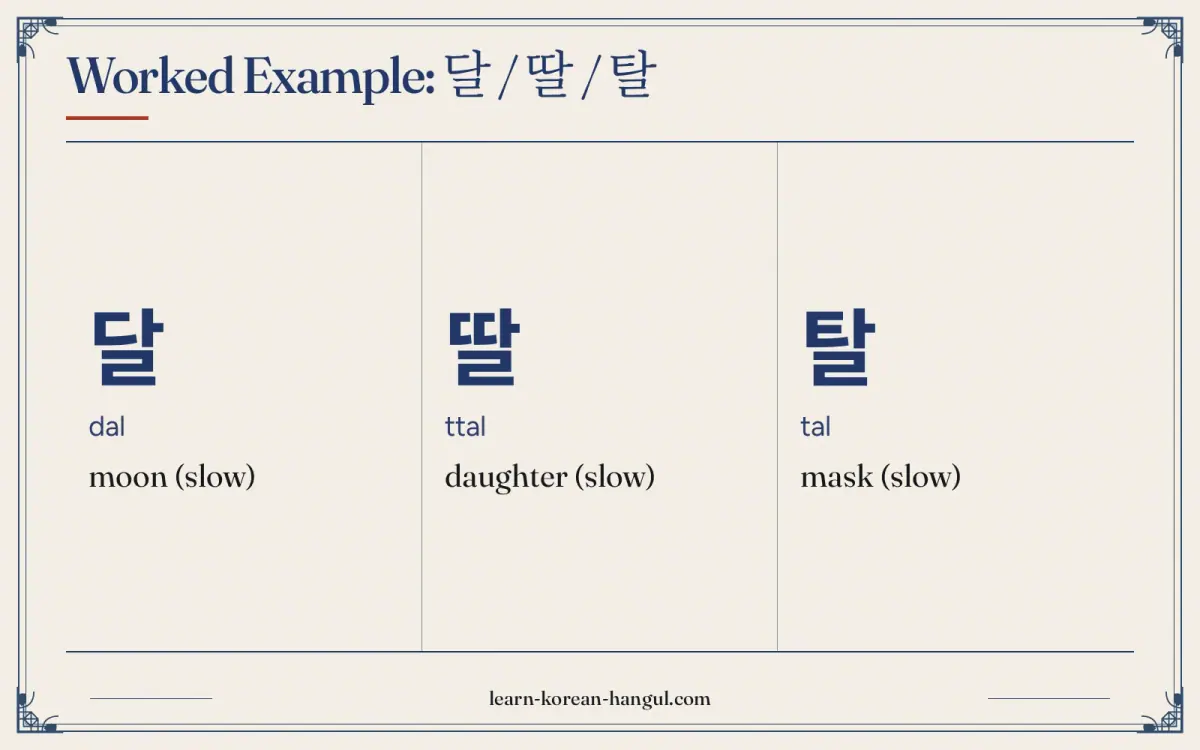
The worked example takes one triple through the whole task, from listening to saying.
- Listen. Play the three slow clips in order.
달
dal
moon (slow)
딸
ttal
daughter (slow)
탈
tal
mask (slow)
- Ask the airflow question. Is there a puff? Only 탈 has a strong one.
- Ask the throat question. Does the throat feel tight, with the vowel starting abruptly? That is 딸.
- Decide by elimination. The word with no puff and no tightness is 달.
- Say it. Say each word with a hand in front of your mouth. Only 탈 should push the hand.
After the three words, play the same pair of questions on 불 / 뿔 / 풀. Next, the errors to avoid.
What Mistakes Do Learners Make Here?
The most common mistake is to treat tense as louder, and the second is to expect voicing at the start of a word. Both come from English habits.
- Learners often assume tense means loud or emphatic. Actually tense is about a tight throat and a short, held closure, so 딸 can be spoken quietly and still be tense.
- Learners often assume plain ㄷ is the same as English "d". Actually plain ㄷ is voiceless at the start of a word, and it only turns voiced between vowels, as in 아가.
- Learners often assume aspirated and tense are both "strong". Actually aspirated has a puff and tense has none, so they differ on the airflow cue.
Regional and generational variation exists, and the cues above are tendencies in careful speech. The set also trains easy items first: 자다 / 짜다 / 차다 tends to be the clearest for beginners, because the aspirated 차다 has an obvious puff, while 사다 / 싸다 is typically hardest, because the only difference is tension and length. These are typical patterns, so your own order may differ. Try the written check below.
Practice and Answer Key
Use these written checks after the audio set. Each line gives the romanization of a word you have heard on this page. Choose the Hangul.
- dal, ttal or tal for "daughter"?
- bul, ppul or pul for "grass"?
- jada, jjada or chada for "to be salty"?
- ssal or sal for "uncooked rice"?
- appa or apa for "it hurts"?
Answer key: 1. ttal, 딸. 2. pul, 풀. 3. jjada, 짜다. 4. ssal, 쌀. 5. apa, 아파.
As a speaking task, say 달, 딸, 탈 three times each with a hand in front of the mouth and record yourself. Feel the puff for 탈 only. You can read more word pairs in Korean minimal pairs, and the letters themselves are taught in Korean double consonants.
Where to Go Next
The plain tense aspirated listening practice above covers word-initial and word-medial consonants in 20 items. It does not test final consonants, vowels or sentences, and it does not judge how you speak. Pair it with the listening strategies for better results, and the word pairs behind this set are explained in Korean minimal pairs.
Next: Korean Vowel Listening Practice. To return to all the drills, see Sound Discrimination.
Frequently Asked Questions
Why do 달, 딸 and 탈 sound alike to me? English has no three-way split, so your ear merges them into two groups. Start by finding the puff in 탈, which is the easiest to hear, then compare 딸 and 달 by throat tension. Slow clips help, and the contrast usually becomes clearer after several short sessions across different days.
Is the difference loudness or breath? Breath and tension, not loudness. Aspirated sounds such as ㅌ release a strong puff of air. Tense sounds such as ㄸ have no puff but a tight throat. Plain sounds such as ㄷ sit between the two. A quiet 딸 is still tense, so do not judge by volume.
How many items should I get right? Aim for 16 of 20, which is 80 percent. A score of 16 or more on two different days is a sensible sign that the contrast is stable. Below 11, return to the sound lesson and repeat only the consonant families you missed.
Is 살 versus 쌀 the same contrast? Partly. ㅅ and ㅆ form a plain and tense pair, but Korean has no aspirated ㅅ, so there are only two choices. The cue is the length and tightness of the hissing sound: ㅆ is tighter and held longer than ㅅ.