
What Are Korean Double Consonants?
Korean double consonants are five consonant letters made by writing a plain letter twice: ㄲ (from ㄱ), ㄸ (from ㄷ), ㅃ (from ㅂ), ㅆ (from ㅅ) and ㅉ (from ㅈ). They are the tense (also called fortis) members of the 19-consonant system, next to the plain letters and the aspirated letters. The 국립국어원 표준 발음법 (Standard Pronunciation Rules, National Institute of Korean Language) counts them among the 19 consonants.
Their names add 쌍 (ssang) to the plain letter's name: 쌍기역, 쌍디귿, 쌍비읍, 쌍시옷 and 쌍지읒. The names are explained on the page about Korean consonant names. The double consonants are the third group in all Korean consonants.
Why Are They Called Double, Tense or Ssang?
The five letters have three names because each name describes a different thing. "Double" and 쌍 (ssang, "pair" or "twin") describe how the letter is written: two copies of one shape. "Tense" and 된소리 (doenssori, "hard sound") describe how the sound feels: a tight throat. The Korean word for the group, 쌍자음 (ssangjaeum), is the "twin consonants" and refers to the shapes.
So 쌍자음 names the letters and 된소리 names the sounds, and for these five the two terms point to the same group.
How Do You Make a Tense Sound?
To make a tense sound, tighten the throat, close the mouth at the right place, and release the sound without letting air out. The result has no puff, and the vowel that follows starts sharply. A strip of paper in front of your lips stays still for a tense sound.
English has a close match in words where the stop follows an s:
- ㄲ is close to the k in "sky".
- ㄸ is close to the t in "stop".
- ㅃ is close to the p in "spin".
The limit of this cue is that English has the s before the stop, while Korean tense sounds start a word on their own. The tension is also stronger in Korean. ㅆ and ㅉ do not have such an English cue, so you learn them from the audio on their own lesson pages. Never say a double consonant as a long double sound. Each letter is one sound.
Next, the five letters in the order of the course.
The 5 Double Consonant Lessons
Each lesson covers the sound, stroke order, example words with audio and a listening drill. The recommended order follows the order of the plain letters, so it mirrors the order you already learned.
ㄲ (ssanggiyeok): Tense K
ㄲ is a tight k, as in 꿈 (kkum, dream) and 토끼 (tokki, rabbit). The lesson on the letter ㄲ is the best starting point because 밖 [박] (outside) shows a double letter at the end of a syllable.
ㄸ (ssangdigeut): Tense T
ㄸ is a tight t, as in 딸 (ttal, daughter) and 떡 (tteok, rice cake). The lesson on the letter ㄸ uses the 달 / 탈 / 딸 set, and explains why ㄸ never ends a syllable.
ㅃ (ssangbieup): Tense P
ㅃ is a tight p, as in 아빠 (appa, dad) and 빵 (ppang, bread). The lesson on the letter ㅃ uses the 불 / 풀 / 뿔 set and shows ㅃ in the verbs 바빠요 and 예뻐요.
ㅆ (ssangsiot): Tense S
ㅆ is a tight s, as in 싸다 (ssada, to be cheap) and 있어요 (isseoyo, there is). The lesson on the letter ㅆ is the one you will see most at the end of verbs, as in 갔어요 (gasseoyo, went).
ㅉ (ssangjieut): Tense J
ㅉ is a tight j, as in 진짜 (jinjja, really) and 찌개 (jjigae, stew). The lesson on the letter ㅉ covers the sound and the words that make it common in speech.
Which Double Consonants Can End a Syllable?
Only ㄲ and ㅆ can be written as final consonants (batchim); ㄸ, ㅃ and ㅉ never are. At the end of a syllable, the final-sound rules reduce every consonant to one of 7 sounds, so ㄲ is read [k] and ㅆ is read [t].
| Letter | Name | Romanization | Can be batchim? | Example |
|---|---|---|---|---|
| ㄲ | 쌍기역 | kk | yes, read [k] | 밖 [박] (outside) |
| ㄸ | 쌍디귿 | tt | no | 딸 (daughter) |
| ㅃ | 쌍비읍 | pp | no | 아빠 (dad) |
| ㅆ | 쌍시옷 | ss | yes, read [t] | 있다 [읻따] (to exist) |
| ㅉ | 쌍지읒 | jj | no | 진짜 (really) |
This spelling fact is covered in the seven final sounds. Before a vowel, a final ㄲ or ㅆ returns as a full tense sound: 밖에 is [바께], and 있어요 is [이써요].
Where Do You Hear Tense Sounds That Are Not Written?
You hear tense sounds in places where the spelling shows a plain letter, because Korean tenses ㄱ, ㄷ, ㅂ, ㅅ and ㅈ after a final consonant pronounced [k], [t] or [p]. This is called tensification (경음화), and examples are 학교 [학꾜] (school) and 식당 [식땅] (restaurant).
The spelling stays plain, so you must learn to expect the tense sound after a final [k], [t] or [p], as in 학교 and 식당. The lesson on tensification lists the contexts.
Double, Plain and Aspirated Consonants Compared
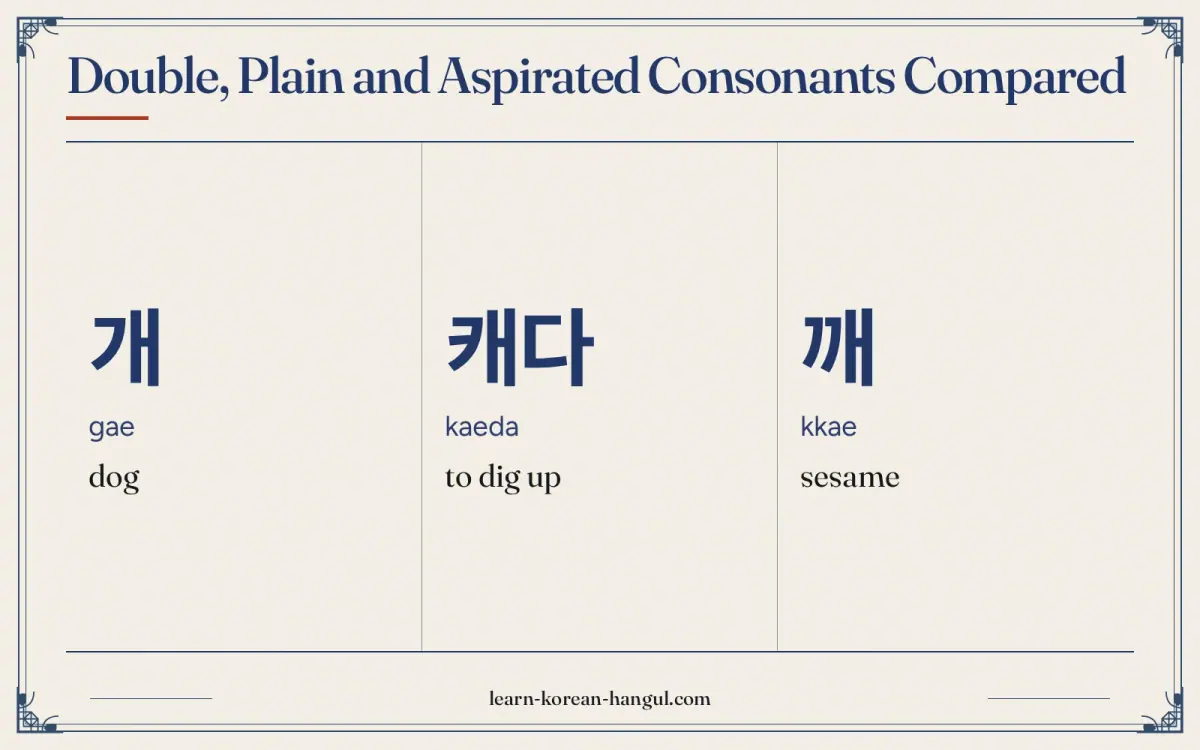
The same mouth position gives three sounds: plain, aspirated and tense. The table sets them side by side with one example for each. ㅅ has no aspirated partner, so it forms only a pair with ㅆ.
| Mouth position | Plain | Aspirated | Tense |
|---|---|---|---|
| back of tongue | ㄱ 개 (dog) | ㅋ 캐다 (to dig up) | ㄲ 깨 (sesame) |
| tongue tip | ㄷ 달 (moon) | ㅌ 탈 (mask) | ㄸ 딸 (daughter) |
| lips | ㅂ 불 (fire) | ㅍ 풀 (grass; glue) | ㅃ 뿔 (horn) |
| tongue and palate | ㅈ 자다 (to sleep) | ㅊ 차다 (to kick) | ㅉ 짜다 (to be salty) |
| tongue and teeth | ㅅ 사다 (to buy) | none | ㅆ 싸다 (to be cheap) |
Plain: Light Breath; Aspirated: Strong Puff; Tense: No Breath and a Tight Throat
| Korean | Romanization | Meaning | Sound |
|---|---|---|---|
| 개 | gae | dog | |
| 캐다 | kaeda | to dig up | |
| 깨 | kkae | sesame |
Plain: Light Breath; Aspirated: Strong Puff; Tense: No Breath and a Tight Throat
| Korean | Romanization | Meaning | Sound |
|---|---|---|---|
| 달 | dal | moon | |
| 탈 | tal | mask | |
| 딸 | ttal | daughter |
Plain: Light Breath; Aspirated: Strong Puff; Tense: No Breath and a Tight Throat
| Korean | Romanization | Meaning | Sound |
|---|---|---|---|
| 불 | bul | fire | |
| 풀 | pul | grass; glue | |
| 뿔 | ppul | horn |
Plain: Soft S; Tense: Tight, Sharper S
| Korean | Romanization | Meaning | Sound |
|---|---|---|---|
| 사다 | sada | to buy | |
| 싸다 | ssada | to be cheap |
Compare them with the Korean aspirated consonants, which do have a puff. Train your ear further with plain, tense and aspirated sounds.
Should You Learn Double Consonants before Compound Vowels?
Learn the double consonants after the 14 basic and aspirated consonants, and either before or after the compound vowels. The answer depends on what you want to read first.
- If you want to read everyday words soon, learn the double consonants next. Words such as 아빠, 빵 and 꿈 use only simple vowels.
- If you want a clean vowel set first, learn the compound vowels before the double consonants. The word 깨 uses the vowel ㅐ, which is written by combining ㅏ and ㅣ and is taught with the compound vowels, although it is pronounced as a single vowel sound.
- If you are unsure, start with the letter ㄲ, and learn the vowel ㅏ first if you have not yet.
Whichever order you choose, practice with the Hangul flashcard decks, trace the shapes on the double consonants worksheet and see how two letters fit into one slot in stroke order for double letters. Audio on this page is machine-generated and its review status is shown beside each clip; the Korean content is a draft until a Korean specialist signs it off.
Questions about Korean Double Consonants
Is a double consonant pronounced twice as long? No. A double consonant is one sound, not two. The doubled letter shows tension: the throat is tight and no puff of air escapes. The sound is not longer than a plain consonant in a way that learners should copy. Think of the k in "sky", and say it as one quick, firm sound.
What is the difference between 쌍자음 and 된소리? 쌍자음 (ssangjaeum) means "twin consonants" and names the letters ㄲ ㄸ ㅃ ㅆ ㅉ by how they are written. 된소리 (doenssori) means "hard sounds" and names the tense sounds by how they feel. For these five letters the two terms refer to the same group, but 된소리 also covers tense sounds that are not written as double letters.
Why is there no double ㄴ or ㅁ in modern Korean? Modern Hangul pairs only the five consonants that have a plain and a tense form: ㄱ, ㄷ, ㅂ, ㅅ and ㅈ. Nasals and ㄹ do not have a tense counterpart in standard Korean, so there is nothing for a doubled ㄴ or ㅁ to spell. Doubling is a spelling signal for tension and not a general rule.
Are double consonants harder than aspirated ones? Often, yes. Aspirated letters carry an audible puff, similar to English at the start of words, and the ear catches it. Double consonants have no puff, so the difference from the plain letters is smaller and more subtle. The listening sets in each lesson are designed to train that difference.
How do I write ㅃ neatly? Write ㅃ as two separate ㅂ shapes, each drawn completely, in 8 strokes. Keep both the same height and size, make them narrow enough to fit in one letter space, and do not share the middle stroke between them. Practice on grid paper to keep the proportions. The lesson on ㅃ shows the stroke order step by step.