What you'll learn
- Say first to tenth with 번째 and use the irregular 첫.
- Build higher ordinals such as 열한 번째 (11th), 스무 번째 (20th) and 백 번째 (100th).
- Ask 몇 번째예요? and answer with the pattern.
- Tell 번째 apart from the counters 번 and 층.
Prerequisites: native Korean numbers 1-10. Estimated time: 35 minutes.
First Second Third Fourth in Korean: the Essentials
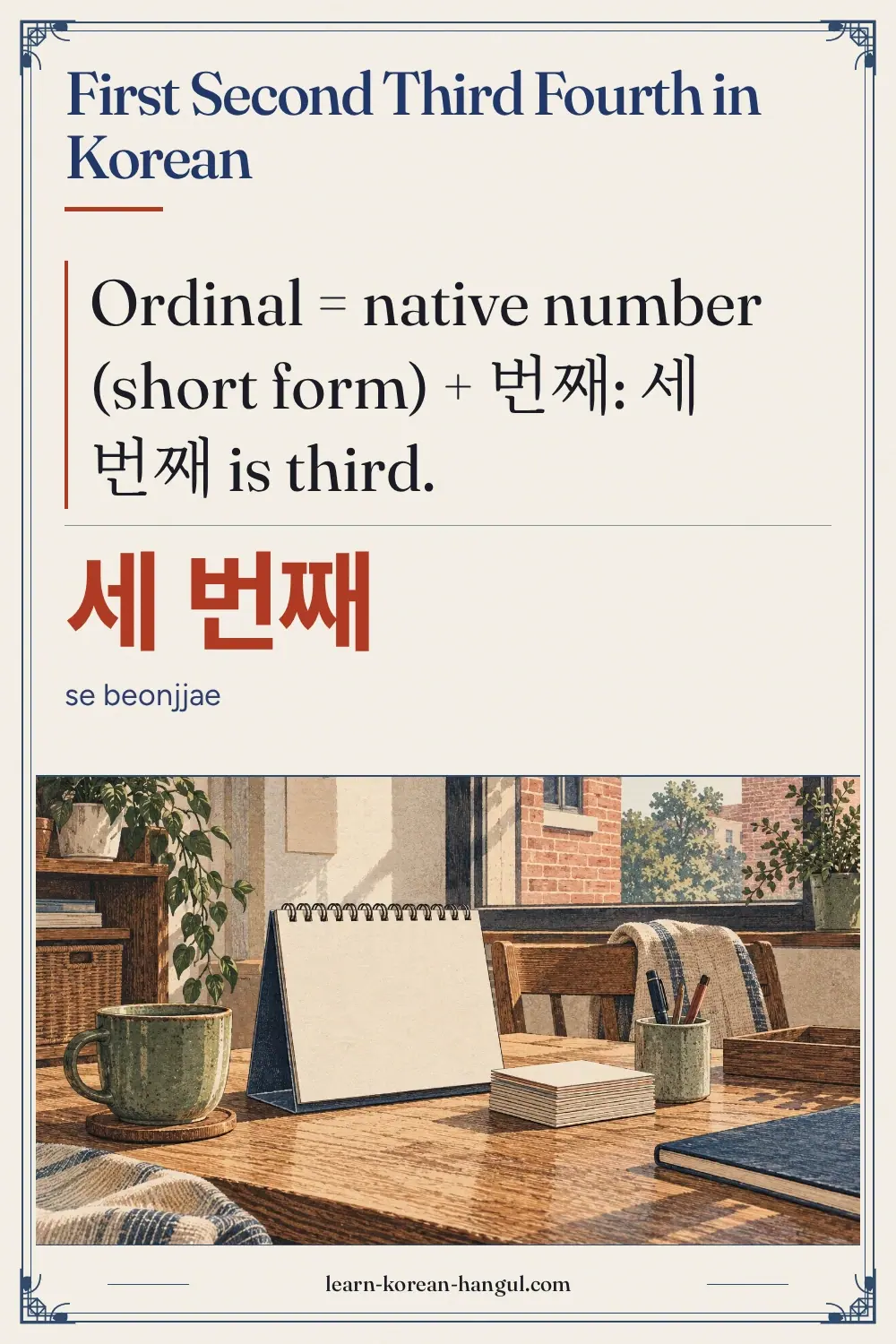
First second third fourth in Korean follow one pattern: take the native number, use its short form, and add 번째 (beonjjae). The word 번째 is a bound noun, which means a word that cannot stand alone and always follows another word. It means "-th in order". The short form is the one you use before a counter: 하나 becomes 한, 둘 becomes 두, 셋 becomes 세 and 넷 becomes 네.
| Order | Number form | Korean | Romanization |
|---|---|---|---|
| 1st | 첫 | 첫 번째 | cheot beonjjae |
| 2nd | 두 | 두 번째 | du beonjjae |
| 3rd | 세 | 세 번째 | se beonjjae |
| 4th | 네 | 네 번째 | ne beonjjae |
| 5th | 다섯 | 다섯 번째 | daseot beonjjae |
| 6th | 여섯 | 여섯 번째 | yeoseot beonjjae |
| 7th | 일곱 | 일곱 번째 | ilgop beonjjae |
| 8th | 여덟 | 여덟 번째 | yeodeol beonjjae |
| 9th | 아홉 | 아홉 번째 | ahop beonjjae |
| 10th | 열 | 열 번째 | yeol beonjjae |
Write the number and 번째 as two words with a space, as 세 번째. The National Institute of Korean Language (국립국어원) spelling rules put a space before a bound noun. With Arabic numerals the attached form 3번째 is also accepted, and you will see it often on signs and in messages.
Here the ordinal is used in a sentence: 두 번째 문이 제 방이에요 (The second door is my room). The word 문 means "door" and 방 means "room". Notice that the ordinal comes before the noun it describes, just like an adjective.
The one irregular word in the table is the first, and the next section explains why.
Why Is First 첫 번째 and Not 한 번째?
The first is 첫 번째 because Korean has a separate word 첫 that means "first" before a noun, and it replaces 한 when the number is a plain one. The word 첫 is a determiner, a word that always comes before a noun. You already know it from words such as 첫눈 (the first snow of the year), 첫사랑 (first love) and 첫인상 (first impression).
A good rule of thumb: 첫 means "the first of its kind" and 한 means "one". So 한 번째 is not the standard way to say first. When the number one is the last digit of a larger number, 한 comes back. The eleventh is 열한 번째, built from 열 (10) and 한 (1). The twenty-first is 스물한 번째.
| Wrong | Right | Why |
|---|---|---|
| 한 번째 | 첫 번째 | 첫 replaces 한 for the plain first |
| 열첫 번째 | 열한 번째 | inside a larger number, 한 stays |
| 하나 번째 | 첫 번째 | the stand-alone form 하나 never takes 번째 |
Once you know 첫, the rest of the ordinals follow the same logic as the native numbers you already know.
How Do You Form Higher Ordinals?
To form a higher ordinal, take the native number up to 99 in its short form and add 번째. For the 100th and above, use the Sino-Korean 백 for the hundred and a native number for the rest. The short forms matter only at the endings 1, 2, 3, 4 and 20.
| Ordinal | Korean | Pattern |
|---|---|---|
| 11th | 열한 번째 | 열 + 한 |
| 12th | 열두 번째 | 열 + 두 |
| 13th | 열세 번째 | 열 + 세 |
| 14th | 열네 번째 | 열 + 네 |
| 20th | 스무 번째 | short form of 스물 |
| 21st | 스물한 번째 | 스물 + 한 |
| 30th | 서른 번째 | no change |
| 99th | 아흔아홉 번째 | 아흔 + 아홉 |
| 100th | 백 번째 | native numbers stop at 99 |
| 101st | 백한 번째 | 백 + 한 |
Two patterns stand out. First, 20th is 스무 번째, and only exactly 20 uses 스무, while 21st to 29th use 스물 plus the short form. Second, native numbers stop at 99, so the 100th is 백 번째 and the 101st mixes the Sino 백 with the native 한 in 백한 번째. This mixed form is what speakers use in practice.
Expert insight: if you can count with the counter 개 (한 개, 두 개, 세 개), you already know the number half of every ordinal. Swap 개 for 번째 and you have the ordinal. The page on the 번 counter shows the same short forms with the counter 번.
With the forms in hand, you can ask and answer the question that uses them most.
How Do You Ask 몇 번째?
To ask the position of something, use 몇 번째 (myeot beonjjae), "which in order" or "how many-th". The word 몇 means "how many", so 몇 번째예요? asks "Which number is it?" The answer repeats the ordinal and adds 예요 or 이에요: 세 번째예요 ("It's the third").
| Question | Answer | Meaning |
|---|---|---|
| 몇 번째예요? | 세 번째예요. | Which one is it? It's the third. |
| 몇 번째 줄이에요? | 다섯 번째 줄이에요. | Which row? The fifth row. |
| 제가 몇 번째예요? | 열 번째예요. | What number am I? You are tenth. |
Here is a short exchange at a bus stop. The traveller asks which stop to get off at and hears the answer.
- 승객: 우리 학교는 몇 번째 정류장이에요? (Which stop is our school?)
- 기사: 다섯 번째 정류장이에요. (It's the fifth stop.)
- 승객: 그럼 다섯 정거장 가야 해요. (Then I have to ride five stops.)
The check is simple: the fifth stop from here means five stops of riding, so the ordinal 다섯 번째 and the count 다섯 정거장 use the same number. The words 정류장 and 정거장 both mean "stop" or "station", and the lesson uses both because both appear in real speech. The question 몇 번째 also works with 번째 plus a noun: 몇 번째 줄 (which row), 몇 번째 문 (which door).
Ordinals describe order, and counters describe amounts. The next section sets the two side by side.
How Are Ordinals Different from Counters?
Ordinals answer "which one in order?" and counters answer "how many?". Korean builds them from the same native numbers, so they look alike, and the differences are small words: 번 (times) versus 번째 (order), 층 (floor) versus 번째, and 일 (day of the month) versus 번째.
| English | Counter or form | Ordinal | What changes |
|---|---|---|---|
| three times | 세 번 | 세 번째 (third time) | 번 counts, 번째 orders |
| the 2nd floor | 이 층 | 두 번째 층 (second one in a list) | floors use Sino numbers and 층 |
| the 2nd day of the month | 이 일 | 두 번째 날 (second day of a trip) | dates use Sino numbers and 일 |
| two people | 두 명 | 두 번째 사람 (second person) | 명 counts, 번째 orders |
The floor example is the one learners miss most. Korean names floors with a Sino-Korean number and the counter 층, as in the 층 counter, so the second floor is 이 층. Saying 두 번째 층 is understood, but it means "the second floor in a series", not "floor 2". For the same reason, a date such as the 2nd of May is 오월 이 일, with a Sino number.
Positions from the Front or the Back
To give a position from one end of a line, add 앞에서 (from the front) or 뒤에서 (from the back) before the ordinal. The phrase 앞에서 세 번째 means "third from the front", and 뒤에서 두 번째 means "second from the back". The same frame works in queues, classrooms and train carriages.
| Position | Korean | Meaning |
|---|---|---|
| front | 앞에서 세 번째 | third from the front |
| back | 뒤에서 두 번째 | second from the back |
| left | 왼쪽에서 네 번째 | fourth from the left |
| right | 오른쪽에서 첫 번째 | first from the right |
A natural sentence is 앞에서 세 번째 사람이 제 친구예요 (The third person from the front is my friend). The particle 에서 means "from" here, and the ordinal sits right before the noun it describes. The next sub-section looks at a related pair of words that learners often mix up.
Saying for the First Time
For a first experience, say 처음 or 처음으로. The sentence 처음으로 김치를 먹었어요 means "I ate kimchi for the first time". The form 첫 번째로 is different: it means "as the first one in a sequence", as in 첫 번째로 도착했어요 ("I arrived first"). The two often translate to "first" in English, but they ask different questions: when did it happen for the first time, or who was first?
Another everyday frame counts occasions: 이번이 세 번째예요 means "This is the third time". Here 이번 means "this time", and the whole sentence tells how often something has happened up to now. It is the natural way to say that this is your second visit or your third attempt.
Two more words sit beside the ordinals and need no number: 마지막 (the last) and 다음 (the next). Say 마지막 문 for the last door and 다음 문 for the next door, and do not add 번째.
Sino-Korean Ordinals with 제
Sino-Korean numbers do form ordinals, but with the prefix 제 (je), not with 번째. The first is 제일, the second 제이 and the third 제삼. You see them in numbered units such as 제1과 (lesson 1), 제2장 (chapter 2) and 제3회 (the third round or edition). The word 제일 also means "the most", as in 제일 좋아요 ("I like it best"). Everyday sequences take 번째, and numbered units take 제. The next lesson explains 제 in full.
The next section puts the ordinals into everyday sentences, and the section after it collects the common mistakes.
Everyday Sentences with Ordinals
Ordinals appear in instructions, queues and lists. Five short sentences cover many daily situations. Read each one aloud and cover the English meaning.
| Korean | Meaning |
|---|---|
| 첫 번째 질문이에요. | It is the first question. |
| 세 번째 줄에 앉으세요. | Please sit in the third row. |
| 네 번째 버튼을 누르세요. | Press the fourth button. |
| 다섯 번째 손님이에요. | You are the fifth customer. |
| 두 번째 사진이 제일 예뻐요. | The second photo is the prettiest. |
Each sentence puts the ordinal before the noun, and the verb comes last, which is normal Korean order. The endings 이에요, 으세요 and 어요 are polite, so they suit teachers, staff and strangers. After you can read these without the English, you are ready to produce your own with any number from 1 to 100.
Common Mistakes and Fixes
Most mistakes with first second third fourth in Korean come from carrying English habits or the wrong number list into 번째. Check yourself against this list.
- Saying 한 번째. Right: 첫 번째. Use 한 only inside a larger number, as in 열한 번째.
- Using the stand-alone number. Wrong: 셋 번째, 둘 번째. Right: 세 번째, 두 번째.
- Using Sino-Korean numbers. Wrong: 이 번째, 삼 번째. Right: 두 번째, 세 번째.
- Writing 번째 attached to a Hangul number. Right: 첫 번째 with a space. The attached form is normal with an Arabic numeral (3번째).
- Saying 스물 번째 for 20th. Right: 스무 번째.
- Confusing 번 and 번째. 세 번 is three times, and 세 번째 is the third.
- Using 번째 for floors or dates. Right: 이 층 and 이 일.
Limitation: this lesson covers the standard 번째 pattern and the closest alternatives. Family order (첫째, 둘째), numbered units (제1과), rank (1등) and rounds (2차) are covered on a separate page. Small variations, such as 두번째 without a space, are common in informal writing, but the spaced form is the standard one.
Practice Set
Answer each item aloud before you read the answers.
- Say "the first door".
- Say 4th, 10th and 20th.
- Ask "Which row is it?"
- Say "the 11th".
- How do you name the second floor?
- What is the difference between 세 번 and 세 번째?
Practice · 5
How do you say first in Korean?
Show answer
첫 번째
Which is the correct third?
Show answer
세 번째
How do you say the 20th?
Show answer
스무 번째
Which question asks which one in order?
Show answer
몇 번째예요?
How do you name the second floor?
Show answer
이 층
Answers:
- 첫 번째 문.
- 네 번째, 열 번째, 스무 번째.
- 몇 번째 줄이에요?
- 열한 번째.
- 이 층.
- 세 번 counts times (three times), and 세 번째 gives order (the third).
Five or more correct means the pattern is secure.
What to Learn Next
You can now say first second third fourth in Korean with the 번째 pattern, build higher ordinals and ask 몇 번째. Continue in this order:
- Korean ordinals for 첫째, 제, 등 and 차.
- The 번 counter for counting times.
- Native Korean numbers 1-10 if any short form still feels uncertain.
- Ordinal Numbers for the whole section.
Frequently Asked Questions
How do I say the second floor in Korean?
Say 이 층, written 2층. Floors use the Sino-Korean number with the counter 층, not the ordinal 번째. The phrase 두 번째 층 would mean the second floor in some list or sequence, such as the second floor you visit, and it is not the normal way to name a floor. The first floor is 일 층.
Can 번째 take Sino-Korean numbers?
Mostly not. The standard ordinals use native numbers, so the second is 두 번째, not 이 번째. Sino-Korean numbers appear in the large number 백 번째 and in other ordinal forms, such as 제 for units (제이 장) and 등 for ranks (이 등). The next lesson covers those forms.
How do I say this is the third time?
Say 이번이 세 번째예요. The word 이번 means this time, the particle 이 marks it as the subject, and 세 번째 gives the count in order. The same frame works for any number: 이번이 두 번째예요 is the second time. For something that has happened three times in total, say 세 번 했어요 instead.
How do I say last and next in Korean?
Say 마지막 for last and 다음 for next. These two words do not take 번째: the last door is 마지막 문 and the next door is 다음 문. Use 이번 for this time and 지난번 for last time. They sit beside the ordinals, and they replace the number when you do not need one.
Is there a space in 첫 번째?
Yes, write 첫 번째 with a space, because 번째 is a bound noun and the standard spelling puts a space before it. With Arabic numerals, spelling rules allow the attached form, so both 3번째 and 3 번째 appear. Spoken Korean has no spaces, so the question matters only when you type.