What you'll learn
- Say and write 하나 to 열 with the correct sounds.
- Give the short form for 1 to 4 before a counter: 한, 두, 세, 네.
- Use the numbers in ten short phrases, such as 한 개 and 두 명.
- Say the hour from one o'clock to twelve o'clock.
Prerequisites: reading basic Hangul syllables. Estimated time: 35 minutes.
What Are the Native Korean Numbers 1-10?
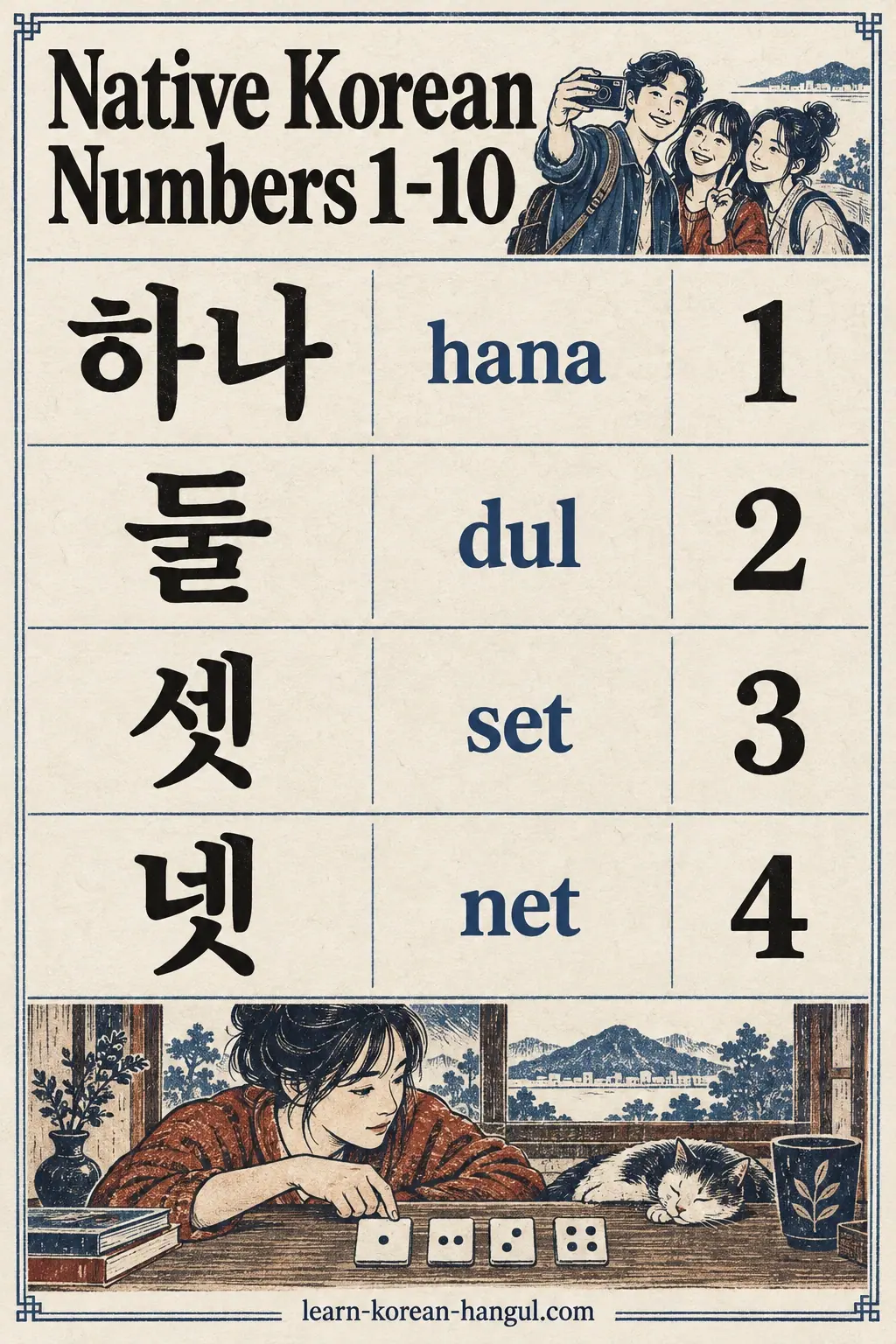
The native Korean numbers 1-10 are the ten original Korean words for counting from one to ten. "Native" means the words are not borrowed from Chinese, unlike the Sino-Korean set 일, 이, 삼. You use native numbers to count things you can see and touch, to say the hour, and to give a spoken age.
| Number | Hangul | Revised Romanization | Said as |
|---|---|---|---|
| 1 | 하나 | hana | [하나] |
| 2 | 둘 | dul | [둘] |
| 3 | 셋 | set | [섣] |
| 4 | 넷 | net | [넫] |
| 5 | 다섯 | daseot | [다섣] |
| 6 | 여섯 | yeoseot | [여섣] |
| 7 | 일곱 | ilgop | [일곱] |
| 8 | 여덟 | yeodeol | [여덜] |
| 9 | 아홉 | ahop | [아홉] |
| 10 | 열 | yeol | [열] |
Revised Romanization (RR) is the official Latin-letter system of South Korea. It appears here only as a learning aid, because the Hangul is the real spelling. The last column, "Said as", shows the sound when the word stands alone. It differs from the spelling for 셋, 넷, 다섯, 여섯 and 여덟, which end in a consonant that is not pronounced as written.
How Can You Remember the Order?
Sort the ten words into four small groups and learn one group at a time. Memory works better with chunks than with a ten-item list.
- The four that change: 하나, 둘, 셋, 넷. These are also the four that have short forms.
- The two that end in 섯: 다섯, 여섯. They share the same ending, so you learn one pattern for two words.
- The three with vowel starts: 일곱, 여덟, 아홉. Each begins with a vowel sound (일, 여, 아) and ends in a consonant.
- The round number: 열, which also begins every number from 11 to 19.
Counting aloud in this order is the same rhythm Koreans use when they say 하나, 둘, 셋 before a photo, and then the word 김치, which makes the mouth smile. That habit is a fun anchor for the first three words.
The next question is why the first four words have two forms.
Why Do 하나, 둘, 셋 and 넷 Change?
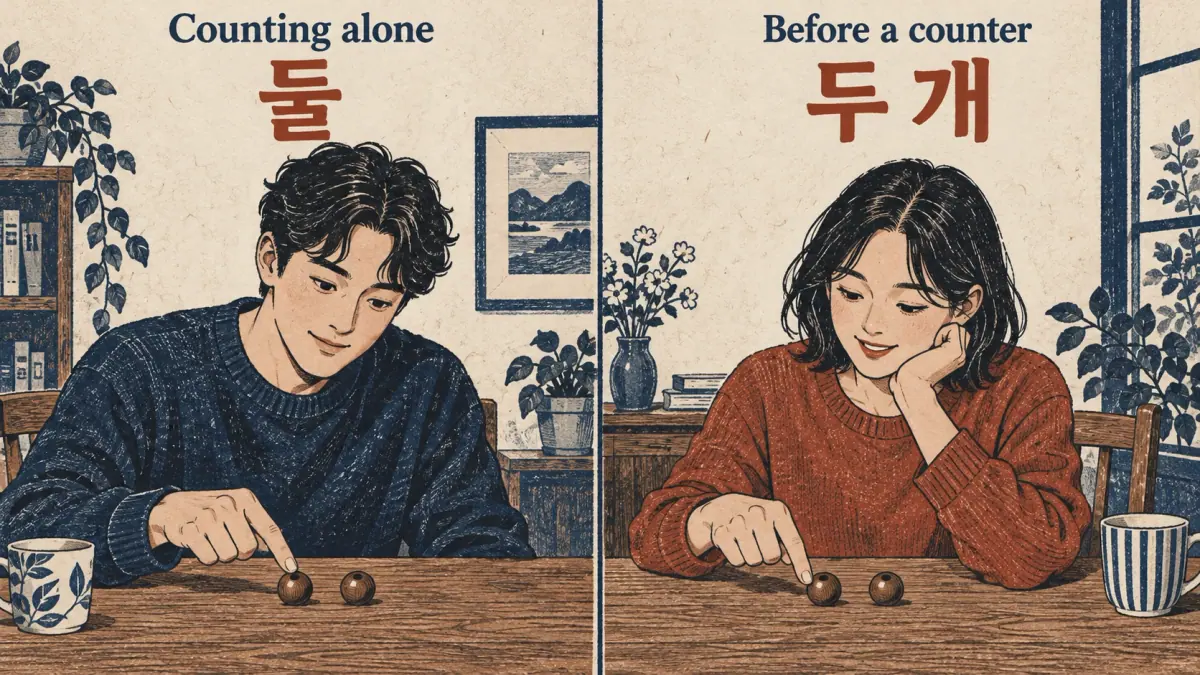
The first four native numbers have a second, shorter form that you use whenever a counter follows: 한, 두, 세 and 네. A counter is a small word that comes after the number and says what kind of thing is counted, such as 개 for objects or 명 for people. The short form works as a modifier, a word that describes the noun-like counter after it, much like the "a" in "a cup".
| Number | Counting alone | Before a counter | Example |
|---|---|---|---|
| 1 | 하나 | 한 | 한 개 |
| 2 | 둘 | 두 | 두 개 |
| 3 | 셋 | 세 | 세 개 |
| 4 | 넷 | 네 | 네 개 |
| 20 | 스물 | 스무 | 스무 개 |
Numbers 5 to 10 do not change. So you say 다섯 개 and 열 개 with the same form you use for counting alone. The twenty row is a preview: the native word for 20, 스물, becomes 스무 before a counter, which the lesson on native Korean numbers 1-100 explains in full.
Here is the trap, and it is the most common mistake with this lesson. 둘 and 두 are different words, and 셋 and 세 are different words. They are not spelling variants of one word. 둘 is what you say when counting out loud or answering "how many?", while 두 is what you say before a counter. Saying 둘 개 or 셋 명 sounds wrong to a Korean listener.
You can check yourself with one test. If a counter follows the number, use the short form for 1 to 4. If nothing follows, use the full form.
Ten Native Numbers in Real Phrases
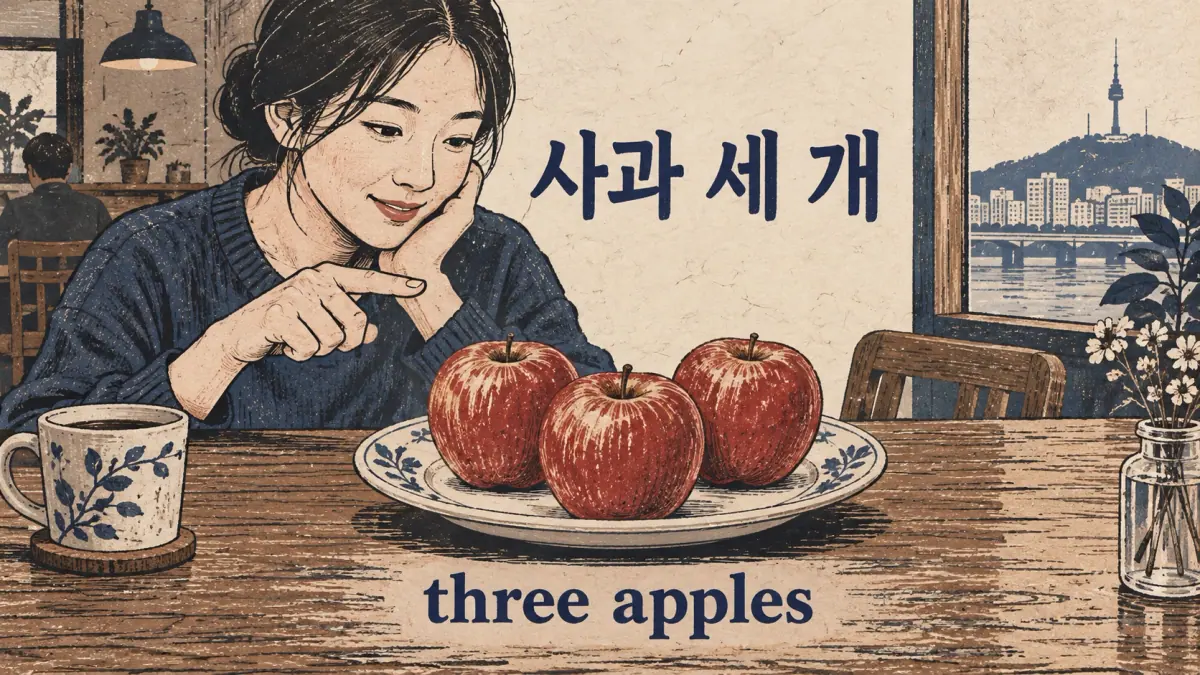
Native numbers appear in the order noun, number, counter, as in 사과 세 개 ("three apples"). In practice you often drop the noun and say only the number and counter. The ten phrases below each use a different counter and a different number, so they cover the whole list.
| Phrase | Counter | Meaning |
|---|---|---|
| 한 개 | 개 (things) | one piece |
| 두 명 | 명 (people) | two people |
| 세 잔 | 잔 (cups) | three cups |
| 네 마리 | 마리 (animals) | four animals |
| 다섯 시 | 시 (hour) | five o'clock |
| 여섯 권 | 권 (books) | six books |
| 일곱 병 | 병 (bottles) | seven bottles |
| 여덟 장 | 장 (sheets) | eight sheets |
| 아홉 살 | 살 (age) | nine years old |
| 열 번 | 번 (times) | ten times |
Write a space between the number and the counter, as in 한 개. The spacing rule is in the National Institute of Korean Language (국립국어원) orthography rules (한글 맞춤법 제43항), which say that a unit noun (단위 명사) is written separately from the number before it. The lesson on the 개 counter shows how the same pattern works with everyday objects.
Now try a complete sentence. In a café you can say 커피 두 잔 주세요, which means "Two coffees, please." The noun comes first (커피), then the short form (두), then the counter (잔), then the request (주세요).
The second sentence, 학생이 세 명 있어요, means "There are three students." The pattern is the same, with 있어요 ("there is, there are") at the end.
How Do You Say the Hour with Native Numbers?

To say the hour, use a native number plus 시, with the short forms for 1 to 4. This is the main everyday use of 한, 두, 세 and 네, and it takes only twelve words to learn. Unlike the minutes, which use Sino-Korean numbers, the hour is always native.
| Clock | Korean | Clock | Korean |
|---|---|---|---|
| 1:00 | 한 시 | 7:00 | 일곱 시 |
| 2:00 | 두 시 | 8:00 | 여덟 시 |
| 3:00 | 세 시 | 9:00 | 아홉 시 |
| 4:00 | 네 시 | 10:00 | 열 시 |
| 5:00 | 다섯 시 | 11:00 | 열한 시 |
| 6:00 | 여섯 시 | 12:00 | 열두 시 |
The last two items, 열한 시 and 열두 시, go beyond the numbers 1-10. They are built from 열 (ten) plus the short forms 한 (one) and 두 (two). After noon, spoken Korean starts again at 한 시 and adds 오후 (p.m.), as in 오후 한 시. The lesson on saying the hour with 시 covers the full system, including 오전 and 오후.
11 and 12: 열 Plus a Digit
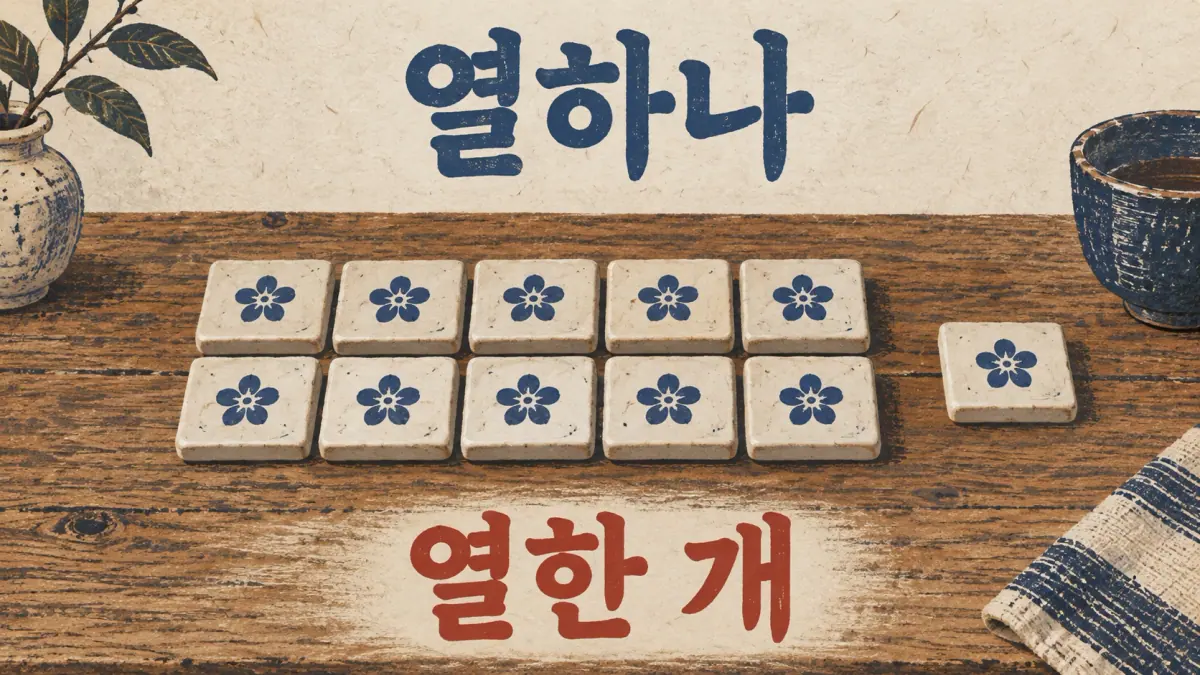
To say 11, 12 and the other numbers up to 19, say 열 and then add the ones digit: 열하나 (11), 열둘 (12), 열셋 (13). Before a counter, use the short forms again: 열한 개 (11 things) and 열두 명 (12 people). There is no space inside the number.
| Number | Counting alone | Before a counter |
|---|---|---|
| 11 | 열하나 | 열한 |
| 12 | 열둘 | 열두 |
| 13 | 열셋 | 열세 |
| 14 | 열넷 | 열네 |
| 15 | 열다섯 | 열다섯 |
Learners often try 열일 for 11, copying the Sino-Korean 십일. That is a mix of the two systems. The Sino-Korean 십일 and the native 열하나 mean the same number, but you cannot blend 열 with 일. The ones digit after 열 must be a native word.
Pronunciation of the Tricky Ones
Five native numbers end in a consonant that does not sound the way it is written. The standard pronunciation rules (표준 발음법) of the National Institute of Korean Language say that a final ㅅ is pronounced [ㄷ], and that in a double final such as ㄹㅂ in 여덟 only one sound is kept, here [ㄹ]. These rules explain the "Said as" column in the first table.
| Written | Said as | Rule in one line |
|---|---|---|
| 셋, 넷 | [섣], [넫] | final ㅅ sounds like [ㄷ] |
| 다섯, 여섯 | [다섣], [여섣] | the same rule |
| 여덟 | [여덜] | ㅂ is silent at the end of the word |
After the [ㄷ] sound of 셋, 넷, 다섯 and 여섯, a counter that starts with ㄱ, ㄷ, ㅂ, ㅅ or ㅈ sounds tense. So 다섯 시 sounds like [다섣씨] and 다섯 개 like [다섣깨]. After 여덟 the counter is also often heard tense, as in 여덟 시 [여덜씨]. You do not write this change, but you must hear it. Listen to the audio to hear the tense sound.
A second sound change happens when 둘, 셋 or 넷 is followed by the subject marker 이. The final consonant moves across to the next syllable: 둘이 sounds like [두리], 셋이 sounds like [세시] and 넷이 sounds like [네시]. This is called liaison (연음), and you hear it in sentences such as 둘이서 먹어요 ("The two of us eat together").
How Do You Count Things in a Full Sentence?

To count things in a sentence, put the noun first, then the subject marker, then the number and counter, and end with 있어요 ("there is, there are") or a request. The marker 이 or 가 tells the listener which word is the subject. Use 이 after a consonant and 가 after a vowel.
| Sentence | Meaning | Pattern |
|---|---|---|
| 책이 한 권 있어요. | There is one book. | noun + 이 + number + counter + 있어요 |
| 친구가 두 명 있어요. | I have two friends. | noun + 가 + number + counter + 있어요 |
| 물 세 병 주세요. | Three bottles of water, please. | noun + number + counter + 주세요 |
| 고양이가 네 마리 있어요. | There are four cats. | noun + 가 + number + counter + 있어요 |
In the third sentence the marker is missing. When you ask for something, Koreans usually drop the marker and say only noun, number, counter and 주세요, so 물 세 병 주세요 is natural. This is the pattern you will use most often in shops and restaurants.
Notice what stays constant in all four sentences: the number is a native one, the counter follows it, and the short form appears for 1 to 4. Only the noun and the counter change. If you remember this frame, you can build hundreds of sentences from the ten numbers in this lesson.
A Five-Minute Practice Routine
Short, daily practice fixes the ten words faster than one long session. The routine below takes five minutes and needs only the things around you.
- Count aloud. Say 하나, 둘, 셋 up to 열 with the audio, three times.
- Count objects. Pick up to five objects and say the number and counter, for example 펜 세 개 for three pens.
- Say the hour. Look at a clock and say the hour with 시, for example 네 시.
- Write three phrases. Write them in Hangul, with a space before the counter.
You will know the routine works when you can say the short forms without pausing. For a longer plan with a day-by-day schedule, see how to memorize native Korean numbers.
How Do Native Numbers Compare with Sino-Korean 1-10?
Native and Sino-Korean numbers name the same quantities with different words, and the counter in the phrase decides which set you need. The table puts the same quantity, three, in four common phrases.
| Phrase | Meaning | System |
|---|---|---|
| 세 개 | three things | native |
| 세 시 | 3 o'clock | native |
| 삼 분 | three minutes | Sino-Korean |
| 삼월 | March | Sino-Korean |
Learn the native set first for counting and hours, then compare the two sets side by side on Korean Numbers 1-10: Both Systems Side by Side With Audio. The rule that decides between them is in Sino vs native Korean numbers.
Common Mistakes and Fixes
Most errors with the native numbers 1-10 involve the short forms and the mixing of the two systems. Check each of these before you speak.
- Using the counting form before a counter. Wrong: 하나 개, 둘 명, 셋 잔. Right: 한 개, 두 명, 세 잔.
- Using the short form alone. Wrong: counting 한, 두, 세 aloud. Right: 하나, 둘, 셋.
- Using Sino-Korean numbers with 개 or 시. Wrong: 삼 개, 오 시. Right: 세 개, 다섯 시.
- Saying 열일 for 11. Right: 열하나, or 열한 before a counter.
- Confusing 네 with 넷. 네 means "yes" when it stands alone, and it means "four" before a counter, as in 네 개. Counting aloud, "four" is 넷.
- Forgetting the sound change in 여덟. The spelling has two final consonants, but the word is said [여덜].
Limitation: this lesson covers the standard forms. A few older counters, such as the one in 석 달 (three months), use other short forms, and spoken Korean has casual shortcuts that this lesson does not teach. Learn the standard forms first.
Practice Set
Answer each item before you read the answer line.
- Say "two people" in Korean.
- Say "three cups".
- Say "five o'clock".
- Say "eleven things".
- What is wrong with 하나 개?
- How is 여덟 said aloud?
Practice · 8
How do you say "two people"?
Show answer
두 명
Before a counter, 둘 shortens to 두, and 명 takes native numbers: 두 명.
How do you say "five o'clock"?
Show answer
다섯 시
The hour always uses native numbers with 시. Numbers 5 to 10 keep the same form before a counter.
How do you say "eleven things"?
Show answer
열한 개
11 is 열 plus a native digit, and 하나 shortens to 한 before a counter: 열한 개. 열일 mixes the two systems.
Which native number is 8?
Show answer
여덟
The order is 다섯 (5), 여섯 (6), 일곱 (7), 여덟 (8), 아홉 (9).
How is 여덟 said aloud on its own?
Show answer
[여덜]
In the double final ㄹㅂ only [ㄹ] is kept, so 여덟 is said [여덜].
When you count aloud without a counter, what is "four"?
Show answer
넷
The short form 네 is used only before a counter; counting aloud, "four" is 넷.
Which phrase means "three cups"?
Show answer
세 잔
Before the counter 잔, 셋 takes its short form 세.
How do you say "12 o'clock"?
Show answer
열두 시
The hour uses native numbers: 열 plus the short form 두 gives 열두 시.
Answers:
- 두 명 (du myeong).
- 세 잔 (se jan).
- 다섯 시 (daseot si).
- 열한 개 (yeolhan gae).
- Before the counter 개, 하나 must take its short form: 한 개.
- [여덜] (yeodeol). The ㅂ is not pronounced at the end of the word.
Five or more correct means you have the list.
What to Learn Next
You can now say the native Korean numbers 1-10, use the short forms 한, 두, 세, 네 and give the hour. Continue in this order:
- Native Korean numbers 1-100 to learn 스물, 서른 and the rest of the tens.
- How to memorize native Korean numbers if the list will not stay in your head.
- The 개 counter to count everyday objects.
- Telling the hour with 시 for a full clock lesson.
Frequently Asked Questions
Why is 1 하나 alone but 한 before a counter?
하나 is the full counting form, used when you count aloud or answer "how many?" 한 is the shortened form that Korean uses as a modifier before a counter, as in 한 개. The two are different words, not spelling variants. The same happens with 둘 and 두, 셋 and 세, and 넷 and 네.
How do I say 11 and 12 in native Korean?
Say 열 and add the ones digit: 열하나 for 11 and 열둘 for 12. Before a counter, use the short forms: 열한 개 and 열두 명. There is no space inside the number. For 13 to 19 the pattern continues, such as 열셋 and 열다섯. The 1-100 lesson lists every form.
What is the difference between 열 and 십?
Both mean ten. 열 is the native Korean word, used for counting objects, people and hours, as in 열 개 and 열 시. 십 is the Sino-Korean word, used for minutes, dates and money, as in 십 분 and 십 원. Pick the word that matches the counter in the phrase.
How do I pronounce 여덟?
Say [여덜]. The spelling has two final consonants, ㄹ and ㅂ, but at the end of a word only the ㄹ sound is kept, so the ㅂ is silent. Before a vowel it comes back, as in 여덟이 [여덜비]. Before a consonant the ㅂ stays silent, so 여덟 시 is [여덜시], often heard with a tense [씨] in everyday speech.
How do I count to ten in Korean quickly?
Learn the four groups in this lesson: 하나 둘 셋 넷, then 다섯 여섯, then 일곱 여덟 아홉, then 열. Say them aloud with the audio three times a day for three days. Then use them in phrases such as 한 개 and 두 명 so the short forms are fixed.