What you'll learn
- Choose between 번째, 째, 제, 등 and 차 for a given situation.
- Name birth order with 첫째, 둘째, 셋째 and 막내.
- Read numbered units such as 제1과 and ranks such as 1등.
- Understand 2차 and 3차 at a dinner or in an exam.
Prerequisites: first, second, third in Korean. Estimated time: 35 minutes.
Korean Ordinals: the Essentials
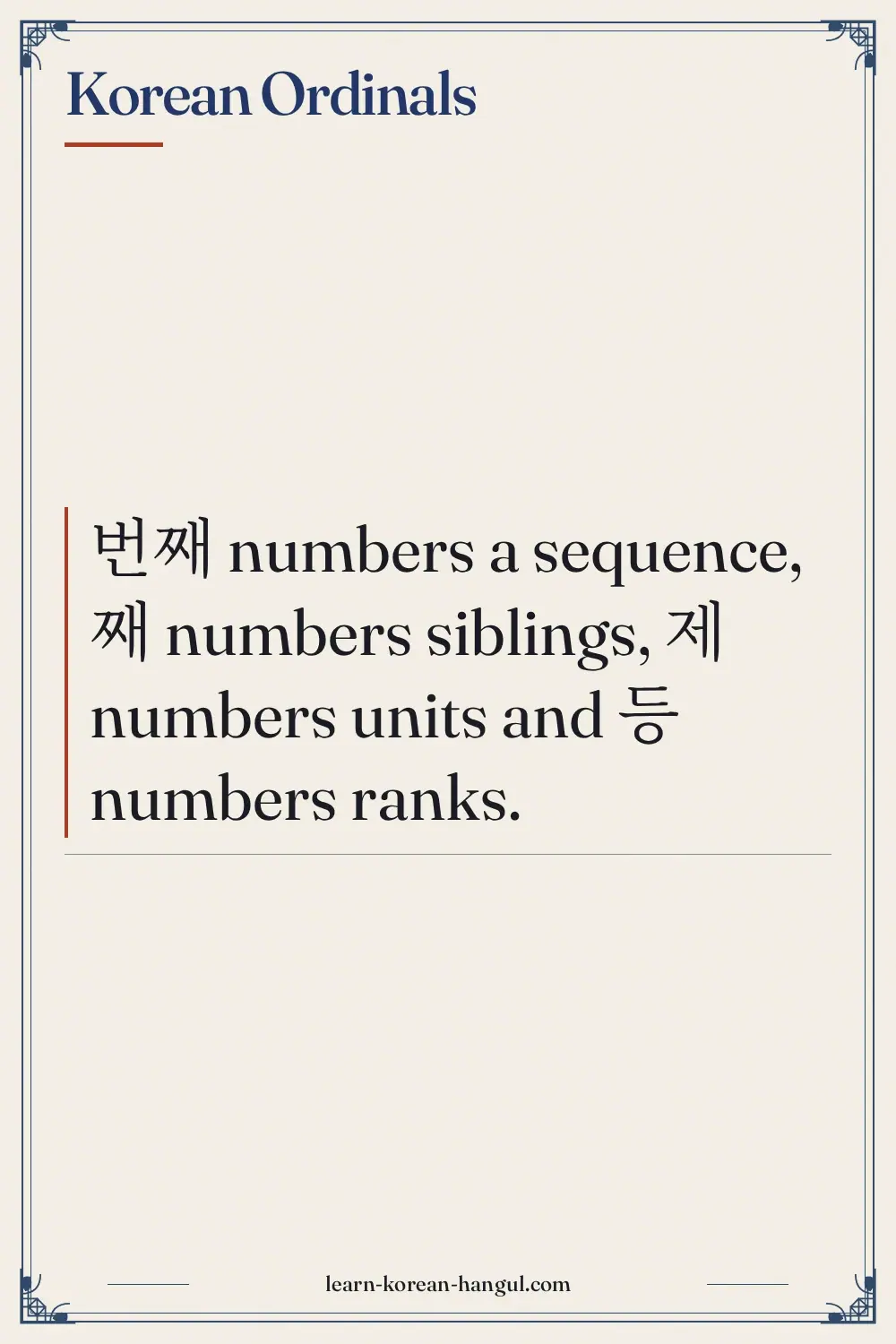
Korean ordinals are chosen by what you are ordering, not by the English word. Five forms cover most situations, and each one pairs with a number system. Sequences and family order use native numbers, while units, ranks and rounds use Sino-Korean numbers.
| Form | Used for | Number system | Example | Meaning |
|---|---|---|---|---|
| 번째 | sequences, turns, items | native | 세 번째 | third in order |
| 째 | siblings, weeks, lists | native | 둘째 딸 | second daughter |
| 제 | numbered units | Sino-Korean | 제1과 | lesson 1 |
| 등 | rank, prizes | Sino-Korean | 일 등 | first place |
| 차 | rounds, stages | Sino-Korean | 이 차 | second round |
Treat the split as a usage pattern to memorize, not as a rule you can work out from word origins. The units 제, 등 and 차 are Sino-Korean (Hanja) words and take Sino-Korean numbers, but 번 in 번째 is also a Hanja word (番), and it still takes native numbers. The page on Sino vs native Korean numbers explains which numbers go where in more detail.
A quick check helps with choosing: ask whether the thing is a sequence, a family, a unit or a result. The first answer in each case is the form in the table. The family case is the one that surprises learners, so it comes first.
How Does Birth Order Work?
Birth order uses the suffix 째 (jjae) attached to a native number. A suffix is a word part that attaches to the end of another word. The eldest child is 첫째, the second is 둘째, the third is 셋째, and so on. The youngest child has a special word, 막내 (mangnae), which needs no number.
| Order | Korean | Example | Meaning |
|---|---|---|---|
| 1st | 첫째 | 첫째 아들 | eldest son |
| 2nd | 둘째 | 둘째 딸 | second daughter |
| 3rd | 셋째 | 셋째 아들 | third son |
| 4th | 넷째 | 넷째 딸 | fourth daughter |
| 5th | 다섯째 | 다섯째 | fifth child |
| 10th | 열째 | 열째 | tenth |
| youngest | 막내 | 막내딸 | youngest daughter |
Two details matter. First, the stand-alone numbers keep their shape: 둘째 and not 두째, 셋째 and not 세째, and 넷째 and not 네째. Second, 첫째 is a fixed form for the eldest, and it does not follow 한째. Write the noun after it with a space: 첫째 아들 (eldest son), and the youngest form joins its noun: 막내딸.
To ask about birth order, use 몇째예요? ("Which child are you?"). A typical answer includes the number of children: 저는 삼 남매 중 둘째예요 ("I'm the second of three siblings"). The word 남매 means a group of brothers and sisters, and 삼 남매 means three siblings. Note 삼 here: the Sino-Korean word 남매 usually takes a Sino-Korean number (삼 남매), although 세 남매 is also heard.
The suffix 째 also works outside the family. It numbers weeks in a month (첫째 주, the first week; 셋째 주 월요일, the third Monday) and days in a sequence (둘째 날, the second day). When people list reasons or steps, 첫째, 둘째 and 셋째 mean "firstly, secondly, thirdly". So 첫째, 시간이 없어요 means "First, I have no time".
Describing Your Own Family Order
Put the pieces together in a short self-introduction. The speaker below is a woman, so she says 오빠 for her older brother and 언니 for her older sister: 저는 사 남매 중 셋째예요. 첫째는 오빠이고, 둘째는 언니예요. 막내는 남동생이에요. This means "I'm the third of four siblings. The eldest is my older brother and the second is my older sister. The youngest is my younger brother." The sentence uses 남매 with a Sino-Korean count, three ordinals with 째 and the special word 막내, so it covers most of the family vocabulary at once. A male speaker would say 형 for an older brother and 누나 for an older sister.
둘째 Versus 두 번째
The forms 둘째 and 두 번째 both mean second, but they are not interchangeable. The form 두 번째 counts a position in any sequence, such as a door or a try. 둘째 is compact and tied to family, weeks and enumerations. You can say 둘째 딸 for the second daughter and 두 번째 딸 only in a rare context, and you say 두 번째 문 for the second door, where 둘째 문 is much less common. The next form leaves native numbers and moves to units.
What Is 제?
제 (je) is a prefix that turns a Sino-Korean number into the ordinal for a numbered unit, such as a lesson, chapter, round or edition. A prefix is a word part added to the front of another word. So 제1과 means lesson 1, 제2장 means chapter 2 and 제3회 means the third round or edition.
| Written | Read | Meaning |
|---|---|---|
| 제1과 | 제 일 과 | lesson 1 |
| 제2장 | 제 이 장 | chapter 2 |
| 제3회 졸업식 | 제 삼 회 졸업식 | the third graduation ceremony |
| 제1조 | 제 일 조 | Article 1 of a text or law |
| 제1차 세계 대전 | 제 일 차 세계 대전 | World War I |
Each number after 제 is read in Sino-Korean: 일, 이, 삼. The unit word follows it: 과 (lesson), 장 (chapter), 회 (round, occasion), 조 (article) and 차 (round, stage). The prefix 제 attaches directly to the number in writing (제1과), and a space follows the unit.
You will see 제 in textbooks, event posters, school schedules and legal texts, and you will hear it in announcements. It is rare in casual chat. The word 제일 (제 일) also means "the most" or "the best", as in 제일 좋아요 ("I like it best"), which is a very common everyday word.
Common mix-up: the word 제 can also mean "my", as in 제 이름 (my name). This 제 is a contraction of 저의, and it has nothing to do with the prefix. The context makes the meaning clear: 제 before a noun with no number is "my", and 제 before a number is the ordinal prefix.
For units that are about winning or losing, Korean uses a different form: 등.
How Do You Say Ranks with 등?
To give a rank, say a Sino-Korean number and then 등 (deung). So first place is 일 등, written 1등, second place is 이 등 and third place is 삼 등. The word 등 means "grade" or "rank", and it attaches to results, prizes and seat classes.
| Written | Read | Meaning |
|---|---|---|
| 1등 | 일 등 | first place |
| 2등 | 이 등 | second place |
| 3등 | 삼 등 | third place |
| 1등상 | 일등상 | first prize |
| 1등석 | 일등석 | first-class seat |
A common sentence is 시험에서 일 등을 했어요 ("I came first in the exam"). The verb 하다 turns the rank into an action: 일 등을 했어요 means "I took first place". To ask for a rank, say 몇 등이에요? ("What place is it?") or 몇 등 했어요? ("What place did you get?"). The answer uses the same pattern: 삼 등 했어요 ("I came third").
The word 등 has other meanings. It can mean "and so on" after a list (사과, 배 등, "apples, pears and so on"), and it is also the word for "back" of the body. The number before it tells you which meaning is in play. The word 꼴찌 (kkolji) means "last place", and it is used in speech where English says "last".
Some results come in stages instead of ranks, and for those Korean uses a fifth form.
How Are Rounds and Stages Numbered with 차?
Rounds and stages take 차 (cha) after a Sino-Korean number: 일 차 is the first stage and 이 차 is the second. Unlike 번째, which counts any item, 차 counts the rounds of a process: exams, interviews, vaccination doses and nights out.
| Written | Read | Meaning |
|---|---|---|
| 1차 시험 | 일 차 시험 | first-round exam |
| 2차 면접 | 이 차 면접 | second interview |
| 2차 접종 | 이 차 접종 | second vaccine dose |
| 2차 | 이 차 | the second venue of an evening |
| 5년 차 | 오 년 차 | in the fifth year |
The last row shows a second use of 차: it counts the year or day of an ongoing role. A worker who says 오 년 차입니다 is in their fifth year on the job, and 삼 일 차 is the third day of a trip or course. This use is common in work talk and travel. The number is Sino-Korean, followed by the unit 년 (year) or 일 (day) and then 차.
At a work dinner, 1차 is the meal, 2차 is the next place, often for drinks or singing, and 3차 is a third stop. Someone may ask 2차 가실래요? ("Will you go to the second place?"). The practice is a social custom, and it depends on the group. You can say no politely by saying 저는 먼저 가볼게요 ("I'll head home first").
Each form is now clear on its own. The last step is seeing them side by side with floors, dates and counters.
Forms Compared with Floors, Dates and Counters
The forms in this lesson differ from three neighbouring patterns that look similar in English. Floors, dates and plain counters use Sino-Korean numbers or counters, not ordinal words, so check the table before choosing 번째 or 째.
| English | Korean | Why not an ordinal? |
|---|---|---|
| the 2nd floor | 이 층 | floors use Sino numbers with 층 |
| 2 May | 오월 이 일 | dates use Sino numbers with 일 |
| two times | 두 번 | 번 counts, 번째 orders |
| second daughter | 둘째 딸 | family order takes 째 |
For counting amounts, see the 번 counter. For family words such as 누나, 언니 and 막내, see Korean family members.
Common Mistakes and Fixes
Most mistakes with Korean ordinals come from using the wrong number system or the wrong form for the situation. Check your answers against this list.
- Writing 두째 or 세째. Right: 둘째, 셋째.
- Using native numbers with 등. Wrong: 하나 등. Right: 일 등.
- Using Sino-Korean numbers with 째. Wrong: 이째 딸. Right: 둘째 딸.
- Using 제 with a native number. Wrong: 제 하나 과. Right: 제1과 (제 일 과).
- Using 제 in casual conversation. In chat, say 첫 번째 or 처음.
- Taking 2차 literally. It is the second stop of an evening, not a second helping.
- Mixing the two meanings of 제. 제 이름 is "my name", and 제1과 is "lesson 1".
- Looking for a number in 막내. The word has none. Use it alone for the youngest child, and never build it as a number plus 째, because a form such as 마지막째 does not exist.
Expert insight: the quickest test for the right form is the thing being ordered. If it is a family, use 째. If it is a book, a contest or a process with a name, use 제, 등 or 차, with Sino-Korean numbers. If it is none of those, use 번째.
Limitation: this lesson covers the everyday forms. It does not cover the full legal numbering style (제1항, 제1호) or traditional titles, and some educational materials mix the forms differently. Use the examples here as safe defaults.
Practice Set
Answer each item aloud before you read the answers.
- Say "eldest son" and "second daughter".
- Read 제3회 aloud.
- Say "second place".
- What is the youngest child called?
- What does 2차 mean after dinner?
- How do you say "I am in my fifth year at work"?
Practice · 5
Which form names the second daughter?
Show answer
둘째 딸
How do you read 제3회?
Show answer
제 삼 회
How do you say second place?
Show answer
이 등
What does 막내 mean?
Show answer
The youngest child
What is 2차 after a dinner?
Show answer
The second venue
Answers:
- 첫째 아들, 둘째 딸.
- 제 삼 회.
- 이 등.
- 막내.
- The second place the group goes to after the meal.
- 오 년 차예요.
Five or more correct means you can choose the right form.
What to Learn Next
You can now choose between the Korean ordinals 번째, 째, 제, 등 and 차, and you know the number system behind each one. Continue in this order:
- First, second, third in Korean to review the 번째 pattern.
- The 번 counter for counting times.
- Korean family members for 언니, 누나, 형 and 오빠.
- Ordinal Numbers for the whole section.
Frequently Asked Questions
What is 2차 at a Korean dinner?
2차 (이 차) is the second stop of an evening out. After dinner, the 1차 (일 차), the group moves to another place for drinks, coffee or karaoke, and that move is the 2차. A third stop is 3차 (삼 차). The word 차 counts rounds, so it fits any event with stages.
How do I say my eldest sister in Korean?
A younger sibling can say 큰언니 if the speaker is a woman or 큰누나 if the speaker is a man. To describe her in a neutral way, say 첫째 딸 (the eldest daughter). The word 큰 means big, so 큰언니 and 큰누나 mean the oldest sister of several.
What does 막내 mean?
막내 (mangnae) means the youngest child in a family, and it also names the youngest or newest member of a group, such as the junior at an office. It has no number in it, because the youngest of any group is simply 막내. Birth order before it uses 첫째, 둘째 and 셋째.
Is 제 used in speech?
Rarely in casual talk. 제 as an ordinal prefix lives in titles, schedules, announcements and textbooks, such as 제3회 졸업식 (the third graduation ceremony). In conversation, people say 세 번째 for a sequence. Do not confuse it with the word 제, meaning my, as in 제 이름 (my name).
How do I say first prize in Korean?
Say 일등상, written 1등상, which uses 등 for rank and 상 for prize. The second and third prizes are 이등상 and 삼등상. For a medal, gold, silver and bronze are 금메달, 은메달 and 동메달. The number before 등 is Sino-Korean, so 하나등 is not used.