Korean Phone Number Format at a Glance
A phone number is an identifier with a context. Its digits may be displayed with spaces or hyphens for reading, stored as a global address, or split across fields in a contact form. Those representations are related, but they do not always contain the same characters. The domestic zero and international country code perform different jobs.
For an ordinary Korean mobile pattern, compare 010-XXXX-XXXX with +82 10 XXXX XXXX. The domestic trunk zero disappears from the national significant part when the global country code is added. The remaining digits retain their order. The plus sign indicates a global address; it is not a mathematical positive-number sign. Treat the complete value as text throughout copying, saving and import.
The formatter starts with South Korea as the default number country. That choice interprets a number without an explicit country code. An explicit foreign country code takes precedence, so a Spanish number beginning with +34 stays Spanish. Choosing South Korea does not turn every pasted sequence into a Korean number. Incomplete or conflicting input stays visible for correction.
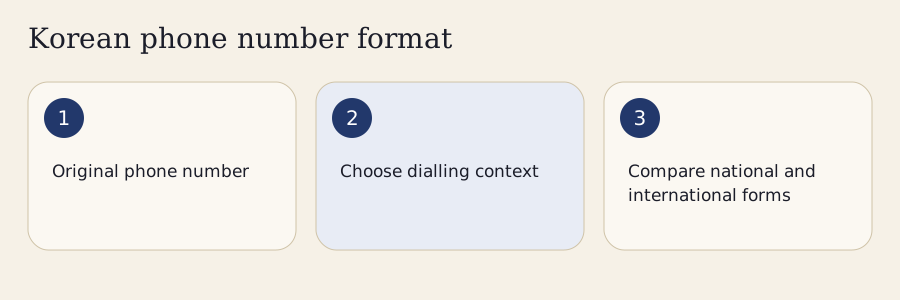
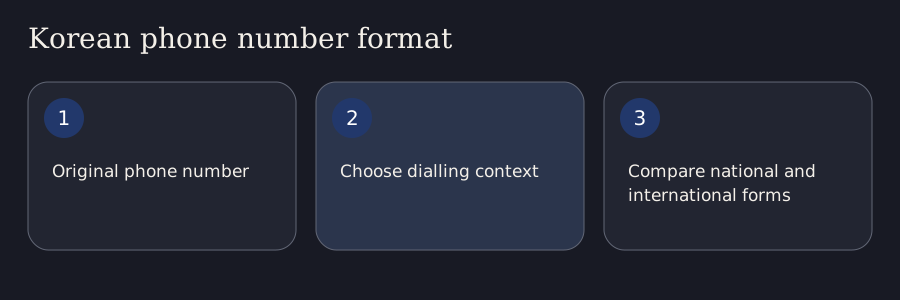
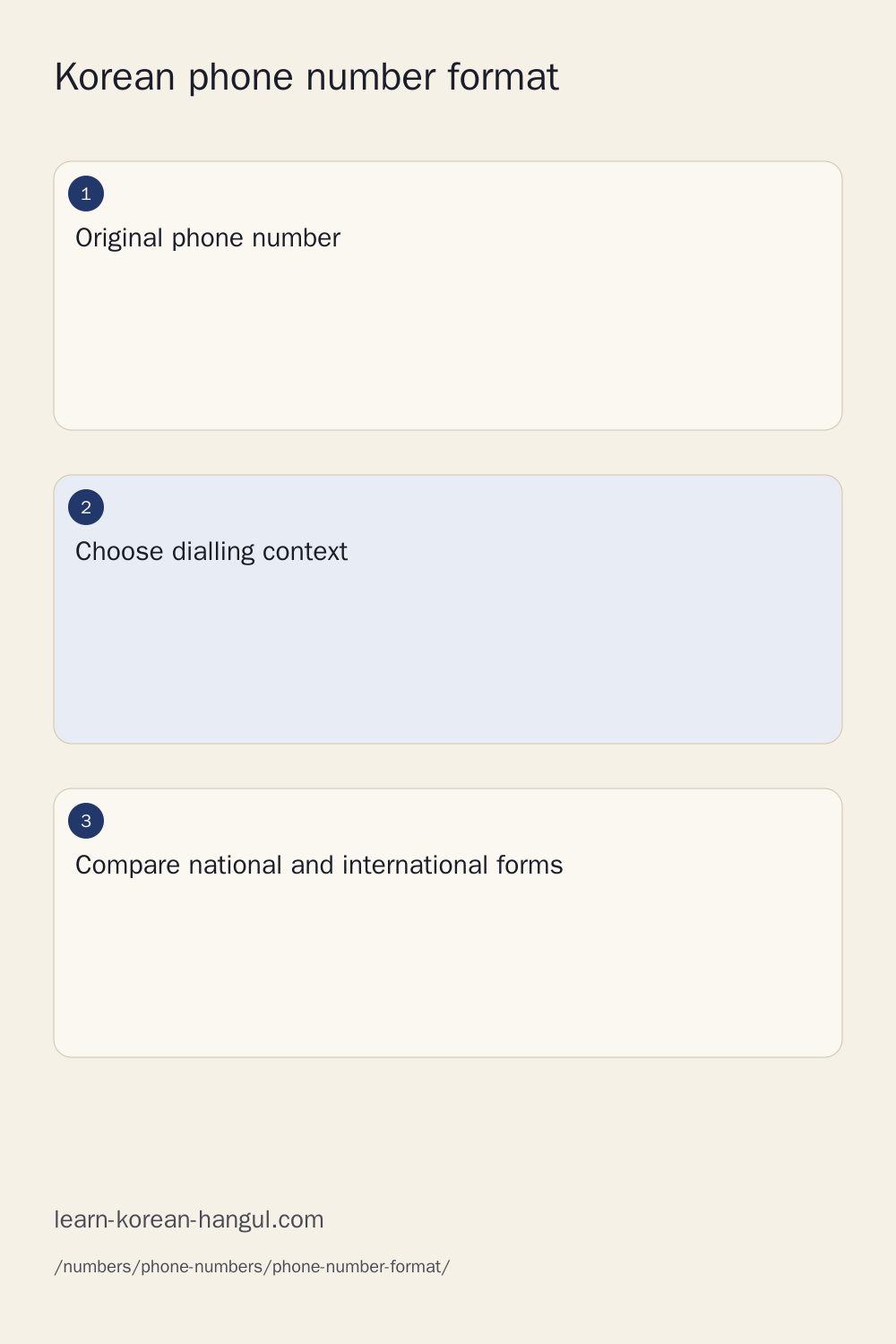
Choose Format after entering the source. The result gives domestic and international displays. Copy format offers E.164, country-code digits, domestic digits, the original input and an extension-aware RFC 3966 identifier. More contains origin settings, contact-list import, digit reading, shopping-form examples, metadata details and a calling-time worksheet.
How Do You Convert 010 to +82?
Start from the complete domestic mobile pattern 010-XXXX-XXXX. Remove the domestic trunk zero, retain 10, and add the country code +82. The result is +82 10 XXXX XXXX. A compact E.164-shaped representation removes display separators, giving +8210XXXXXXXX. The X characters here are teaching masks, not a usable address or a claim about an unassigned line.
The same principle works for a Seoul fixed-line pattern. 02-XXX-XXXX becomes +82 2 XXX XXXX; the longer middle group in 02-XXXX-XXXX becomes +82 2 XXXX XXXX. Both examples show why assuming one universal Korean phone length is a mistake. Grouping follows the number’s category and supported length rather than a single fixed template.
A regional fixed-line pattern such as 031-XXX-XXXX becomes +82 31 XXX XXXX. A four-digit middle group remains four digits. Do not discard a subscriber digit to make the result resemble a familiar template. If the original number lacks an area prefix, ask for that prefix instead of guessing Seoul.
An extension is a separate instruction. The domestic display can include ext 123, while the base E.164 address excludes those extension digits. An RFC 3966 identifier can represent the same separation with an ext parameter. Copying only the base address is appropriate for a field that explicitly requests E.164; a switchboard note may need both parts.
Why Does an Extra Zero Require Confirmation?
Input such as +82 (0)10 XXXX XXXX often shows the domestic zero as an editorial hint. A parser may be able to remove it automatically, but changing an identifier should be deliberate. The formatter describes the proposed change and requires confirmation before producing the corrected result. Compare the source and destination before copying.
A bare sequence beginning with 82 is also ambiguous. It might be a country code with a missing plus sign, or it might belong to another numbering context. The tool proposes a country-code interpretation only when appropriate and waits for confirmation. The original text remains available, so a proposed correction does not overwrite the evidence you started with.
Which Korean Area Codes Are Used?
The domestic area-prefix reference contains 17 entries. Seoul uses 02. Gyeonggi uses 031, Incheon 032 and Gangwon 033. South Chungcheong uses 041, Daejeon 042, North Chungcheong 043 and Sejong 044. Busan uses 051, Ulsan 052, Daegu 053, North Gyeongsang 054 and South Gyeongsang 055. South Jeolla uses 061, Gwangju 062, North Jeolla 063 and Jeju 064.
| Domestic prefix | Numbering region |
|---|---|
| 02 | Seoul |
| 031 | Gyeonggi |
| 032 | Incheon |
| 033 | Gangwon |
| 041 | South Chungcheong |
| 042 | Daejeon |
| 043 | North Chungcheong |
| 044 | Sejong |
| 051 | Busan |
| 052 | Ulsan |
| 053 | Daegu |
| 054 | North Gyeongsang |
| 055 | South Gyeongsang |
| 061 | South Jeolla |
| 062 | Gwangju |
| 063 | North Jeolla |
| 064 | Jeju |
An area prefix describes numbering origin. It does not establish the caller’s physical location, the owner’s address or the place where a service is currently delivered. A listed regional label helps interpret a fixed-line pattern; it is not a location lookup. Keep that distinction when exporting an annotated contact list.
Area prefixes and calling districts are different levels of information. This page provides the area reference, source-labelled prefix annotations and a paged transcription of the calling-district annex published with MSIT notice 2021-93. The archived HWP source, edition and file hash accompany that table. It records 143 district names across 17 area entries in that edition; it does not establish that every district or allocation remains current in 2026. A newer regulator edition and independent transcription review are needed before treating it as a current allocation directory. No reserve-band claim is inferred from a competitor’s list. Where an annotation is missing, the result remains unknown rather than supplying an attractive guess.
Mobile, VoIP and Special-Number Patterns
Ordinary 010 mobile numbers, 070 VoIP, 080 toll-free, 060 premium-rate and 050 personal-number patterns belong to different metadata categories. Historical mobile and pager patterns can also appear in published metadata. Their length and formatting rules are not interchangeable. A type label describes a pattern; it does not promise a service’s present operation, cost or SMS capability.
The tool uses full Korean ordinary metadata from libphonenumber-js 1.13.15, with a separate short-service matcher derived from a pinned Google metadata source. The source version remains available in Details and exports. Possible length, matching pattern and current allocation are separate questions. A number can meet one condition while failing another.
The dated MSIT ordinary subscriber-block rules for 010 and 070 are narrower than permissive historical metadata. The formatter displays that distinction without deleting the source number. A broad metadata match outside the ordinary allocation pattern does not prove a line is fictional, and it does not prove an exception applies. Service-specific interpretation needs the relevant current policy.
The 012 machine-service context is identified separately. Do not assume that a machine-service identifier is a person’s mobile voice or messaging number. Likewise, an original-allocation carrier annotation cannot establish the current carrier after number portability. The tool labels what the source provides and leaves the remaining facts unknown.
Can a Familiar Prefix Guarantee a Free Call?
No. A toll-free category is not enough to establish international routing or the price charged by an originating operator. Premium and national business numbers have additional conditions. Ask the service and your operator for the actual tariff and overseas route. The formatter’s call-cost worksheet uses rates you enter; it does not supply a provider quotation.
Can You Call Short or Business Numbers from Abroad?
Short services need their own pipeline. Domestic emergency numbers 112 and 119 do not become ordinary global addresses by adding +82. The result explains the domestic service context and suppresses a fabricated E.164 output. A short sequence that lacks a recognized service pattern is preserved as an unsupported special number for clarification.
Korea Tourism Organization publishes a separate overseas form for its 1330 service: +82-2-1330. That is a specific documented instruction, not a universal rule for transforming short codes. The formatter explains the exception when 1330 is entered and distinguishes it from the incorrect generic +82 1330 construction. KTO’s original service page.
National business services such as masked 1544-XXXX and 1588-XXXX patterns can receive a metadata-formatted representation. That does not establish overseas reachability. The result retains an explicit unknown-routing message. Use a published overseas alternative from the organization when one exists; do not invent an area code or subscriber number.
Some international-freephone and network-access patterns explicitly suppress ordinary international display. They remain domestic or special-access instructions. This prevents a plausible-looking +82 string from being mistaken for a routable global number. If an operator requires a carrier-selection prefix, preserve that context separately from the destination’s identity.
Choosing Your Country and Calling Origin
Default number country, calling origin and device are separate settings. The first interprets unprefixed destination digits. The second interprets an exit prefix in a dial string. The third helps describe how a mobile plus-address instruction differs from a landline exit-code instruction. None is inferred from your IP address or the language of this page.
For an explicit global address, the destination country code is already present. Changing the calling origin can change instructions without changing the destination. This is useful when a saved contact is used from different countries. A roaming recipient can also be outside the country associated with the number; choose their actual timezone when planning a call.
Do 00 and 011 Mean the Same Thing?
They can both serve as international exit prefixes in different origins, but they are not globally interchangeable. Spain commonly uses 00; the US and Canada use 011. Australia’s 0011 and Japan’s 010 require their own origin context. Korean carrier-selection international prefixes need the selected Korean origin and the relevant operator convention.
The formatter interprets those prefixes only after an origin is supplied. A bare 00 sequence without origin produces a request for context rather than a silent plus conversion. This matters especially when a prefix also resembles a domestic number pattern. Keep the original string until you understand which digits represent access instructions and which belong to the destination.
Formats for Korean Shopping Forms and Contacts
A shopping form may request the entire domestic number, a country picker plus significant digits, or separate prefix and subscriber fields. Those are interface conventions rather than one new numbering standard. Use the Shopping-form formats workspace to compare them. Follow the actual form’s instructions and do not assume that a correctly formatted string guarantees acceptance.
When +82 is already supplied by the country picker, the remaining field generally needs the national significant part rather than another country code. A form explicitly asking for domestic digits has a different requirement. Pasting a complete global address into every field can duplicate prefixes. Check field labels and help text before entering a value.
Split forms need careful handling of Seoul’s two-digit prefix and the three-digit regional or mobile prefixes. The simulator separates prefix and subscriber values from a completed result. It does not infer an unknown area. Extensions remain separate, because adding extension digits to a base field can change the apparent number length and prevent correct parsing.
RFC 3966 text represents a telephone identifier with explicit parameters. Here it is copyable text, not a link that starts a call. Duplicate extension parameters, conflicting subaddresses and local identifiers without a global phone-context are rejected with an explanation. This protects against accidental last-value-wins behavior in imported contact data.
How Do You Clean a Contact List Safely?
Open More, choose Contact lists, and paste or select a local file. CSV, TSV, ordinary text and vCard inputs are interpreted in the browser. Choose the delimiter and whether the first row is a header. Confirm the phone-column numbers rather than relying on a guessed field. Multiple phone columns can be processed while retaining the original source row.
Country interpretation can come from the default number country, a selected country column or explicit per-column overrides. A mixed international list should not silently inherit South Korea for every unprefixed value. An explicit plus-address retains its destination country. Missing country context and malformed numbers stay in diagnostics and complete exports rather than disappearing.
The CSV parser respects quoted commas, escaped quotes and quoted line breaks. A contact name containing a comma is one field when correctly quoted; it should not shift the phone column. Encoding is also explicit. If a file cannot be decoded under the chosen encoding, select the correct encoding or recover a clean text export from its source.
Large files are processed in bounded chunks with progress and cancellation. Desktop chunks permit up to 100,000 rows and phone chunks up to 10,000. Capacity limits describe the current operation, not a daily quota. A locally downloaded resume file carries remaining source rows for another operation. It contains contact data, so keep it somewhere appropriate.
How Do Duplicate Groups Preserve Extensions?
The default key contains the base E.164 address and extension. Two people on the same switchboard can therefore remain different records. A second view groups by base address for comparison, while preserving the separate extensions and names. Grouping never automatically merges people or discards source rows.
Filter by status, country, type or duplicate group and inspect one current row at a time. Previous and Next preserve the source position. Export all rows when you need a complete audit, including invalid entries, or export a selected filter when its narrower purpose is clear. JSON and text-safe CSV serve different downstream uses; choose deliberately.
Why Should Spreadsheet-Safe Export Be Explicit?
A spreadsheet may treat an initial plus as a formula prefix, remove a leading zero or coerce a long identifier into scientific notation. That changes representation before the next application sees it. The safe export protects text-like fields and formula-leading content. Preview the serialized output before opening it elsewhere.
A raw machine export is also available for applications that require unmodified identifiers. Do not confuse that file with the spreadsheet-safe version. Import phone fields as text and retain an original source backup. If a spreadsheet has already rounded digits away, the formatter cannot reconstruct them from the damaged value.
What Does a Valid Pattern Actually Prove?
The result distinguishes incomplete input, malformed syntax, possible length, a published pattern match, an unsupported special service and a confirmed correction. Those labels describe processing evidence. They do not establish that a number is assigned, connected, active, owned by someone specific or eligible for a service’s verification process.
Metadata has a version and can lag changes to an operator’s allocation or product. The formatter retains the pinned version in diagnostics so a result can be reproduced. A future metadata update needs regression comparisons before replacing the current rules. A formatting disagreement is a reason to inspect source versions and context rather than to make an unsupported certainty claim.
Prefix geography and original-allocation carrier information also have limits. They are not a present-location service or a real-time carrier lookup. A sanitized issue report contains category and source information without the private number. You can independently contact the maintainer through the correction page if the published rule appears inconsistent.
Saying a Phone Number in Korean
Telephone digits are read one by one rather than as a quantity. The digit reference uses 공 for zero, then 일, 이, 삼, 사, 오, 육, 칠, 팔 and 구. Retained groups become pauses. The tool’s Read digits workspace displays the complete text and offers slow or normal playback through a locally available Korean device voice.
If no local Korean voice is installed, the visible reading remains useful. The tool does not send a private number to a remote text-to-speech service. Play, pause and replay are user actions. Listen to the group boundaries and compare the written digits instead of expecting automatic speech to confirm that the address itself is correct.
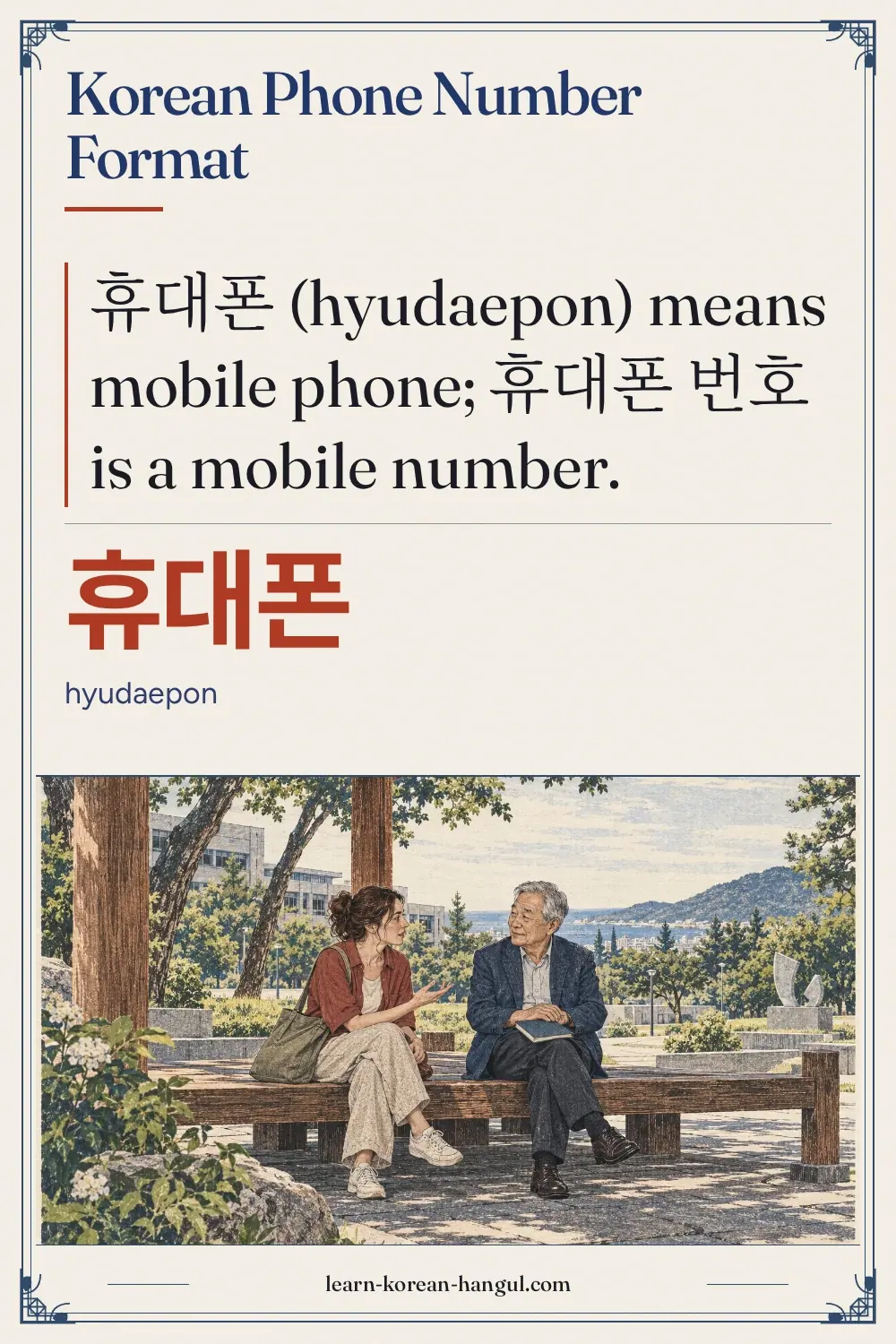
Useful terms include 전화번호 for phone number, 국가번호 for country code, 지역번호 for area code, 휴대폰 번호 for mobile number, 연락처 for contact details and 내선 for extension. Continue with the dedicated say the digits in Korean lesson and Sino-Korean digits for the wider pronunciation explanation.
When Should You Call, and How Is Cost Calculated?
Calling time requires a date, a caller zone and the recipient’s actual zone. The timezone attached to a prefix is only a suggestion. Override it for a roaming or relocated recipient. The worksheet uses the shared pinned IANA time engine, including skipped and repeated local times, and displays the resulting calendar date as well as the clock.
Call cost uses a user-entered rate, connection fee, duration, free allowance and billing increment. For a rate of 0.10 per minute, a 61-second call billed in 60-second increments has 120 charged seconds and costs 0.20 before a connection fee. With a 30-second allowance and a 0.05 connection fee, the same duration has 60 charged seconds and costs 0.15.
These examples demonstrate arithmetic rather than a provider tariff. The currency label and rounding are visible, and exact decimal calculations precede final display rounding. Ask the operator about taxes, special-service charges, allowances and the actual charging policy. A plausible number format cannot answer those commercial questions.
Privacy, Offline Use and a Reproducible Result
A phone list can contain personal information even when it has no names. The formatter therefore keeps source strings and processed records in browser memory. Selecting a file does not upload it. Formatting does not trigger a call, send a message or ask a remote service whether a subscriber exists. Those boundaries also apply to the prefix annotations: the tool uses public source tables rather than a private-number lookup service.
A clean page share contains the route alone. Including a number requires a separate preview and an explicit choice. The private fragment can still be retained by a recipient or browser history, so do not treat a shared link as anonymous. Reset removes the current input and fragment. If you copied or downloaded a contact file, deleting browser state does not remove that separate copy.
Offline files are also distinct from contact records. The public cache action saves the loaded page and its public tool assets. It excludes phone inputs and contact rows. A mode or international metadata pack that has never loaded may still need its first download. Once its public assets are available, the corresponding calculations can run without a network connection. Removing the public cache does not erase a file you previously exported.
A reproducible result needs the original string, chosen number country, origin context, extension policy and metadata version. Preserve those details in an audit export when the downstream use requires an explanation. A bare formatted address cannot reveal whether an extra zero was confirmed, whether a country was supplied by a column, or whether the input began as a short service. Keep changes beside results rather than overwriting the source column.
A Small Contact-List Example to Check before a Large Import
Begin with a header and two masked records. Put a display name in the first column and an ordinary domestic phone pattern in the second. Confirm that the chosen delimiter produces two fields, select column 2, and mark the header checkbox. Then replace the teaching masks with data you are authorized to process; masks themselves remain teaching patterns and never become validated addresses.
Inspect one result row and its original source position. Check the country, extension and normalized representation. Export the small sample in the format your next application expects, reopen it as text and compare the serialized fields. Only then process the larger file. This sequence catches delimiter, encoding and spreadsheet interpretation mistakes before they affect many contacts.
Frequently Asked Questions
Can I use +82 on a Korean mobile while in Korea?
A global +82 address can be stored on a mobile phone, including when you are in Korea. Whether a particular operator and service accepts it is separate from formatting. Follow the service’s instructions. Special short codes and national business services have their own routing rules and should not receive a generic +82 prefix.
Why does a phone form reject a metadata-valid number?
A form may require domestic digits, separate country and subscriber fields, a particular service type or its own verification conditions. A published metadata pattern does not establish that the line is assigned or eligible. Compare the requested format first, then contact the service if a correctly formatted number is still rejected.
Can a 050 number reveal the person’s real location?
No. A personal-number prefix can identify a category in a published numbering plan, but it cannot establish the user’s present location or the underlying destination. Even geographic prefixes describe numbering origin rather than a person’s current residence. Mobile roaming and number portability create further reasons to avoid location or carrier assumptions.
Does the formatter confirm ownership or SMS verification?
No. The formatter checks syntax, possible length and published patterns locally. It does not contact an operator, send a message, confirm an owner or prove that a line is active. Assignment, reachability and SMS eligibility remain unknown. Use the relevant service’s own legitimate verification process when that service requires one.
Why did my CSV lose a plus sign or leading zero?
Spreadsheet software can interpret phone identifiers as numbers or formulas when a CSV is opened. That can remove a leading zero, change a plus sign or display scientific notation. Use the spreadsheet-safe text export and import phone columns as text. Keep a raw machine export separately when another application needs exact strings.
Can I keep an extension when exporting contacts?
Yes. The formatter keeps the extension separate from the base E.164 address and includes it in extension-aware display, JSON, CSV and vCard representations. The default duplicate key includes both base and extension. Two extensions on the same switchboard remain separate contact records unless you deliberately choose a different grouping view.
Your Next Korean Phone Number Format Check
Check the Korean phone number format, confirm the country and origin, and copy the representation the receiving form requests. Preserve the extension and source version when exporting contacts. For language practice, continue with phone numbers in Korean, Korean phone phrases or Korean number reading. Use free Korean tools and Korean for travel for the next practical task.