
Key facts
- Units: 백 100, 천 1,000, 만 10,000, 억 100,000,000.
- They are used for minutes, seconds, dates, money, phone numbers and floors.
Sino Korean Numbers: the Essentials
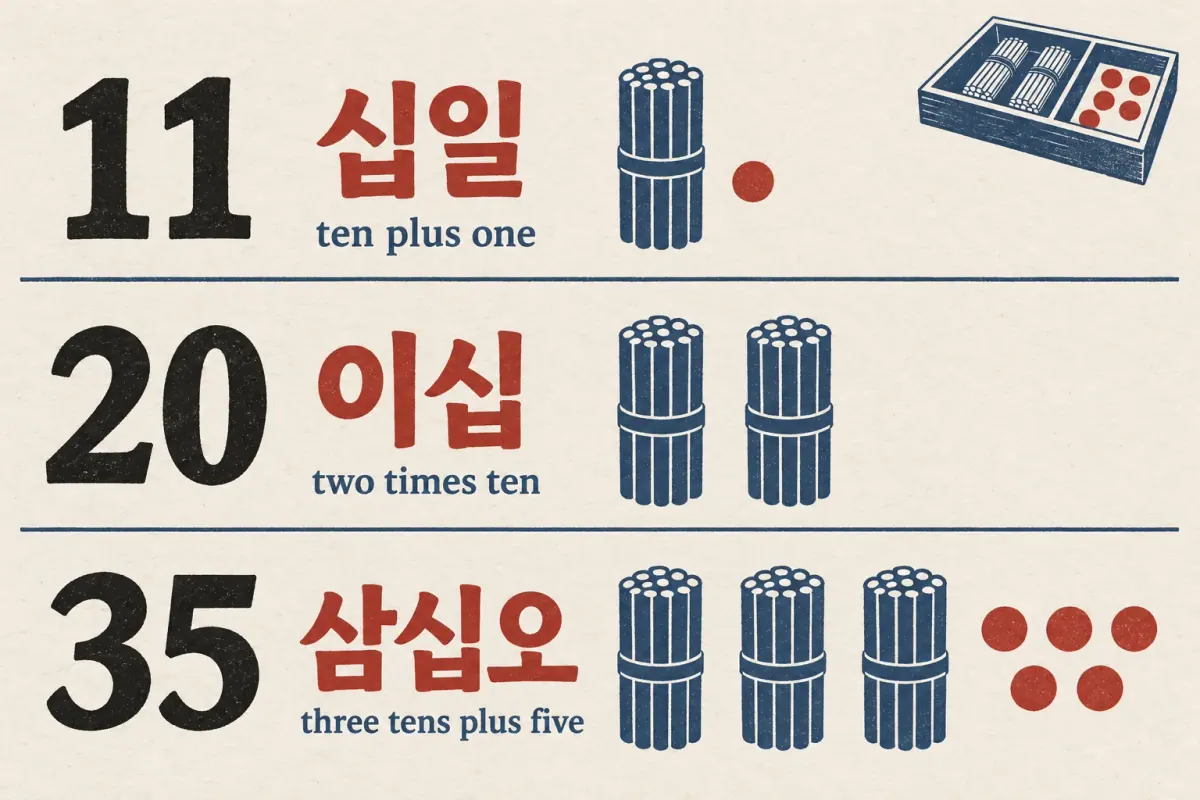
Sino Korean numbers are the set of Korean number words that come from Chinese (the prefix "Sino" means Chinese). Linguists call them 한자어 수사 (hanja-eo susa), which means "numerals of Chinese-character origin". Korean also has a second set of original Korean words, called native numbers (하나, 둘, 셋). Sino-Korean numbers are the more regular of the two, because one short rule builds every number from the same ten words.
| Number | Hangul | Revised Romanization |
|---|---|---|
| 1 | 일 | il |
| 2 | 이 | i |
| 3 | 삼 | sam |
| 4 | 사 | sa |
| 5 | 오 | o |
| 6 | 육 | yuk |
| 7 | 칠 | chil |
| 8 | 팔 | pal |
| 9 | 구 | gu |
| 10 | 십 | sip |
Revised Romanization (RR) is the official system the South Korean government uses to write Korean sounds in Latin letters, and it appears here only as a learning aid. The Hangul is the real spelling.
The build rule has three lines. Eleven is 십일 (ten plus one), twenty is 이십 (two times ten), and thirty-five is 삼십오 (three tens plus five). Notice that ten is just 십, never 일십. The same applies to 백 (100) and 천 (1,000), which do not take a leading 일 in everyday reading.
The next section shows where each lesson in this set fits.
What Can You Learn in This Section?
This section has two lessons, and each one answers the question a learner asks next. First comes the complete list from 1 to 100, then the method for numbers beyond it. A third question, which system to use, is answered on a neighbouring page.
Number Lists
Sino Korean Numbers 1-100: Full List, Rules and Audio lays out every number in a table with audio and shows the build rule for 11 to 99. After this lesson you can read 47, 82 and 100 aloud and write them in Hangul, without looking at a list.
Large Numbers and Rules
How to Say Large Numbers in Korean: 100, 1,000, 10,000+ explains why Korean groups digits by 10,000 instead of 1,000. It teaches the units 만 and 억, so 150,000 reads 십오만 and 1,500,000 reads 백오십만.
Related Lessons outside This Section
Two lessons that belong to the wider numbers hub help most learners next. Sino vs native Korean numbers gives a single table for choosing a system in ten everyday situations. Korean Numbers 1-10: Both Systems Side by Side With Audio lets you hear both sets of ten words in one place.
Now the question is when to pick this system at all.
When Do You Use Sino-Korean Numbers?
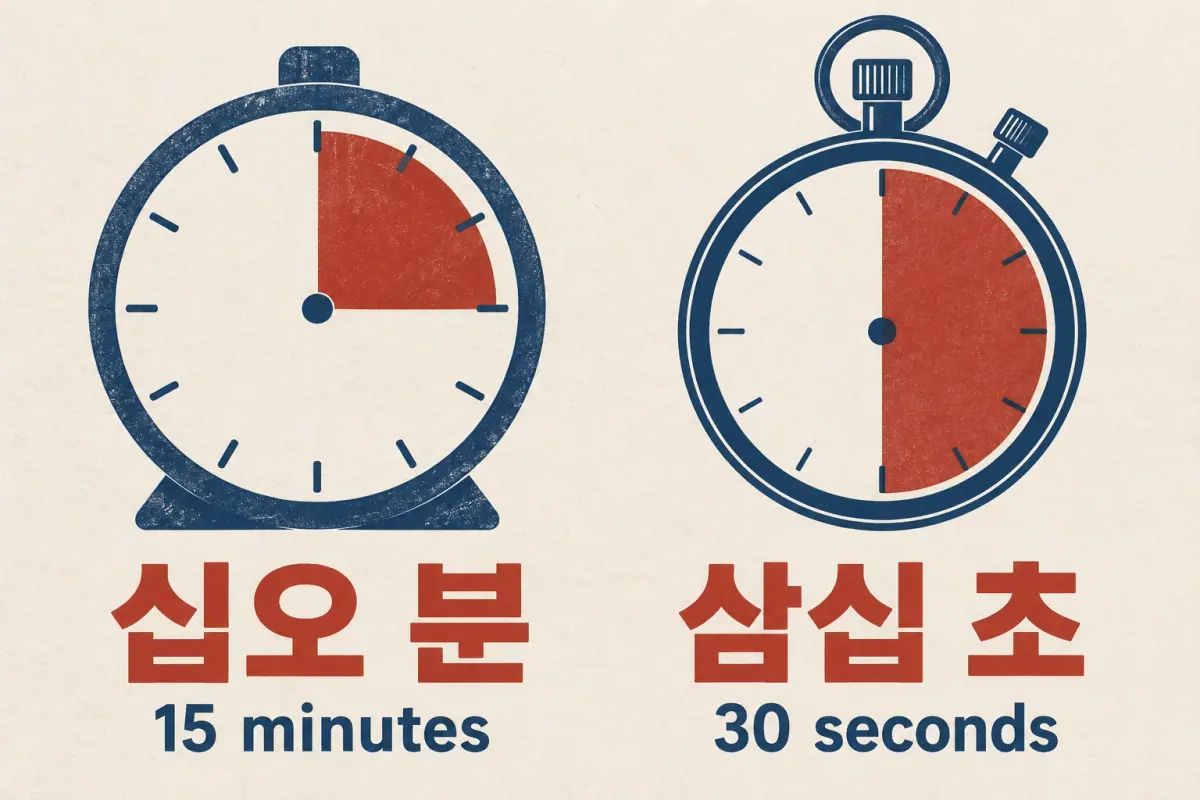
Use Sino-Korean numbers whenever you read a label, a price or a calendar, and whenever you measure something. Use native numbers when you count objects or give the hour. The table lists the common Sino-Korean jobs, each with a short example.
| Situation | Counter or unit | Example | Meaning |
|---|---|---|---|
| Minutes | 분 | 십오 분 | 15 minutes |
| Seconds | 초 | 삼십 초 | 30 seconds |
| Months | 월 | 오월 | May |
| Days of the month | 일 | 이십칠 일 | the 27th |
| Money | 원 | 오천 원 | 5,000 won |
| Floors | 층 | 삼 층 | third floor |
| Phone digits | none | 공일공 | 010 |
A rule of thumb helps: if you read it from a sign, a screen or a calendar, it is probably Sino-Korean. If you can ask "how many things?", it is probably native. Two cases are not obvious. The hour uses native numbers (세 시, three o'clock), while the minutes use Sino-Korean ones (십오 분). Age is spoken with native numbers and a counter (스무 살) but written on forms with Sino-Korean numbers (20세).
Next, a few sound changes decide whether you can say these numbers naturally.
Which Pronunciation Traps Should You Know?

Two traps matter most for beginners: some numbers change their sound next to the word that follows, and two months have irregular spellings. The sound change follows the standard pronunciation rules (표준 발음법) of the National Institute of Korean Language (국립국어원), and the month names are fixed spellings you learn as a pair.
- 십육 is said [심뉵]. An [ㄴ] sound is added before 육, and the ㅂ at the end of 십 sounds like [ㅁ] before it. The spelling stays 십육.
- June is 유월 and October is 시월. Written with the usual pattern they would be 육월 and 십월, but Korean drops the final sound of 육 and 십 in these two month names.
- Six keeps its final sound elsewhere. 육 stays 육 in 육 분 (six minutes) and 육 층 (sixth floor).
Hear these four items before you move on, because the sound is the part that learners most often get wrong when they study only from a written list. The first item combines two rules, ㄴ insertion (ㄴ 첨가) and nasalization (비음화), and the National Institute of Korean Language describes both in the same standard.
How Do You Say Zero?
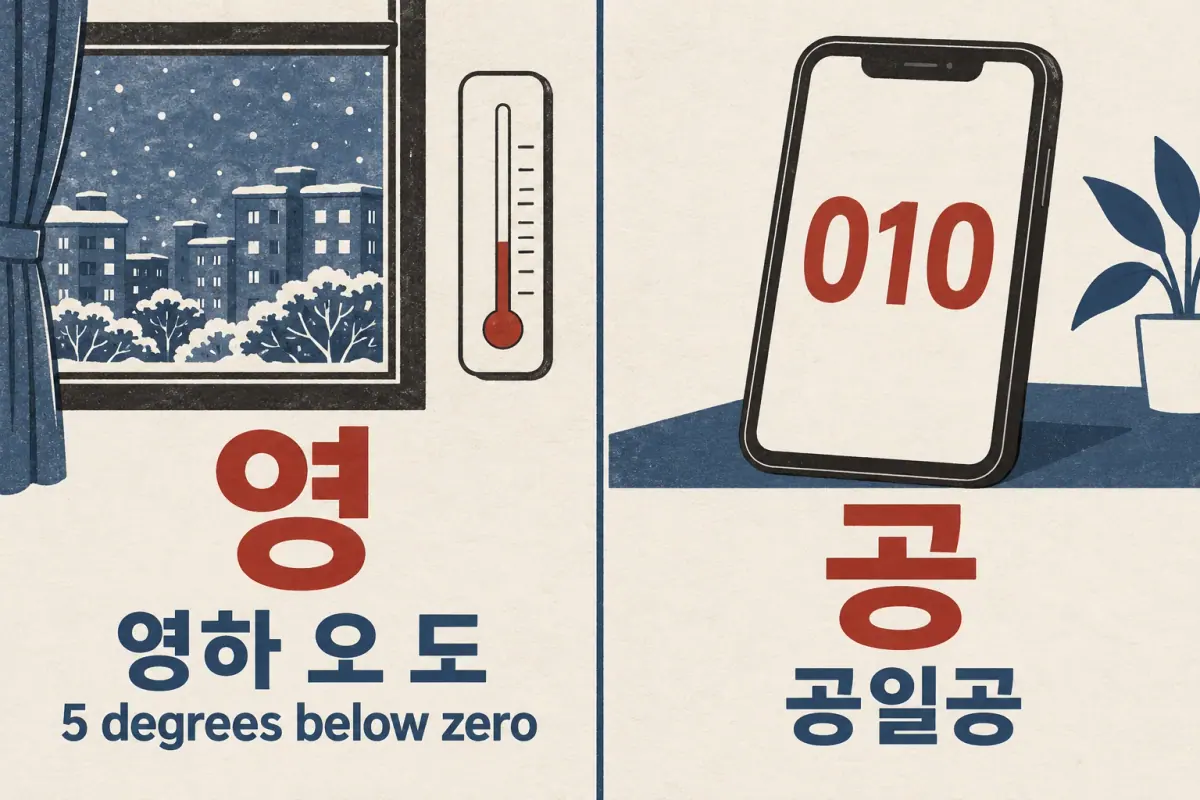
Zero has two Sino-Korean words, and each has its own job. Use 영 in maths, temperatures and general counting, as in 영하 오 도 (5 degrees below zero). Use 공 when reading phone numbers, so that 010 becomes 공일공.
Mixing them up is easy to understand but sounds odd. A phone number read with 영 is still understood, and 공 is simply the habit that keeps the digits short and clear.
Why Do 만 and 억 Matter so Much?
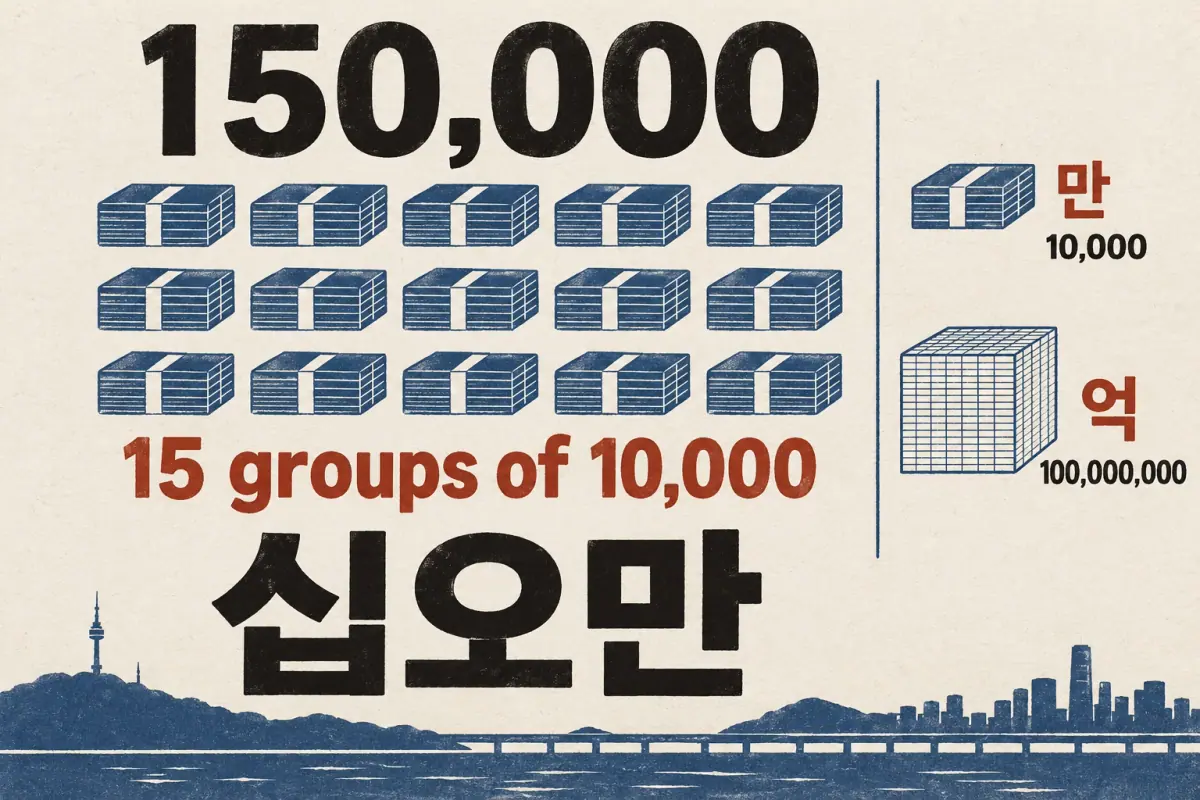
The units 만 (10,000) and 억 (100,000,000) are the pivot points of every large Sino-Korean number, because Korean counts in groups of four digits. English counts in groups of three, which is why 150,000 reads 십오만 (15 groups of 10,000) and not "one hundred fifty thousand". The lesson on large numbers in Korean teaches this regrouping step by step. For prices, Korean Numbers Million and Billion: 만, 억, 조 Explained applies it to money.
What Is Not Covered Here?
This section teaches Sino-Korean numbers and their everyday uses. It does not teach the counters for objects and people, which belong to the counters hub. It also leaves out native numbers, which have their own section, native Korean numbers.
Two related pages have a different job. The Sino-Korean numbers flashcards are the spaced-review deck for these words, while this section teaches the numbers and their uses. The page on Korean numbers in hanja shows the Chinese characters behind each Sino-Korean number, for readers who want the roots.
Limitation: this section is written for beginners. It states the common spoken forms, and some older or formal readings, such as 일천 for 1,000 in legal writing, are not covered.
Where to Start with Sino-Korean Numbers
Begin with the strip of ten words above, then open the 1 to 100 lesson and practise until 47, 82 and 100 come without effort. After that, read the large-numbers lesson so that prices and populations make sense. Come back to this page whenever you need to check which system a situation uses or how a trap such as 십육 sounds.
Frequently Asked Questions
What is the difference between 영 and 공?
Both mean zero. 영 is used in maths, scores of nothing and temperatures, such as 영하 오 도. 공 is used when reading phone numbers and similar digit strings, so 010 is said 공일공. Either word is understood in most settings, but each has a habitual place.
Why is June 유월 and not 육월?
The month names 유월 (June) and 시월 (October) drop the final consonant of 육 and 십 for ease of speech. The spelling is fixed in the dictionary, so you learn it as a pair of exceptions. The other months follow the regular pattern, such as 오월 for May.
Do Sino-Korean numbers have a counter?
Yes. A Sino-Korean number usually sits in front of a unit word, such as 분 for minutes, 월 for months, 원 for won, 층 for floors and 번 for numbers. The unit follows the number and is written after a space in most cases, as in 오천 원.
What is the largest unit learners need?
Most learners need 만 (10,000) and 억 (100,000,000). Prices, salaries and populations use them every day. The next unit, 조 (one trillion), appears in company budgets and news reports. Units beyond 조 are rare outside mathematics and are not needed at beginner level.
Are Sino-Korean numbers used for age?
In writing, yes. Forms use a Sino-Korean number plus 세, as in 25세. In speech, Koreans use native numbers plus 살, such as 스물다섯 살. So the same age has two forms, and the situation decides which one you should choose.