The Jeju dialect, called Jejueo (제주어, Jejueo), is the traditional speech of Jeju Island, south of the Korean mainland. It keeps older sounds and many words that Standard Korean does not have, so fluent Jejueo is hard for other Koreans to follow. UNESCO lists it as critically endangered. This lesson explains the status and teaches three phrases.
Key facts
- Jejueo is the traditional language of Jeju Island, listed by UNESCO as critically endangered.
- Korean usage calls it a 방언 (dialect), while many linguists describe it as a separate language.
- Older Jeju speech keeps an archaic vowel, written ㆍ (arae-a), that Standard Korean dropped.
- It has many words unlike Standard Korean, and fluent Jejueo is hard for other Koreans to follow.
- Jeju speech appears in dramas, songs and signs set on the island.
- Standard Korean remains the learner's starting point.
Last updated: 2026-10-09.
What you'll learn
- State why Jejueo is described as endangered, and where to find the current status.
- Recognise and understand three Jeju phrases: 혼저 옵서예, 하르방 and 폭싹 속았수다.
- Explain what the arae-a is and why it is a historical letter, not a modern one.
- Say why a learner of Korean starts with the standard and meets Jejueo as listening and travel vocabulary.
Prerequisites: you know the polite -요 style and have read Standard Korean. Estimated time: 20 minutes.
What Is the Jeju Dialect?
The Jeju dialect is the speech that people on Jeju Island (제주도, Jejudo) used in daily life before Standard Korean spread through schools and broadcasting. Its Korean name is 제주어 (Jejueo, "Jeju language"), and older names are 제주말 (Jeju mal, "Jeju speech") and 제주 사투리. The island forms the Jeju Special Self-Governing Province (제주특별자치도).
Three facts frame everything that follows. First, Jeju speech is related to Korean and shares the same basic grammar order: the verb comes last and particles follow nouns. Second, it differs from the mainland in vocabulary, endings and some old vowel sounds. Third, today it is mostly spoken by older islanders, while younger people speak a Korean close to the standard with some local words.
Geography explains why the speech grew apart: Jeju is an island, and for centuries travel between the island and the mainland was slow and limited. Isolation lets a language keep older features and develop its own words. The next section explains why this lesson is a challenge for a learner.
Why Jeju Speech Is Hard for English Speakers
Jeju speech is hard for English speakers because it is two steps from what they have learned. The first step is Standard Korean, which they are still learning. The second is the gap between Standard Korean and Jejueo, which is larger than the gap between Seoul and Busan. In a Busan sentence, grammar and most words stay familiar. In a fluent Jejueo sentence, many words and endings are new.
There is also a problem with sources. Jejueo has no single fixed spelling, textbooks for learners are few, and the same word may be written in several ways. It reads the written forms in a standard-style voice, so it shows how the words are put together but not how an islander says them. Treat it as an introduction, and listen to Jeju speakers in interviews and documentaries to hear the real sound. The next section answers the first question most people ask.
Is Jejueo a Dialect or a Language?
Both descriptions are used, and the choice depends on the purpose. In Korean usage and in Korean government usage, Jeju speech is a 방언 (bangeon, "dialect") of Korean. Many linguists describe Jejueo as a separate language within the Koreanic family, because fluent Jejueo is hard for other Koreans to understand and it has its own vocabulary and archaic features. It also has its own language code (jje) in the international ISO 639-3 list.
| Question | Dialect view | Language view |
|---|---|---|
| Who uses the term | everyday Korean usage, official Korean usage | many linguists, language-rights groups |
| Main argument | shares grammar and history with Korean | mutual intelligibility is low |
| What follows | treated as a regional variety | treated as a language that needs its own protection |
The word "dialect" in English can suggest a lesser speech, but in linguistics it means a variety, without any ranking. Whichever word you choose, the speakers' language is old, rich and at risk. The next section explains the risk.
Why Is Jejueo Endangered?
Jejueo is endangered because most fluent speakers are old and young people no longer learn it as a first language. UNESCO's Atlas of the World's Languages in Danger lists it as critically endangered, a category for languages whose youngest speakers are grandparents or older and who use it rarely. The listing dates from 2010, and the atlas can change, so the entry on unesco.org is the source for the current status.
Several forces explain the decline:
- Schooling in Standard Korean. For decades, schools and broadcasting used the standard, so children learned it as the language of success.
- Moving to the mainland. Many young islanders study and work in Seoul and other cities.
- Pressure of the standard. Jejueo was often treated as backward, which made families stop using it at home.
- A small base. Estimates of fluent speakers vary by source and are small, so this lesson does not quote a number.
Revival efforts exist. The provincial government has an ordinance to protect and promote the language. Local groups run classes and festivals, and publish dictionaries and children's books. Jeju phrases also appear in dramas and on tourist signs, which raises interest even among people who cannot speak it. The next section looks at how Jejueo differs from the standard.
How Jeju Speech Differs from Standard Korean
Jeju speech differs from Standard Korean in vocabulary, endings and old vowel sounds. The table shows four areas with one example each.
| Area | Standard Korean | Jeju speech | Note |
|---|---|---|---|
| Vocabulary | 할아버지 (grandfather) | 하르방 | many everyday words differ |
| Vocabulary | 할머니 (grandmother) | 할망 | |
| Welcome | 어서 오세요 | 혼저 옵서예 | 혼저 means "quickly, at once" |
| Polite ending | -습니다 | -수다 (as in 속았수다) | polite statement ending |
| Old vowel | merged into ㅏ and other vowels | ㆍ (arae-a), in older speech | historical letter |
Most of these items are words and endings, which you can learn as a list. The old vowel is a sound difference, and the next section explains it.
What Is the Arae-a (ㆍ)?
The arae-a (아래아, "lower a") is an old Hangul vowel letter written as a single dot, ㆍ. King Sejong's original Hunminjeongeum (훈민정음, 1446) included it as one of the basic vowels, and it was used in Korean writing for centuries. In mainland speech the sound merged with other vowels, mostly ㅏ, and the Unified Hangul Spelling System of 1933 removed the letter from standard spelling.
In older Jeju speech, a vowel matching the arae-a is still described as being pronounced. Researchers describe its exact quality in different ways, and it is often described as a sound between ㅏ and ㅗ, so a learner does not need to produce it. Some Jeju writing guides and local publications bring the letter back into print to write the sound, which is why you may see ㆍ in a Jeju book or sign. Standard keyboards cannot type it directly, so searching for Jeju words online often uses the nearest standard letter.
This is a point of history, not of everyday learning. A beginner who sees ㆍ in a Jeju text can note that it is an old letter, "arae-a", and move on. The next section covers phrases worth knowing.
Jeju Phrases Worth Knowing
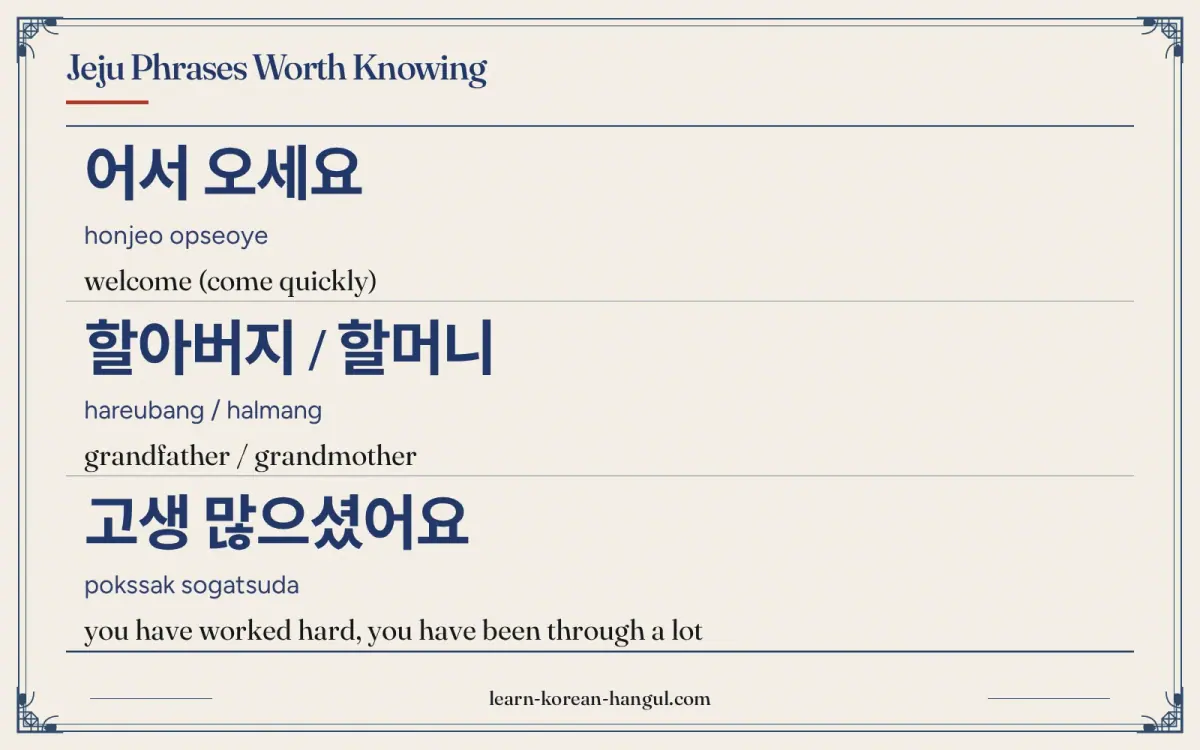
Three phrases and two words appear most often on the island and in media. Learn to recognise them first.
| Jeju | Revised Romanization | Meaning | Standard Korean |
|---|---|---|---|
| 혼저 옵서예 | honjeo opseoye | welcome (come quickly) | 어서 오세요 |
| 하르방 / 할망 | hareubang / halmang | grandfather / grandmother | 할아버지 / 할머니 |
| 폭싹 속았수다 | pokssak sogatsuda | you have worked hard, you have been through a lot | 고생 많으셨어요 |
| 올레 | olle | the lane from the street to a house gate | 골목 |
| 맨도롱 또똣 | maendorong ttottot | pleasantly warm | 따뜻하다 |
Notes on each:
- 혼저 옵서예 is a welcome you see on signs and hear at the airport. It is also written 혼저옵서예 as one word, and its sound is [혼저 옵써예] because ㅅ after ㅂ is tensed. Revised Romanization does not show that tensing.
- 하르방 is best known from the stone statues called 돌하르방 (dolhareubang), a symbol of the island.
- 폭싹 속았수다 has two parts: 폭싹, an adverb of degree, and 속았수다, a polite past form of the verb 속다 (to go through hardship). It is pronounced [폭싹 소갇쑤다], and it is written 폭삭 속았수다 as well. The 2025 drama with this title, released in English as When Life Gives You Tangerines, is set on Jeju.
- 올레 is the word behind the walking trails called the Jeju Olle (제주올레), which follow old lanes and coastal paths.
- 맨도롱 또똣 describes a pleasant, gentle warmth, like a warm drink.
A final particle, 마씀 (maseum), is often added at the end of Jeju sentences for politeness. It works a little like -요 in Standard Korean. The next section asks how far a learner should go with Jejueo.
Can Learners Study Jejueo?
Yes, but as an extra, not a first course. Start with Standard Korean, because all textbooks, apps and exams use it. Once you can follow polite speech, Jeju becomes a pleasant second layer for travel, listening and cultural interest.
A realistic path looks like this:
- Learn the three phrases above and the words 하르방 and 할망.
- Read signs and menus on a trip. Many Jeju places write the local word beside the standard one.
- Listen to Jeju speakers in documentaries, interviews and local radio, with subtitles.
- Use dictionaries and classes published by Jeju institutions if you want to go further. They teach Jejueo in more detail than a Korean textbook can.
- Respect the language. Ask a local speaker before you try a Jeju phrase in conversation.
Anyone with a serious interest in Jejueo should rely on materials made by Jeju language specialists. This site gives an introduction, not a course. Now follow one phrase in detail.
Worked Example: 혼저 옵서예
The phrase 혼저 옵서예 shows how Jejueo sits beside Standard Korean. Follow these steps.
- Split the phrase. 혼저 (honjeo, quickly) + 옵서 (opseo, come, a respectful command) + 예 (ye, a polite closing).
- Compare with the standard. 어서 (eoseo, quickly) + 오세요 (oseyo, please come). The pattern is the same: an adverb, the verb "come" and a polite ending.
- Say the sound. The phrase is [혼저 옵써예]. The ㅅ after ㅂ is tensed, as in many Standard Korean words. Revised Romanization writes honjeo opseoye.
- Check the use. It welcomes visitors. A friend on the island may also say it playfully.
- Note the spelling. You may see 혼저옵서예 as one word on signs.
You will know it worked when you can say the two versions in turn and hear that only the first word and the ending change. This is the usual shape of a Jeju phrase: familiar grammar with unfamiliar words.
Common Learner Mistakes
Mistake 1: thinking Jeju speech is a thicker accent. Learners often assume it is Standard Korean said strangely. Actually fluent Jejueo has its own vocabulary and endings, and an accent alone would not make it hard to understand. Fix: treat Jejueo as a separate set of words.
Mistake 2: assuming all Jeju people speak it. Learners often expect everyone on the island to use Jejueo. Actually most people, especially younger ones, speak a standard-like Korean. Fix: use the standard first and listen for local words.
Mistake 3: using Jeju phrases to be funny. Learners often copy 폭싹 속았수다 as a joke. Actually it is a phrase of thanks and respect for hard work. Fix: use it sincerely and only if a Jeju speaker welcomes it.
Mistake 4: expecting to type ㆍ. Learners often search for the dot letter on a keyboard. Actually standard keyboards do not include it. Fix: copy it from a text or use the nearest standard letter when searching.
Mistake 5: believing the audio is authentic Jejueo. Learners often take the clips on a learning site as real island speech. Fix: use it for forms, and listen to island speakers for the sound.
Practice: Recognise the Jeju Word
Give the Standard Korean word for each Jeju word.
- 하르방
- 할망
- 혼저 옵서예
Then answer.
- Is Jejueo called a 방언 in everyday Korean usage?
- What organisation lists Jejueo as critically endangered?
- What is the arae-a?
Answers.
- 할아버지 (grandfather).
- 할머니 (grandmother).
- 어서 오세요 (welcome).
- Yes. It is a 방언 in Korean usage, though many linguists call it a separate language.
- UNESCO, in its Atlas of the World's Languages in Danger.
- An old Hangul vowel letter written ㆍ, no longer used in standard spelling but linked to a vowel in older Jeju speech.
If you answered five or six correctly, you have the main points.
Where to Go Next
The lesson before this one is Gyeongsang dialect. The standard for comparison is Standard Korean, and the section hub Korean accents and dialects lists all regional lessons. For the wider cultural background of the island and its language, see Korean culture.
This lesson does not teach Jejueo grammar, the full word list or the pitch of Jeju speech. The status information is general, and the current UNESCO entry should be checked at unesco.org. In short, the Jeju dialect is the traditional language of Jeju Island, endangered, partly archaic and hard for other Koreans to follow, and a learner meets it best after the standard.
Frequently Asked Questions
Is Jeju dialect a language? It depends on who you ask. In Korean usage it is a 방언 (dialect) of Korean. Many linguists describe Jejueo as a separate language in the Koreanic family, because fluent Jejueo is hard for other Koreans to follow and it has its own vocabulary and archaic features. Both views agree that it is closely related to Korean.
Can Seoul speakers understand Jeju dialect? Not easily, if the Jejueo is fluent and traditional. Seoul speakers may catch grammar words and a few well-known phrases such as 혼저 옵서예, but they often miss vocabulary and endings. Most younger Jeju people speak a version close to Standard Korean with some local words, which Seoul speakers follow without trouble.
What is 하르방? 하르방 (hareubang) is the Jeju word for grandfather, which Standard Korean calls 할아버지. It is best known from the stone statues called 돌하르방 (dolhareubang, "stone grandfather") that stand around Jeju. The matching word for grandmother is 할망 (halmang), standard 할머니.
What does arae-a mean? Arae-a (아래아) is the name of an old Hangul vowel letter written ㆍ, a single dot. It was used in early Hangul, dropped from the standard spelling in 1933, and has merged with other vowels in most speech. Older Jeju speech is described as still having a vowel that matches it.
Is 폭싹 속았수다 a Jeju phrase? Yes. 폭싹 속았수다 is a Jeju phrase that expresses thanks for someone's hard work and endurance, roughly "you have really been through a lot". It became widely known outside Jeju through the 2025 drama with that title, released in English as When Life Gives You Tangerines. It is also written 폭삭 속았수다.