
Korean dialects are the regional varieties of Korean, called 사투리 (saturi) in everyday speech, that differ from Standard Korean (표준어, pyojuneo) in pitch, sentence endings, a few sounds and vocabulary. This hub explains the standard, the main regions and the lessons on this site, and tells you which one to open first.
Last updated: 2026-10-09.
What Are Korean Dialects?
A Korean dialect is a regional variety of the same language, and a dialect speaker still speaks Korean. Korean has the everyday word 사투리 (saturi) for regional speech and the technical word 방언 (bangeon) for dialect. Dialects differ from the standard in four areas: the pitch pattern of words, the endings of sentences, some sounds and some words.
The differences are real but usually small enough for people from different regions to understand each other. They are easiest to hear in casual speech with family and friends, and in media that wants local colour. Young speakers often move toward the standard at school and work, so the strongest forms are most common among older speakers and in rural areas. The sections below place each region and link to its lesson.
Where to Start with Korean Dialects
Start with the lesson that matches your reason for learning. The table gives a path for four common reasons.
| If you want to... | Open this lesson first | Why |
|---|---|---|
| Understand what "standard" means | Standard Korean Language | it is the base for all comparisons |
| Follow a Busan speaker in a drama or on a trip | Seoul vs Busan Korean | ten paired phrases with audio |
| Know why Gyeongsang speech sounds different | Gyeongsang Dialect | pitch accent and question endings |
| Understand Jeju speech or travel to Jeju | Jeju Dialect | status, the old vowel and three phrases |
If you have no special reason, read the lessons in the order of the table at the end of this page. Each takes about 20 minutes and suits learners who already know the polite -요 style.
What Is Standard Korean?
Standard Korean (표준어) is the form of Korean that the 1988 Standard Language Rules define, as a rule, as the modern speech of educated people in Seoul. Schools, dictionaries, broadcasts and textbooks use it, and it is the form this site teaches. The lesson Standard Korean Language covers the definition, the National Institute of Korean Language (국립국어원) that maintains it and the difference between the standard and regional speech. It also explains why a word such as 짜장면 was accepted beside 자장면 in 2011.
How Do Seoul and Busan Speech Differ?
Seoul and Busan speech differ in pitch, endings, sounds and words. Busan words carry a pitch pattern, casual questions end in -나, -노 or -꼬 where Seoul speakers say -어, and the pairs ㅓ and ㅡ, and ㅅ and ㅆ, can sound alike. The lesson Seoul vs Busan Korean pairs ten Seoul and Busan phrases, such as 밥 먹었어? and 밥 먹었나?, with audio and an English gloss, and explains why the Busan form is for friends and family only.
What the Gyeongsang Dialect Adds
The Gyeongsang dialect is the speech of the south-east, including Busan, Daegu and Ulsan, and it is the best-known dialect with word-level pitch accent. The lesson Gyeongsang Dialect explains pitch accent in plain English, gives five phrases with audio and Standard Korean equivalents, and lists common words: 보소, 억수로, 와 and 정구지. It also shows why the speech sounds blunt to Seoul ears and why that impression is misleading.
What about Jeju and Other Regions?
Jeju speech (Jejueo, 제주어) is the most distinct regional variety, and UNESCO lists it as critically endangered; the current entry is on unesco.org. The lesson Jeju Dialect explains the dialect-or-language debate, the old vowel arae-a (ㆍ) and the phrases 혼저 옵서예 (welcome), 하르방 (grandfather) and 폭싹 속았수다 (you have worked hard).
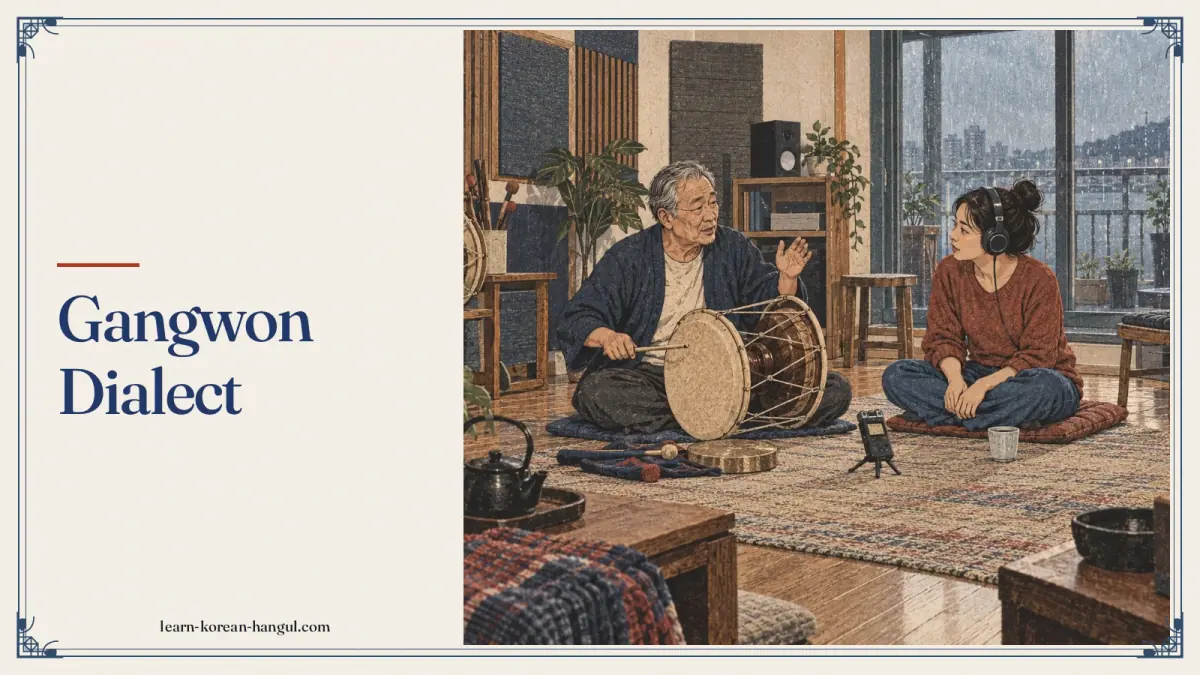
The Jeolla Dialect, Chungcheong Dialect and Gangwon Dialect lessons cover the other mainland regions. The table below gives a short overview of what each region is known for. These are widely cited tendencies, and speakers vary by town and age.
North and South Korean Compared
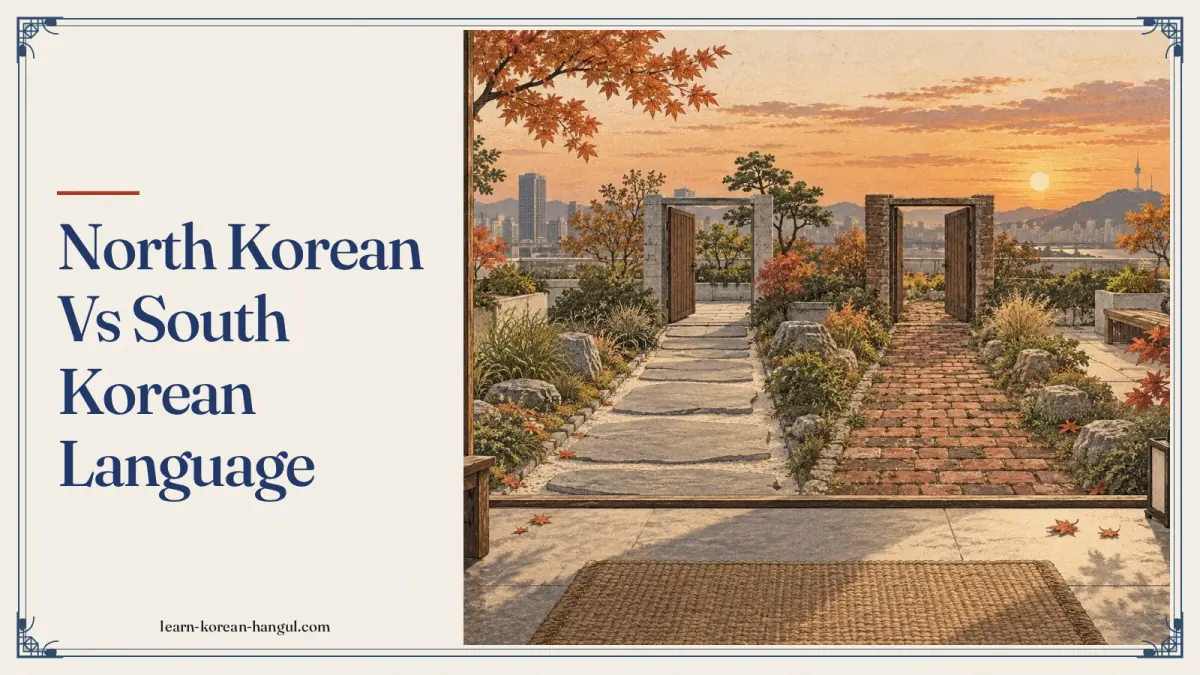
North and South Korean share Hangul and most grammar, but each side keeps its own standard: 표준어 in the South, based on Seoul speech, and 문화어 (munhwaeo) in the North, based on Pyongyang speech. Some spellings and loanwords differ, such as the South 노동 and the North 로동 for "labour". The lesson North Korean vs South Korean Language compares the two standards in sounds, spelling and words.
Comparing the Regions
The table compares the main regions on pitch, endings and a stock phrase. Every region in the table has its own lesson; the Busan comparison is covered in Seoul vs Busan Korean.
| Region | Sound and pitch | Typical endings or markers | Stock phrase | Lesson |
|---|---|---|---|---|
| Seoul (standard) | pitch grouped by phrase | -어, -어요 | 밥 먹었어? | Standard Korean lesson |
| Gyeongsang | word-level pitch accent | -나, -노, -꼬, -가 | 밥 먹었나? | Gyeongsang lesson |
| Jeolla | often described as having a strong singing rhythm | the filler 거시기; a sentence-final -잉 | 거시기 (that thing, um) | Jeolla lesson |
| Chungcheong | often described as slower in tempo | -유 endings, as in 뭐 해유? | 뭐 해유? (What are you doing?) | Chungcheong lesson |
| Gangwon | a mix of features; some east-coast speech is described as having pitch accent | varies by area | 그랬드래요 (they say it was so; older speech) | Gangwon lesson |
| Jeju | an old vowel and many different words | -수다, 마씀 | 혼저 옵서예 | Jeju lesson |
Treat the Jeolla, Chungcheong and Gangwon rows as pointers to what to listen for, not as full descriptions; each lesson gives the detail, and speakers vary by town and age.
How to Practise Korean Accents and Dialects
Practise dialects through listening, in five steps.
- Learn the standard first. You need a base to compare against.
- Choose one region. Pick the one you will visit or hear most.
- Learn the endings and ten words. Use the lesson tables and audio.
- Listen to short real clips. Dramas, interviews and variety shows set in that region, with Standard Korean subtitles, are good material. The page of K-drama phrases helps you check the standard form of common lines.
- Copy only if invited. A dialect phrase used without an invitation can sound like mockery.
You will know it works when you can say, after one listen, "this is a question, and the speaker is from the south-east." Recognition, not imitation, is the goal. Pitch features also connect to the Korean intonation lessons.
Study Order at a Glance
| # | Lesson | Level | Time |
|---|---|---|---|
| 1 | Standard Korean Language | A2 | 20 minutes |
| 2 | Seoul vs Busan Korean | B1 | 20 minutes |
| 3 | Gyeongsang Dialect | B1 | 20 minutes |
| 4 | Jeju Dialect | B1 | 20 minutes |
| 5 | Jeolla Dialect | B1 | 20 minutes |
| 6 | Chungcheong Dialect | B1 | 20 minutes |
| 7 | Gangwon Dialect | B1 | 20 minutes |
| 8 | North Korean vs South Korean Language | B1 | 20 minutes |
The eight lessons take about two hours and forty minutes in total.
Start Here
The standard is the base that every regional lesson compares against.

Regional Lessons
Each lesson has audio for its phrases and a short test.





Audio, Review Status and Scope
It reads the written forms of dialect words in a standard-style voice, so it shows words and endings and not the true regional melody. The lessons describe general tendencies; speech differs by town, age and speaker. This hub does not teach how to speak a dialect or cover every regional word.
Related Sections
The Korean pronunciation hub lists the sound lessons. The glossary entry 사투리 defines the term, and pitch accent explains the idea behind Gyeongsang speech. Korean accents and dialects connect to the culture around the language, covered under Korean culture.
Frequently Asked Questions
What is a Korean dialect? A Korean dialect is a regional variety of Korean, called 사투리 or 방언. It differs from Standard Korean in pitch, sentence endings, a few sounds and vocabulary, but it shares the grammar. A speaker of a dialect is speaking Korean, and people from different regions usually understand each other without difficulty.
Is Busan Korean hard to understand? Not for long. Grammar and most words are the same as the standard. The first hurdles are the endings -나, -노 and -꼬, the pitch movement and a few words such as 억수로. Once you know these, most sentences are clear. Fast casual speech between friends is the hardest case.
Should I learn a dialect? Learn Standard Korean first, because textbooks, apps and exams use it. Add a dialect if you will live in or visit a region, or want to enjoy dramas set there. Aim to recognise dialect forms by listening before you try to speak them.
Is Jeju language different from Korean? Jeju speech is related to Korean but differs a great deal in vocabulary, endings and an old vowel. In Korean usage it is a 방언 (dialect), and many linguists describe Jejueo as a separate language. Fluent traditional Jejueo is hard for other Koreans to follow.
Can Koreans from different regions understand each other? Usually yes. Dialects share the grammar and most vocabulary, and many speakers shift toward the standard when talking to someone from another region. Understanding is easiest between Seoul and mainland dialects and hardest for traditional Jejueo, which differs in vocabulary, endings and an old vowel.