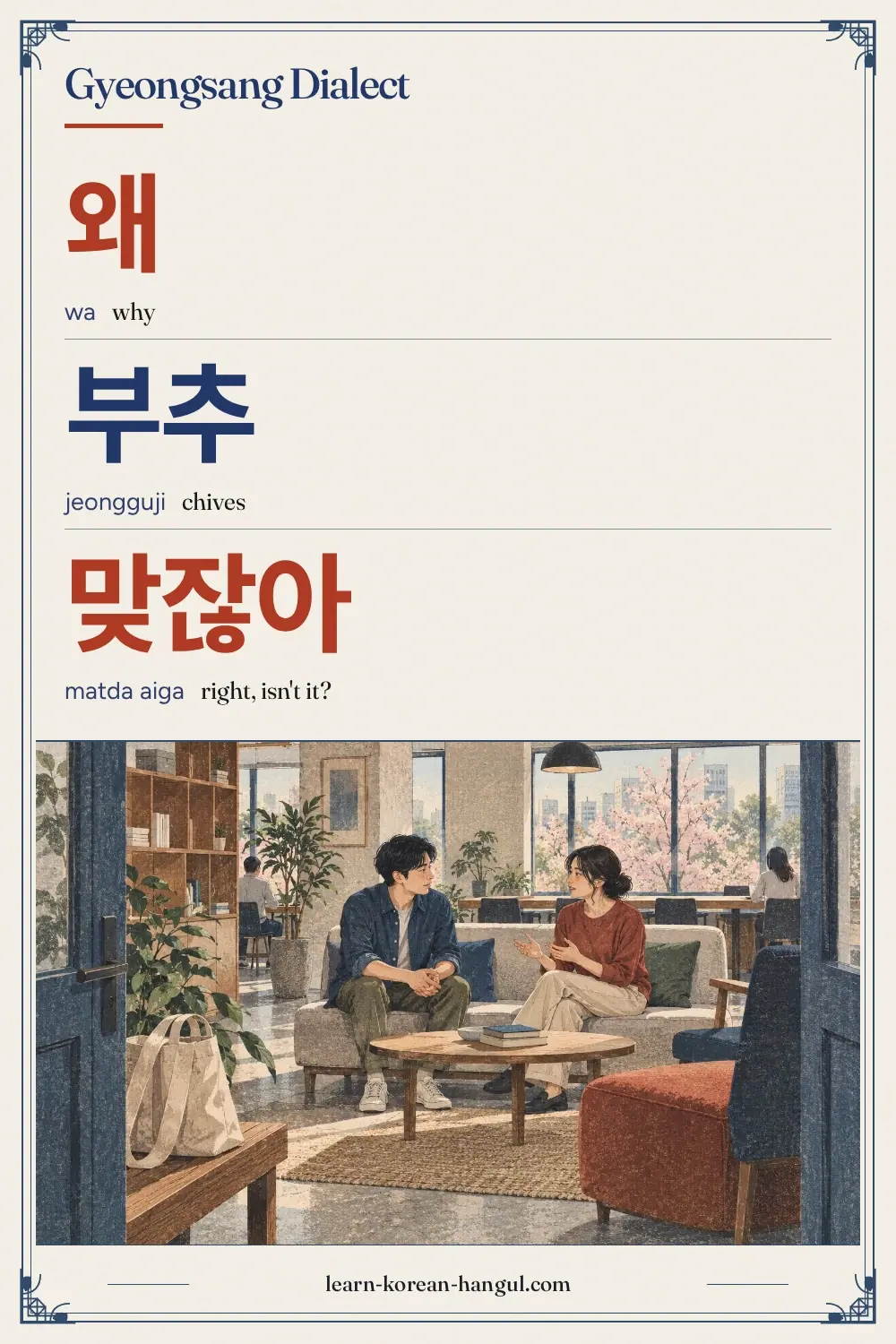
The Gyeongsang dialect (경상도 사투리, Gyeongsangdo saturi) is the speech of south-east Korea, including Busan, Daegu, Ulsan and Gyeongju. It is the best-known Korean dialect for keeping word-level pitch patterns, for question endings such as -나, -노 and -꼬, and for words such as 억수로 (very). This lesson teaches you to recognise it.
Key facts
- The Gyeongsang dialect is spoken in Busan, Daegu, Ulsan and the provinces of North and South Gyeongsang (경상북도, 경상남도).
- Words carry pitch patterns, called pitch accent. Seoul speech does not use pitch to tell words apart.
- Casual questions end in -나 or -가 for yes/no and -노 or -꼬 with a question word.
- Common words: 보소 (hey, look), 억수로 (very), 와 (why), 정구지 (chives).
- Standard Korean is understood everywhere and stays the base for study.
- Regional speech has no fixed spelling, so the forms here are common spellings.
Last updated: 2026-10-09.
What you'll learn
- Describe three features of Gyeongsang speech: pitch accent, question endings and vocabulary.
- Recognise and understand five common Gyeongsang phrases.
- Match six Gyeongsang words to their Standard Korean equivalents.
- Explain why a learner studies the standard first and treats the dialect as listening practice.
Prerequisites: you know the Standard Korean polite style and have read Standard Korean. Estimated time: 20 minutes.
What Is the Gyeongsang Dialect?
The Gyeongsang dialect is the regional variety of Korean spoken in the south-east, in the area that was historically called Gyeongsang (경상). Korean uses the word 사투리 (saturi) for any regional speech and 방언 (bangeon) for dialect in the technical sense. A Gyeongsang speaker speaks Korean. The variety differs from the standard in pitch, a few sounds, sentence endings and vocabulary.
The region covers more than one city, and speech changes from place to place.
| Place | Where | What to know |
|---|---|---|
| Busan (부산) | south-east coast, the largest port | the variety most learners hear first, because of dramas and travel |
| Daegu (대구) | inland, north of Busan | has its own pitch and word habits, but shares the endings in this lesson |
| Ulsan (울산) | east coast, next to Busan | neighbours Busan and shares many of its habits |
| Gyeongju (경주) | historic city in North Gyeongsang | often listed as a Gyeongsang sub-region |
| Rural Gyeongsang | villages in both provinces | strongest traditional forms, heard mostly from older speakers |
The table shows a spread, not sharp borders. Dialects blend into each other like a colour chart, so a person from a town between two cities may use features of both. Younger speakers also move toward the standard in school, work and media, which reduces the strongest forms. The next section explains why the dialect is hard to follow at first.
Why Gyeongsang Speech Is Hard to Follow
English speakers find Gyeongsang speech hard because they learn the standard first, and the dialect changes the three things that standard listening relies on: the pitch, the sentence ending and a handful of high-frequency words. When all three change at once in fast speech, a sentence made of familiar words can sound foreign.
There is also a perception effect. Gyeongsang words move up and down in pitch, endings are short and the polite -요 is often missing in casual talk. To a Seoul listener that can sound blunt or loud, and dramas use this impression on purpose. The speakers themselves are not angry; the sound is simply their normal speech. Learners should avoid reading emotion into the pitch of a dialect they do not yet know.
It reads the written dialect forms clearly, so it shows you the words and endings, but it cannot reproduce the real regional pitch. Treat it as a guide to the forms, and listen to Gyeongsang speakers in dramas and interviews for the melody. The next section shows where you will meet the dialect.
Where Gyeongsang Speech Is Used
Gyeongsang speech is used in daily life across the south-east, and in media whenever a story is set there. Local people use it at home, with friends and in shops. In offices, schools and on the news, many of the same speakers switch toward the standard.
| Setting | What you hear | Learner note |
|---|---|---|
| Street, market, taxi in Busan or Daegu | strong dialect, casual endings | listen for -나, -노 and 보소 |
| Family and friends | the fullest dialect | not a model for polite speech |
| Dramas and films set in the region | dialect used for local colour | the drama 응답하라 1997 (Eungdaphara 1997, Reply 1997) is set in Busan and is a well-known example |
| Variety shows and interviews | a mix of dialect and standard | a gentle way to train your ear |
| News and textbooks | standard | the form this site teaches |
A drama that uses the dialect gives you two advantages for listening practice: subtitles in Standard Korean, and the same lines repeated in different scenes. The practice section at the end of this lesson gives a short routine. The lesson K-drama phrases lists the standard forms of common drama lines, so you can compare them with what you hear.
What Does Pitch Accent Mean in Gyeongsang Speech?
Pitch accent means that the pattern of high and low pitch is part of the word. In Seoul Korean, a word has no fixed pitch of its own; the melody belongs to the whole phrase (see Korean pitch and phrasing). In Gyeongsang speech, the position of the high pitch is stored with the word, and it can differ from one word to another.
A simplified teaching model shows the idea. Take two words with two syllables each. In one the first syllable is high and the second is low. In the other, the first is low and the second is high. A Gyeongsang listener hears the two shapes as part of what each word is. A Seoul listener hears the same four syllables as a phrase and uses the context to choose the word.
Word shape A:   H  L      (high on the first syllable)
Word shape B:   L  H      (high on the second syllable)
Researchers describe the patterns in more than one way, and the number of patterns and the way they combine with particles depend on the town, so a single chart would mislead you. For a learner, three points are enough. First, the pitch movement inside words is normal and not a sign of emphasis. Second, you do not need to copy it to be understood, because the context and the vocabulary carry the meaning. Third, the term for the idea is explained in the glossary entry on pitch accent.
Pitch accent is not the same as the tones of Mandarin. A tone language gives every syllable a tone, and a pitch accent system marks one place in the word. The next section moves from pitch to the part you can learn from text: the endings.
What Are the Gyeongsang Sentence Endings?
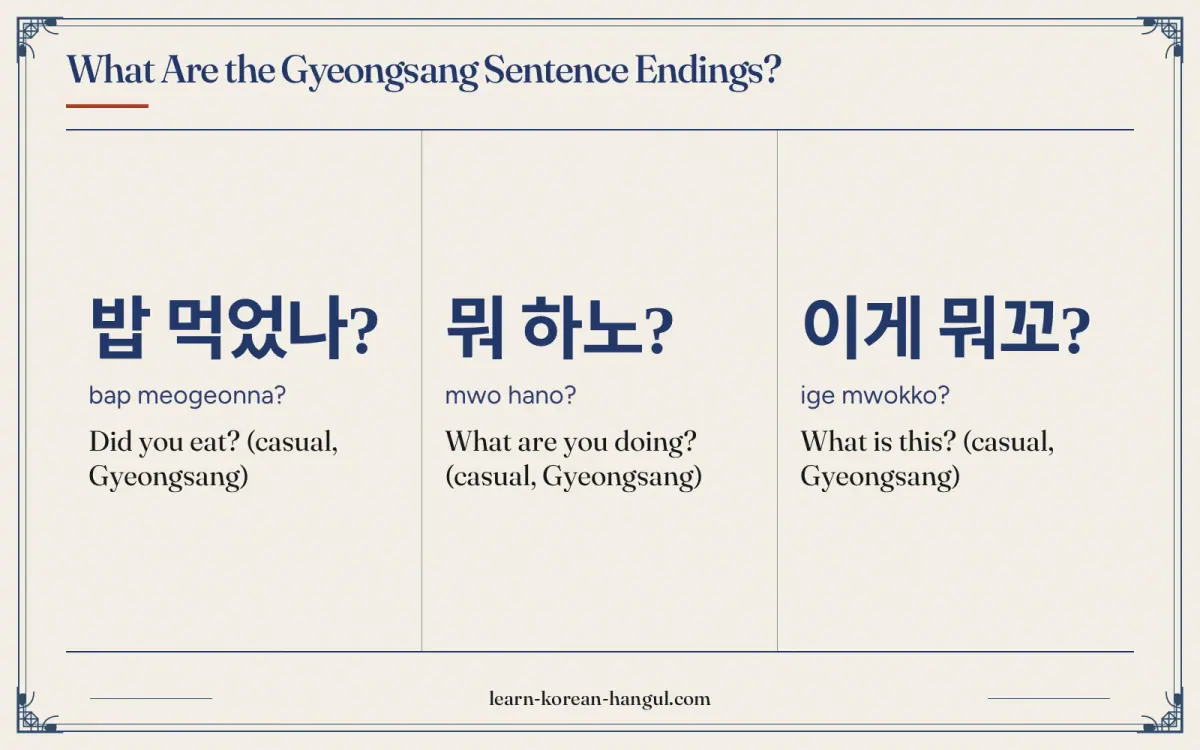
The Gyeongsang question endings depend on the kind of question. A yes/no question ends in -나 or -가, and a question with a question word (who, what, where, why) ends in -노 or -꼬. Standard Korean casual speech uses -어 or -야 for both. The rule is easy to remember: -나 and -가 are for "yes or no", and -노 and -꼬 are for "who, what, where, why".
| Question type | Standard casual | Gyeongsang | Sound and Revised Romanization |
|---|---|---|---|
| yes/no with a verb | 밥 먹었어? (Did you eat?) | 밥 먹었나? | [밤 머건나] bap meogeonna |
| question word with a verb | 뭐 해? (What are you doing?) | 뭐 하노? | [뭐 하노] mwo hano |
| yes/no with 맞다 (be right) | 맞아? (Is that right?) | 맞나? | [만나] manna |
| question word with 이다 | 이게 뭐야? (What is this?) | 이게 뭐꼬? | [이게 뭐꼬] ige mwokko |
| why | 왜 그래? (Why are you like that?) | 와 그라노? | [와 그라노] wa geurano |
In 밥 먹었나, the ㅂ of 밥 becomes ㅁ before the ㅁ of the next word in connected speech, so you hear [밤 머건나]. Inside 먹었나, the final ㅆ sounds like ㄷ and then turns into ㄴ before ㄴ, so the word is [머건나]. Revised Romanization romanizes the two spaced words separately and writes the sound change only inside a word: bap meogeonna. These are the ordinary sound rules of Standard Korean applied to dialect words.
The -나 ending also exists in Seoul speech, where it is a soft question to oneself ("I wonder if he ate"). In Gyeongsang speech it is a direct question to the other person, with the same meaning as the Seoul -어. Do not carry the Seoul meaning into the Gyeongsang one.
밥 먹었나?
bap meogeonna?
Did you eat? (casual, Gyeongsang)
뭐 하노?
mwo hano?
What are you doing? (casual, Gyeongsang)
이게 뭐꼬?
ige mwokko?
What is this? (casual, Gyeongsang)
Question words keep the prominence in these sentences, as in Standard Korean, so a question with 뭐 does not end with a sharp rise. See question intonation for the general rule. The next section turns to polite speech.
Polite Forms in Gyeongsang Speech
Gyeongsang speech has its own polite forms, so the absence of -요 in casual talk does not mean the dialect has no politeness. A formal question that a Seoul speaker ends with -습니까 often ends in -습니꺼 in Gyeongsang, and an invitation such as 어서 오세요 (welcome) is often 어서 오이소. Polite learners should still use the standard -요 style, which every speaker understands.
| Standard polite | Gyeongsang polite | Sound and Revised Romanization |
|---|---|---|
| 식사하셨습니까? (Have you eaten?) | 식사하셨습니꺼? | [식싸하셛씀니꺼] siksahasyeotseumnikkeo |
| 어서 오세요. (Welcome.) | 어서 오이소. | [어서 오이소] eoseo oiso |
The first pronunciation shows two tensing changes that are typical of Standard Korean. In 식사, the ㅅ after ㄱ is tensed to [싸]. In 하셨습니꺼, the ㅅ in 습 after the final ㅆ sound [ㄷ] is tensed to [씀]. Revised Romanization does not show either change, because they are caused by a neighbouring sound and not by a written tense letter.
Treat the polite forms as listening vocabulary. If you use the Gyeongsang polite ending as a visitor, it can sound like a joke or an imitation, even if the grammar is right. The safe choice is the standard polite style. The next section covers the words.
Common Words in Gyeongsang Speech
Six words cover most of what a visitor hears: 보소, 와, 억수로, 정구지, 아이가 and 묵다. The table gives each with the Standard Korean word that a textbook uses.
| Gyeongsang | Revised Romanization | Meaning | Standard Korean |
|---|---|---|---|
| 보소 | boso | hey, look, excuse me | 보세요 / 저기요 |
| 와 | wa | why | 왜 |
| 억수로 | eoksuro | very, a lot | 아주, 매우, 엄청 |
| 정구지 | jeongguji | chives | 부추 |
| 맞다 아이가 | matda aiga | right, isn't it? | 맞잖아 |
| 묵다 | mukda | to eat | 먹다 |
Notes on the words:
- 보소 is a call for attention, used like "hey" or "excuse me". It is blunt in Seoul but ordinary in Gyeongsang.
- 와 looks like the Standard Korean particle 와 (and) and the casual 와 (come) from 오다. In Gyeongsang it means "why", so 와? alone is a short question.
- 억수로 is an adverb meaning "very", used before an adjective: 억수로 좋다.
- 아이가 at the end of a clause asks for agreement, like "right?" or "isn't it?" It is a tag, not the noun 아이 (child).
- 묵다 is heard instead of 먹다 from many Gyeongsang speakers, so 밥 묵었나? is also common beside 밥 먹었나?.
The word 정구지 shows what a dictionary does with regional words: the standard dictionary lists 부추 as the standard form and records 정구지 as a regional word. The next section covers sounds.
Which Sounds Differ from Seoul Speech?
Two sound differences are widely described for Gyeongsang speech, and both are about merging two sounds that Seoul keeps apart. Many speakers do not clearly separate ㅓ from ㅡ, and many do not separate ㅅ from tense ㅆ. These descriptions vary by speaker and town.
| Feature | Seoul (standard) | Common Gyeongsang pattern | Example |
|---|---|---|---|
| ㅓ and ㅡ | two different vowels | the two can sound alike | 거 (geo) and 그 (geu) are heard close together |
| ㅅ and ㅆ | plain ㅅ and tense ㅆ differ | the two can sound alike | 쌀 (rice) may sound like 살 |
The first row matters for listening. A learner who has worked on the contrast between ㅓ and ㅡ may hear 음식 (food) as closer to 엄식, and the second row means 쌀 can be mistaken for 살 (flesh, or age in a counter). Context tells the listener which word is meant, just as it does in Seoul for words that sound alike. Other vowel and consonant differences exist, and they vary by town, so this lesson names only the two that appear in most descriptions.
The standard keeps these sounds apart, and so does this site's audio. If you want to practise the standard contrasts, the lessons on Korean simple vowels (ㅓ and ㅡ) and ㅅ and ㅆ cover them. Now see all three features in one word.
Worked Example: 억수로
The word 억수로 shows how a dialect word still follows the standard sound rules. Follow these steps.
- Read the blocks. 억 (eok), 수 (su), 로 (ro). The word has three blocks.
- Find the final consonant. The block 억 ends in ㄱ, and the next block starts with ㅅ.
- Apply tensing. A plain consonant after a final stop sound ㄱ is tensed. So ㅅ in 수 is said as ㅆ: [억쑤로].
- Check the Revised Romanization. The romanization is eoksuro. It does not show the tensing, because the tensing comes from the neighbouring sound and is not written in Hangul.
- Put it in a sentence. 여기 억수로 맛있다. [여기 억쑤로 마싣따], yeogi eoksuro masitda, "It is really good here." The adjective 맛있다 is pronounced [마싣따] (the standard also allows [마딛따]), and the polite standard form is 맛있어요.
You will know it worked when the clip and your own voice both give three even blocks with a tight s in the middle. Say the sentence with an even, relaxed rhythm first. Then listen to how a Busan speaker adds pitch movement in a drama, and copy it only if you have a reason to.
Common Learner Mistakes
Mistake 1: treating dialect forms as errors. Learners often assume 밥 먹었나? is a bad version of 밥 먹었어?. Actually it is a normal form in its region, with its own rules. Fix: label it "Gyeongsang" in your notes, not "wrong".
Mistake 2: using dialect endings in polite situations. Learners often copy the casual -노 to a boss or teacher. Actually the casual endings are for friends and family, and strangers may hear them as rude or mocking. Fix: keep the standard -요 style and use the dialect for listening.
Mistake 3: mixing the two question endings. Learners often use -나 with a question word, like 뭐 하나?. Actually -나 and -가 go with yes/no questions, and -노 and -꼬 go with question words. Fix: ask "does the question have who, what, where or why?" before choosing.
Mistake 4: expecting one Gyeongsang dialect. Learners often assume Busan and Daegu are the same. Actually they share the group but differ in details. Fix: say which town a speaker comes from before you generalise.
Mistake 5: copying the pitch from text. Learners often try to learn pitch accent from a chart. Actually the patterns come from listening to speakers, and charts vary by researcher. Fix: shadow short clips from real speakers and do not rely on a written pattern.
Practice: Standard or Gyeongsang?
Say each Gyeongsang form aloud, then give the Standard Korean word or question.
- 정구지
- 억수로
- 뭐 하노?
- 밥 먹었나?
- 와?
Then answer these.
- Which ending fits a yes/no question: -나 or -노?
- Is 식사하셨습니꺼? casual or formal?
- Which two sounds do many Gyeongsang speakers merge?
Answers.
- 부추 (chives).
- 아주, 매우 or 엄청 (very).
- 뭐 해? (What are you doing?)
- 밥 먹었어? (Did you eat?)
- 왜? (Why?)
- -나 is for yes/no. -노 goes with a question word.
- Formal. It matches 식사하셨습니까?.
- ㅓ and ㅡ, and ㅅ and ㅆ.
Seven or eight correct means you can recognise the main features. If you scored lower, reread the endings table.
For a listening routine, pick a short clip of 30 seconds from a drama set in Busan or Daegu, read the Standard Korean subtitles once, and listen three times: first for the endings, then for the words, then for the melody. Write down only what you heard, not what you expected.
Where to Go Next
The lesson before this one is Seoul vs Busan Korean, which pairs ten Seoul and Busan phrases. The lesson after it is the Jeju dialect, the most distinct regional variety. The section hub is Korean accents and dialects, and the glossary entry 사투리 (saturi) defines the term.
This lesson does not cover every Gyeongsang town, the full list of pitch patterns, dialect writing or how to speak the dialect. Spoken forms vary by speaker and age, and the forms here are widely cited examples, not a complete description. In short, the Gyeongsang dialect is the south-eastern variety of Korean, known for word-level pitch, the question endings -나, -노 and -꼬, and words such as 억수로 and 정구지, and a learner who studies the standard first can recognise it with the help of this lesson.
Frequently Asked Questions
Why does Gyeongsang dialect sound loud? It sounds loud or blunt to many Seoul listeners because each word carries its own pitch shape, so the voice moves up and down inside words, and because casual endings are short and drop the polite -요. The speakers are usually not angry. The same sentence in a Seoul rhythm would sound flatter and softer.
What is 정구지? 정구지 (jeongguji) is the Gyeongsang word for chives, which Standard Korean calls 부추 (buchu). It is a good example of a regional noun: both words mean the same plant, and a dictionary lists 부추 as the standard form. In Gyeongsang markets and restaurants you will see and hear 정구지 on menus and labels.
Is Daegu different from Busan? Yes, in details, but they belong to the same Gyeongsang group. Daegu is an inland city in the north of the region and Busan is on the south-east coast, and speakers of each notice differences in pitch patterns and some words. A learner can treat them together at first, because the question endings and the pitch idea in this lesson apply to both.
Is Gyeongsang pitch accent real? Yes. Linguists describe Gyeongsang speech as a pitch accent dialect, which means a word has a pitch pattern as part of the word. Researchers disagree on how many patterns there are and how they behave in each town, so this lesson explains the idea and does not list every pattern.
Can I understand Gyeongsang speakers if I only know Standard Korean? Mostly yes. Grammar and most words are shared, and many Gyeongsang speakers shift toward the standard when they talk to someone from another region. The hardest parts are the unfamiliar endings, a few common words and the fast pitch movement. Knowing the five endings and six words in this lesson removes most of the confusion.