How Do I Use the Korean Sound Change Checker?
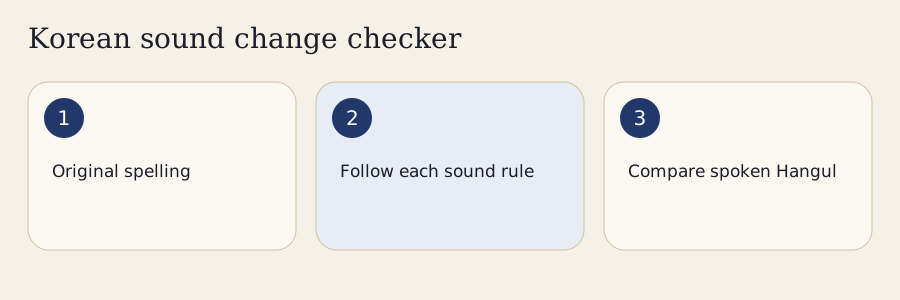
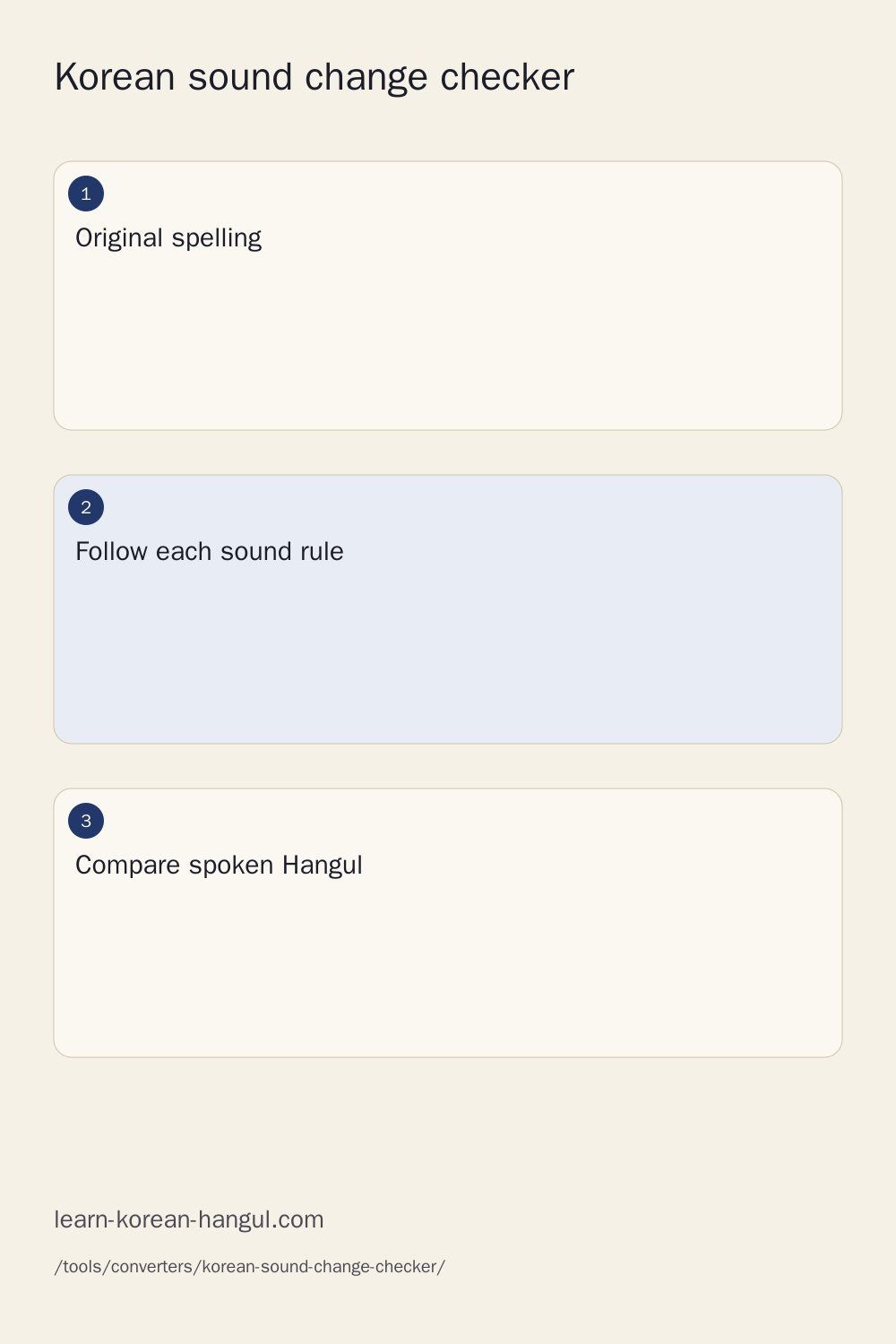
Start with a short word whose spelling you know. The default example is 국물. Press Check and compare the original field with the bracketed result. The input is your written source; the output is a pronunciation aid. If you are copying a message, assignment or subtitle, keep the written source rather than replacing it with the bracketed form. The changes explain listening, not a new spelling system.
Read the sentence under the result before moving to another example. It tells you what environment causes a consonant to change. Use the arrow buttons to move through the steps. A longer passage has segment controls so you can inspect a manageable piece without losing the original input. A sense question appears for listed ambiguous words. Choose the meaning and press Check again to apply that context.
Listen only when you want audio. The browser reads the original Korean spelling through an installed Korean voice. Its delivery can differ from a particular speaker or dictionary recording. If no Korean voice exists, the written result remains available. Copy sends the selected spoken form to your clipboard; More contains file exports and the selectable fallback for devices that block clipboard access.
Written Hangul and the Spoken Result
Hangul spelling records distinctions that can disappear in a particular sound environment. A written final consonant can link to the following syllable, become nasal, or take one of the restricted final sound values. Those changes do not mean the spelling is wrong. They show why the same consonant letter can sound different in two grammatical settings.
Square brackets conventionally separate a pronunciation from the written word. 국물 is the source spelling and [궁물] is the pronunciation aid. Keep this distinction when making cards: put the source on the question side and the spoken form with a short explanation on the answer side. If you only practise the respelling, you may struggle to recognize the real word in a book or menu.
Spoken Hangul is useful because it keeps the learner within the Korean writing system. It still has limits. It does not show every phonetic detail, syllable duration, voice quality or sentence melody. A recording captures one speaker in one context. A written pronunciation represents a selected analysis. Use both, and check a dictionary when an unfamiliar word has an unexpected lexical reading.
How Does the Checker Choose a Pronunciation?
The checker separates the original text from its normalized analysis. Modern conjoining Hangul can be normalized to the same syllable blocks used in ordinary text. That analysis does not overwrite your source, punctuation or line breaks. A result export includes the original input so that you can inspect what was checked and return to it later.
Listed examples supply known contextual readings. Other Hangul runs pass through consonant rules, with unfamiliar words marked as needing context. This distinction matters because spelling alone cannot determine every compound boundary, lexical exception or grammatical sense. A rule-based output is useful evidence about a possible reading, rather than a replacement for a dictionary entry with the right meaning.
A changed join has an explanation and a link to the governing pronunciation standard. The standard is maintained by the National Institute of Korean Language. Its rules describe conditions and exceptions; a short tool explanation summarizes a particular transition. For the complete lesson, read the Korean pronunciation rules. If the tool and a trusted dictionary disagree, preserve the input and both results for comparison rather than assuming that the shorter output must be correct.
Rule Order and Changed-Letter Traces
Rules interact. A compound can acquire a consonant at its internal boundary before assimilation changes the consonant immediately before it. In 학여울, the n-insertion environment leads to a nasal sequence. Looking only at the final result hides the reason that the written ㄱ changes. A sequence of intermediate forms lets you ask which change depends on an earlier one.
A double final can also split at a grammatical join. 값이 is a useful example because the final cluster and the following consonant are connected. Treating every final cluster as a single consonant before examining the next syllable can remove information needed for the result. A trace explains the affected join, not just the letters that differ between two finished strings.
When an entry requires a lexical reading, the tool names that condition instead of presenting a generic consonant rule as sufficient. Some alternate entry readings do not yet have a complete independent trace. Use the context choice and the cited source to understand the distinction; an unexplained difference deserves closer dictionary checking.
Which Final Sounds Can Batchim Become?
Korean final consonants occupy a more restricted set of sound categories than initial consonants. This is why several different letters can have the same final realization when no following vowel opens a linking environment. The written consonant still matters for spelling, related word forms and the next grammatical ending. It should not be erased from your learning materials.
| Final category | Representative written finals | What to watch |
|---|---|---|
| ㄱ | ㄱ, ㄲ, ㅋ | A following nasal can change the final category |
| ㄴ | ㄴ | A neighboring ㄹ can affect the join |
| ㄷ | ㄷ, ㅅ, ㅆ, ㅈ, ㅊ, ㅌ | Linking can preserve the underlying consonant |
| ㄹ | ㄹ | Cluster and lexical conditions still matter |
| ㅁ | ㅁ | Nasal environments are easier to hear slowly |
| ㅂ | ㅂ, ㅍ | A following nasal can produce ㅁ |
| ㅇ | ㅇ | Final ㅇ is a consonant sound, unlike silent initial ㅇ |
This table summarizes categories rather than every double-final rule. Final stops are not pronounced by adding a new vowel. Listen to how a Korean speaker finishes the syllable, then compare a form with a following vowel. Review batchim pronunciation before interpreting a complicated trace.
Worked Example: 국물 → [궁물]
국물 gives a direct demonstration of nasal assimilation. The first syllable has final ㄱ and the next starts with ㅁ. In this environment the final stop is realized as the nasal ㅇ. The second syllable keeps its spelling in the pronunciation aid, producing [궁물]. The Korean Learners' Dictionary supplies this pronunciation for the word.
Type 국물, press Check and read the step explanation. Notice that the changed letter is the final consonant of the first syllable. The tool keeps the original spelling in the input and gives you the spoken form separately. This is a useful pattern for recognizing other stop-plus-nasal joins, but the meaning and structure of another word still need checking.
For a listening task, say the original word to yourself, play the device voice, then compare the final sound you expected with what you heard. Avoid exaggerating the nasal or inserting a vowel between the syllables. See the dictionary search for 국물 for the lexical reference.
Linking Consonants into the Next Syllable
A following vowel can create a linking environment. The final consonant is then heard as the onset of the next syllable instead of staying in its isolated final category. A grammatical particle or ending often creates this environment. The important question is what kind of boundary connects the two parts, rather than simply whether the next written block begins with ㅇ.
The written ㅇ at the start of a vowel syllable does not mean that the vowel is separated by a pronounced consonant. This permits a preceding consonant to link. However, a compound boundary or independent word can have different conditions. An automatic rule that moves every final consonant before every vowel can miss n-insertion, substantive boundaries and lexical exceptions.
Use 꽃을 as a short example. Keep the original final ㅊ available until the vowel join is considered; the pronunciation aid is [꼬츨]. Reducing the consonant to its isolated final category too early would lose the distinction needed at that join. The liaison lesson compares endings and word boundaries in more detail. Practise a pair of forms together so that the grammatical environment stays visible.
Why Do Two Meanings of 밭이랑 Sound Different?
밭이랑 illustrates genuine contextual ambiguity. The same written sequence can contain the particle meaning “and,” or it can refer to a furrow in a field. These analyses create different internal boundaries. It is therefore useful for a checker to ask about meaning rather than silently choose the first reading it knows.
For the particle analysis, the pronunciation aid is [바치랑]. The consonant links into the grammatical vowel environment and palatalization affects the result. For the furrow compound, the listed reading is [반니랑]. The compound boundary leads to n-insertion and the preceding final adapts to that nasal environment. These are different analyses of the source, not interchangeable random spellings.
Enter the word and inspect both candidates. Then choose the relevant meaning, press Check and notice which parts of the trace change. Keep a short English meaning beside the word when exporting it to a practice list. A bare card with no sentence or sense can make both valid answers seem contradictory. The NIKL answer about this boundary provides the official comparison.
Nasalization, Liquidization and ㅎ Changes
Assimilation describes a sound adapting to a neighboring sound. Nasalization commonly changes a final stop before ㄴ or ㅁ. Liquid assimilation concerns joins involving ㄴ and ㄹ, with lexical exceptions that need separate attention. These families are related because they affect adjacent consonants, but they should not be merged into one vague instruction to “say it smoothly.”
신라 gives the familiar [실라] example. The written consonants meet at a join where the lateral sequence matters. 종로 instead illustrates a different nasal-plus-liquid environment. A learner who applies one memorized replacement everywhere can fail on a word whose structure or lexical treatment differs. Read both the condition and the exception before extending an example to new vocabulary.
ㅎ interacts with neighboring consonants through aspiration or loss under specified conditions. 좋다 is represented as [조타], with aspiration on the following consonant. It is not simply a matter of dropping ㅎ and reading the rest unchanged. Keep the original spelling available when reviewing the form so that you can connect it to related grammatical endings. For a broader comparison, return to the pronunciation rules lesson and use the checker to inspect one join at a time.
Worked Example: 굳히다 → [구치다]
굳히다 combines conditions that can be difficult to hear from spelling alone. The final consonant of the first syllable meets ㅎ and the following vowel environment. The resulting pronunciation aid is [구치다]. The initial consonant of the next spoken syllable is central to the explanation; aspiration belongs to that onset rather than a decorative mark after the preceding vowel.
This example is useful for distinguishing a surface result from a sequence of grammatical spelling choices. You should continue to write 굳히다 when you mean the written word. The bracketed form helps you anticipate the spoken join. If you are learning a related verb form, check the ending and its boundary rather than copying the same change to every form of the stem.
Read the trace, then compare the NIKL romanization examples, which also show relevant sound changes. These examples are evidence for the word's treatment, but romanization itself has further conventions. A Latin spelling is not a phonetic recording. The official NIKL romanization page explains that distinction and gives source examples.
Tensing and Compound N-Insertion
Tensing changes the following consonant category in particular environments. A common introductory example is a stop-final syllable before another eligible consonant. Other cases depend on a stem, ending, compound or lexical pattern. A simple spelling-only rule cannot identify all of these grammatical conditions, even when its output looks plausible.
Compound n-insertion can create the nasal environment that a later rule needs. This is why it helps to learn a compound with its internal structure and meaning. The written word does not acquire a new letter in normal spelling. The inserted consonant belongs to the pronunciation analysis. Keep the written source and the spoken form together when practising or teaching the example.
The rule explorer lets you disable a family and compare the resulting hypothetical form. This is a learning aid for seeing causality. It is not a list of equally acceptable pronunciations. Restore standard settings after an experiment, press Check and inspect the result again. For the conditions and exceptions behind a compound analysis, read the n-insertion lesson. Unknown compounds still require meaningful segmentation, not an automatic guess based on the next vowel alone.
Worked Example: 꽃잎을 → [꼰니플]
꽃잎을 demonstrates a compound followed by a grammatical particle. The compound creates an n-insertion environment; the preceding final consonant becomes nasal. At the later particle boundary, the written final ㅍ links to the following vowel. The result is [꼰니플]. A tempting but incorrect shortcut is to treat the final consonant as ㅂ before every later operation.
Move through the intermediate steps and identify the boundary involved in each change. The compound boundary and the particle boundary do different jobs. This is why a finished-string comparison cannot explain the pronunciation by itself. The rule has to retain the underlying consonants until the relevant boundary conditions have been considered.
For practice, keep 꽃잎 and 꽃잎을 on adjacent cards. Ask what the extra particle changes and which part of the compound reading remains. The NIKL discussion of flowers, particles and insertion provides the source context. When a form is unfamiliar, verify its grammar before interpreting a pronunciation as the only possible reading.
Can a Word Have More than One Standard Reading?
Some words have permitted alternate standard readings. A tool should show these as alternatives rather than mark one as an error merely because another appears first. 맛있다 is a useful example: the source discussion distinguishes the principle reading [마딛따] and the permitted reading [마싣따]. The two outputs need their proper context and source rather than a fabricated probability score.
Possessive 의 also has a permitted pronunciation alternative in suitable grammatical contexts. 나의 can retain [나의] or use the allowed [나에] reading. Do not generalize that permission to every occurrence of the same vowel sequence without checking the word's role. An independent lexical item and a grammatical particle do not necessarily have identical conditions.
Standard alternatives, conversational adaptations and hypothetical rule experiments are different categories. A device voice may choose one variant, and a speaker may use a particular style. Hearing a different recording does not automatically prove that the written candidate is wrong. Compare the actual sense and profile. Consult the NIKL explanation of 맛있다 when learning this example.
What Do IPA and Romanization Add?
IPA and romanization answer different questions. An IPA transcription describes a selected sound analysis using an international symbol system. Revised Romanization follows a named spelling convention with special provisions. It is therefore unsafe to assume that converting the spoken Hangul directly into Latin letters always gives official Revised Romanization.
학교 illustrates the distinction. The spoken form is [학꾜], but the official romanized spelling is hakgyo. A Latin rendering that simply doubles letters whenever the spoken form has a tense consonant would fail this example. Names and certain noun boundaries have additional conventions that belong in a romanization tool rather than an undocumented pronunciation shortcut.
Use the Korean romanization converter for a named Latin system and its explanations. This checker currently concentrates on spoken Hangul and consonant traces; specialist phonetic profiles require separately checked symbol conventions. Do not treat an English-looking approximation as a recording. In particular, eo and eu represent Korean vowel conventions rather than instructions to pronounce an English or Spanish diphthong. Listen to the original Korean and keep the scheme name with any exported Latin aid.
Sentences, Pauses and Listening in Context
A sentence contains more than neighboring consonants. Meaning, phrase boundaries, emphasis and speaking style affect how a listener groups the sounds. Whitespace alone does not fully specify a spoken pause. Strong punctuation offers a useful boundary, but a tool's written analysis cannot establish one universal melody for every reading of an unfamiliar sentence.
Start with a short phrase and locate the word you are studying. Inspect its local trace before using the full sentence for listening practice. If the result needs context, supply the meaning or consult a dictionary. Sentence mode preserves punctuation and line breaks so that the source remains available. A Latin name or number stays visible when its Korean reading has not been selected.
Device synthesis always receives the original spelling. Sending a pedagogical respelling instead can cause a voice engine to apply sound rules again or produce an unintended lexical interpretation. A recording from a human speaker is also a specific performance, not a universal pitch model. For contrast practice, train Korean sound discrimination with examples whose listening task and accepted answers are clear.
Are Double Batchim Rules the Same for Every Word?
Double finals have family patterns and lexical or grammatical exceptions. The underlying pair matters, as does the following sound. Reading a cluster before a vowel can involve splitting it, while reading it before a consonant can involve reduction. A single table for isolated syllables is useful, but it does not determine every inflected word.
밟다 and 넓다 illustrate why word-specific conditions belong alongside the family rule. The pronunciation aids [밥따] and [널따] differ in which final survives. Related forms can introduce another boundary condition, so the dictionary entry and grammatical ending deserve attention. Do not infer every stem's pronunciation from one visually similar cluster.
When practising, put the stem and ending on the same card and explain the environment in one sentence. Export the original spelling with the trace so that another learner can see which form was checked. The NIKL discussion of ㄼ examples explains relevant exceptions. The checker can help compare forms, while unresolved lexical context remains a reason to consult the source.
Practice, Print and Save a Rule Example
Practice mode asks you to predict the spoken Hangul. Enter an answer, reveal the result and compare the changed join. There is no mandatory timer. If your answer differs, read the explanation, listen again where a Korean device voice is available and retry the same word. A single matched answer measures this exercise, not overall pronunciation ability.
More lets you save a word on your device or export text, CSV, TSV or JSON. JSON preserves the original source and structured trace; plain text is convenient for a lesson handout. CSV protects cells that could be interpreted as spreadsheet formulae. Print opens your browser's print dialogue, where PDF availability depends on the device. Keep the sense beside an ambiguous example when assembling a practice list.
Privacy, Offline Use and Unsupported Input
Checking runs locally after the tool's assets load. Your input does not need a paid service or account. Device voices can depend on installed language support and may have their own network behavior. Written conversion remains usable when no voice is available. Saving a word is an explicit local action; exported files remain under your control.
Text files must be UTF-8 and below 1 MiB, with at most 1,000 lines for a wordlist. The extracted text limit is 20,000 code points. Very long inputs run in a worker and can be cancelled without discarding the source. Numbers, Hanja and Latin names require a chosen Korean reading. Loose jamo should be composed or studied as letters rather than given a fabricated syllable pronunciation.
Frequently Asked Questions
Can I Paste a Song Lyric or Subtitle?
You can paste a short passage for private checking. Keep its original spelling and punctuation because omitted words, names and sentence boundaries affect interpretation. The tool does not publish your input. A result is a pronunciation aid rather than permission to redistribute copyrighted lyrics, subtitle files or someone else's recordings.
Why Can Audio Sound Different from the Written Result?
The Listen action uses an installed Korean device voice and the original spelling. A voice chooses its own delivery and may select an allowed alternative. Spoken Hangul summarizes a sound analysis rather than every detail of timing, pitch or articulation. Compare the word's meaning and boundaries before deciding that an audible difference is an error.
Can I Check a Name Written Only in English Letters?
Choose or verify the Korean spelling first. Latin letters do not uniquely identify a pronunciation, and a name can have several plausible Korean renderings. The checker preserves unsupported letters instead of silently assuming that they are Revised Romanization. Once you have a suitable Hangul candidate, check it and keep the original name alongside it.
Will Turning off a Rule Show a Valid Pronunciation?
Turning off a family creates a hypothetical form for comparison. It helps you see what that rule contributes, but it does not establish an accepted standard reading. Restore standard settings and press Check when you finish exploring. Permitted alternatives need separate evidence and context; a rule toggle cannot create that evidence.
Why Is Listening Unavailable on My Device?
Your browser may have no Korean voice installed, or the voice may require a network connection. The written result and explanations remain available. Install a Korean language voice through your device settings where supported, then retry Listen. The tool does not invent a recording or promise downloadable audio from a device speech engine.
Use the Korean Sound Change Checker with Real Listening
Choose one word you expect to hear today. Use the Korean sound change checker to inspect its join, keep the original spelling and listen to a short Korean passage containing it. Try to recognize the word without staring at the respelling. Then return to the pronunciation rules or batchim lesson for the condition you found most difficult. Repeat with a related grammatical form so that the rule stays connected to meaning.