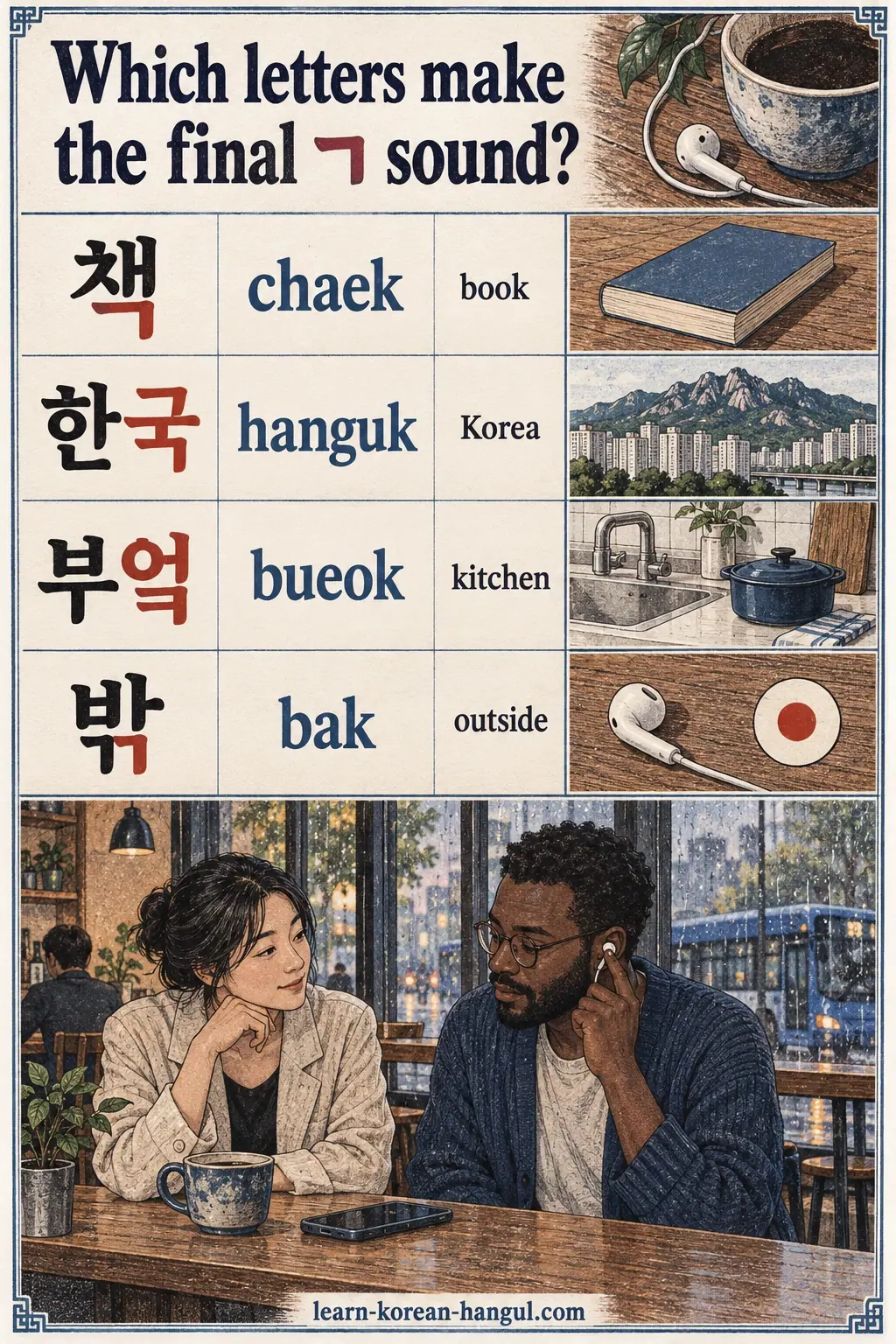
What you'll learn
- Name the letters that end in the ㄱ sound: ㄱ, ㅋ, ㄲ, and the double batchim ㄳ and ㄺ.
- Stop the back of the tongue against the soft palate without releasing air.
- Predict the released forms: 부엌이 [부어키], 책이 [채기], 밖에 [바께].
- Say 먹는 as [멍는], and know why the ㄱ turns into ng.
Prerequisites: you can read Hangul blocks and know that a batchim is the consonant under a syllable. Time: about 20 minutes.
Key facts
- The group is ㄱ, ㅋ and ㄲ. The double batchim ㄳ and ㄺ also reduce to it.
- A following vowel releases the letter: 부엌이 [부어키].
- Revised Romanization writes the final as k: 책 chaek, 밖 bak, 부엌 bueok.
Listen to four words that all end in the same sound.
The sound is simple. The confusion comes from the spelling, as the next section shows.
Why English Speakers Struggle with the ㄱ Batchim
English speakers struggle with the ㄱ batchim for two reasons. The first is spelling: Korean writes this sound as ㄱ, ㅋ or ㄲ, and the learner expects to hear a "g", a "k" or a doubled "kk". The second is habit: English often finishes "back" or "book" with a small burst of air.
Korean does not release the sound. The back of the tongue meets the soft palate, which is the soft area at the back of the roof of the mouth, and then stays there. Learners who release it produce "chaek-uh" for 책 or "bakk" for 밖. Both sound foreign.
A voicing mistake also appears. Because Revised Romanization writes ㄱ as g at the start of a syllable (가 ga), some learners carry a voiced "g" to the end of the word. RR itself writes the final as k: 한국 hanguk. Final ㄱ is never voiced in Standard Korean. It is closer to the end of "book" said without the release.
You do not need to learn which of the three letters is written to say the word alone. All three give [k̚]. The next section lists them.
Which Letters Make the Final ㄱ Sound?

Three single letters, ㄱ, ㅋ and ㄲ, make the final ㄱ sound. Two double batchim, ㄳ and ㄺ, reduce to it as well. The table shows a real word for each. A spoken form appears in [brackets], and the Revised Romanization (RR) column is a learning aid.
| Letter | Word | Spoken | RR (aid) | Meaning |
|---|---|---|---|---|
| ㄱ | 책 | [책] | chaek | book |
| ㄱ | 한국 | [한국] | hanguk | Korea |
| ㅋ | 부엌 | [부억] | bueok | kitchen |
| ㅋ | 키읔 | [키윽] | kieuk | the name of the letter ㅋ |
| ㄲ | 밖 | [박] | bak | outside |
| ㄲ | 낚시 | [낙씨] | naksi | fishing |
| ㄳ | 몫 | [목] | mok | share, portion |
| ㄺ | 닭 | [닥] | dak | chicken |
All of these words are said with the same closed ending, [k̚]. The words 밖 and 박 (a surname, and also a gourd) sound identical when spoken alone. The doubled ㄲ in the spelling does not mean a doubled or stronger sound at the end of the syllable.
Another example is the verb 읽다 (to read), said [익따]. Its batchim is the double ㄺ, which reduces to ㄱ before ㄷ. Before ㄱ, the same verb behaves differently: 읽고 is [일꼬]. That exception belongs to the double batchim lessons.
The Standard Pronunciation Rules (표준 발음법, 국립국어원) list ㄱ as one of the seven representative sounds in Article 8. Article 9 reduces ㅋ and ㄲ to it, and Articles 10 and 11 do the same for ㄳ and ㄺ. The set is introduced in The 7 Final Sounds. The next section turns the rule into a mouth movement.
How Do You Pronounce the ㄱ Batchim?
To pronounce the ㄱ batchim, raise the back of the tongue to the soft palate and hold it there without letting air out. Practise with 책 in five steps.
- Say 채 with the tongue tip resting behind the lower teeth.
- Keep the vowel at normal length. Do not stretch it.
- Raise the back of the tongue until it touches the soft palate. You will feel a light contact at the back of the mouth.
- Hold for about one beat. The throat stays quiet, and the cheeks do not puff.
- Lower the tongue silently. No "uh" sound follows.
You'll know it worked when the word sounds stopped, as if somebody paused a recording. A listener should hear [책] and not "chaek-uh".
Two self-checks. The tissue test: hold a thin tissue five centimetres from the mouth and say 책 at the end of a phrase. It should not flutter. The mirror test: open your mouth wide while holding the final sound. You should not see the tongue tip move, because the closure is in the back.
책
English "back" gives a useful contrast. In careful speech it ends with a release of air. Say it and stop one moment before the release. That is the Korean ㄱ batchim. The wider idea is described in Korean Unreleased Consonants. The next section shows what happens when a vowel follows and the closure must open.
What Changes before a Vowel?

Before a vowel, the original letter returns and moves to the start of the next syllable. This is liaison, and it explains why 부엌 and 부엌이 sound so different. The closure is released because the consonant now begins a syllable.
| Written | Spoken | The returning sound | RR (aid) |
|---|---|---|---|
| 책이 | [채기] | ㄱ | chaegi |
| 부엌이 | [부어키] | ㅋ with its puff | bueoki |
| 부엌에 | [부어케] | ㅋ | bueoke |
| 밖에 | [바께] | ㄲ, tense | bakke |
| 밖이 | [바끼] | ㄲ, tense | bakki |
| 몫이 | [목씨] | ㅅ, tense | moksi |
| 닭이 | [달기] | ㄱ | dalgi |
Compare 부엌 [부억] with 부엌이 [부어키]. The final consonant is only a closure in the first word. In the second, ㅋ is back with its breath. Learners who always say [부어기] have applied the "g" rule that works for ㄱ but not for ㅋ.
The double batchim show a different pattern. In 몫이, ㄳ splits: the ㄱ stays as the batchim of the first syllable and the ㅅ moves across and becomes tense, giving [목씨]. In 닭이, ㄺ splits so that ㄹ stays and ㄱ moves, giving [달기]. Both are covered further in double batchim.
Particles follow the same logic. 책을 is [채글], 부엌은 is [부어큰], and 밖은 is [바끈]. Once you know the rule, a new word needs no special memory. The next section covers what happens before a nasal.
What Changes before ㄴ or ㅁ?

Before ㄴ or ㅁ, final ㄱ becomes ng. The back of the tongue is already at the soft palate for ㄱ, and the neighbour is a nasal, so the stop turns into the back nasal [ŋ], the "ng" of "sing". This is nasalization, set out in Article 18 of the Standard Pronunciation Rules.
| Written | Spoken | What happens | RR (aid) |
|---|---|---|---|
| 먹는 | [멍는] | ㄱ + ㄴ becomes ㅇ + ㄴ | meongneun |
| 국물 | [궁물] | ㄱ + ㅁ becomes ㅇ + ㅁ | gungmul |
| 한국말 | [한궁말] | ㄱ + ㅁ becomes ㅇ + ㅁ | hangungmal |
| 작년 | [장년] | ㄱ + ㄴ becomes ㅇ + ㄴ | jangnyeon |
| 부엌문 | [부엉문] | ㅋ reduces to ㄱ, then to ㅇ | bueongmun |
먹는 is the most useful case, because the present-tense ending -는 appears on many verbs. Written 먹는, it is said [멍는]: the ㄱ never reaches a "k". Revised Romanization follows the sound here and writes meongneun, so the romanization shows the change.
Before a plain ㄱ, ㄷ, ㅂ, ㅅ or ㅈ, final ㄱ stays closed and the next consonant becomes tense. 먹다 is [먹따], 학교 is [학꾜], and 국밥 is [국빱]. This is tensification (Article 23).
A full lesson on the nasal case is ㄱ nasalization. The next section applies everything to one word.
Worked Example: 책

책 (book) is a good worked example because it is a daily word, it has a clear vowel, and it shows the three behaviours of the ㄱ batchim.
Step 1: read the blocks. 책 has ㅊ as the first consonant, ㅐ as the vowel, and ㄱ as the batchim.
Step 2: say the first part. ㅊ is aspirated, so 채 begins with a strong puff: [채].
Step 3: close the back of the tongue. The ㄱ at the end closes and holds: [책]. RR writes chaek.
Step 4: add a vowel. With 이, 책이 becomes [채기]. The ㄱ moved across and was released as a soft "g".
Step 5: add a nasal. With 만 (only), 책만 becomes [챙만].
Step 6: add a plain consonant. With 도 (also), 책도 becomes [책또].
| Form | Spoken | Which rule |
|---|---|---|
| 책 | [책] | unreleased final ㄱ |
| 책이 | [채기] | liaison |
| 책만 | [챙만] | nasalization |
| 책도 | [책또] | tensification |
The English contrast "back" and "bang" helps as a memory hook. The first ends with the tongue stopped at the back. The second ends with the same tongue place but with air through the nose. Korean 책 and 챙 differ the same way. If you pinch your nose, 챙 changes and 책 does not. The nasal version is explored further in ㅇ Batchim.
The next section lists where learners go wrong.
Common Learner Mistakes with the ㄱ Batchim
Learners often assume one of four things about the ㄱ batchim. Each has a reason and a quick fix.
Learners often assume ㄱ at the end sounds like "g". Actually it is an unreleased [k̚], because Standard Korean does not voice a final stop. Fix: rest two fingers on your throat. If the buzz of the vowel carries on into the ending, the sound is voiced.
Learners often assume ㄲ at the end is a long, held, tense stop. Actually 밖 is [박]. The doubling shows in spelling and in the released form [바께], but not at the end of the word. Fix: say 박 and 밖 and check that both endings match.
Learners often assume ㅋ at the end keeps its breath. Actually the aspiration disappears, because it needs a following vowel to be heard. Fix: say 부엌 and 부억, then add 이 to hear where the puff returns.
Learners often assume the vowel must be added. Actually the syllable simply stops. Adding "uh" changes the word's rhythm, so 책 sounds like it has two syllables. Fix: count one beat of closure and relax silently.
An honest limit: this lesson describes Seoul Standard Korean. Some speakers release final stops more audibly, particularly when speaking slowly to a learner. The unreleased version is still the best target for natural speech.
The next section lets you test yourself.
Practice and Answer Key

Complete the four tasks, then check the key.
Task 1. Write the spoken form: 책, 밖, 부엌, 키읔, 몫.
Task 2. Write the spoken form with a particle: 책이, 부엌이, 밖에, 닭이.
Task 3. Write the spoken form: 먹는, 국물, 한국말, 먹다.
Task 4. Which word ends differently from the other three? 책, 밖, 부엌, 병.
Practice · 8
Which three single letters make the final ㄱ sound?
Show answer
ㄱ, ㅋ and ㄲ
ㄱ, ㅋ and ㄲ all reduce to the unreleased [k̚] at the end of a syllable.
How is 밖 pronounced on its own?
Show answer
[박]
ㄲ cannot be heard as tense at the end of a syllable, so 밖 is [박].
How is 부엌이 pronounced?
Show answer
[부어키]
Before a vowel the original letter returns: ㅋ moves across with its puff, giving [부어키].
How is 먹는 pronounced?
Show answer
[멍는]
Before ㄴ or ㅁ, final ㄱ becomes the nasal ng (nasalization): [멍는].
How is 책도 pronounced?
Show answer
[책또]
Before a plain consonant, final ㄱ stays closed and the next consonant becomes tense: [책또].
How is 몫 pronounced on its own?
Show answer
[목]
The double batchim ㄳ reduces to the ㄱ sound: [목].
Which word ends differently from the other three?
Show answer
병
병 ends in the nasal ng; 책, 밖 and 부엌 all end in the unreleased [k̚].
Is final ㄱ in 한국 voiced like an English 'g'?
Show answer
No, it is an unreleased, voiceless [k̚]
Standard Korean never voices a final stop, and RR writes the final as k: hanguk.
Answer key
- 책 [책], 밖 [박], 부엌 [부억], 키읔 [키윽], 몫 [목].
- 책이 [채기], 부엌이 [부어키], 밖에 [바께], 닭이 [달기].
- 먹는 [멍는], 국물 [궁물], 한국말 [한궁말], 먹다 [먹따].
- 병. It ends in the nasal ng [병], not a stop. The other three end in the unreleased [k̚].
If you missed no more than two of the fourteen items, move on. If the nasal forms in task 3 were hard, say 먹는 slowly and notice the tongue stays at the back.
Where to Go Next
After the ㄱ batchim, continue with ㄴ Batchim, where the tongue tip replaces the tongue back and air goes through the nose. To compare the start-of-syllable versions of these letters, read ㄱ ㄲ ㅋ difference. The parent page is The 7 Final Sounds.
This lesson does not cover the full double batchim list (11 spellings), the full set of tensification rules, or regional variation. Those topics have their own lessons in the Pronunciation hub.
About this page. Last updated 2026-10-09. The Korean text, spoken forms and audio on this page were machine-generated and reviewed and signed off by Min-ji Park on 15 October 2026. Standard Korean follows the National Institute of Korean Language (국립국어원) Standard Pronunciation Rules, and romanization follows the Revised Romanization of Korean (2000).
Frequently Asked Questions
Is final ㅋ pronounced as k? Final ㅋ is pronounced, but as an unreleased [k̚] and not as an aspirated k. In 부엌 the ㅋ loses its puff and sounds like 부억. When a vowel follows, the ㅋ returns with its breath: 부엌이 is [부어키]. The ㄱ batchim sound is the same in both ㄱ and ㅋ words.
Why is 밖 pronounced 박? 밖 is pronounced [박] because ㄲ cannot be heard as a tense sound at the end of a syllable. The Standard Pronunciation Rules reduce ㄲ to the representative sound ㄱ [k̚] before a consonant or at the end of a word. With a vowel after it, the tense sound returns: 밖에 is [바께].
How do I say 부엌? 부엌 is said [부억]. Say 부어, then close the back of your tongue against the soft palate and stop, with no puff of air. Revised Romanization writes bueok. With a particle the ㅋ returns: 부엌이 is [부어키] and 부엌에 is [부어케]. The ㄱ batchim ending is silent but complete.
What happens in 먹는? 먹는 is said [멍는]. The ㄱ meets ㄴ and turns into the nasal ng, because the back of the tongue stays in place and air moves through the nose. Say 멍, then 는. Revised Romanization writes meongneun. The same change happens in 국물 [궁물] and 한국말 [한궁말].