
The Korean ㄱ ㅋ ㄲ difference is a difference in breath and throat tension at the back of the tongue: plain ㄱ is relaxed with a light puff, tense ㄲ is tight with almost no puff, and aspirated ㅋ is relaxed with a strong puff. The three letters change meaning, as in 굴 (oyster), 꿀 (honey) and 쿨 (cool).
What you'll learn
- Pronounce ㄱ, ㄲ and ㅋ distinctly at the start of a syllable.
- Identify them in audio of 굴, 꿀 and 쿨.
- Explain why ㄱ is neither exactly g nor exactly k.
- Predict how each letter sounds between vowels and at the end of a syllable.
Prerequisites: the basic letter sounds in Korean Consonant Sounds and the overview Plain Tense Aspirated Consonants. Estimated time: 25 minutes.
What Is the Korean ㄱ ㅋ ㄲ Difference?
The Korean ㄱ ㅋ ㄲ difference is the three-way contrast that Korean makes at the back of the mouth. Korean has three letters for what English treats as one k-like sound, and the three are different words in Korean. Linguists call this a three-way laryngeal contrast, because the larynx (the voice box) sets the breath and tension.
Each letter has a Korean name and a technical label:
| Letter | Name | Type | Breath after release | Throat | Pitch of next vowel |
|---|---|---|---|---|---|
| ㄱ | 기역 (giyeok) | plain (평음) | light | relaxed | lower |
| ㄲ | 쌍기역 (ssanggiyeok) | tense (경음) | almost none | tight | higher |
| ㅋ | 키읔 (kieuk) | aspirated (격음) | strong | relaxed | higher |
The place in the mouth is identical for all three: the back of the tongue lifts and touches the soft part of the roof of the mouth (the velum). This is the same tongue position as the k in English "cook". Only the release changes.
The shapes also help. ㄲ is two ㄱ letters side by side, and ㅋ is ㄱ with one extra stroke. You can study each letter in detail in the lessons on ㄱ, ㄲ and ㅋ. This lesson compares the three sounds, starting with the problem that makes the comparison necessary.
Why Do English Speakers Mix up ㄱ, ㄲ and ㅋ?
English speakers mix up ㄱ, ㄲ and ㅋ because English sorts its k and g sounds by voicing, and Korean sorts them by breath and tension. In English, "gap" and "cap" differ because the vocal cords vibrate for g and do not for c. Korean ㄱ at the start of a word never vibrates, so an English ear files it under "k" or, because the spelling says g, under "g". Neither is quite right.
Two English habits cause most errors:
- Hearing ㄲ as ㄱ. English has no word pair that depends on a tense k, so the ear ignores tightness.
- Hearing ㄱ as ㅋ or g. The light puff on initial ㄱ sounds like English "k" to some learners and the written g makes others voice it.
English does contain all three sounds. The k in "kite" is close to ㅋ, and the k in "sky" is close to ㄲ and ㄱ, because English drops the puff after s. English speakers simply never use these differences to separate words, and Korean does. The next section describes each sound on its own.
How Do ㄱ, ㄲ and ㅋ Sound on Their Own?
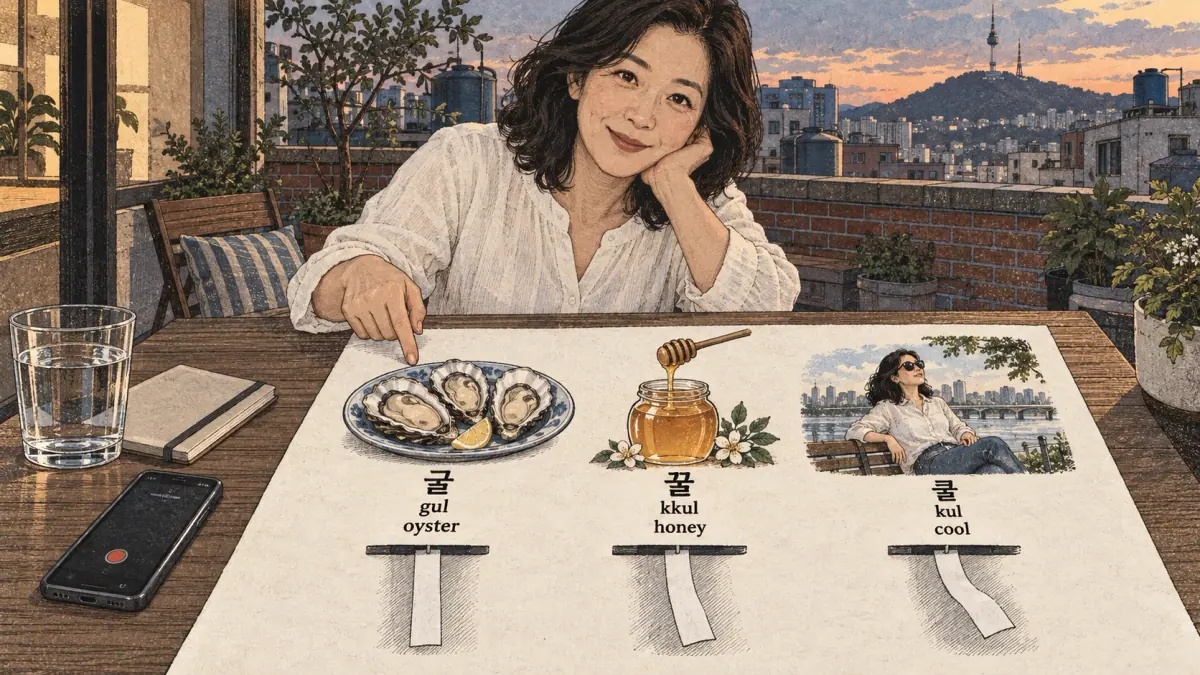
Each of the three letters has one clear mouth recipe at the start of a syllable. All three examples below use the vowel ㅣ or ㅜ so that the vowel does not change the sound.
ㄱ: the Plain Sound
Plain ㄱ is a soft, relaxed k with a light puff of air and a low start to the vowel. Put the back of your tongue against the roof of the mouth, keep the throat loose and let the sound go with a small breath. Example: 기 (energy, spirit) and 굴 (oyster; also a cave or tunnel). The result sits between English "k" and "g". If an English listener hears "gool" or "cool", the sound is close enough that context decides.
ㄲ: the Tense Sound
Tense ㄲ is a tight, short k with almost no puff and a higher start to the vowel. Tighten the throat as if you were holding your breath for a second, close the back of the tongue, then release without pushing any air. Example: 끼 (a meal in 한 끼, "one meal"; also talent, flair) and 꿀 (honey). The sound is not louder or longer than ㄱ. It is tighter.
ㅋ: the Aspirated Sound
Aspirated ㅋ is a k with a strong, audible puff of air and a high start to the vowel. Release the tongue and let a clear breath follow, as in a small sigh. Example: 키 (height; also a key) and 쿨 (cool, a loanword). English speakers already make this sound at the start of "kite" and "key".
The three sounds are best remembered as a scale of breath: ㅋ is a lot, ㄱ is a little, ㄲ is none. A listening check follows the triplet.
Plain: a Little Breath; Tense: None; Aspirated: a Lot
| Korean | Romanization | Meaning | Sound |
|---|---|---|---|
| 굴 | gul | oyster | |
| 꿀 | kkul | honey | |
| 쿨 | kul | cool |
Play the four clips in order, then play them again with your eyes closed and name each first consonant. With the three sounds described, the next question is the one that confuses almost every beginner: whether ㄱ is a g or a k.
Is Korean ㄱ a G or a K?

Korean ㄱ is neither a pure g nor a pure k; it is one sound that shifts with its neighbours. The shift is predictable: plain stops take a voiced quality between voiced sounds. This is a phonetic detail described in Korean phonetics textbooks rather than a numbered rule of the Standard Pronunciation Rules (표준 발음법), and Revised Romanization does not show it.
| Position of ㄱ | What you hear | Example | Revised Romanization |
|---|---|---|---|
| start of a word | voiceless, light puff, close to k | 기 (energy) | gi |
| between two vowels | voiced, close to g | 고기 (meat) [고기] | gogi |
| end of a syllable | unreleased, no puff | 박 (gourd) | bak |
In 고기, the first ㄱ is the start of the word and sounds closer to k, and the second ㄱ sits between vowels and sounds like g. Romanization writes gogi for both, so a reader who pronounces gogi with two identical g sounds will sound foreign.
The voicing change applies to plain ㄱ only. Tense ㄲ keeps its tightness between vowels: the ㄲ in 어깨 (shoulder) stays tight and unvoiced. Aspirated ㅋ keeps its puff in any position, as in the first syllable of 커피 (coffee). You can hear both words below. The voicing rule has its own lesson in Korean Consonant Voicing.
The voicing behaviour is easy to forget, so the position of the letter matters as much as the letter itself. The end of a syllable is the one position where the three letters stop being different.
Where Do ㄱ, ㄲ and ㅋ Go at the End of a Syllable?

At the end of a syllable, ㄱ, ㄲ and ㅋ all sound the same: an unreleased k that stops the sound without a puff. This is called neutralization, because the three-way contrast is neutralized. A syllable-final consonant is called batchim (받침), and the sound it makes is the subject of the ㄱ batchim lesson.
| Written | Meaning | Spoken | Final letter |
|---|---|---|---|
| 박 | gourd; also a surname | [박] | ㄱ |
| 밖 | outside | [박] | ㄲ |
| 부엌 | kitchen | [부억] | ㅋ |
An unreleased stop means that the tongue closes at the back of the mouth and stays closed. English speakers often add a small puff, which makes 밖 sound like "bak-uh". Keep the tongue closed and end the syllable.
The contrast returns when a vowel follows. In 밖에 (outside, at) the ㄲ moves to the next syllable and is spoken as [바께], with a tight ㄲ. The same sound change appears in 부엌이 [부어키], where ㅋ keeps its puff. Final letters therefore hide the contrast only until a vowel arrives. The next section applies everything so far to one fully worked example.
Worked Example: 굴, 꿀, 쿨

The worked example takes the three words one at a time and checks each against the three cues of breath, tension and pitch.
- Set your mouth. For all three words, lift the back of the tongue to the roof of the mouth and keep the lips relaxed and slightly rounded for the vowel ㅜ.
- Say 굴. Release gently with a small puff, keeping the throat relaxed. The vowel starts low.
- Say 꿀. Tighten the throat first, then release with almost no air. The vowel starts higher and sounds clipped.
- Say 쿨. Release with a clear puff of air, like a sigh. The vowel starts high.
- Check with your hand. Hold a palm about 5 cm (2 inches) from your lips. You should feel a little air for 굴, almost none for 꿀 and a clear push for 쿨.
You will know it worked when a listener, or the clip, can tell the three apart without seeing the letters. Note that 쿨 comes from English "cool" and is common in modern speech, for example in 쿨하다, "to be cool and relaxed". The two native words 굴 and 꿀 are older. The same hand check works at home.
How Can You Test the Difference at Home?

You can test the difference at home with two simple checks: a breath check with your hand and a throat check with your fingers. Both take under a minute and need no equipment.
- Breath check. Hold the palm of your hand 5 cm in front of your mouth. Say 키, 기 and 끼 in turn. 키 should push the most air, 기 a little, and 끼 almost none.
- Throat check. Place two fingers on your throat. For 끼, feel the tightness before the release. For 기 and 키 the throat stays loose.
- Order check. Record yourself saying 기 끼 키, 기 끼 키 and listen back. If two of the three sound the same, repeat the weaker one slowly three times.
The checks measure the sound relatively, so compare your three attempts with each other instead of with a fixed number. Distance and loudness change how much air your hand feels. With the tests done, the usual mistakes are easier to spot.
Common Learner Mistakes
Four mistakes cause most of the confusion between ㄱ, ㄲ and ㅋ. Each follows the same pattern: what learners assume, what is actually true and the reason.
Learners often assume ㄲ is a louder ㄱ; actually ㄲ is tighter, not louder, because the contrast is in the throat and not in volume. Fix: tighten, then release quickly and quietly.
Learners often assume ㄱ is always g; actually it sounds closer to k at the start of a word, because Korean plain stops are voiceless there. Fix: say 기 like a soft English "key" and keep g for the middle of words, as in 아기 (baby).
Learners often assume the final ㅋ in 부엌 has a puff; actually it is unreleased, because the contrast is neutralized at the end of a syllable. Fix: close the tongue and stop.
Learners often assume ㅋㅋ in chat is read as "kk"; actually it stands for laughter. It is informal text, like "haha", and Korean speakers type it in repeated ㅋ letters. It is not a spelling rule and tells you nothing about how ㅋ is pronounced in words.
One further point looks like a mistake but is a rule: when a syllable ends in a final ㄱ and the next syllable begins with ㄱ, ㄷ, ㅂ, ㅅ or ㅈ, that consonant becomes tense. For example, 학교 (school) is spoken [학꾜]. That sound change is covered in Korean tensification, and it is why you meet ㄲ-like sounds in words spelled with ㄱ.
Practice and Answer Key
Work through the exercises in order. The answers follow after Exercise 4.
Exercise 1: listen and choose. Play each clip once, then write ㄱ, ㄲ or ㅋ for the first consonant.
Practice · Read
Show answer
굴
listen-first clip 1: 굴, oyster (plain ㄱ)
Show answer
꿀
listen-first clip 2: 꿀, honey (tense ㄲ)
Show answer
쿨
listen-first clip 3: 쿨, cool (aspirated ㅋ)
Show answer
기 끼 키
triplet in a row: 기, 끼, 키
Show answer
고기
voicing: 고기, meat
Show answer
어깨
tense ㄲ between vowels: 어깨, shoulder
Show answer
커피
aspirated ㅋ: 커피, coffee
Show answer
박 밖 부엌
final position: 박, 밖, 부엌 in a row
Show answer
굴 꿀 쿨
worked example: 굴, 꿀, 쿨 in a row
Exercise 2: sort the letters. Name the type (plain, tense or aspirated) of the first letter in each word: 1 꼬리 (tail), 2 커피 (coffee), 3 가다 (to go), 4 크다 (to be big), 5 까다 (to peel).
Exercise 3: predict the sound. Say whether the ㄱ in each word is closer to k or g: 1 기 (energy), 2 아기 (baby), 3 고기 (meat, second ㄱ).
Exercise 4: final position. Write how each word is pronounced: 1 박, 2 밖, 3 부엌.
Answers.
Exercise 2: 1 tense. 2 aspirated. 3 plain. 4 aspirated. 5 tense.
Exercise 3: 1 k-like (start of the word). 2 g-like (between vowels). 3 g-like (between vowels).
Exercise 4: 1 [박]. 2 [박]. 3 [부억].
If you got Exercise 2 right but struggled with Exercise 1, your knowledge is ahead of your hearing, which is normal. Repeat the audio daily for a week. The minimal pairs page has more triplets, and the plain, tense and aspirated listening practice trains the ear specifically. Hangul flashcards in the Hangul decks keep the letters fresh.
Where to Go Next
Continue with Korean ㄷ ㅌ ㄸ Difference, which applies the same three cues to the tongue-tip set. Return to Plain Tense Aspirated Consonants for the whole system, or open Plain, Tense and Aspirated Sounds for the full lesson list. The full picture of each letter is in the Hangul consonants lessons.
This lesson covers ㄱ, ㄲ and ㅋ at the start, middle and end of a syllable. It does not cover sound changes between words, such as tensification in 학교, regional differences, or the acoustic measurements behind the pitch cue. Each of those has its own page.
The Korean ㄱ ㅋ ㄲ difference comes down to breath and tension: ㅋ is a strong puff, ㄱ is a light puff and ㄲ is tight with none. Learn them by ear and hand, and trust the audio over the romanization.
Frequently Asked Questions
Is Korean ㄱ a g or a k? Korean ㄱ is both, depending on position. At the start of a word it is voiceless with a light puff, so it sounds closer to k. Between vowels it is voiced and sounds like g. Revised Romanization writes g at the start and between vowels, and k at the end of a syllable.
How is ㄲ different from ㅋ? ㄲ and ㅋ are made in the same place, but they release in opposite ways. ㅋ sends out a strong puff of air, like the k in English 'kite'. ㄲ is tight and sends out almost no air, closer to the k in 'sky'. A hand held in front of your mouth feels the difference.
Why is ㅋㅋ used for laughing in Korean texts? Korean speakers type ㅋㅋ or ㅋㅋㅋ to show laughter in messages. The letter stands for a short, breathy k-like sound, similar to the sound of a chuckle. It is informal chat writing, not a word, so each extra ㅋ simply adds more laughter.
Do ㄱ, ㄲ and ㅋ sound different at the end of a word? No. At the end of a syllable, all three become the same unreleased k, written [ㄱ] in pronunciation notes. 박 (gourd) and 밖 (outside) both sound [박], and 부엌 (kitchen) sounds like [부억]. The contrast only works when a vowel follows the consonant.
Which of the three is hardest for English speakers? Most English speakers find ㄲ hardest, because English has no word pair that depends on a tense k. The usual error is to say ㄲ like a plain ㄱ. A tight throat and no puff of air fix it. ㄱ and ㅋ are easier because English already has a light k and a strong k.