What you will learn
- Say 먹는, 국물, 한국말, 읽는 and 막내 with ㅇ in place of ㄱ.
- Name the five spellings that give the final ㄱ sound.
- Explain why the verb ending -는 triggers the change so often.
- Predict the spoken form of a new word with a ㄱ-type final before ㄴ or ㅁ.
Before you start: you know the final ㄱ sound from the ㄱ batchim lesson and have met the nasalization rules. Time: about 25 minutes with audio.
Key Facts
- The final sounds ㄱ, ㅋ, ㄲ, ㄳ and ㄺ are pronounced [ㄱ] at the end of a syllable, and that [ㄱ] becomes [ㅇ] before ㄴ or ㅁ.
- The trigger is a following ㄴ or ㅁ.
- Common examples: 먹는 [멍는], 국물 [궁물], 막내 [망내], 학년 [항년].
- ㄺ followed by ㄴ gives [ㅇㄴ]: 읽는 is [잉는].
- The change also applies across a space in a phrase: 책 넣는다 (put a book in) is [챙넌는다].
- The rule is in Article 18 of the Standard Pronunciation Rules (표준 발음법).
Last updated: 2026-10-08. The Korean text, romanization and audio scripts on this page are generated drafts that still await review by a Korean specialist.
What Is Korean ㄱ Nasalization?

Korean ㄱ nasalization is a sound change in which a back-of-the-tongue stop becomes the back-of-the-tongue nasal. A stop is a consonant that fully blocks the air for a moment. A nasal is a consonant that lets air out through the nose. At the end of a block, the nasal made at the back of the tongue is written ㅇ and sounds like the end of the English word "sing".
When a block ends in a ㄱ sound and the next block starts with ㄴ or ㅁ, the ㄱ is spoken as that "ng" sound. The tongue stays in the same place, and the air moves to the nose.
| Written | Spoken | Revised Romanization | Meaning |
|---|---|---|---|
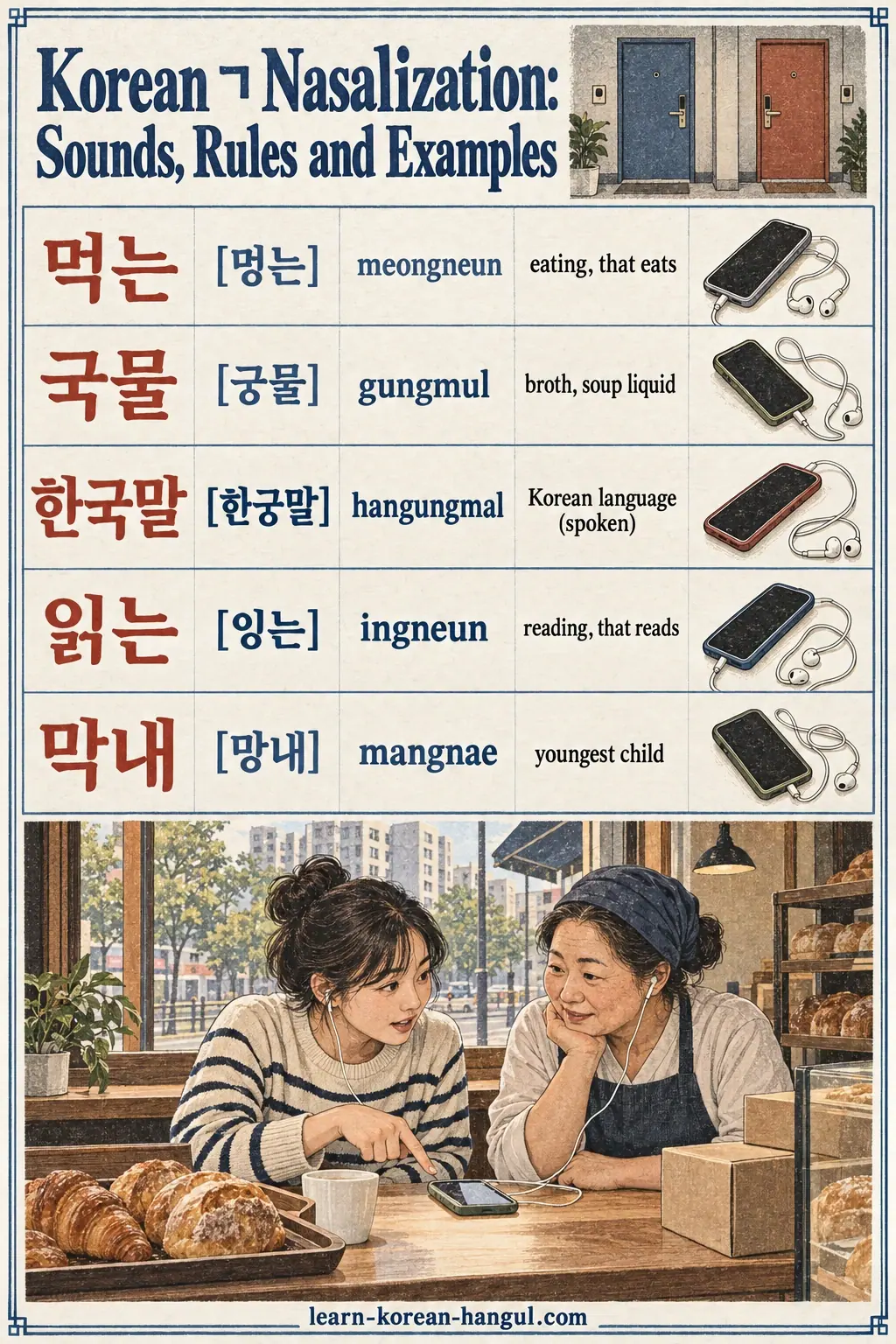
| 먹는 | [멍는] | meongneun | eating, that eats |
| 국물 | [궁물] | gungmul | broth, soup liquid |
| 한국말 | [한궁말] | hangungmal | Korean language (spoken) |
| 읽는 | [잉는] | ingneun | reading, that reads |
| 막내 | [망내] | mangnae | youngest child |
Revised Romanization (RR) follows the spoken form here, so meongneun shows the ng sound. RR is a learning aid on this page, and the Hangul is the reference. The table shows the result, and the next section explains why English speakers tend to miss it.
English Speakers and the "Meok-Neun" Habit

English speakers tend to read 먹는 as "meok-neun" and finish the first block with a small k. The letter ㄱ looks like a "g" or "k", so the habit is to say it. In Korean, a final ㄱ is an unreleased stop: the back of the tongue touches the roof of the mouth and stops there, with no puff of air.
That closed position is already the position for the "ng" sound. Korean nasalization simply opens the nose while the tongue is in place. The change feels smaller than it looks on paper.
A second problem is that the spelling does not change. Nobody writes 멍는, and a learner who sees 먹는 on the page has no visual cue. The solution is a rule that you can apply on sight, which follows next.
What Does ㄱ Become before ㄴ or ㅁ?

Before ㄴ or ㅁ, a final ㄱ sound becomes ㅇ. The place stays the same, because both ㄱ and the final ㅇ use the back of the tongue, and the manner changes from stop to nasal. This is nasal assimilation: the stop takes on the nasal quality of the sound after it.
The same idea works for all three stop families, and this lesson covers the back-of-the-tongue one.
| Stop (final sound) | Becomes | Place in the mouth | Example |
|---|---|---|---|
| ㄱ | ㅇ (ng) | back of the tongue | 먹는 [멍는] |
| ㄷ | ㄴ | tongue tip | 닫는 [단는] |
| ㅂ | ㅁ | lips | 합니다 [함니다] |
Try a body test. Say "sing" and hold the last sound: the back of your tongue is raised and the air hums through your nose. Now say [멍] with the same tongue position, then add 는. The change from ㄱ to ㅇ is only the nose opening.
Because the change only depends on the sound that comes after, the question that remains is which spellings count as a ㄱ sound.
Which Letters Make the Final ㄱ Sound?
Five spellings give the final ㄱ sound: ㄱ, ㅋ, ㄲ, ㄳ and ㄺ. At the end of a syllable, Korean has only seven final sounds, and all of these collapse into [ㄱ]. The table shows each spelling with a word.
| Spelling | Example | Spoken | Meaning |
|---|---|---|---|
| ㄱ | 국물 | [궁물] | broth |
| ㅋ | 부엌문 | [부엉문] | kitchen door |
| ㄲ | 닦는 | [당는] | wiping, that wipes |
| ㄲ | 밖만 | [방만] | only outside |
| ㄳ | 몫만 | [몽만] | only the share |
| ㄺ | 읽는 | [잉는] | reading, that reads |
The rule works because of the final-sound rule, also called the batchim representative sound rule: at the end of a syllable (or before a consonant), ㅋ and ㄲ are pronounced [ㄱ], and a double letter like ㄳ or ㄺ drops to its representative sound. The first step is covered in the ㄱ batchim lesson, and the second step is this lesson.
Expert tip: do not try to memorize the five spellings as a list. Instead, remember the one test: does the block end in a sound made at the back of the tongue? If so, and ㄴ or ㅁ follows, expect [ㅇ].
The most common source of the pattern is not a noun at all, but a verb ending.
How Do Verbs with -는 Change?
The verb ending -는 triggers ㄱ nasalization more than any other pattern. The ending -는 marks a present-tense action (먹는 사람, "a person who eats") and also forms the plain present tense with -는다. Because it starts with ㄴ, any verb stem that ends in a ㄱ sound changes before it.
| Written | Spoken | Meaning |
|---|---|---|
| 먹는 | [멍는] | eating, that eats |
| 읽는 | [잉는] | reading, that reads |
| 닦는 | [당는] | wiping, that wipes |
| 적는 | [정는] | writing down, that writes down |
| 먹네요 | [멍네요] | (I see) you are eating |
| 먹나요 | [멍나요] | do you eat? |
The ending -는 is not the only one: -네요 and -나요 also begin with ㄴ and trigger the same change. In all six rows the verb stem ends in a ㄱ-type final, and the first sound of the ending is a nasal.
Verbs that end in a vowel, such as 가다, never trigger it, because they have no final consonant: 가는 stays [가는]. Learners should check for the final first, then for the nasal. One verb deserves a closer look because it has a double letter.
What about ㄺ?
When the final is ㄺ, two things happen in order. First, ㄺ is pronounced [ㄱ] before a consonant. Then the usual nasal change turns [ㄱ] into [ㅇ]. The word 읽는 is therefore ㄺ → [ㄱ] → [ㅇ], giving [잉는].
The same verb, 읽다, shows how the sound depends on what follows. With a vowel, liaison moves the ㄱ forward. With a stop, the syllable is tense. With a nasal, the final goes to [ㅇ].
| Form | Spoken | Rule at work |
|---|---|---|
| 읽어요 | [일거요] | liaison: ㄹ stays, ㄱ moves |
| 읽다 | [익따] | final-sound rule and tensification |
| 읽는 | [잉는] | final-sound rule and ㄱ nasalization |
The three forms come from one stem and sound quite different. The lesson on double batchim ㄺ gives the full picture. The pattern is not limited to verbs, as the next section shows.
ㄱ Nasalization in Nouns and Compounds
The rule applies inside nouns and across the join of two words. The word 막내 (the youngest) is spoken [망내], and 학년 (school year) is [항년]. The compound 한국말 (Korean language) is [한궁말], where 한국 ends in ㄱ and 말 starts with ㅁ.
| Written | Spoken | Meaning |
|---|---|---|
| 막내 | [망내] | youngest child |
| 학년 | [항년] | school year, grade |
| 작년 | [장년] | last year |
| 한국말 | [한궁말] | Korean language |
| 독립 | [동닙] | independence |
The last row has a bonus change: ㄹ first becomes ㄴ after ㄱ, and then ㄱ becomes ㅇ before that ㄴ, so 독립 is [동닙]. The case belongs to the ㄹ nasalization lesson.
The change also applies across a space when two words are said together in one phrase. The phrase 책 넣는다 (put a book in) is spoken [챙넌는다], as if it were one word; the ㅎ of 넣 also becomes [ㄴ] before 는, as the ㄷ nasalization lesson explains. A pause between the words would stop the change, but in normal speech the phrase flows. Short sentences show all of this at work.
ㄱ Nasalization in a Short Sentence
Whole sentences train the habit of checking every block boundary, not only the one you were expecting. Read the three sentences below, mark each ㄱ-type final before ㄴ or ㅁ, and then say the spoken form.
| Written | Spoken | Meaning |
|---|---|---|
| 국물을 먹는다. | [궁무를 멍는다] | I eat the broth. |
| 막내가 책을 읽는다. | [망내가 채글 잉는다] | The youngest reads a book. |
| 한국말을 읽는 학생 | [한궁마를 잉는 학쌩] | a student who reads Korean |
The sentences mix three rules. In 국물을, nasalization changes ㄱ to ㅇ and liaison then moves the ㄹ of 물 onto 을. In 책을, liaison alone applies, as taught in the lesson on liaison with particles. In 학생, the ㅅ after ㄱ becomes a tense sound. Telling the three apart is the main skill, and the only question to ask is what sound comes next.
Worked Example: 먹는

The word 먹는 is the stem 먹 (eat) plus the ending -는, and it is spoken [멍는]. It is the most useful example of the rule.
- Break it into blocks: 먹 / 는.
- Mark the final of the first block: 먹 ends in ㄱ.
- Mark the next onset: 는 starts with ㄴ, which is a nasal.
- Apply the rule: ㄱ before ㄴ becomes ㅇ, so 먹 is spoken [멍].
- Say it as one flow: [멍는].
- Check the Romanization: RR writes meongneun, which matches.
You will know it worked when the back of your tongue stays up through the whole word, and a hum comes through the nose before the vowel of 는. If you hear a small click or puff after 먹, the stop was released.
The word 먹는 also appears in longer forms such as 먹는다 [멍는다] and 먹는 사람 [멍는 사람]. Each time, the ㅇ sound carries on unchanged. The next section covers the slips that learners make.
Common Learner Mistakes
Learners often let the written ㄱ decide the sound. The mistakes below come from that habit.
- Mistake 1: releasing the ㄱ. Learners often say "meok-neun" with a click. Actually the tongue stays closed and the sound goes through the nose, because ㄴ comes next.
- Mistake 2: writing the spoken form. Learners often write 멍는 in dictation. The spelling stays 먹는, because the change is in speech only.
- Mistake 3: skipping ㅋ and ㄲ. Learners often think the rule applies to ㄱ only. Actually ㅋ, ㄲ, ㄳ and ㄺ are included, because they all reach the final sound [ㄱ] first.
- Mistake 4: changing before a vowel. Learners often nasalize 먹어요. Actually the next sound must be ㄴ or ㅁ; with a vowel the rule is liaison, and 먹어요 is [머거요].
- Mistake 5: stopping ㄺ at the first step. Learners often say 읽는 as [익는]. Actually the final goes on to [ㅇ], because the nasal rule applies after the final-sound rule.
Rule of thumb: when ㄴ or ㅁ starts a block, look at the block before. If it ends in a back-of-the-tongue sound, say "ng".
The practice set puts the rule to the test.
Practice and Answer Key

Write the spoken form of each word in brackets. Say each one aloud first.
- 먹는
- 국물
- 한국말
- 읽는
- 막내
- 학년
- 부엌문
- 먹어요
Answer key
- 먹는 → [멍는]
- 국물 → [궁물]
- 한국말 → [한궁말]
- 읽는 → [잉는]
- 막내 → [망내]
- 학년 → [항년]
- 부엌문 → [부엉문]
- 먹어요 → [머거요] (no nasalization: the next sound is a vowel, so liaison applies)
Seven or eight correct means the pattern is secure. Number 8 is a trap, and getting it right shows you can tell nasalization from liaison. The next lesson moves the idea to the tongue tip.
Where to Go Next
The next lesson, Korean ㄷ nasalization, covers the largest letter group, with 있는 and 닫는. Return to the Nasalization section to see all four patterns together.
This lesson does not teach the meaning or grammar of the ending -는. It covers the sound of Korean ㄱ nasalization only. The case of ㄱ before ㄹ is left to the ㄹ nasalization lesson. The audio shows one standard Seoul pronunciation, and speakers vary in speed.
Frequently Asked Questions
How do you say 먹는? Say [멍는]. The final ㄱ of 먹 becomes the "ng" sound before the ㄴ of 는, so the first syllable sounds like the end of "sing". Keep the back of your tongue raised and let the air hum through your nose. Revised Romanization writes meongneun, which shows the same sound.
Is 한국말 pronounced 한궁말? Yes. The final ㄱ of 한국 meets the ㅁ of 말 and becomes ㅇ, so the word is spoken [한궁말]. Revised Romanization writes hangungmal. 한국말 is written as one word, but the same change also crosses a space when two words are said as one phrase, as in 책 넣는다 [챙넌는다], unless the speaker pauses.
Is ㄱ nasalization optional? The Standard Pronunciation Rules (표준 발음법) set it out as the regular pronunciation, and it is heard in everyday Seoul speech, so learners should treat it as required. Speakers may vary in how clearly they produce it in very slow, careful reading, but the nasal form is the standard one.
What about 학년? Say [항년]. The final ㄱ of 학 becomes ㅇ before the ㄴ of 년. Revised Romanization writes hangnyeon. Because 학년 means "school year" or "grade", you meet it in sentences like 일 학년 (first year). The spelling stays 학년, and only the speech changes.