Korean pitch and phrasing is the way Seoul speech groups words into short phrases, each with a typical low-to-high pitch shape. A phrase usually holds one content word plus its particle or ending, such as 책을 or 읽어요. This lesson shows how to mark phrase boundaries in five sentences and how to say them with the Seoul rise.
Key facts
- An accentual phrase (AP) groups a content word with its particle or ending.
- A four-syllable AP typically goes low, high, low, high (LHLH).
- A phrase that starts with a tense, aspirated, ㅅ or ㅎ sound usually starts high.
- Several APs form one intonational phrase, which ends with the sentence-final tone.
- Researchers describe the system with K-ToBI (Korean Tones and Break Indices).
- The pattern is typical, not fixed, and it varies with speed, emphasis and speaker.
Last updated: 2026-10-09.
What you'll learn
- Define an accentual phrase and find its boundaries in a sentence.
- Describe the typical low-high pattern and say when a phrase starts high.
- Mark the phrase boundaries in five sentences.
- Practise phrasing with a four-step routine.
Prerequisites: you read Hangul comfortably and know basic particles. This is an advanced lesson. Review Korean rhythm and Korean stress first. Estimated time: 20 minutes.
What Is Korean Pitch and Phrasing?
Korean pitch and phrasing describes how the voice rises and falls in a Seoul sentence and where it breaks the sentence into small groups. Pitch is how high or low the voice sounds. Phrasing is the grouping of words into chunks that are spoken as one unit. Seoul Korean uses pitch for this grouping, and does not use it to tell words apart.
Say 마리아가 책을 읽어요 ("Maria reads a book"). It does not come out as a flat line or as one big hill. It comes out as three small hills: 마리아가, 책을, 읽어요. Each hill is one accentual phrase. The voice rises toward the end of each group and resets at the boundary. That small, repeated shape gives Seoul Korean its melody.
The next section explains why English speakers have trouble with this melody.
Why English Speakers Find Phrasing Hard
English speakers find Korean phrasing hard because English builds its melody on word stress, and Korean has none. In English, each content word has one stressed syllable, and the sentence melody is hung on those stresses. When English speakers speak Korean, they often place a stress on one syllable of each word, make the pitch fall after it and leave the particle weak. The result is a pattern that Seoul listeners hear as "foreign" even when every sound is correct.
Two other habits cause trouble. The first is splitting a word from its particle, saying 책 and 을 as two words with a pause. The second is falling at the end of every word, as English does at the end of a statement. In Korean, a phrase typically rises toward its end, and the fall belongs to the end of the sentence. The lesson on Korean stress covers the stress habit, and the next section defines the phrase unit.
What Is an Accentual Phrase?
An accentual phrase is a short group of syllables, usually one content word with its particles or endings, that carries one typical pitch pattern in Seoul speech. The term "accentual" is a label from research; it does not mean that one syllable is stressed. The glossary entry accentual phrase gives the short definition.
| Part of speech | What goes in the phrase | Example | Phrases |
|---|---|---|---|
| Noun + particle | the noun and its particle | 학교에 (to school) | 1 |
| Verb + ending | the verb stem and its endings | 갔어요 (went) | 1 |
| Adverb | the adverb alone, or with the next word | 어제 (yesterday) | 1 |
| Noun + noun | two short nouns may merge | 영화 감독 (film director) | 1 or 2 |
The particle stays inside the phrase. So 책을 is one unit, and the sentence 책을 읽어요 has two phrases, not three. The grouping can also change with speed: in fast speech, 어제 학교에 can merge into one phrase, and in slow, careful speech it can split. For this reason, the phrase boundaries in this lesson mark the usual places, not rules.
The next larger unit is the intonational phrase (IP). Several APs form one IP, and the IP ends with a clear pause and a final tone. In 마리아가 책을 읽어요, there are three APs and one IP. The sentence-final tone, which makes a statement fall or a question rise, is the subject of the lesson on sentence-final intonation.
What Is the Typical Pitch Pattern?
The typical pattern for a four-syllable accentual phrase is low, high, low, high, written LHLH. The first high falls on the second syllable and the second high falls on the last syllable. Shorter phrases show fewer of these tones, because there are fewer syllables to hold them.
마  리  아  가
L   H   L   H
The count is of spoken syllables. Their number matches the written blocks, but a sound can move across the boundary: 책을 is spoken [채글], two syllables, because the final ㄱ of 책 moves to the next block.
| Spoken syllables | Typical shape | Example |
|---|---|---|
| 2 | low, high | 어제 |
| 3 | low, high, high | 일거요 (읽어요) |
| 4 | low, high, low, high | 마리아가 |
| 5 or more | the pattern repeats or stretches | 대한민국이 |
The shapes in the table are simplified, and phonetic studies show that real speech varies a lot. Use them as a guide for listening. The first tone has a special rule, which the next section explains.
How Tense and Aspirated Consonants Change the Start
A phrase that begins with a tense, aspirated, ㅅ or ㅎ sound usually starts with a high tone instead of a low tone. In the notation, the first L becomes H. The plain consonants ㄱ, ㄷ, ㅂ, ㅈ, the nasals ㄴ and ㅁ, the liquid ㄹ and the silent ㅇ keep the low start.
| First sound of the phrase | Start | Example | Pattern |
|---|---|---|---|
| plain ㄱ ㄷ ㅂ ㅈ, ㄴ ㅁ ㅇ ㄹ | low | 마리아가, 읽어요, 주말에 | L... |
| aspirated ㅋ ㅌ ㅍ ㅊ | high | 책을 [채글], 커피를 | H... |
| tense ㄲ ㄸ ㅃ ㅆ ㅉ | high | 딸이, 빵을 | H... |
| ㅅ or ㅎ | high | 학교에, 사과를 | H... |
For example, 책을 starts with the aspirated ㅊ, so it starts high: H H. The word 학교에 starts with ㅎ, so its first syllable is already high. This is the link between the sound of a consonant and the pitch of the vowel after it. The lesson on Korean consonants and pitch explains that link, and why younger Seoul speakers rely on it.
The rule comes from published descriptions of Seoul speech and is a tendency. Some speakers show it more clearly than others. The next section applies the rules to five sentences.
Five Sentences with the Phrase Boundaries Marked
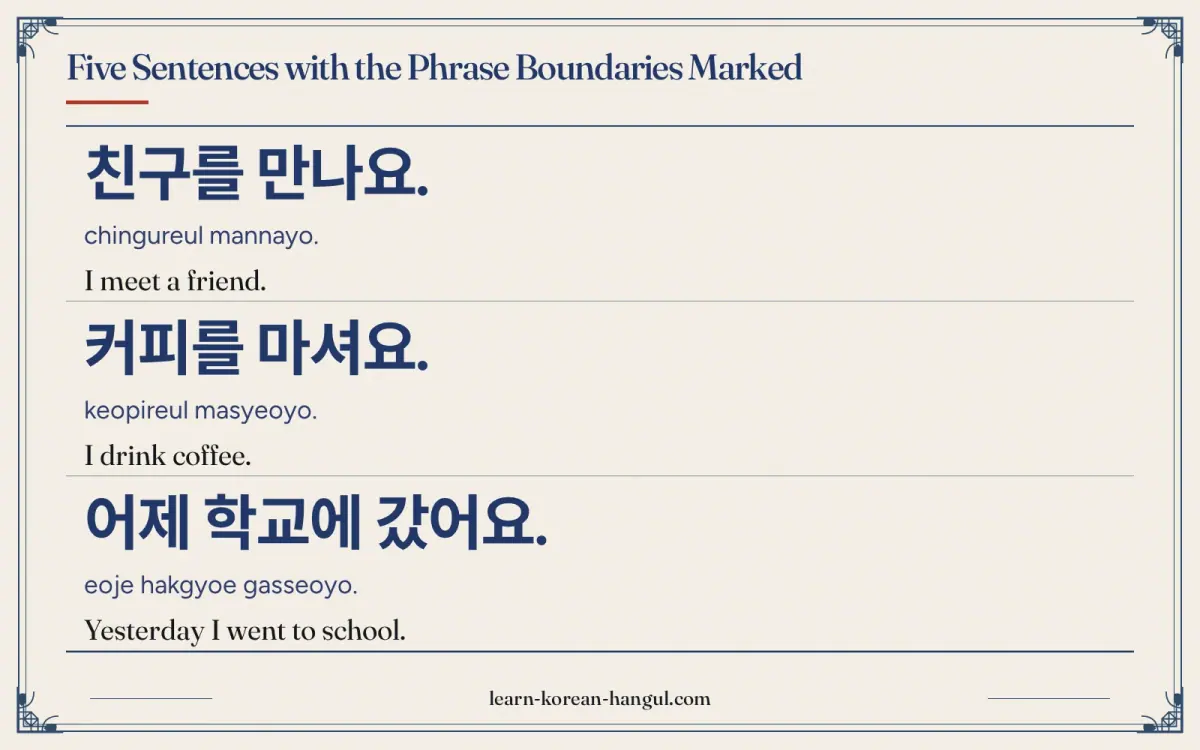
Each sentence below has its accentual phrases separated by a vertical bar. The last column gives the usual start tone of each phrase, from the rules above. Play the clip and listen for the small rise toward the end of each phrase.
| # | Sentence | Spoken | Revised Romanization | Start tones |
|---|---|---|---|---|
| 1 | 마리아가 | 책을 | 읽어요. | [마리아가 채글 일거요] | Mariaga chaegeul ilgeoyo | L, H (ㅊ), L |
| 2 | 친구를 | 만나요. | [친구를 만나요] | chingureul mannayo | H (ㅊ), L |
| 3 | 커피를 | 마셔요. | [커피를 마셔요] | keopireul masyeoyo | H (ㅋ), L |
| 4 | 어제 | 학교에 | 갔어요. | [어제 학꾜에 가써요] | eoje hakgyoe gasseoyo | L, H (ㅎ), L |
| 5 | 주말에 | 영화를 | 봤어요. | [주마레 영화를 봐써요] | jumare yeonghwareul bwasseoyo | L, L, L |
Sentence 1 means "Maria reads a book," 2 "I meet a friend," 3 "I drink coffee," 4 "Yesterday I went to school," and 5 "I watched a movie at the weekend." In sentences 4 and 5 the verbs 갔어요 and 봤어요 are [가써요] and [봐써요]; Revised Romanization writes the tense letters as they are spelled and does not show tensing caused by neighbouring sounds, such as the [꾜] of 학교.
친구를 만나요.
chingureul mannayo.
I meet a friend.
커피를 마셔요.
keopireul masyeoyo.
I drink coffee.
어제 학교에 갔어요.
eoje hakgyoe gasseoyo.
Yesterday I went to school.
주말에 영화를 봤어요.
jumare yeonghwareul bwasseoyo.
I watched a movie at the weekend.
The last phrase of a statement usually ends lower than the pattern suggests, because the sentence-final tone of a statement falls. For a question the tone rises, as covered in the lesson on question intonation. Text-to-speech may not show the small rises as clearly as a person does, so use it to check the grouping and rely on real speech for the melody. The next section gives a way to practise.
How to Practise Phrasing
Practise phrasing in four steps, using a short sentence and a clip of real speech.
- Mark the phrases. Write the sentence and draw a bar after each content word with its particle or ending. You will know it worked when each bar falls after a particle or an ending, never between a word and its particle.
- Hum the shape. Hum each phrase on one note that rises a little toward the end. Do not add words yet. A common mistake is to hum a fall at the end of each phrase.
- Say it with words. Say each phrase as one unit with the same small rise. Leave a tiny reset between phrases, not a pause.
- Shadow a speaker. Play a short clip from a real Seoul speaker, say the sentence a half-second behind, and compare. The lesson on Korean shadowing describes the method.
Five minutes a day on two or three sentences is enough. You will know it worked when a listener tells you that your speech sounds "smooth", or when you hear the same small hills in the clip and in your own voice. The next section works through one sentence in detail.
Worked Example: 책을 읽어요
The sentence 책을 읽어요 ("I read a book") has two accentual phrases. Follow these steps.
- Find the phrases. 책을 (book + object particle) and 읽어요 (read, polite). Two content words, two phrases.
- Work out the sound. 책을 is [채글]: the final ㄱ moves to the front of 을. 읽어요 is [일거요]: of the double final ㄺ, the ㄹ stays and the ㄱ moves to the next block. So the sentence is [채글 일거요].
- Count the spoken syllables. 채글 has two syllables, and 일거요 has three.
- Set the start tones. 책을 starts with aspirated ㅊ, so it starts high. 읽어요 starts with the silent ㅇ, so it starts low.
- Draw the shape. The first phrase is high, high. The second is low, high, and then falls at the end of the sentence.
채  글  |  일  거  요
H   H   |  L   H   ↘
- Check the Revised Romanization. It writes the sound: chaegeul ilgeoyo.
You will know it worked when your voice resets low at 일 after the high of 글, and rises through 거 before falling on 요. If you stay high through the whole sentence, you have merged the two phrases into one.
Is the Pattern the Same Every Time?
No, the pattern changes with speed, emphasis and speaker. In fast speech, two short phrases can merge into one, and the middle tones disappear. In emphatic speech, the speaker widens the pitch range on the important word and compresses the words after it. Longer words repeat the pattern. Some speakers show a clear rise, and others hardly any.
The pattern also differs by dialect. Seoul speech phrases the sentence as described here, while Busan and other Gyeongsang speech stores a pitch pattern with each word. The lesson Seoul vs Busan Korean compares the two. Research on Seoul phrasing uses K-ToBI, a labelling system developed from the 1990s, and its descriptions have been refined over time, so you may see slightly different notations in different sources.
Common Learner Mistakes
Mistake 1: stressing one syllable. Learners often put English stress on the first syllable of 마리아가. Actually Korean has no word stress, and the pitch belongs to the phrase. Fix: say all four syllables evenly and let the small rise happen toward the end.
Mistake 2: separating the particle. Learners often say 책 ... 을 as two words. Actually the particle is part of the phrase, and the sound moves across the block, as in [채글]. Fix: say the noun and the particle as one chunk.
Mistake 3: falling after every word. Learners often drop the pitch at the end of each phrase, as English statements do. Actually the fall belongs to the end of the sentence. Fix: keep a small rise at the end of each internal phrase.
Mistake 4: pausing between phrases. Learners often stop after each phrase. Actually phrases are joined with only a pitch reset. Fix: practise sentences at conversation speed with no gaps.
Mistake 5: treating the LHLH pattern as a rule. Learners often force LHLH onto every phrase. Actually it is a typical shape, and many phrases show fewer tones. Fix: copy the grouping first and the exact tones second.
Practice: Mark the Phrases
Mark the accentual phrases with a bar and say whether each phrase starts low or high.
- 선생님이 한국어를 가르쳐요. (The teacher teaches Korean.)
- 친구가 커피를 사요. (A friend buys coffee.)
- 내일 도서관에 가요. (Tomorrow I go to the library.)
Then answer.
- How many spoken syllables does 책을 have?
- Which of 마리아가 and 커피를 starts high, and why?
Answers.
- 선생님이 | 한국어를 | 가르쳐요. 선생님이 starts with ㅅ (high). 한국어를 starts with ㅎ (high). 가르쳐요 starts with plain ㄱ (low).
- 친구가 | 커피를 | 사요. 친구가 starts with aspirated ㅊ (high), 커피를 with aspirated ㅋ (high), 사요 with ㅅ (high).
- 내일 | 도서관에 | 가요. 내일 starts with ㄴ (low), 도서관에 with ㄷ (low), 가요 with ㄱ (low).
- Two, [채글].
- 커피를 starts high because ㅋ is aspirated. 마리아가 starts low because ㅁ is a plain nasal.
If you marked all nine phrases correctly, you can find phrase boundaries. The start tones are a bonus, since they follow the research tendency.
Where to Go Next
The lesson that connects the consonant to the pitch is Korean consonants and pitch. The sentence-final tone is covered in sentence-final intonation. The next lesson in the sequence is Korean accents and dialects, and the section hub is Korean intonation and rhythm. For the term itself, read the glossary entry on pitch accent.
This lesson does not teach the full K-ToBI notation, sentence-final tones, focus or the phrasing of every dialect. It covers the Seoul accentual phrase at a basic level and marks the pattern as typical. In short, Korean pitch and phrasing groups a content word with its particle or ending into one low-to-high unit, and a learner who says phrases as units, not word by word, sounds more like a Seoul speaker.
Frequently Asked Questions
What is K-ToBI? K-ToBI stands for Korean Tones and Break Indices, a system researchers use to label the pitch and the phrase breaks of Korean speech. It records the tone of syllables and how strong the break after each phrase is. It is a research tool, and learners can follow every lesson on this site without it.
Is the LHLH pattern fixed? No. LHLH is a typical shape for a four-syllable phrase in Seoul speech. Shorter phrases show fewer of the tones, longer phrases repeat the pattern, and a first sound that is tense, aspirated, ㅅ or ㅎ starts the phrase high. Speed, emphasis and speaker style also change it, so treat it as a tendency.
Do learners need the accentual phrase? Not at the start. In Seoul Korean the phrase pitch does not tell one word from another, so you are understood without it. It helps later for natural rhythm and for following fast speech. A good first step is to say a word and its particle as one unit, with a gentle rise, and not as two separate words.
How is phrasing different in Busan? Busan and other Gyeongsang speech has word-level pitch accent, where each word carries a pitch pattern. The Seoul accentual phrase describes a pattern for the phrase instead. The two systems are different, so a pitch pattern that fits Seoul speakers should not be assumed for a Busan speaker.