Assimilation Meaning in Korean
Sounds sitting side by side influence each other, and the easiest change for the mouth is to make one sound more like its neighbour. Korean calls this 동화 (donghwa), literally "becoming the same", and uses 자음동화 (jaeumdonghwa) for the consonant kind.
The direction of the influence gives two types.
- Regressive assimilation. The later sound changes the earlier one. In 국물 (gungmul, broth) the nasal ㅁ pulls the ㄱ before it into the nasal [ㅇ], so the word is spoken [궁물].
- Progressive assimilation. The earlier sound changes the later one. In 설날 (seollal, Lunar New Year) the ㄹ pulls the ㄴ after it into [ㄹ], so the word is spoken [설랄].
Regressive assimilation is the more common direction in Korean: nasalization, palatalization and 신라 [실라] all work this way.
How Much Does a Sound Change?
Assimilation can be total or partial. The difference is whether the two sounds end up identical.
| Type | What happens | Example | Spoken |
|---|---|---|---|
| total | the sound becomes identical to its neighbour | 신라 (Silla) | [실라] |
| partial | the sound takes on one feature of its neighbour | 국물 (broth) | [궁물] |
In 신라 the ㄴ becomes ㄹ and the two letters sound the same. In 국물 the ㄱ becomes a nasal but stays at the back of the mouth, so it does not become identical to ㅁ. It copies only the nasal feature.
Which Korean Rules Are Assimilation?
Several sound-change rules belong to this family.
- Nasalization. A stop before a nasal becomes a nasal, as in 먹는 [멍는], and ㄹ after ㅁ or ㅇ becomes ㄴ, as in 종로 [종노]. See Korean nasalization.
- Liquidization. ㄴ next to ㄹ becomes ㄹ, as in 신라 [실라] and 설날 [설랄].
- Palatalization. ㄷ and ㅌ before the vowel 이 across a suffix shift to ㅈ and ㅊ, as in 같이 [가치].
The wider lesson on consonant assimilation covers all three. Tensification and liaison are not assimilation. Tensification makes a consonant tight after an obstruent, and liaison moves a final consonant onto a following vowel. Neither copies a feature from a neighbour.
Assimilation Versus Neutralization
Neutralization is the nearest confusable term. It looks similar, because it also changes how a written letter is spoken, but the cause differs.
| Feature | Assimilation | Neutralization |
|---|---|---|
| Cause | a neighbouring sound | the position at the end of a syllable |
| Needs a neighbour | yes | no |
| Direction | toward the neighbour | toward one of seven sounds |
| Example | 국물 [궁물] | 부엌 [부억] |
The page on final consonant neutralization explains the second type. In many words both apply: 부엌만 is first reduced to [부억], then nasalized to [부엉만].
What Are Examples of Assimilation?
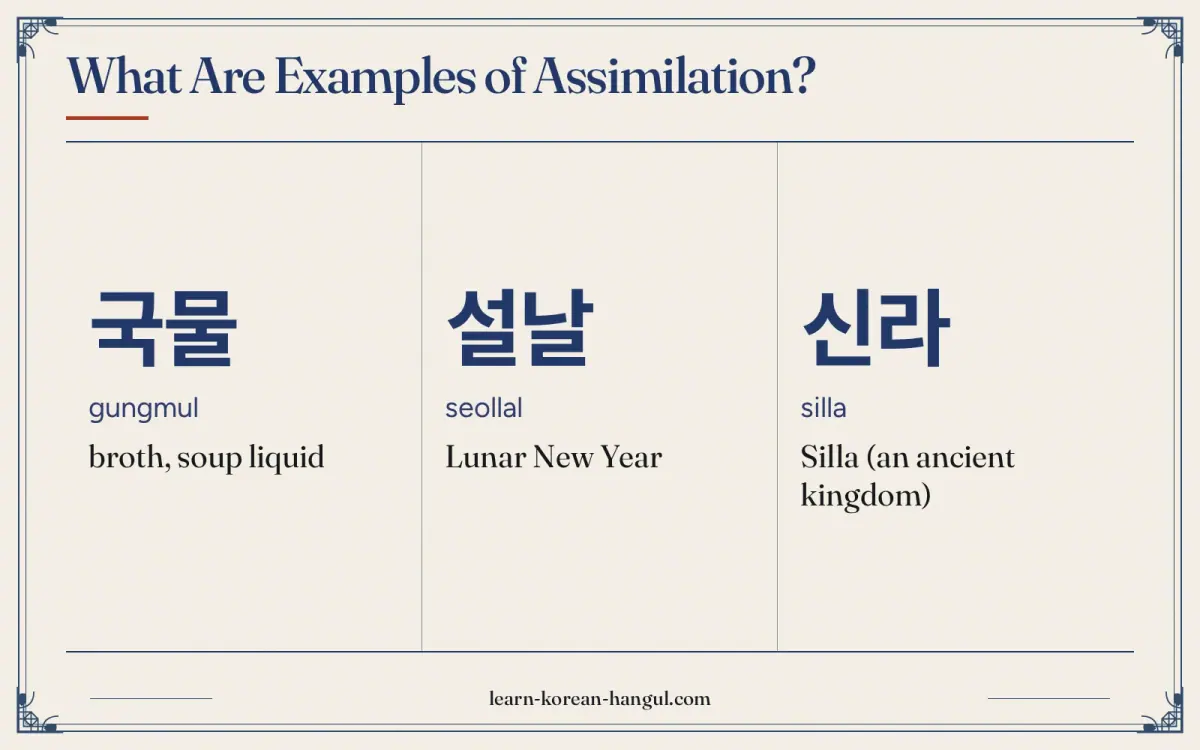
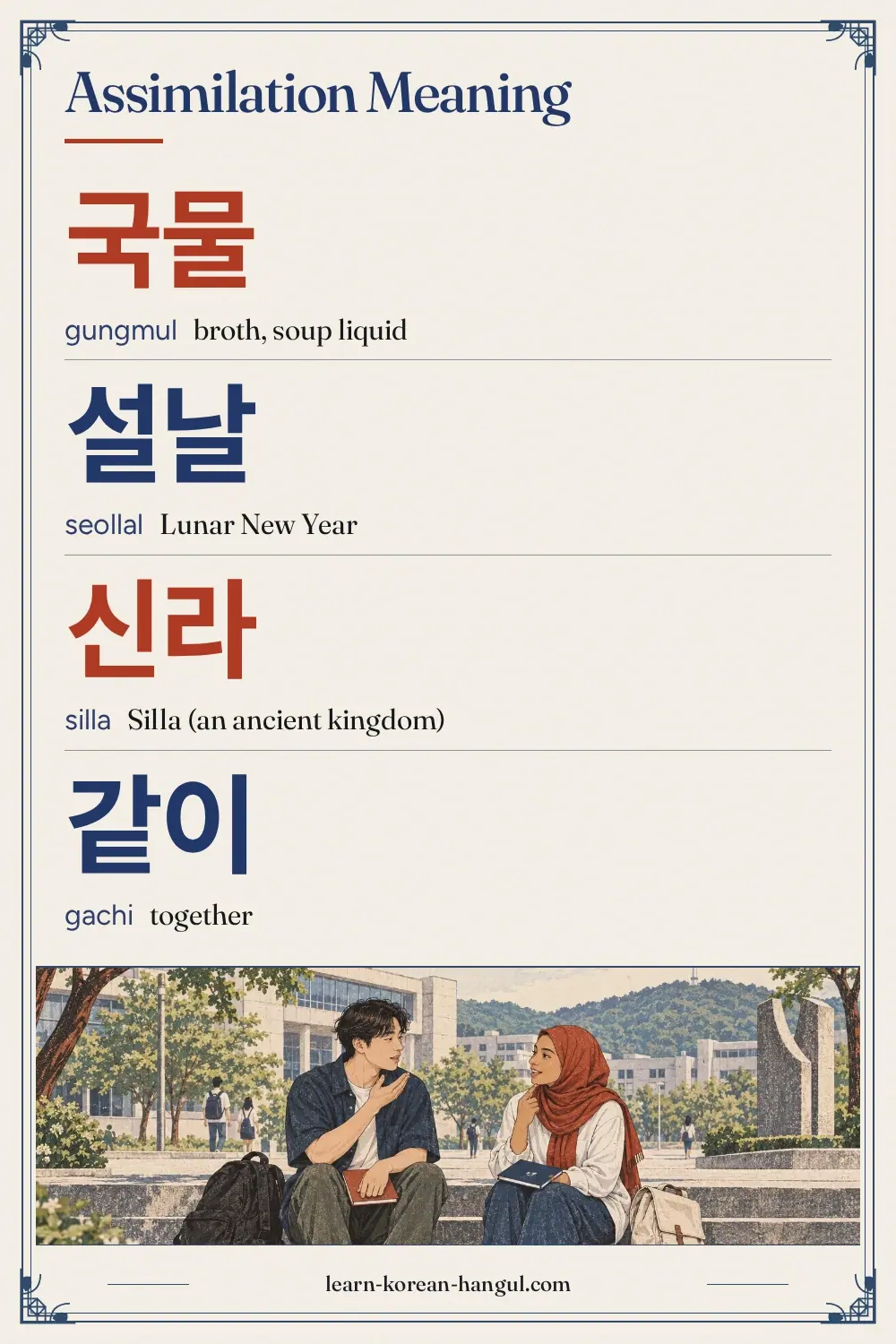
국물
gungmul
broth, soup liquid
설날
seollal
Lunar New Year
신라
silla
Silla (an ancient kingdom)
같이
gachi
together
What Do Learners Get Wrong about Assimilation?
Learners usually read every written letter. The words above then come out as "guk-mul", "seol-nal", "sin-la" and "gat-i", each of which sounds unnatural. The spelling stays the same, but the standard pronunciation follows the sound change.
- Thinking it is optional. For the cases above the standard pronunciation (표준 발음법) requires the change.
- Calling every change assimilation. If no neighbour causes it, the change is something else.
- Confusing the direction. Regressive means the later sound acts on the earlier one.
This page names the idea and does not list every rule. Rule numbers and exceptions belong to the sound-change lessons.
Frequently Asked Questions
What is assimilation? Assimilation is a sound change in which one sound becomes more like a neighbouring sound. In 국물 (broth) the ㄱ takes on the nasal quality of ㅁ and is spoken [ㅇ], giving [궁물]. Linguists name the direction regressive or progressive, and the degree total or partial.
Is liaison assimilation? No. Liaison moves a final consonant onto a following vowel, as in 밥이 [바비]. No sound copies a feature from its neighbour, so it is a different kind of change. Assimilation always involves one sound becoming more like another. Tensification, which tightens a consonant after an obstruent, is also not assimilation, and neither is neutralization.
What is 동화? 동화 (donghwa) is the Korean word for assimilation. It literally means "becoming the same". When the sounds are consonants, textbooks say 자음동화 (jaeumdonghwa). The lessons call the idea assimilation and name each rule separately. Korean textbooks teach the consonant kind as part of the chapter on sound changes, so the word is worth recognising.
Which Korean rules are assimilation? Nasalization (먹는 [멍는]), liquidization of ㄴ and ㄹ (신라 [실라], 설날 [설랄]) and palatalization (같이 [가치]) are assimilation. Final consonant neutralization, tensification and liaison are separate rule families. The consonant assimilation lesson explains the three that count, with the exact conditions for each one and exceptions such as 의견란 [의견난], where ㄹ becomes ㄴ instead.
Related Terms and Lessons
Assimilation meaning leads into the lessons on consonant assimilation and Korean nasalization. The contrasting term is final consonant neutralization. All terms are listed in the Korean Pronunciation Glossary.