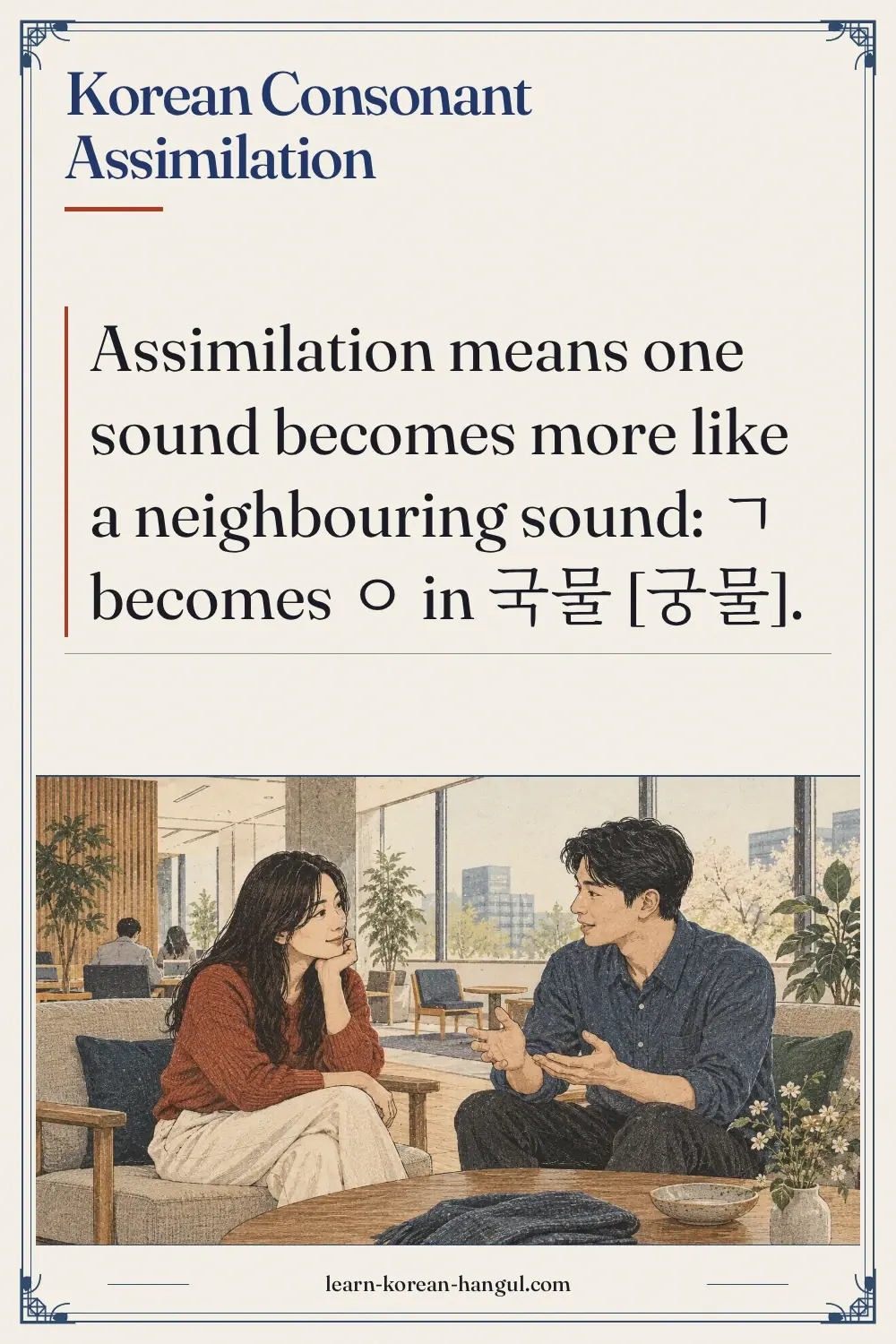
Korean consonant assimilation (자음동화, jaeumdonghwa) is the change by which a consonant becomes more like a neighbouring consonant, as when ㄱ turns into ㅇ in 국물 [궁물] or ㄴ turns into ㄹ in 신라 [실라]. The Standard Pronunciation Rules describe it in Chapter 5, Articles 17 to 20.
Key facts
- Tensification, liaison and aspiration are different processes.
Last updated: 2026-10-09.
What you'll learn
- Define assimilation and say which Korean rules count as assimilation.
- Label an example as progressive or regressive, and as total or partial.
- Say 국물, 신라, 설날, 종로 and 같이 with the correct change.
- Explain which sound changes are not assimilation.
Prerequisites: you have read Korean Sound Changes Explained and know the seven final sounds. Estimated time: 25 minutes.
What Is Korean Consonant Assimilation?
Korean consonant assimilation is the process in which a consonant takes on a feature of the consonant next to it. A feature is one property of a sound, such as where in the mouth it is made (place), how air is released (manner), or whether the nose is open. Assimilation makes two neighbouring sounds easier to say together.
English does this too. The prefix in- becomes im- before p in "impossible", because the lips are already closing for p. Korean does it in the same spirit, but the changes are fixed by rule in standard speech, and the spelling does not show them. The word 국물 (soup broth) is written with ㄱ and ㅁ, but it is spoken [궁물]. That gap between spelling and sound is the main source of errors. The next section explains why English speakers meet it as a surprise.
Why Assimilation Surprises English Speakers
Assimilation surprises English speakers because Korean writes the underlying form and requires the spoken change. English spelling also hides sound changes, but English speakers rarely feel that a change is required. If you say "impossible" with n, listeners still understand. If you say 국물 with a clear k, a Korean listener hears a careful, foreign reading.
Korean spelling keeps the base form of each word part so that the same part looks the same everywhere. The part 국 looks the same in 국 (soup), 국물 and 국이. The sound changes with its neighbours. A learner who reads letter by letter gets the base form, not the spoken one. The remedy is to learn the few triggers. The next section names the terms.
The Five Labels for Assimilation
Five labels describe any assimilation, and each answers a different question. Direction asks which sound changes. Degree asks how far the change goes. The table gives the labels with Korean terms.
| Label | Korean term | Meaning | Example |
|---|---|---|---|
| Regressive | 역행동화 | a later sound changes an earlier one | 국물 [궁물]: ㅁ changes ㄱ |
| Progressive | 순행동화 | an earlier sound changes a later one | 설날 [설랄]: ㄹ changes ㄴ |
| Mutual | 상호동화 | both sounds change | 독립 [동닙] |
| Total | 완전동화 | the sounds become identical | 신라 [실라] |
| Partial | 부분동화 | one feature changes, the rest stay | 국 → 궁 |
Direction is not left or right in the printed word; it is the direction of influence. In 국물 the ㅁ acts on the ㄱ before it, so the change is regressive. Degree depends on how much changes. In 국물 the ㄱ and ㅇ are both made at the back of the tongue, so the place stays and only the manner changes, which makes the change partial. In 신라 the ㄴ becomes ㄹ completely, which is total assimilation.
Terms vary between books. Some English sources say lateralization where Korean books say liquidization (유음화), and some Korean books list only two types as 자음동화. The glossary entry on assimilation gives the site's wording. The next section links the labels to the Korean rules.
Which Korean Rules Are Assimilation?
Four rules in the Standard Pronunciation Rules are assimilation. They fall into three groups (nasalization, liquidization and palatalization), and the table links each rule to its label and an example.
| Rule | Condition | Assimilation type | Example |
|---|---|---|---|
| Nasalization of stops (비음화) | ㄱ, ㄷ, ㅂ before ㄴ or ㅁ become ㅇ, ㄴ, ㅁ | regressive, partial | 국물 [궁물], 믿는 [민는], 밥물 [밤물] |
| Nasalization of ㄹ | ㄹ after ㅁ or ㅇ becomes ㄴ; after ㄱ, ㅂ it becomes ㄴ and then the stop nasalizes | progressive, partial; mutual in 독립 | 심리 [심니], 종로 [종노], 독립 [동닙] |
| Liquidization (유음화) | ㄴ next to ㄹ becomes ㄹ | total; regressive in 신라, progressive in 설날 | 신라 [실라], 설날 [설랄], 난로 [날로] |
| Palatalization (구개음화) | ㄷ or ㅌ before 이 becomes ㅈ or ㅊ | regressive, partial | 같이 [가치], 굳이 [구지] |
Each group has its own lesson: Korean nasalization, Korean liquidization and Korean palatalization. This lesson only classifies them. Notice a pattern: nasalization and liquidization change the manner of articulation, while palatalization is triggered by the vowel 이. The audio below lets you hear the groups.
Why Do Textbooks List Only Nasalization and Liquidization?
Many Korean school textbooks define 자음동화 as a change in the manner of articulation, which gives two groups: nasalization (비음화) and liquidization (유음화). Palatalization is usually taught under its own name, 구개음화, because a vowel triggers it. Sources in English often treat all three as assimilation, because the process is the same in kind.
The Standard Pronunciation Rules do not use the school split. They put palatalization (Article 17), nasalization (Articles 18 and 19) and liquidization (Article 20) together in Chapter 5, titled "Assimilation of sounds" (소리의 동화). This site follows the Rules, which means three groups of assimilation, and notes the school split so you can read either kind of book. If a test uses the narrow school definition, you will see two items. Next, check the other direction: what is not assimilation.
What Is Not Assimilation?
Several common sound changes are not assimilation, even though they happen in the same words. The test is simple. In assimilation one sound becomes more like its neighbour. If the change has another cause, it belongs to another rule.
| Process | Why it is not assimilation | Example |
|---|---|---|
| Tensification (된소리되기) | a plain consonant becomes tense, with no neighbour's feature copied | 밥상 [밥쌍] |
| Liaison (연음) | a final consonant moves to a vowel-initial block | 국이 [구기] |
| Aspiration | ㅎ and a stop merge into one aspirated sound, a contraction (축약) | 좋다 [조타] |
| ㅎ weakening | ㅎ is dropped or weakened between sounds | 좋아 [조아] |
| N-insertion | a ㄴ sound is added, not changed | 한여름 [한녀름] |
Another group is also missing: place assimilation. In English, "input" is often said as "imput". In Korean standard speech this is not accepted. Article 21 of the Standard Pronunciation Rules does not accept this kind of change as standard, and its examples include 감기, 문법, 옷감, 있고, 꽃길, 젖먹이 and 꽃밭: 감기 stays [감기], not [강기]. A learner who copies the English habit and says 강기 will be corrected. The related lessons are liaison, tensification, aspiration, ㅎ weakening and ㄴ insertion.
How Can You Predict an Assimilation?
An assimilation can be predicted by looking at the sound that follows a final consonant. Check the three questions below in order, and stop at the first match.
- Is the next sound a vowel? Then the final consonant links forward. This is liaison, not assimilation (국이 [구기]).
- Is the next sound ㄴ, ㅁ or ㄹ? Then a nasal or liquid rule may apply; the table below shows which final consonants change.
- Is the next block 이 after ㄷ or ㅌ? Then palatalization applies.
If none of the three matches, no assimilation happens, and the final consonant is read with its representative sound. The table turns the first two checks into a lookup.
| Final sound | Next sound | Result | Example |
|---|---|---|---|
| ㄱ, ㄷ, ㅂ | ㄴ or ㅁ | becomes ㅇ, ㄴ, ㅁ | 국물 [궁물], 믿는 [민는], 밥물 [밤물] |
| ㅁ, ㅇ | ㄹ | ㄹ becomes ㄴ | 심리 [심니], 종로 [종노] |
| ㄱ, ㅂ | ㄹ | ㄹ becomes ㄴ, then the stop nasalizes | 독립 [동닙] |
| ㄴ | ㄹ | ㄴ becomes ㄹ | 신라 [실라], 난로 [날로] |
| ㄹ | ㄴ | ㄴ becomes ㄹ | 설날 [설랄] |
| ㄷ, ㅌ | 이 | becomes ㅈ, ㅊ | 굳이 [구지], 같이 [가치] |
The table covers the core cases only. Exceptions exist, such as words in which ㄴ and ㄹ do not change, and the single-rule lessons list them. The key habit is to scan each final consonant and its neighbour before you read aloud. A note on vowels comes next.
What about Vowels?
Vowels take part in far less assimilation than consonants, so learners can focus on consonants. Korean has a vowel harmony pattern, in which verb endings change between 아 and 어 by the vowel of the stem: 잡아요 but 먹어요. That is a grammar pattern, not a sound rule. A vowel change such as saying 애기 for 아기 (baby) exists in speech, but the standard does not accept it. The only vowel-triggered consonant change in this chapter is palatalization before 이.
Drill the consonant rules first. The mouth cue below explains the physical reason these changes feel natural.
How the Mouth Explains the Change
The mouth changes the sound because the tongue and soft palate are already moving toward the next sound. In 국물, the back of the tongue closes for ㄱ, and the next sound ㅁ needs the nasal passage open. Opening the nose early turns ㄱ into ㅇ [ŋ], the nasal made at the same place. Place is unchanged, manner changes, so the movement is small.
A similar pattern explains 신라. Both ㄴ and ㄹ are made with the tongue tip against the ridge behind the upper teeth, so the tongue stays in place and ㄴ takes the side-airflow of ㄹ. The change is easy, which is why speakers do it automatically. In both words the changed consonant keeps its place and copies the manner of its neighbour, so the tongue barely moves. Now follow one word through all the steps.
Worked Example: 국물
The word 국물 shows regressive, partial assimilation step by step.
- Spell the word. 국 + 물: ㄱ ends the first block and ㅁ starts the second.
- Find the final sound. The final ㄱ of 국 is unreleased [k̚], one of the seven final sounds.
- Look at the next sound. ㅁ is a nasal consonant, made with the nose open.
- Apply the rule. Article 18: ㄱ before ㄴ or ㅁ becomes ㅇ.
- Write the spoken form. [궁물], romanized gungmul.
- Label it. The later sound (ㅁ) changed the earlier one (ㄱ), so it is regressive. Only the manner changed, so it is partial.
You will know it worked when you hear a nasal hum at the end of the first block and no k. A common mistake is to say [국물] and add a nasal after it. Replace the k entirely with ng. The worked example for 신라 is the same with Article 20: ㄴ before ㄹ becomes ㄹ, so 신라 is [실라], regressive and total.
Common Learner Mistakes
Mistake 1: reading as spelled. Learners often say 국물 with a clear k. Actually the standard is [궁물]. Fix: check for a nasal or ㄹ neighbour before you read a final stop.
Mistake 2: calling every sound change assimilation. Learners often file tensification and liaison under assimilation. Actually assimilation needs a sound to become more like its neighbour. Fix: ask which feature was copied.
Mistake 3: applying English place assimilation. Learners often say 감기 as [강기] or 문법 as [뭄뻡]. Actually the standard does not accept these changes (Article 21). Fix: keep 감기 as [감기].
Mistake 4: mixing the direction labels. Learners often take regressive to mean "left to right". Actually it means a later sound changes an earlier one. Fix: name the sound that caused the change first.
Mistake 5: expecting romanization to show the spelling. Learners often expect gukmul. Actually Revised Romanization writes the sound: gungmul. Fix: learn the Hangul and treat romanization as a record of the spoken form.
Practice: Write the Spoken Form and the Label
Write the spoken form of each word and label the direction.
- 국물
- 신라
- 설날
- 종로
- 같이
- 감기
Answers.
- [궁물], regressive, partial.
- [실라], regressive, total.
- [설랄], progressive, total.
- [종노], progressive, partial.
- [가치], regressive, partial (palatalization).
- [감기], no assimilation: Article 21 does not allow [강기].
If you got five or six right, move on. If you got fewer, reread the rule table and say each word aloud.
Where to Go Next
The next lesson is Korean sai siot, which covers the linking ㅅ in compounds such as 냇가. Before this lesson, review Korean Sound Changes Explained. For the single rules, see nasalization, liquidization and palatalization. The section hub is Korean sound change rules.
This lesson does not teach the full condition lists for each rule or all exceptions. It also does not cover non-standard or regional assimilation. In short, Korean consonant assimilation means a consonant becomes more like its neighbour, and the Standard Pronunciation Rules cover it with nasalization, liquidization and palatalization.
Frequently Asked Questions
What is 자음동화? 자음동화 (jaeumdonghwa) is the Korean term for consonant assimilation: a consonant changes to become more like a neighbouring consonant. In school grammar it usually means nasalization (국물 [궁물]) and liquidization (신라 [실라]). Broader descriptions also include palatalization (같이 [가치]). Textbooks differ on the scope, so check which list your book uses.
Is liaison assimilation? No. Liaison moves a final consonant to the next block when that block starts with a vowel, as in 국이 [구기]. No sound becomes more like another, so it is not assimilation. Both processes appear in the Standard Pronunciation Rules, but in different chapters, and they follow different triggers.
Is tensification assimilation? No. Tensification turns a plain consonant into a tense one after certain final sounds, as in 밥상 [밥쌍]. The changed sound does not become more like its neighbour. Textbooks place it in its own chapter, so keep it separate from nasalization and liquidization in your notes.
What is regressive assimilation? Regressive assimilation means a later sound changes an earlier one, so the influence runs backward. In 국물 [궁물], the nasal ㅁ pulls the earlier ㄱ toward a nasal ㅇ. Most Korean nasalization and the ㄴ to ㄹ change in 신라 [실라] are regressive. Progressive assimilation runs the other way, as in 설날 [설랄].