Key facts
- The coda is optional: 아 has none, and 한 has ㄴ.
Syllable Coda Meaning in Korean

A coda is the closing consonant of a syllable. Linguists split a syllable into three parts: the onset, which comes before the vowel; the nucleus, which is the vowel; and the coda, which comes after it. The coda is the only optional part in a Korean written block that has a vowel, because the onset position is always filled, by a silent ㅇ if needed.
The block 한 shows all three parts.
| Part | Name in English | Korean name | In 한 |
|---|---|---|---|
| before the vowel | onset | 초성 (choseong) | ㅎ |
| the vowel | nucleus | 중성 (jungseong) | ㅏ |
| after the vowel | coda | 종성 (jongseong) | ㄴ |
A syllable without a coda is called open (아, 가, 나), and a syllable with a coda is called closed (한, 밥, 강). Hear a closed syllable in 한.
Korean lets only seven sounds sit in a coda, as the page on final consonant neutralization explains. Two details deserve attention. First, the letter ㅇ is silent in the onset but is the sound [ŋ], like the end of English "sing", in the coda: 강 (river) ends in [ŋ]. Second, two letters can be written in a coda, as in 닭 (chicken), but only one sound is spoken: [닥]. The next section sets the coda beside its partner.
Coda Versus Onset

The coda closes a syllable and the onset opens it. They use many of the same letters but follow different rules, and the table lists the main differences.
| Feature | Onset (초성) | Coda (종성) |
|---|---|---|
| Position in the block | top or left | bottom |
| Required in writing | yes (ㅇ if silent) | no |
| Possible sounds | 18 consonants plus silent ㅇ | 7 sounds |
| ㅇ means | silence | [ŋ] |
| Example | 한 → ㅎ | 한 → ㄴ |
This is why the same consonant letter can sound different at the start and end of a syllable. The letter ㄱ is light and voiceless at the start of a word, voiced between vowels, and unreleased at the end. For the writing side, see syllable blocks. Examples follow.
What Are Examples of a Syllable Coda?
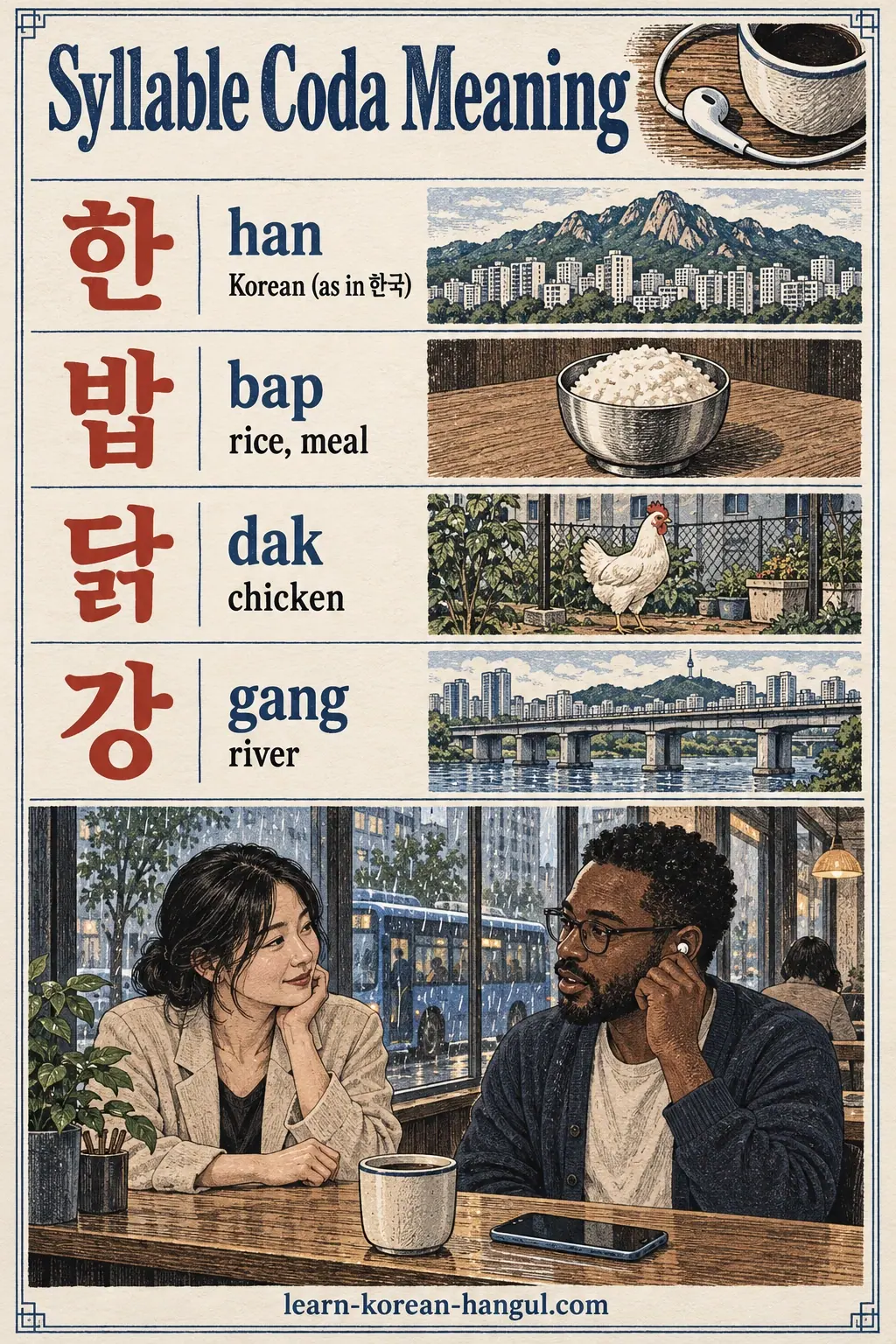
Four words show four different codas.
한
han
Korean (as in 한국)
밥
bap
rice, meal
닭
dak
chicken
강
gang
river
In 한 the coda is ㄴ, a nasal. In 밥 it is ㅂ, an unreleased stop. In 닭 two letters are written, ㄹ and ㄱ, but the spoken coda is [ㄱ], so the word is [닥]. In 강 the coda is ㅇ, pronounced [ŋ]. Note that a coda can move: before a vowel-initial particle, as in 닭이 [달기], the last letter slides into the next syllable and stops being a coda. Those cases explain the usual errors.
What Do Learners Get Wrong about the Syllable Coda?

Learners often assume that every written letter in the coda is spoken, so they try to say both ㄹ and ㄱ in 닭. In fact the coda keeps one sound, [닥]. Another error is reading ㅇ as silent everywhere. It is silent only in the onset; as a coda it is [ŋ].
Two more cautions:
- Mixing writing with sound. Batchim is a spelling term, while coda is a sound term. A word can have two batchim letters and one coda sound.
- Assuming English rules. English codas can hold clusters, as in "texts", while Korean codas hold one consonant sound. English speakers may therefore try to pronounce both written letters of a word like 닭, while Korean speakers learning English often do the reverse and add a vowel to break up an English cluster.
Remember that the coda is the closing consonant, and that it is simplified. The questions below pick up what remains.
Frequently Asked Questions

What is a coda? A coda is the consonant or consonants that end a syllable, after the vowel. In 한 (han) the coda is ㄴ. In 아 (a) there is no coda. The three parts of a syllable are the onset before the vowel, the nucleus, which is the vowel, and the coda after it. Korean calls the coda position 종성.
Is batchim the same as coda? Almost. Coda names a sound position in any language, while 받침 (batchim) names the Korean letters written at the bottom of a syllable block. A letter such as ㄺ in 닭 is a batchim written with two letters, but its sound is one coda, [ㄱ]. So batchim is the writing and coda is the sound.
How many consonants can a coda have? In Korean, a coda holds one consonant sound when a word is said alone, even if two letters are written. The word 닭 (chicken) has two letters, ㄹ and ㄱ, in its final position but is pronounced [닥]. English differs: the word "strengths" ends in a coda of several consonants, which Korean speakers must simplify.
What is 종성? 종성 (jongseong) is the Korean term for the final position of a syllable block, where the coda sits. It is the third of three positions, after 초성 (choseong, the initial consonant) and 중성 (jungseong, the vowel). Textbooks often use 받침 (batchim) for the letters in that position. See the Jongseong page for the details.
Related Terms and Lessons
Syllable coda meaning is closely tied to jongseong, the formal name for the final position, and to the lessons on batchim pronunciation, which show how each written final is spoken. For the writing side, see syllable blocks. All sound terms are listed in the Korean Pronunciation Glossary.