Jongseong Meaning in Korean

Every Korean syllable block is built from slots. The first slot holds the initial consonant, 초성 (choseong, "first sound"). The second holds the vowel, 중성 (jungseong, "middle sound"). The third holds the closing consonant, 종성 (jongseong, "last sound"), and it sits at the bottom of the block. The third slot is optional: the block 가 has two parts and the block 간 has three.
| Slot | Name | Korean | What it holds | Number of options |
|---|---|---|---|---|
| 1 | choseong | 초성 | initial consonant | 19 |
| 2 | jungseong | 중성 | vowel | 21 |
| 3 | jongseong | 종성 | final consonant | 27, or none |
These counts explain the size of the writing system. With 19 choices for the first slot, 21 for the second and 28 for the third (27 finals plus none), Hangul can form 19 × 21 × 28 = 11,172 blocks, although everyday Korean uses only a small fraction of them. Hear the block 한, which has all three slots.
Of the 27 written finals, 16 are single letters and 11 are two-letter clusters such as ㄺ, and all of them are spoken as one of seven sounds. That reduction is the subject of final consonant neutralization. Next comes the second word used for the same slot.
Jongseong Versus Batchim

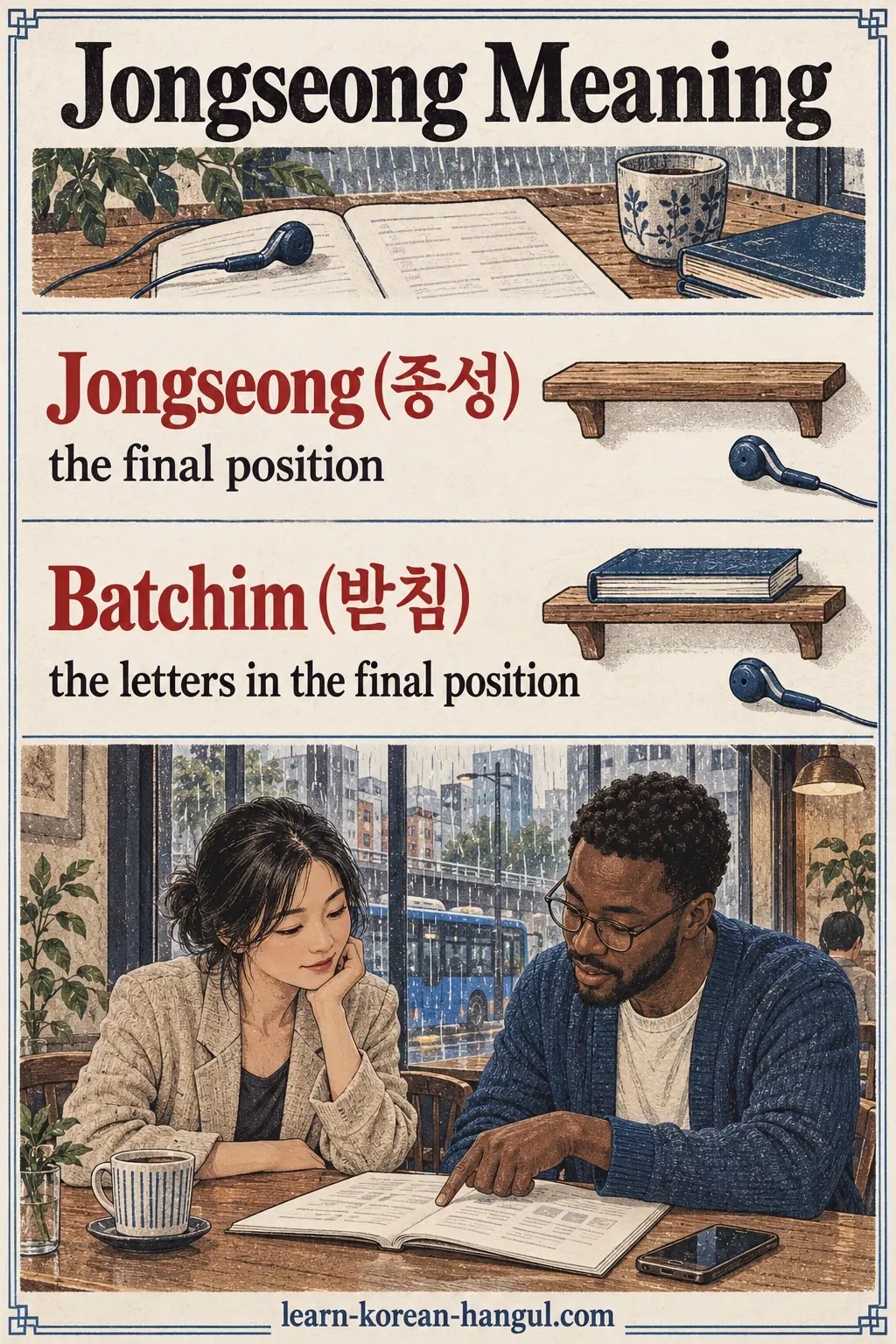
Jongseong names a position, while batchim names the letters in that position. The two words refer to the same part of a block, so lessons treat them as near synonyms, and the table shows what separates them.
| Feature | Jongseong (종성) | Batchim (받침) |
|---|---|---|
| Meaning | the final position | the letters in the final position |
| Literal sense | "last sound" | "support", "prop" |
| Typical use | grammar and linguistics | teaching and everyday talk |
| In 밥 | the third slot | ㅂ |
The literal sense of 받침 comes from the verb 받치다, "to prop up". The final letter props up the block from below. This site uses batchim for the letters and the sound lessons, and jongseong when it names the slot. Examples follow.
What Are Examples of Jongseong?

Three everyday one-syllable words show three different jongseong.
한
han
Korean (as in 한국)
밥
bap
rice, meal
곰
gom
bear
In 한 the jongseong is ㄴ, in 밥 it is ㅂ and in 곰 it is ㅁ. The blocks 하, 바 and 고 have no jongseong at all, so adding a letter at the bottom creates a new syllable. Learners who practise many closed blocks such as these sometimes expect every block to need a final letter. That expectation leads to the mistakes below.
What Do Learners Get Wrong about Jongseong?
Learners often assume that the position decides the sound, so that a letter at the bottom is pronounced the same as the same letter at the top. In fact the bottom position follows its own rules: ㅇ is silent at the top but [ŋ] at the bottom, and ㅅ is pronounced as the unreleased stop [ㄷ].
Two further points:
- Treating the two words as rivals. Textbooks differ in which they use, and neither is wrong. Learn both.
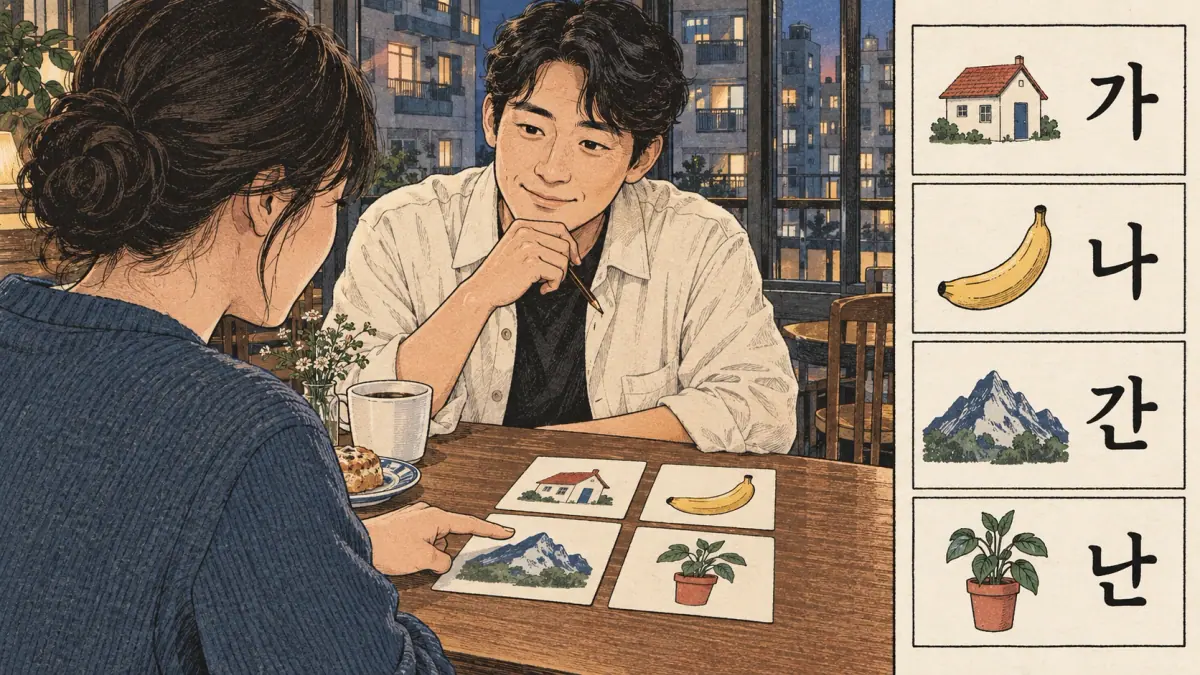
- Forgetting the empty slot. A block without a jongseong is complete. 가 and 나 are as valid as 간 and 난.
Remember that the position is a slot and the letters are batchim. The questions below follow from that.
Frequently Asked Questions

What is jongseong? Jongseong (종성) is the formal name for the final consonant position of a Korean syllable block. It is the third slot after choseong (초성, the initial consonant) and jungseong (중성, the vowel). In the block 한, the jongseong is ㄴ. A block may also have no jongseong, as in 가.
Is it the same as batchim? They overlap but are not identical. Jongseong names the position in the block, a grammar and linguistics term. Batchim (받침) names the letters written there and is the everyday teaching word. The block 밥 has jongseong ㅂ, and you can say that ㅂ is its batchim. Lessons often use the two words as near synonyms.
What are choseong and jungseong? Choseong (초성) is the initial consonant position and jungseong (중성) is the vowel position. Together with jongseong (종성) they form the three slots of a Korean syllable block. In 한, the choseong is ㅎ, the jungseong is ㅏ and the jongseong is ㄴ. The page on all three terms shows the slot counts: 19, 21 and 27.
How many jongseong are there? There are 27 written final spellings, made of 16 single letters (including ㄲ and ㅆ) and 11 two-letter clusters, but only seven final sounds: ㄱ ㄴ ㄷ ㄹ ㅁ ㅂ ㅇ. A block can also have no final at all. Counting the empty final as one option gives 28 choices for the third slot, which is why Hangul has 11,172 possible blocks.
Related Terms and Lessons
Jongseong meaning connects to the sound-side term syllable coda, to the three-slot overview in choseong, jungseong and jongseong, to the writing lesson on final consonants and to batchim pronunciation. Every other term is defined in the Korean Pronunciation Glossary.