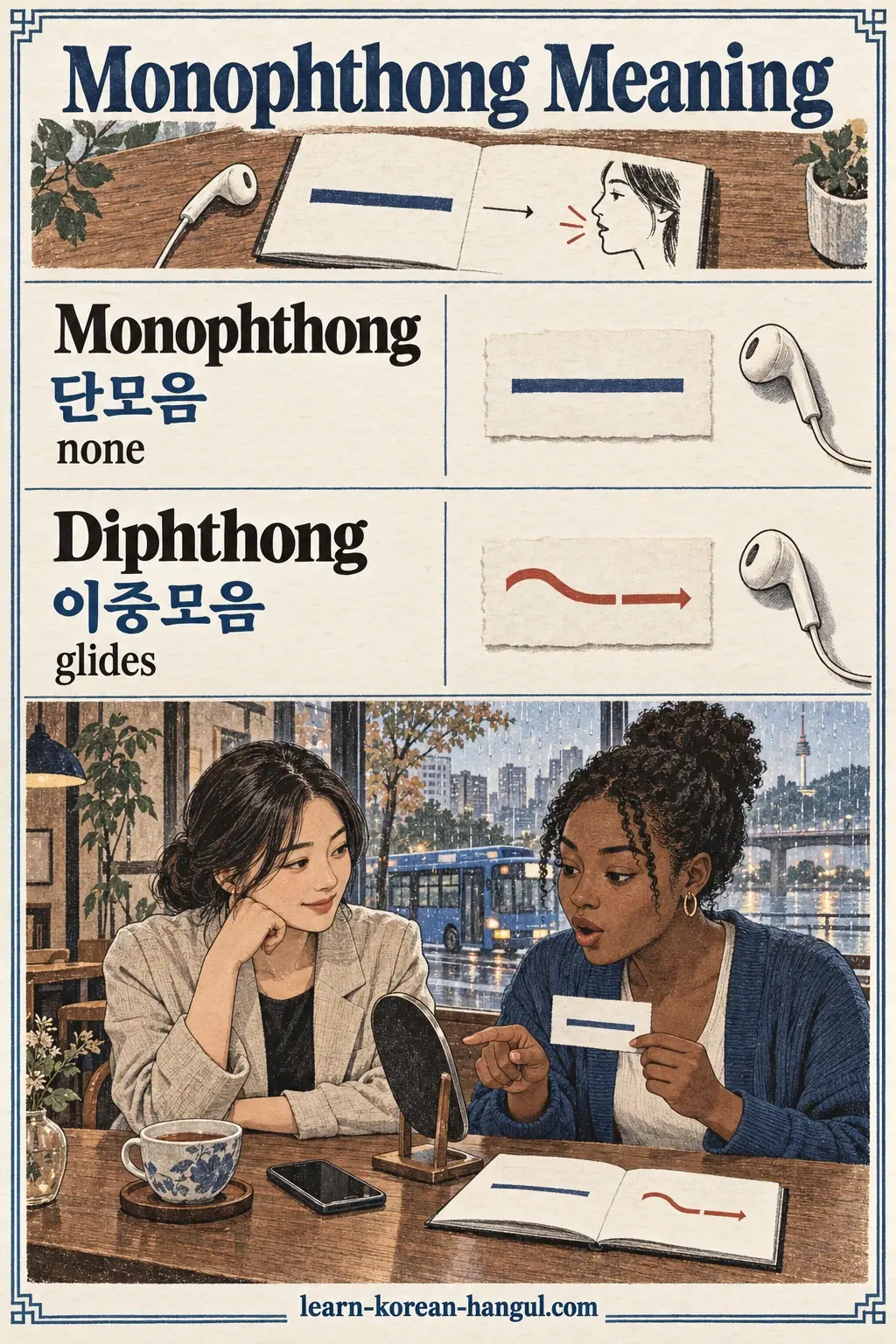
Monophthong Meaning in Korean

A monophthong is a "single-note" vowel. Your tongue and lips settle into one position and hold it. The name comes from Greek roots meaning "one sound". Korean linguists use 단모음 for the same idea, as set out in Article 4 of the Standard Pronunciation Rules (표준 발음법).
The standard lists ten monophthongs. The table gives each one with a common word.
| Vowel | Revised Romanization | Example word |
|---|---|---|
| ㅏ | a | 아이 (child) |
| ㅓ | eo | 어머니 (mother) |
| ㅗ | o | 오다 (to come) |
| ㅜ | u | 우유 (milk) |
| ㅡ | eu | 그림 (picture) |
| ㅣ | i | 이 (tooth) |
| ㅐ | ae | 개 (dog) |
| ㅔ | e | 게 (crab) |
| ㅚ | oe | 외국 (foreign country) |
| ㅟ | wi | 귀 (ear) |
The last two vowels, ㅚ and ㅟ, are listed as single vowels by the standard, but they are commonly said with a glide. Many guides therefore teach eight monophthongs and put ㅚ and ㅟ with the diphthongs. Hear two steady vowels in 아이.
The practical count can fall further, because most Seoul speakers now say ㅐ and ㅔ the same. A learner needs to read ten, say about seven or eight, and know the reason for the gap. Next comes the sound class that monophthongs are most often confused with.
Monophthong Versus Diphthong

A monophthong holds one mouth position, while a diphthong starts in one position and moves to another within the same syllable. The English word "go" is the classic test: most English speakers move from "o" toward "w" as they say it. Korean ㅗ stays at "o".
| Feature | Monophthong | Diphthong |
|---|---|---|
| Mouth movement | none | glides |
| Korean term | 단모음 | 이중모음 |
| Example letter | ㅏ in 아이 | ㅑ in 야구 |
| English test | "bit" (steady) | "boy" (moves) |
You can test any vowel by saying it slowly in a mirror. If your lips or tongue move, you have made a glide. The diphthong entry covers the other side of the table. Examples come next.
What Are Examples of Monophthongs?

Three words show steady Korean vowels. Listen first, then say each one slowly and keep your lips still.
아이
ai
child
우리
uri
we, us
오다
oda
to come
In 오다 the ㅗ holds one rounded shape. If you hear yourself ending it with an English "oh-w", relax your lips and stop the movement. The same applies to ㅜ in 우리: hold the rounded lips, then move cleanly to ㅣ in the next syllable. Compare 우유 (milk), whose second vowel ㅠ is a glide vowel and so not a monophthong. Practising these leads to the typical learner errors.
What Do Learners Get Wrong about Monophthongs?

Learners often assume that Korean ㅗ and ㅜ sound like English "oh" and "oo", but those English vowels are usually diphthongs. They glide toward "w", while Korean ㅗ and ㅜ hold their shapes. A learner who glides is understood, but the word sounds heavy with an English accent.
Three more cautions:
- Counting. Do not memorise one fixed number. The standard says ten, many guides say eight and speech may use fewer. All three are correct for their purpose.
- Treating ㅐ and ㅔ as clearly different. They are spelled differently and still listed as two vowels, but many speakers say them alike. See the practice on vowel minimal pairs.
- Listening for length. Most younger Seoul speakers no longer use vowel length to tell words apart, although the Standard Pronunciation Rules (Article 6) still describe long vowels, so do not strain to hear it.
Remember that the point is a steady mouth shape. The questions below follow.
Frequently Asked Questions

What is a monophthong? A monophthong is a vowel that is pronounced with one steady mouth position, so the sound does not move from start to finish. The Korean vowels ㅏ, ㅓ, ㅗ, ㅜ, ㅡ and ㅣ are monophthongs. The opposite is a diphthong, a vowel that glides from one position to another, such as ㅑ or ㅘ.
How many monophthongs are there in Korean? The Standard Pronunciation Rules list ten: ㅏ ㅐ ㅓ ㅔ ㅗ ㅚ ㅜ ㅟ ㅡ ㅣ. Most learner guides teach eight, leaving ㅚ and ㅟ with the diphthongs, because they are often said with a glide. Most Seoul speakers also say ㅐ and ㅔ alike, so the number of distinct sounds in speech can be seven.
Is ㅚ a monophthong? It can be. The standard lists ㅚ as a single vowel [ø], but it also accepts a glide pronunciation, and most Seoul speakers say [we], as in 외국 (foreign country). Many textbooks therefore teach ㅚ and ㅟ as diphthongs. When you read a chart, check which convention it uses before comparing counts.
What is 단모음? 단모음 (danmoeum) is the Korean term for monophthong. The word combines 단, meaning "single" or "simple", with 모음, meaning "vowel". Its opposite is 이중모음 (ijungmoeum), the Korean term for diphthong. You will see both words in Korean textbooks and in the vowel lessons on this site.
Related Terms and Lessons
Monophthong meaning links to the lesson on simple vowels, which trains each steady vowel with audio, and to the full Korean vowel pronunciation section. The contrasting term is the diphthong. Every other sound term is defined in the Korean Pronunciation Glossary.