What you'll learn
- Pronounce all eight simple vowels with the right lip shape.
- Match each vowel to one everyday sample word.
- Explain why Korean vowels stay steady while English vowels glide.
- State which two further vowels, ㅚ and ㅟ, are left for the glide lessons.
Before you start: you should recognise the Hangul vowel letters, which are taught in Korean vowels. The lesson takes about 20 minutes, and audio plays only when you press a button.
Key facts
- Revised Romanization writes them as a, eo, o, u, eu, i, ae and e.
What Are the Korean Simple Vowels?
The Korean simple vowels are single-position vowels, also called monophthongs: the tongue and lips stay in one place for the whole sound. This page teaches eight of them, ㅏ, ㅓ, ㅗ, ㅜ, ㅡ, ㅣ, ㅐ and ㅔ. The standard pronunciation rules of the 국립국어원 (National Institute of Korean Language) list ten single vowels, and the other two, ㅚ and ㅟ, are covered later.
Listen to the first three letter names, spoken as one syllable each.
The clips are 아 (ㅏ), 어 (ㅓ) and 오 (ㅗ). Notice that each clip stays the same from start to finish, so the lips never move. That steadiness is the main skill in this lesson.
The English comparisons are only starting points, so first, why they fail.
Why English Speakers Struggle with Korean Vowels
English speakers struggle with Korean vowels because English vowels move, and Korean vowels do not. English "go" ends with a rounded "w" sound, and "say" ends with an "ee" sound. Learners carry this glide into ㅗ and ㅔ and produce "gow" and "seh-ee".
English also has about a dozen vowel qualities, depending on accent, and many of them reduce to a weak "uh" in unstressed syllables. Korean syllables do not reduce in the same way, so every vowel needs a full, clear shape. A third problem is that Korean has two vowels with no English match: ㅓ, an open sound without lip rounding, and ㅡ, a high back sound with spread lips.
Three habits cause most errors:
- Gliding. The vowel moves, so ㅗ sounds like "ow".
- Reducing. The vowel weakens, so ㅏ sounds like "uh".
- Substituting. The vowel is replaced by the nearest English sound, so ㅡ sounds like ㅜ or ㅓ.
The fix is the same for all three: pick a lip shape, hold it, and listen. First, the complete list.
Which Vowels Are the Korean Simple Vowels?
There are eight simple vowels in this lesson, and each one has a name, a Revised Romanization and an English hint. The table gives all three.
| Letter | Name | Revised Romanization | English hint |
|---|---|---|---|
| ㅏ | 아 | a | "a" in "father" |
| ㅓ | 어 | eo | between "uh" in "cut" and "aw" in "law" |
| ㅗ | 오 | o | "o" in "go", without the glide |
| ㅜ | 우 | u | "oo" in "food", without the glide |
| ㅡ | 으 | eu | no match; "oo" said with spread lips |
| ㅣ | 이 | i | "ee" in "see" |
| ㅐ | 애 | ae | "e" in "bed" |
| ㅔ | 에 | e | "e" in "bed" |
The English hints are approximate. They point to the nearest English vowel, and the Korean vowel is steadier and tighter. Hear the remaining five letter names.
These are 우, 으, 이, 애 and 에. The last two sound the same for most Seoul speakers, which is explained in ㅐ versus ㅔ. Next, how to shape the mouth for each.
How Do You Shape Your Mouth for Each Vowel?
You shape your mouth for each Korean vowel with three controls: how high the tongue is, how far back it is, and whether the lips are rounded or spread. The grid below places the eight vowels on those controls.
| Tongue height | Front, spread lips | Back, spread lips | Back, rounded lips |
|---|---|---|---|
| High | ㅣ | ㅡ | ㅜ |
| Mid | ㅔ | ㅓ | ㅗ |
| Low | ㅐ | ㅏ | (none) |
Read the grid in two directions. Moving down a column, the jaw opens. Moving from the middle column to the right, the lips round. The left column (ㅣ, ㅔ, ㅐ) is front because the tongue is forward, and for ㅐ the jaw opens slightly more than for ㅔ, although most speakers now merge ㅐ with ㅔ.
A lips-in-a-mirror routine uses the grid:
- Smile and say ㅣ. The lips spread and the jaw is nearly closed.
- Keep the smile and pull the tongue back. You arrive at ㅡ.
- Pucker the lips. You arrive at ㅜ.
- Open the jaw slightly while rounding. You arrive at ㅗ.
- Relax the lips and keep the jaw open. You arrive at ㅓ.
- Open the jaw fully. You arrive at ㅏ.
Do the routine in order and in reverse, three times each. It builds a map of the mouth that you can reuse for later lessons. The next question is how this differs from English.
How Are Korean Vowels Different from English Ones?
Korean vowels differ from English ones in steadiness, in reduction and in lip control. Korean vowels hold one position, keep their full quality in every syllable and rely on rounded or spread lips as a main cue. English vowels often glide, reduce and rely on tongue height alone.
| Feature | Korean simple vowels | English vowels |
|---|---|---|
| Movement | Steady, no glide | Often glide ("go", "say") |
| Unstressed syllables | Keep their quality | Often reduce to "uh" |
| Lip rounding | Main cue for ㅗ and ㅜ | Present but less decisive |
| Spread lips | Needed for ㅡ and ㅣ | Rarely a defining feature |
| Count in this lesson | 8 | About a dozen, depending on accent |
A hold-it drill turns the table into practice. Say English "go" slowly and feel the glide, then say 고 (go) and freeze the lips on the first position for two seconds. If the lips close further, the vowel is still gliding. The drill takes one minute a day.
A short, honest limit: in fast, casual speech, Korean vowels can shorten, and the exact quality varies between speakers. This lesson describes careful Seoul speech. Now, the question of why only eight.
Why Are Only Eight Vowels Taught Here?
Only eight vowels are taught here because ㅚ and ㅟ, the other two single vowels in the standard, are usually heard as glides in Seoul speech. The standard allows both a single-vowel and a gliding pronunciation for these two letters, and everyday speech mostly uses the glide, as in the "we" of "wet" for ㅚ and "wee" for ㅟ.
The counts therefore depend on the viewpoint:
- Standard list: 10 single vowels, 8 taught here plus ㅚ and ㅟ.
- Glide vowels: 11 further vowels, ㅑ ㅕ ㅛ ㅠ ㅒ ㅖ ㅘ ㅝ ㅙ ㅞ ㅢ.
- Total letters: 21 vowel letters.
The glide vowels, together with ㅚ and ㅟ, are covered in Korean Diphthongs. For the technical term, see the monophthong glossary entry. Next, real words for each vowel.
Which Words Show Each Vowel?

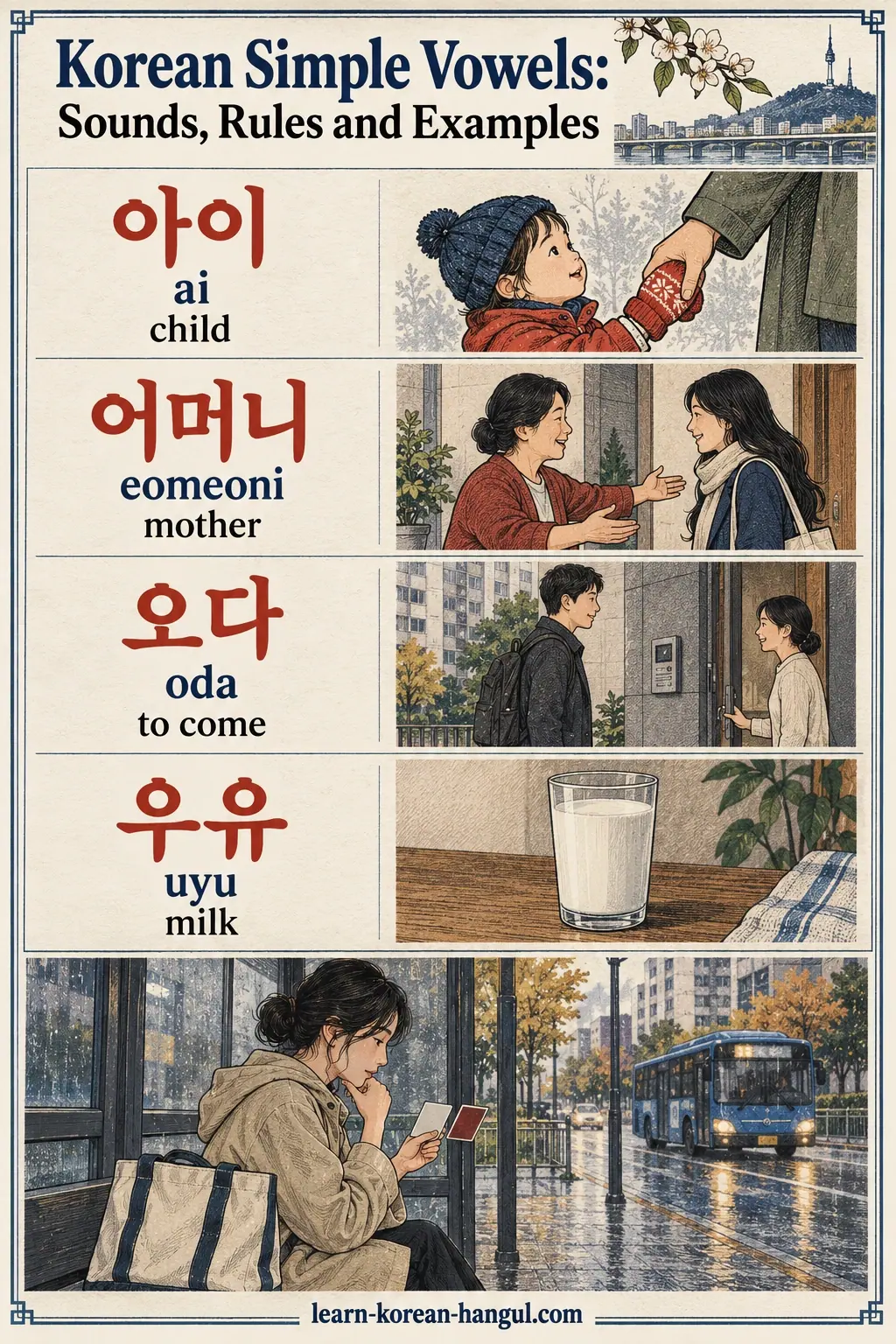
One common word per vowel anchors the sound. Each of the following words contains the vowel as its main sound.
| Vowel | Word | Revised Romanization | Meaning |
|---|---|---|---|
| ㅏ | 아이 | ai | child |
| ㅓ | 어머니 | eomeoni | mother |
| ㅗ | 오다 | oda | to come |
| ㅜ | 우유 | uyu | milk |
| ㅡ | 크다 | keuda | to be big |
| ㅣ | 이 | i | this; tooth; two |
| ㅐ | 개 | gae | dog |
| ㅔ | 세 | se | three (before a counter) |
Hear the four that are not letter names.
The clips are 어머니, 오다, 우유 and 크다. The word 아이 appears in the worked example below. Learners who pick one anchor word per vowel can recall the sound by thinking of the word. Next, a routine that turns the list into habit.
A Five-Day Routine for the Eight Vowels
A five-day routine spreads the eight vowels over short sessions, so lip habits form without strain. Each session takes about ten minutes and ends with a recording.
| Day | Focus | Task |
|---|---|---|
| 1 | ㅏ and ㅣ | Jaw open versus smile; say 아이 slowly |
| 2 | ㅗ and ㅜ | Hold each rounded shape for two seconds, no glide |
| 3 | ㅓ and ㅡ | Relaxed lips versus spread lips; say 어머니 and 크다 |
| 4 | ㅐ and ㅔ | Say one steady "e"; learn 개 and 세 by spelling |
| 5 | All eight | Say the letters in grid order, then record and compare |
Which vowel is hardest? For most English speakers it is ㅡ, followed by ㅓ, because neither has an English match. Spend extra time on days 3 and 5 if your recording shows these two drifting toward ㅜ or ㅗ. The routine is a suggestion from teaching practice, not a tested programme, so change the order if another pair troubles you more.
The routine builds the eight shapes. Now one word in detail.
Worked Example: 아이

This worked example takes the word 아이 (child) and treats each vowel as a separate steady position. Do the steps in order.
- Split the word. 아이 has two syllables, 아 and 이. The silent ㅇ starts each syllable, so only the vowels are pronounced.
- Say 아. Open the jaw wide and keep the lips relaxed. This is ㅏ.
- Say 이. Spread the lips into a smile and raise the tongue. This is ㅣ.
- Join them. Say 아이 with a brief pause, then without.
아이
ai
child
- Check steadiness. Each vowel must stay the same. English "eye" glides from "ah" to "ee" in one syllable, so a learner who says "eye" has made one glide where Korean has two steady vowels.
- Check meaning. 아이 is a child. The same two vowels can also appear in a longer word such as 아이스크림 (ice cream).
The word 아이 shows that Korean syllable beats stay separate. Next, mistakes to avoid.
Common Learner Mistakes

Learners often assume that Korean ㅗ is the English "oh", so they glide. Actually ㅗ is steady, and the lips do not close further as the sound goes on. The result of gliding is that 고 sounds like English "go", which Korean listeners hear as an extra vowel.
Four more mistakes:
- Learners often assume that ㅓ is the English "uh". Actually it needs a more open jaw, and it sits between "uh" and "aw".
- Learners often assume that ㅡ is a form of ㅜ. Actually the lips are spread, not rounded.
- Learners often assume that ㅐ and ㅔ should be different. Actually most Seoul speakers say them the same, so they differ mainly in spelling.
- Learners often assume that romanization shows the sound. Actually "eo" and "eu" are two-letter spellings for single vowels.
Now practise.
Practice and Answer Key

Do these exercises after listening. Cover the answer key until you finish.
Practice · 8
What is the name of the letter ㅗ?
Show answer
오
Each vowel's name is the vowel on silent ㅇ: ㅗ is 오.
How does Revised Romanization write ㅓ?
Show answer
eo
ㅓ is written eo, a two-letter spelling for a single vowel.
Which vowel is in 우유?
Show answer
ㅜ
우유 (milk) is the anchor word for ㅜ, said with rounded lips.
Which vowel uses spread lips?
Show answer
ㅡ
ㅡ is high and back with spread lips; ㅜ and ㅗ are rounded.
You say 고 and your lips close further at the end. What went wrong?
Show answer
The vowel glided like English 'go'
Korean vowels are steady: hold the first lip position of ㅗ without gliding.
Which pair do most Seoul speakers pronounce the same?
Show answer
ㅐ and ㅔ
ㅐ and ㅔ have merged into the 'e' of 'bed' for most Seoul speakers, so they differ mainly in spelling.
Which two single vowels in the standard are left for the glide lessons?
Show answer
ㅚ and ㅟ
ㅚ and ㅟ are usually heard as glides in Seoul speech, so they are taught with the diphthongs.
How should 아이 (child) be pronounced?
Show answer
Two steady vowels, 아 then 이
Korean syllables stay separate: 아이 has two steady vowels where English 'eye' has one glide.
- Name. What is the name of the letter ㅗ?
- Romanization. How does Revised Romanization write ㅓ?
- Word. Which vowel is in 우유: ㅜ or ㅡ?
- Lips. Which of these vowels uses spread lips: ㅡ, ㅜ or ㅗ?
- Steadiness. You say 고 and your lips close further at the end. What went wrong?
Answer key: 1. 오. 2. eo. 3. ㅜ. 4. ㅡ. 5. The vowel glided like the English "go". Hold the first lip position steady.
Common questions come next.
Frequently Asked Questions
How many vowels are in Korean? Korean has 21 vowel letters. Ten are single vowels in the standard, including ㅚ and ㅟ, and eleven are glide vowels such as ㅑ and ㅘ. This lesson teaches eight of the single vowels. The glide vowels are in the diphthongs lesson, and the letters are taught in the Hangul vowels pages.
Is ㅓ like English "uh"? It is close but not the same. ㅓ is an open sound with relaxed lips, between the "uh" in "cut" and the "aw" in "law". English "uh" is often weak and short, while ㅓ is a full, steady vowel. If your lips round, you are drifting toward ㅗ. Keep them relaxed.
Do ㅐ and ㅔ sound different? For most Seoul speakers, no. Both are pronounced like the "e" in "bed". The two letters remain in spelling, so you learn which one each word uses. Listeners rely on context when two words sound the same, such as 개 (dog) and 게 (crab). The ㅐ versus ㅔ lesson covers the spelling aids.
Does Korean have a schwa? Korean has no letter for a weak, unstressed schwa vowel as English does. The nearest full vowels are ㅓ and ㅡ, and both are steady, full sounds. Korean vowels do not reduce to "uh" in unstressed syllables the way English vowels do, so each vowel needs a clear shape.
Where to Go Next
Korean simple vowels give you the base set for everything that follows. This lesson does not cover the glide vowels, vowel length or regional vowel differences, and it does not score your pronunciation. The first hard pair is in ㅓ versus ㅗ, the second in ㅡ versus ㅜ, and the merger is explained in ㅐ versus ㅔ. Return to Korean Vowel Sounds for the section overview.
Next in the series: Korean ㅓ vs ㅗ.