What you'll learn
- Choose the correct word in 12 audible vowel pairs, with at least 10 correct.
- Hear and say the ㅓ/ㅗ and ㅡ/ㅜ contrasts using lip shape as a cue.
- Recognise the four ㅐ/ㅔ pairs as spelling-only.
- Use your errors to pick the next lesson.
Before you start: you should know the vowels ㅓ, ㅗ, ㅡ, ㅜ, ㅐ and ㅔ. The session takes about 25 minutes. Audio plays only when you press a button.
Key facts
- The ㅐ/ㅔ pairs 개/게 and 새/세 are listed but marked as spelling-only.
What Are Korean Vowel Minimal Pairs?

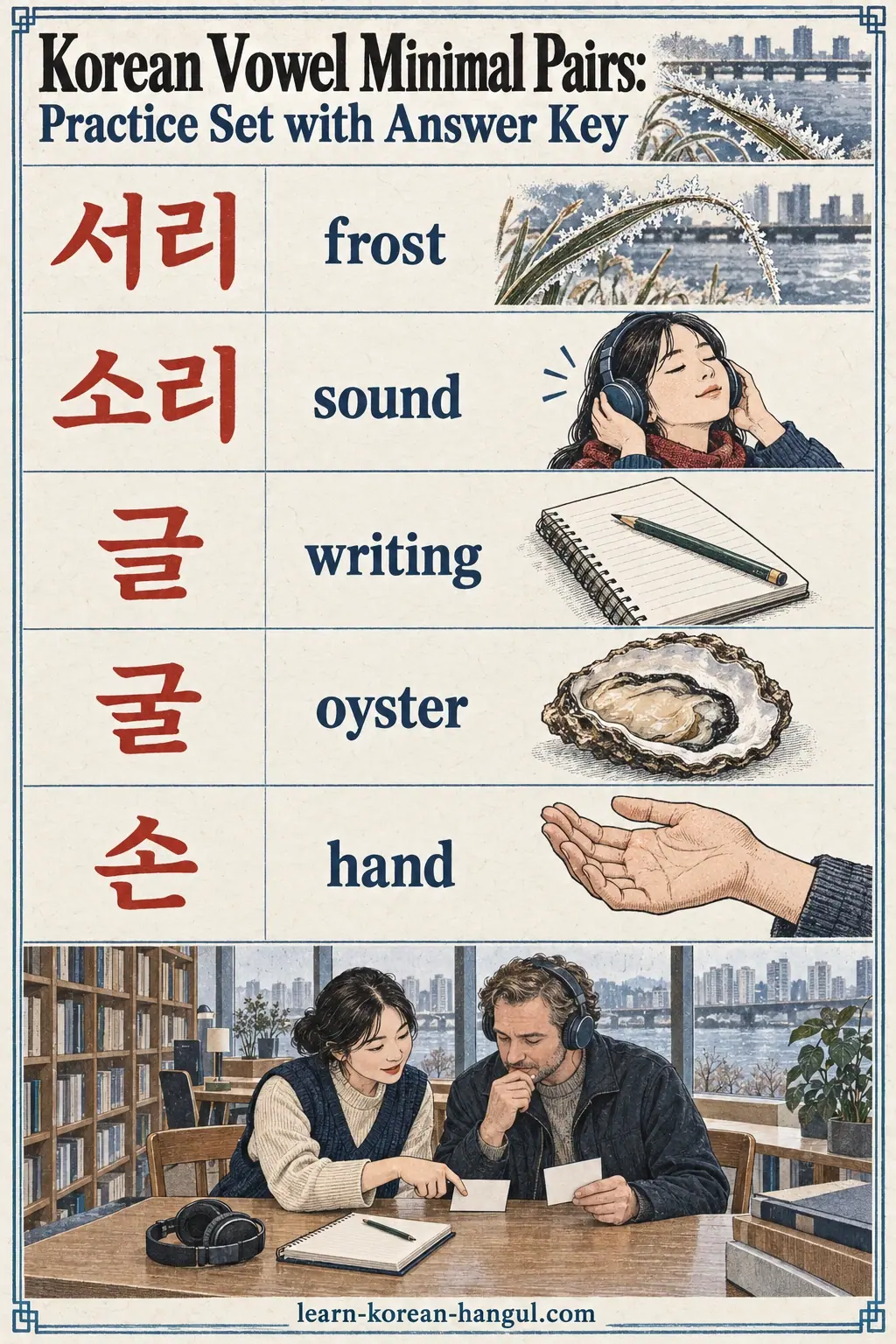
Korean vowel minimal pairs are two real words whose only difference is one vowel. Changing ㅓ to ㅗ turns 서리 (frost) into 소리 (sound), and changing ㅡ to ㅜ turns 글 (writing) into 굴 (oyster). They train your ear on the vowels that English speakers most often merge. Listen to the first pair.
Not every vowel contrast matters equally in modern Seoul speech. The contrasts ㅓ/ㅗ and ㅡ/ㅜ are heard clearly and change meaning. The contrast ㅐ/ㅔ is kept in spelling, but most speakers now say the two vowels the same. This page marks the difference, so you spend listening time where it counts. For the vowels themselves, see vowel sounds.
Next, why English speakers find these pairs hard.
Why English Speakers Struggle with These Vowels
English speakers struggle because English has no exact counterpart for ㅓ or ㅡ, so learners squeeze them into the nearest English vowel. ㅓ is heard as "uh" or "oh", and ㅡ as "oo". The result is that ㅓ merges with ㅗ and ㅡ merges with ㅜ.
The key to both contrasts is lip shape:
- ㅗ and ㅜ use rounded lips. Push your lips forward as if you were going to whistle.
- ㅓ and ㅡ use unrounded lips. For ㅓ the lips are relaxed and the jaw is more open. For ㅡ the lips are spread, as in a flat smile.
Test yourself in a mirror: if your lips move forward for 서리, you are saying 소리. Then hear the spread-versus-rounded pair 글 and 굴.
The sets below make the cue concrete.
Which Pairs Are Included?

The 16 pairs fall into three groups, and the third group is marked spelling-only. Every word is a real word.
| Group | Pair 1 | Pair 2 | Pair 3 | Pair 4 | Pair 5 | Pair 6 |
|---|---|---|---|---|---|---|
| ㅓ / ㅗ | 서리 / 소리 (frost / sound) | 거리 / 고리 (street / ring) | 벌 / 볼 (bee / cheek) | 거기 / 고기 (there / meat) | 선 / 손 (line / hand) | 정 / 종 (affection / bell) |
| ㅡ / ㅜ | 글 / 굴 (writing / oyster) | 쓰다 / 쑤다 (to write / to cook porridge) | 들 / 둘 (field / two) | 그 / 구 (that / nine) | 은 / 운 (silver / luck) | 끌 / 꿀 (chisel / honey) |
| ㅐ / ㅔ (spelling-only) | 개 / 게 (dog / crab) | 새 / 세 (bird / three, before a counter) | 배 / 베 (pear, belly / cloth) | 내 / 네 (my / your, yes) |
The first two groups are audible contrasts. The third group is a spelling test. Which contrasts truly matter is the next question.
Which Contrasts Matter?

The contrasts ㅓ/ㅗ and ㅡ/ㅜ matter for listening and speaking, and ㅐ/ㅔ matters mainly for spelling. The standard describes ㅐ and ㅔ as two vowels, but most speakers in Seoul say both as the same vowel, so 개 (dog) and 게 (crab) can sound identical. Hear 개; most Seoul speakers would say 게 the same way.
This has practical effects:
- Listening. Do not expect to hear the difference in 개/게, 새/세, 배/베 or 내/네. Use the situation to decide.
- Speaking. Say the vowel the way you hear it. Korean listeners will use context.
- Writing. Learn the spelling with each word. A dictation test will check spelling, not sound.
- A common workaround. In casual speech many speakers say 니 for 네 ("your") to avoid confusion with 내 ("my").
The rest of the page follows the same split. Here is the task.
How Do You Do the Task?
The task has a listening part for the twelve audible pairs and a reading part for the four spelling-only pairs. Use this sequence.
- Look at a pair in the table and check the meanings.
- Play a clip at normal speed and choose which word you heard.
- After a wrong answer, play the slow clip and watch your lips as you repeat it.
- Submit your answers. The answer key appears only after you submit.
- Do the ㅐ/ㅔ pairs as a reading quiz, without audio.
- Say each pair aloud with the correct lip shape.
Keep the clips for checking, not for memorising. Next, how to read your score.
Reading Your Score
The score maps your errors to the lesson that fixes them. Count correct answers separately for each group, because a single total hides which contrast is weak.
| Result | What it suggests | Next step |
|---|---|---|
| 5 or 6 correct in ㅓ/ㅗ | Contrast is stable | Move on |
| Fewer than 5 in ㅓ/ㅗ | Lip rounding is not controlled | Study ㅓ versus ㅗ |
| 5 or 6 correct in ㅡ/ㅜ | Contrast is stable | Move on |
| Fewer than 5 in ㅡ/ㅜ | Spread and rounded lips are mixed | Study ㅡ versus ㅜ |
| Any errors in ㅐ/ㅔ | Spelling memory, not hearing | Review the spelling with each word |
Ten or more correct out of the twelve audible pairs is the goal. Now one pair in detail.
Worked Example: 서리 and 소리

This worked example takes one pair through the task.
- Listen. Play the two clips.
서리
seori
frost
소리
sori
sound
- Watch the lips. Say 소리 first. The lips push forward for ㅗ. Then say 서리. The lips relax and the jaw opens a little.
- Choose. A third clip plays one of the two words. Choose which one you heard.
- Check meaning. 서리 is frost on the ground. 소리 is a general word for sound or voice.
- Repeat with the pair 거리 and 고리. The same lip cue applies.
The vowel is the only change, so every part of your answer depends on it. That leads to the typical mistakes.
Common Learner Mistakes
Learners often assume that ㅓ sounds like English "uh" and ㅗ like English "oh", so the two seem far apart. In fact the English "oh" glides, while Korean ㅗ is steady, and ㅓ is roughly the vowel of British "law" said with unrounded lips, rather than "uh". The result is that learners hear a small difference and think they are right.
Three further mistakes:
- Learners often assume that ㅡ is a version of ㅜ. Actually ㅡ is a different vowel made with spread lips, and ㅜ is made with rounded lips. Use a smile and a pucker.
- Learners often assume ㅐ and ㅔ must be heard. Actually most Seoul speakers do not distinguish them, so a failed listening test here is not a failure.
- Learners often listen for length. Actually the pairs differ in quality, not length.
Now practise the set.
Practice and Answer Key

Use the listening task for the twelve audible pairs, then the reading quiz.
Practice · Read
Show answer
서리
seori
frost
Show answer
소리
sori
sound
Reading quiz. Choose the word that matches each meaning.
- Which word means "frost": 서리 or 소리?
- Which word means "oyster": 글 or 굴?
- Which word means "hand": 선 or 손?
- Which word means "two": 들 or 둘?
- Which word means "meat": 거기 or 고기?
- Which word means "to write": 쓰다 or 쑤다?
- Which word means "crab" (spelling-only): 개 or 게?
Answer key: 1. 서리. 2. 굴. 3. 손. 4. 둘. 5. 고기. 6. 쓰다. 7. 게.
Last, a speaking task: say each pair twice with the lip shape for each vowel, and compare yourself with the clips. Common questions and a scope note follow.
Frequently Asked Questions
Is ㅐ/ㅔ in the list? Yes, as four spelling-only pairs: 개/게, 새/세, 배/베 and 내/네. They are included because learners meet them in reading and dictation, but they are marked spelling-only because most Seoul speakers pronounce ㅐ and ㅔ the same. The audio task covers the twelve pairs that speakers actually hear as different.
How many vowel pairs are there? The list has 16 pairs: six for ㅓ versus ㅗ, six for ㅡ versus ㅜ and four for ㅐ versus ㅔ. Twelve are audible contrasts and four are spelling-only. Korean has other vowel contrasts, such as ㅏ versus ㅓ, but these three are the ones English speakers most often confuse or find unclear.
Can I use it for dictation? Yes, for the twelve audible pairs. Play a clip, write the word and then check the answer key. For the four ㅐ/ㅔ pairs, dictation tests spelling memory, because the sound does not decide the answer. Write the word with its meaning in a sentence, so that context helps you choose the correct vowel letter.
Is there audio? Yes. Each audible pair has a normal-speed clip and a slow clip, played only when you press the button. Five clips are on this page, and the practice task uses the rest. The slow clips are best used after a wrong answer. Playing a clip repeatedly before answering trains memory more than hearing.
Why do ㅓ and ㅗ sound so similar? They sound close to English speakers because both are mid back vowels, and English has no clear counterpart for ㅓ. The main difference is lip rounding: ㅗ is made with rounded lips and ㅓ with relaxed lips and a more open jaw. Watching your lips in a mirror gives a useful check.
Where to Go Next
These Korean vowel minimal pairs cover three vowel contrasts only. They do not cover consonants, diphthongs or sentence-level listening, and they do not score your pronunciation. For the vowel lessons, see vowel sounds. For other contrasts, see Korean Minimal Pairs.
Next in the series: Korean Batchim Minimal Pairs.