
What you will learn
- Choose the correct word in 16 final-consonant sets with at least 80 percent accuracy (13 or more correct).
- Hear the difference between the unreleased final stops ㅂ, ㄷ and ㄱ.
- Hear the difference between the final nasals ㅁ, ㄴ and ㅇ.
- Read your score and decide what to practise next.
Before you start: you should know the seven final sounds. Time: about 25 minutes with audio. Audio plays only when you press a button.
Key Facts
- The set has 16 groups of real words across the seven final sounds ㄱ ㄴ ㄷ ㄹ ㅁ ㅂ ㅇ.
- Stops: 밥 / 밭 / 박 differ in the final ㅂ, ㄷ and ㄱ; 밭 is spoken [받].
- Nasals: 산 / 삼 / 상 differ in the final ㄴ, ㅁ and ㅇ.
- Mixed sets add ㄹ: 말 / 맛 / 맘 and 달 / 담 / 단.
- Each word has audio at normal and slow speed.
- The answer key shows only after you submit your answers.
Last updated: 2026-10-09.
What Are Korean Batchim Minimal Pairs?
Korean batchim minimal pairs are sets of real words in which only the final consonant changes. A batchim (받침) is a consonant written at the bottom of a block. At the end of a word, Korean allows only seven sounds there: ㄱ, ㄴ, ㄷ, ㄹ, ㅁ, ㅂ and ㅇ, so a minimal set is a quick way to practise telling them apart.
Listen to the core stop set, 밥, 밭 and 박. The three words end in ㅂ, ㄷ and ㄱ sounds.
Then listen to the nasal set, 산, 삼 and 상, which end in ㄴ, ㅁ and ㅇ.
Revised Romanization (RR) is the official Latin-letter system for Korean, and it writes these as bap, bat, bak and san, sam, sang. RR is a learning aid on this page, and the Hangul and the audio are the reference. Why these endings are hard for English speakers comes next.
Why Do English Speakers Struggle with Final Consonants?
English speakers struggle because English final stops are often released, while Korean holds them closed. In a careful English "cap", the lips open at the end and a small puff follows. In Korean 밥 the lips close and stay closed, so the word ends in silence. A learner who adds the release makes the stops sound alike, or adds an extra vowel, as in "bap-eu".
The nasals bring a different problem. English has the same three nasal sounds at the end of words (the final sounds of "sun", "sum", "sung"), so they are easy to say, but a learner who reads 산, 삼 and 상 by sight often swaps them. The listening cue is the mouth closure: lips for ㅁ, the tongue tip for ㄴ and the tongue back for ㅇ.
Spelling adds a third trap. Several letters give the same final sound, so 밭 is spoken [받], and the spelling does not tell you the sound. The set list below shows both the spelling and the spoken form side by side.
Which Sets Are Included?
The 16 sets are grouped into three blocks: stops, nasals, and mixed sets that include ㄹ. Every word is a real, common word, with no invented syllables. The spoken form is shown wherever it differs from the spelling.
| Block | Set | Meanings | Final sounds |
|---|---|---|---|
| Stops | 밥 / 밭 [받] / 박 | rice / field / gourd | ㅂ ㄷ ㄱ |
| Stops | 숲 [숩] / 숯 [숟] | forest / charcoal | ㅂ ㄷ |
| Stops | 옷 [옫] / 옥 | clothes / jade | ㄷ ㄱ |
| Stops | 꽃 [꼳] / 꼭 | flower / without fail | ㄷ ㄱ |
| Stops | 북 / 붓 [붇] | drum / writing brush | ㄱ ㄷ |
| Stops | 목 / 못 [몯] | neck / nail | ㄱ ㄷ |
| Nasals | 산 / 삼 / 상 | mountain / three / prize | ㄴ ㅁ ㅇ |
| Nasals | 간 / 감 / 강 | liver / persimmon / river | ㄴ ㅁ ㅇ |
| Nasals | 반 / 밤 / 방 | half / night / room | ㄴ ㅁ ㅇ |
| Nasals | 잔 / 잠 / 장 | cup / sleep / chapter | ㄴ ㅁ ㅇ |
| Nasals | 천 / 참 / 창 | cloth / truly / window | ㄴ ㅁ ㅇ |
| Mixed | 말 / 맛 [맏] / 맘 | horse / taste / heart (casual form of 마음) | ㄹ ㄷ ㅁ |
| Mixed | 달 / 담 / 단 | moon / wall / bundle | ㄹ ㅁ ㄴ |
| Mixed | 돌 / 돈 / 독 | stone / money / jar | ㄹ ㄴ ㄱ |
| Mixed | 속 / 손 / 솔 / 솜 | inside / hand / brush / cotton | ㄱ ㄴ ㄹ ㅁ |
| Mixed | 복 / 볼 / 봄 | luck / cheek / spring | ㄱ ㄹ ㅁ |
Six sets are stop pairs or triples, five are nasal triples and five mix ㄹ with other finals, so all seven final sounds appear. Listen to one mixed set before the cues are explained.
How Do You Hear an Unreleased Stop?
An unreleased stop is heard by listening for how the word ends, not for a burst. The three stops differ in where the closure happens and in the way the vowel before them is cut off. Follow these steps.
- Say 밥 and keep your lips shut after the vowel. The word ends in silence.
- Say 밭 [받] and keep the tongue tip on the ridge behind the teeth.
- Say 박 and keep the back of the tongue against the soft palate.
- Play the clip and ask where the sound was cut off: lips, tongue tip or tongue back.
- If you cannot tell, play the slow clip and focus on the vowel just before the closure.
You will know it worked when you can name the closure place before you see the answer. A common mistake is to listen for a burst of air at the end, which these sounds do not have. The nasals are easier because the sound keeps going.
How Do You Hear a Final Nasal?
A final nasal is heard by listening for the hum that continues after the vowel. The mouth closes in the same places as for stops, but air flows through the nose, so the sound does not stop. The three nasals differ in their hum.
- Say 삼 and close your lips. The hum stays at the lips.
- Say 산 and touch the tongue tip to the ridge. The hum sits behind the teeth.
- Say 상 and raise the back of the tongue. The hum sits at the back, as in the end of English "sung".
- Compare the three clips and notice the colour of the hum, from front to back.
The mixed sets add ㄹ, which is also a continuous sound. A final ㄹ keeps the tongue tip on the ridge with air flowing around the sides, so the sound is an l. Scores tell you how well these cues are working.
How Is the Score Used?
The score tells you which of three actions to take: move on, repeat selected sets, or return to the sound lessons. Count one point for each set where you chose the right word at the first listen.
| Score out of 16 | Meaning | Next action |
|---|---|---|
| 13 to 16 | At or above 80 percent | Move on to the nasal and liquid pairs |
| 9 to 12 | You hear most sets but not all | Repeat only the missed sets, then retest |
| 0 to 8 | The final sounds are not yet stable | Read the sound lessons and use the listening drill first |
Scores are a self-check, and the page does not judge your pronunciation. A score of 13 or more on two separate days is a sensible sign that you are ready. The worked example shows the full routine once.
Worked Example: 밥, 밭 and 박
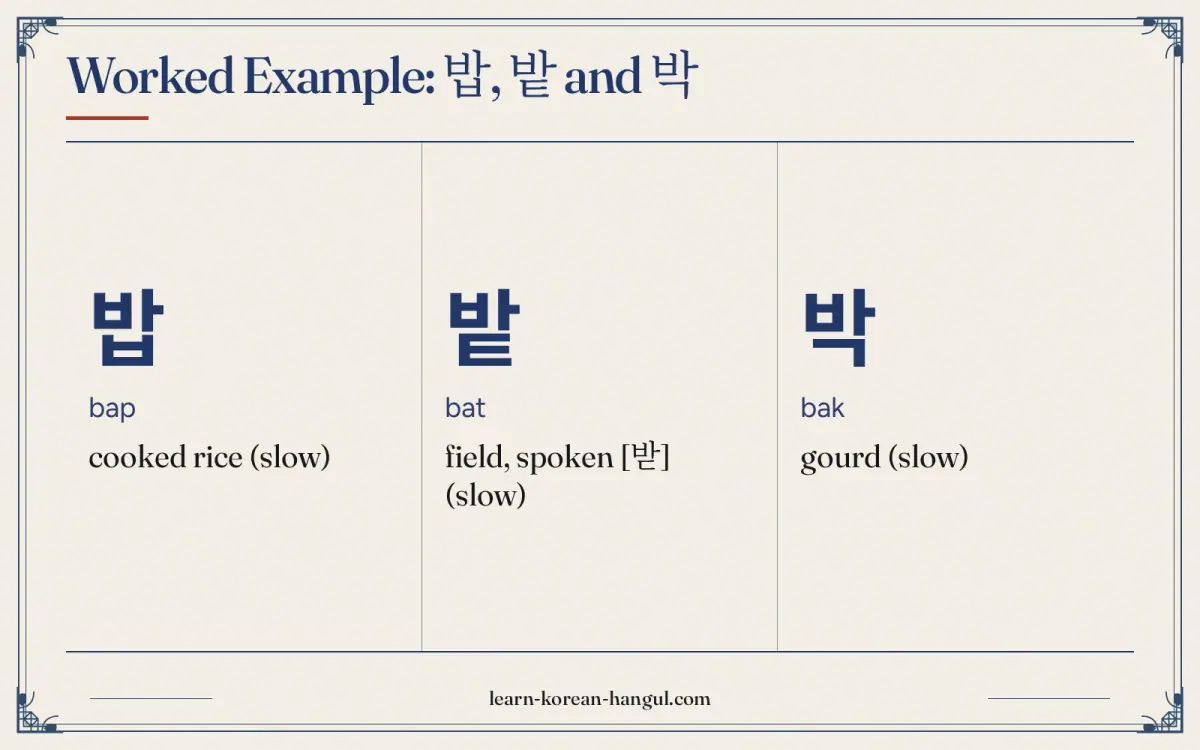
The worked example takes the core stop set through the whole task.
- Listen. Play the three slow clips in order.
밥
bap
cooked rice (slow)
밭
bat
field, spoken [받] (slow)
박
bak
gourd (slow)
- Name the closure. For each clip, decide: lips, tongue tip or tongue back.
- Check the spelling. 밭 ends in ㅌ, but the spoken form is [받], the same final sound as in 옷 [옫] or 꽃 [꼳].
- Choose. A fourth clip plays one of the three. Choose the word you heard.
- Say it. Say each word and keep the closure without a release. Record yourself if you can.
Note that 밭 followed by a vowel changes: 밭이 is [바치] and 밭에 is [바테], where the spelling returns. That is a separate topic, taught in the liaison lessons. Next, the mistakes to avoid.
Common Learner Mistakes
Learners often assume that the spelling shows the final sound, so they look for a ㅌ in 밭. In fact the sound is [ㄷ]. The spelling keeps ㅌ because it comes back when a vowel follows, as in 밭에 [바테], so the spoken form of the word on its own must be learned by ear. Three more mistakes follow a similar pattern.
- Learners often assume the final stop needs a release. Actually Korean leaves it closed, so 밥 ends in silence, and adding a puff or a vowel sounds foreign.
- Learners often assume ㅇ at the end is "n" plus "g". Actually it is one sound, the same as the end of English "sing", so 상 has no separate g.
- Learners often assume a final ㄹ is an English r. Actually it is an l, made with the tongue tip on the ridge, so 말 and 달 end in a clear l.
Test yourself with the full task below.
Practice and Answer Key
Use the listening task first, then the written version. The listening task plays one word from a set at normal or slow speed and asks which word you heard.
Practice · Read
Show answer
밥
bap
cooked rice (slow)
Show answer
밭
bat
field, spoken [받] (slow)
Show answer
박
bak
gourd (slow)
The written version is a dictation check. For each spoken form, choose the spelling.
- [받]: 밥, 밭 or 박?
- [숟]: 숲 or 숯?
- [옥]: 옷 or 옥?
- [꼳]: 꽃 or 꼭?
- [삼]: 산, 삼 or 상?
- [강]: 간, 감 or 강?
- [붇]: 북 or 붓?
- [몯]: 목 or 못?
Answer key: 1. 밭. 2. 숯. 3. 옥. 4. 꽃. 5. 삼. 6. 강. 7. 붓. 8. 못.
As a speaking task, choose any three sets, say each word twice and record yourself. Check that stops end in silence and nasals keep humming. Common questions follow.
Frequently Asked Questions
How many sets are in the list? The list has 16 sets: six stop sets, five nasal triples and five mixed sets that include ㄹ. Together they cover all seven final sounds. Every word is a real, common Korean word, so the practice also builds vocabulary. Sets have two to four words, and the spelling is shown next to the spoken form.
Can I hear the difference between 밥 and 밭? Yes, with practice. 밥 ends with the lips closed, and 밭 is spoken [받], so it ends with the tongue tip on the ridge behind the teeth. Neither has a release of air. Listen for where the sound is cut off, play the slow clip, and say each word aloud to feel the closure.
Is there a dictation version? Yes. The practice section includes a short dictation check in which you read a spoken form, such as [꼳], and choose the correct spelling, 꽃. It tests the link between sound and spelling, which is the part that English speakers find hardest. A longer dictation tool is planned separately.
Is it hard for beginners? The nasal sets are usually easier, because the sound keeps humming and the closure place is easy to feel. The stop sets are harder, because the word ends in silence. Start with the nasal triples 산 / 삼 / 상 and 간 / 감 / 강, then move to the stops.
Where to Go Next
The Korean batchim minimal pairs above cover final consonants only. They do not cover vowel pairs or the initial plain, tense and aspirated contrast, and they do not test pronunciation. For the nasals in more depth, continue with the next list.
Next in the series: Korean ㄴ ㅁ ㅇ ㄹ Minimal Pairs. To return to the full set of contrasts, see Korean Minimal Pairs.