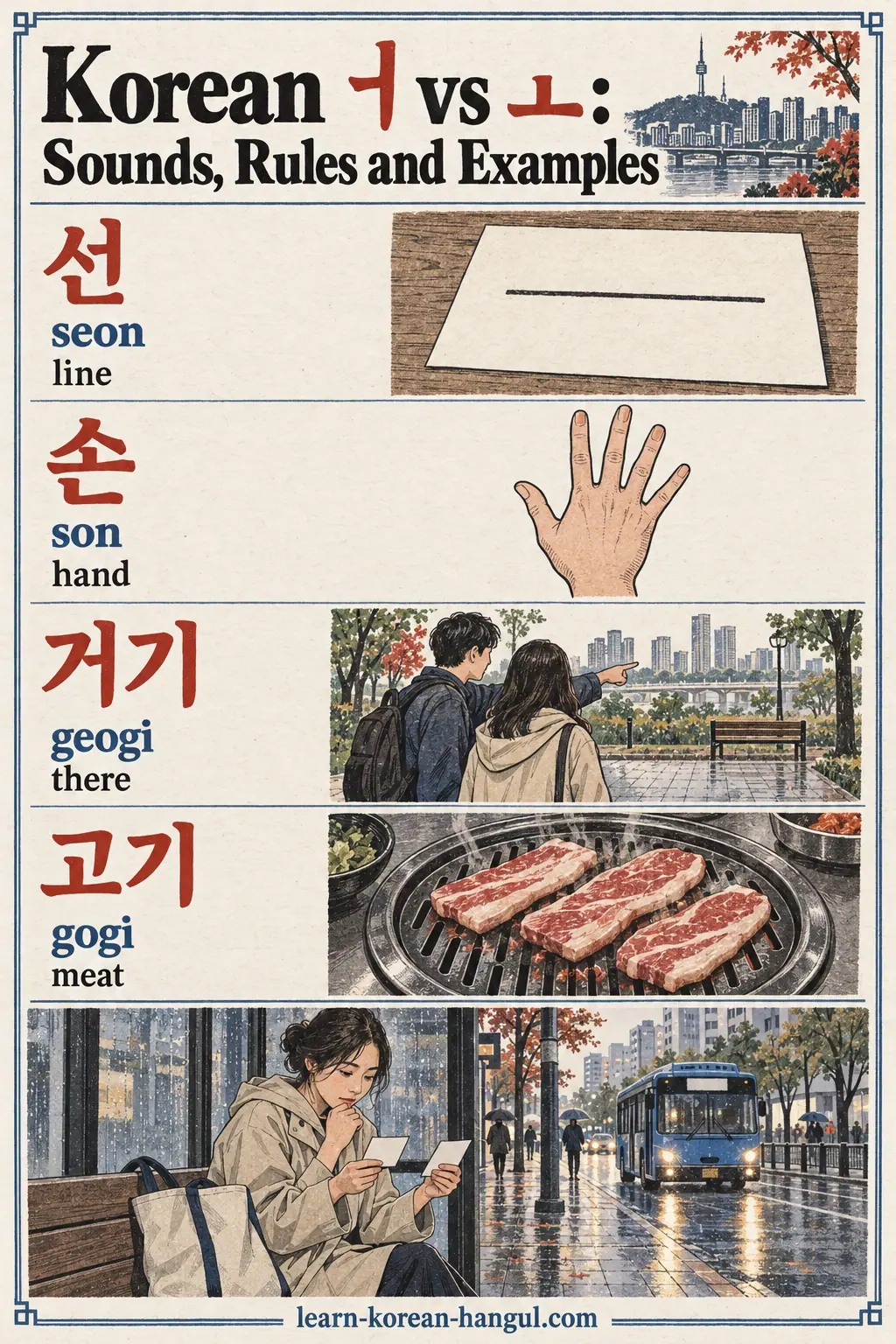
What you'll learn
- Say 어 and 오 with the right lip shape, using a mirror check.
- Choose correctly between 선 (line) and 손 (hand), and between 거기 (there) and 고기 (meat), by ear.
- Explain why Revised Romanization writes ㅓ as "eo" and not "e + o".
- Recognise which Korean vowel an English loanword vowel becomes.
Before you start: review Korean Simple Vowels. The lesson takes about 20 minutes, and audio plays only when you press a button.
What Is the Korean ㅓ vs ㅗ Difference?
The Korean ㅓ vs ㅗ difference is one change in the lips. Both are back vowels, made with the tongue pulled toward the back of the mouth, and both are in the middle of the mouth in height. For ㅗ, the lips round and push forward. For ㅓ, the lips stay relaxed and the jaw opens a little more.
Listen to the two letter names. Each clip is one steady vowel.
The first clip is 어 (the letter ㅓ) and the second is 오 (the letter ㅗ). In the standard language, which is the Seoul-based norm described by the 국립국어원 (National Institute of Korean Language), these are two clearly separate vowels. Unlike ㅐ and ㅔ, the pair ㅓ and ㅗ is audible and changes word meaning, so it deserves real listening practice.
Why do so many learners fail here? The next section explains.
Why English Speakers Struggle with ㅓ and ㅗ
English speakers struggle with ㅓ and ㅗ because English has no steady vowel in exactly those places. English "oh" is usually a glide: "go" is closer to "gow", so the lips and tongue move while the vowel plays. Korean ㅗ stays still. English also has no clear partner for ㅓ, so learners reach for the nearest sounds, "uh" or "aw".
Both guesses cause problems:
- "Uh" as in "cup". This is close, but English speakers often keep the jaw too closed, and listeners hear a weak vowel.
- "Aw" as in "law". The jaw drops and the lips round slightly, which drifts toward ㅗ.
- "Oh" as in "go". This adds a glide, so ㅗ sounds like English "ow".
The best correction is physical, not acoustic. Use the lips as a switch: rounded means ㅗ, relaxed means ㅓ. Now the sound of each vowel in detail, starting with ㅓ.
What Is the Sound of ㅓ?
ㅓ is an open-mid back vowel with unrounded lips. Place your tongue low and slightly back, open the jaw about halfway, and keep the lips relaxed, neither smiling nor pursed. The sound sits between the English "uh" in "cut" and the "aw" in "law". It is steady, so hold it without moving.
Two everyday words use it.
The word 어머니 (eomeoni, mother) has ㅓ twice, in the first and second syllables. The word 오다 (oda, to come) starts with ㅗ and is useful for comparison. Say 어머니 slowly and keep your lips still, because any forward movement turns it into 오머니, which is not a word.
Expert insight: the most reliable ㅓ check is that the lips do nothing. The jaw works; the lips rest. Learners spend effort on a vowel that needs almost none.
Next, the rounded partner.
What Is the Sound of ㅗ?
ㅗ is a rounded mid back vowel. Push the lips forward into a small, round opening, as if blowing on hot tea, and raise the back of the tongue slightly. The sound resembles the "o" in "go" without the glide, so the vowel does not turn into "ow". Hold the shape for the entire vowel.
A quick way to feel it: say "oh" and freeze at the start, before the lips close further. That frozen position is closer to ㅗ than the full English diphthong. Compare it with ㅜ, which is higher and rounder, in the ㅡ versus ㅜ lesson.
Now put the two shapes side by side.
How Do ㅓ and ㅗ Differ in Mouth Shape?
ㅓ and ㅗ differ in two ways: ㅗ rounds the lips, and ㅓ opens the jaw wider. The tongue stays in a similar back position for both, so the lips and jaw do the work.
| Feature | ㅓ (어) | ㅗ (오) |
|---|---|---|
| Lips | Relaxed, unrounded | Rounded, pushed forward |
| Jaw | Open about half | Slightly more closed |
| Tongue | Low-mid, back | Mid, back |
| English comparison | Between "uh" in "cut" and "aw" in "law" | "o" in "go" without the glide |
| Revised Romanization | eo | o |
| Typical learner error | Rounded, heard as ㅗ | Glided, heard as "ow" |
Try this three-step routine with a mirror.
- Say 오. Round the lips and hold a steady "oh".
- Unround without moving the tongue. Let the lips relax into a neutral shape while the sound continues.
- Open the jaw slightly. The sound becomes 어.
Reverse the routine to go from 어 to 오. If you can switch smoothly in both directions, you have both lip shapes. Next, the spelling puzzle that confuses readers of romanization.
Why Does Revised Romanization Write Eo?
Revised Romanization writes ㅓ as eo because the system, adopted in 2000, uses only the 26 basic Latin letters, with no diacritic marks. The older McCune-Reischauer system wrote the same vowel as ŏ, with a breve. When the Ministry of Culture and Tourism adopted Revised Romanization, the breve was replaced by two letters.
The result is easy to misread. The letters "eo" look like "e" followed by "o", but they stand for one vowel. Likewise, ㅡ becomes "eu" and is not a French sound. For example, 어머니 is written eomeoni, a four-syllable-looking word that is really three syllables, 어, 머, 니.
Two rules prevent errors:
- Read "eo" as one vowel. Do not say "eh-oh".
- Do not use the Latin letters to guess the lips. "o" means rounded, and "eo" does not.
Romanization is a learning aid in this series and is never the only form shown. For the rules, see Revised Romanization. Real words show the contrast best, so here are some.
Which Words Test the Pair?

Words that differ only in ㅓ and ㅗ are called minimal pairs: two real words with one sound difference. The table lists everyday pairs. Every entry is a real word.
| ㅓ word | ㅗ word | Meanings |
|---|---|---|
| 선 (seon) | 손 (son) | line / hand |
| 거기 (geogi) | 고기 (gogi) | there / meat |
| 서리 (seori) | 소리 (sori) | frost / sound |
| 벌 (beol) | 볼 (bol) | bee / cheek |
| 정 (jeong) | 종 (jong) | affection / bell |
More pairs, with an answer key, are in vowel minimal pairs.
Listen to the first two.
These clips are 거기 (there) and 고기 (meat). Say each one aloud and watch your lips. A simple drill uses three rounds: listen to a word and write down the vowel you heard, say it aloud with the matching lips, and finally record yourself on a phone and compare the recording with the clip. Three short rounds a day work better than one long session, because lip habits change slowly. If they move forward on 거기, repeat it with a still mouth. Next, a different source of confusion, English words that became Korean words.
Loanwords: Where English Vowels Land

Loanwords show how Korean listeners hear English vowels, and they explain many spelling surprises. English vowels do not map one-to-one. The rule of thumb is that a rounded English "o" becomes ㅗ, while the "uh" and "aw" family often becomes ㅓ.
| English word | Korean | Vowel used | Why |
|---|---|---|---|
| bus | 버스 | ㅓ | English "u" in "bus" is an "uh" sound |
| coffee | 커피 | ㅓ | The first English vowel is "aw"-like |
| hotel | 호텔 | ㅗ | The English "o" is rounded |
| radio | 라디오 | ㅗ | A rounded "o" at the end |
The clips are 커피 (coffee) and 호텔 (hotel). The mapping follows how Korean ears hear English, not how English is spelled. That is why "coffee" has an "o" in English but ㅓ in Korean. For a learner, this is a shortcut: when you hear an unfamiliar loanword, listen for lip rounding.
The next section follows one pair from sound to writing.
Worked Example: 선 and 손

This worked example practises the pair 선 and 손, line and hand, from lips to meaning. Do the steps in order.
- Say the vowels. Make 어 with relaxed lips, then 오 with rounded lips.
- Add the consonants. The consonants ㅅ and ㄴ are the same in both words, so only the vowel changes.
- Say each word.
선
seon
line
손
son
hand
- Watch the lips. For 선, the lips do not move. For 손, they round.
- Check meaning. 선 is a line, such as a drawn line or a train line. 손 is a hand.
- Test yourself. Ask a friend to say one of the two, without telling you which, and choose.
On a keyboard, ㅓ is the J key and ㅗ is the H key on the standard Korean layout, so 선 is typed with T, J, S and 손 with T, H, S. The typing check proves the letters, but the lips prove the sound. Now the typical mistakes.
Common Learner Mistakes

Learners often assume that ㅓ must sound like the English "uh" in "cup", so they say it short and weak. Actually ㅓ is a full, steady vowel with the jaw open, and a weak "uh" can be heard as another vowel entirely. Treat it as a proper vowel.
Four more mistakes:
- Learners often assume that ㅗ is the English "oh". Actually the English vowel glides, and the Korean one stays steady. Freeze the start of "oh" and hold it.
- Learners often assume that "eo" is two sounds. Actually it is one vowel, written with two letters in Revised Romanization to avoid diacritics.
- Learners often assume that vowel length separates the two. Actually the difference is quality, lips and jaw, not length. Some dictionaries mark long vowels, but modern Seoul speech has largely lost that length distinction.
- Learners often assume that a single failed clip means no progress. Actually the contrast is learnable in days with mirror practice, because it depends on the lips.
One honest limit applies to all of this advice. A written description of lips and tongue can guide practice, but it cannot replace a listener. If a Korean speaker can correct you, ask for feedback on exactly this pair. Time to practise.
Practice and Answer Key

Do these exercises after listening to the clips. Cover the answer key first.
Practice · 8
What is the main mouth difference between ㅓ and ㅗ?
Show answer
ㅗ rounds the lips; ㅓ keeps them relaxed with the jaw more open
Both are back vowels; ㅗ rounds and pushes the lips forward, while ㅓ keeps them relaxed and opens the jaw a little more.
Which word means 'hand'?
Show answer
손
손 (son) is hand and 선 (seon) is line; only the vowel changes.
Which word means 'meat'?
Show answer
고기
고기 (gogi) is meat, with rounded ㅗ; 거기 (geogi) means there.
You round your lips while trying to say 서리 (frost). Which word do you really say?
Show answer
소리 (sound)
Rounding turns ㅓ into ㅗ, so 서리 becomes 소리.
Which vowel does the first syllable of 버스 (bus) use?
Show answer
ㅓ
The 'uh' sound of English 'bus' becomes ㅓ in Korean loanwords.
Which loanword uses ㅗ for a rounded English 'o'?
Show answer
호텔 (hotel)
A rounded English 'o' becomes ㅗ, as in 호텔; 커피 and 버스 use ㅓ.
How should you read the Revised Romanization 'eo'?
Show answer
As one vowel, ㅓ
RR uses two letters for ㅓ to avoid diacritics, but eo stands for one vowel.
What separates 선 from 손 for a Korean listener?
Show answer
Vowel quality: lips and jaw
The difference is quality, not length; ㅅ and ㄴ are the same in both words.
- Meaning. Which word means "hand": 선 or 손?
- Meaning. Which word means "meat": 거기 or 고기?
- Lips. You round your lips to say 서리 (frost). Which word did you really say?
- Loanword. The Korean word for "bus" is 버스. Which vowel does the first syllable use: ㅓ or ㅗ?
- Mirror. Say 어머니 five times. Did your lips move? If yes, repeat with a still mouth.
Answer key: 1. 손. 2. 고기. 3. 소리 (sound), because rounding turns ㅓ into ㅗ. 4. ㅓ. 5. The lips should stay relaxed throughout.
Common questions come next, followed by the next lesson.
Frequently Asked Questions
Is ㅓ eo or u? In Revised Romanization, ㅓ is written eo, ㅜ is written u, and ㅡ is written eu. Some older or informal romanizations write ㅓ as ŏ or even u, which causes confusion. Use the Hangul letters as the reference and treat any Latin letters as a hint, not a rule.
How do I tell 어 and 오 apart by ear? Listen for lip rounding. ㅗ has a rounder, darker, more closed quality, while ㅓ sounds more open and flat. Play the clips on this page, repeat them while watching your lips in a mirror, and practise minimal pairs such as 선 and 손 until the difference is easy to hear.
Which words are minimal pairs? Minimal pairs for ㅓ and ㅗ include 선 and 손 (line and hand), 거기 and 고기 (there and meat), 서리 and 소리 (frost and sound), 벌 and 볼 (bee and cheek), and 정 and 종 (affection and bell). The vowel is the only change. A full set with audio is in the vowel minimal pairs practice page.
How do I type ㅓ and ㅗ? On the standard Korean two-set keyboard, ㅓ is the J key and ㅗ is the H key. On a phone, switch to the Korean keyboard and tap the vowel keys directly. The same keys form syllables: type ㅅ, then ㅓ, then ㄴ to get 선, and ㅅ, ㅗ, ㄴ to get 손.
Where to Go Next
Korean ㅓ vs ㅗ is a lip skill, so practise with a mirror and with pairs. This lesson does not cover the other hard pair, ㅡ and ㅜ, nor the y-glide vowels such as ㅕ and ㅛ. It also does not score your pronunciation. Review the full vowel set in Korean Simple Vowels, see other errors in vowel mistakes, and return to Korean Vowel Sounds for the whole section.
Next in the series: Korean ㅡ vs ㅜ.