
What you will learn
- Say 입학, 축하, 맏형, 앉히다 and 먹히다 with the aspirated result.
- Predict the fused sound from the final consonant: ㄱ gives ㅋ, ㄷ gives ㅌ, ㅂ gives ㅍ, ㅈ gives ㅊ.
- Recognise the -히- forms of verbs, such as 먹히다 and 앉히다, and say them correctly.
- Tell this rule apart from vowel linking (입이) and from ㄷ + ㅎ palatalization (닫히다).
Before you start: review the aspiration rules, which show both directions of the change. Time: about 25 minutes with audio.
Key Facts
- A final ㄱ, ㄷ, ㅂ or ㅈ before ㅎ fuses into ㅋ, ㅌ, ㅍ or ㅊ: 입학 is [이팍].
- Examples: 축하 [추카], 국화 [구콰], 맏형 [마텽], 앉히다 [안치다].
- Letters that sound like ㄱ, ㄷ or ㅂ at the end of a block also fuse: 옷 한 벌 is [오탄벌].
- Double finals keep their first consonant: 앉히다 is [안치다] and 밝히다 is [발키다].
- The rule is common in Sino-Korean nouns and in the passive and causative -히- verbs, such as 먹히다 [머키다].
- The rule is in Article 12 of the Standard Pronunciation Rules (표준 발음법).
Last updated: 2026-10-09. The Korean text, romanization and audio scripts on this page are generated drafts that still await review by a Korean specialist.
What Is Korean Aspiration before ㅎ?
Korean aspiration before ㅎ is a sound change that merges a plain stop with a following ㅎ into one aspirated stop. A stop is a consonant that blocks the air for a moment, and an aspirated stop is a stop released with a strong puff of air. Korean has three sets: plain (ㄱ ㄷ ㅂ ㅈ), tense (ㄲ ㄸ ㅃ ㅉ) and aspirated (ㅋ ㅌ ㅍ ㅊ).
The word "before" in the title refers to the order of the letters on the page: the stop is written first, at the bottom of one block, and the ㅎ is written second, at the top of the next. The ㅎ gives its breath to the stop, and the result is the matching aspirated sound at the same place in the mouth.
| Final sound | Plus ㅎ | Written | Spoken | Meaning |
|---|---|---|---|---|
| ㄱ | ㅋ | 축하 | [추카] | congratulation |
| ㄷ | ㅌ | 맏형 | [마텽] | eldest brother |
| ㅂ | ㅍ | 입학 | [이팍] | entering a school |
| ㅈ | ㅊ | 앉히다 | [안치다] | to seat someone |
The spelling does not change. Written 입학 and spoken [이팍] are different, and the learner has to apply the rule. Revised Romanization (RR) is the official Latin-letter system for Korean, and for nouns it keeps the spelling, so 입학 is iphak and 축하 is chukha. RR is a learning aid on this page, and the Hangul and the bracketed forms are the reference. First, a look at why this rule is easy to miss.
Why Do English Speakers Say "Ip-Hak"?
English speakers tend to read 입학 as "ip-hak" with a clear stop and a separate "h", because each letter looks like a separate sound on the page. A learner who sees ㅂ and then ㅎ says two sounds.
Korean does the opposite. The two sounds are squeezed into one, and the breath of ㅎ lands on the lips as a single puff. A second habit is to replace the fused sound with a plain one and say "i-bak", which loses the breath. Both versions sound foreign to a Korean listener.
The fix is to hear the result first and the letters second. Say [팍] as one syllable with a puff of air, and the rest of the word follows. Next comes the rule itself.
What Happens When ㅎ Follows ㄱ ㄷ ㅂ ㅈ?
When ㅎ follows ㄱ, ㄷ, ㅂ or ㅈ at a block boundary, the two sounds merge into the aspirated stop made at the same place. The Standard Pronunciation Rules (표준 발음법), Article 12, state the pattern for these words, and the National Institute of Korean Language (국립국어원) publishes them.
| Final sound | ㅎ makes it | Place in the mouth | Example | Spoken |
|---|---|---|---|---|
| ㄱ | ㅋ | back of the tongue | 먹히다 | [머키다] |
| ㄷ | ㅌ | tongue tip | 맏형 | [마텽] |
| ㅂ | ㅍ | lips | 입학 | [이팍] |
| ㅈ | ㅊ | tongue blade on the palate | 앉히다 | [안치다] |
The final letter in the written block is often not ㄱ, ㄷ, ㅂ or ㅈ itself. At the end of a block, Korean letters fall into groups that sound the same. The letters ㅋ and ㄲ sound like ㄱ, the letters ㅅ, ㅆ, ㅈ, ㅊ and ㅌ sound like ㄷ, and ㅍ sounds like ㅂ. The rule treats them all by their sound, so a final ㅅ, ㅊ or ㅌ before ㅎ also gives ㅌ. The Standard Pronunciation Rules give 옷 한 벌 as [오탄벌] and 꽃 한 송이 as [꼬탄송이].
To apply the rule:
- Find a block that ends in a stop. Look at the bottom of the block (입, 축, 맏, 앉).
- Check the next block. It must start with ㅎ (학, 하, 형, 히).
- Fuse them. The stop and ㅎ become one aspirated sound at the same place.
- Say it as one flow. 입학 becomes 이 + 팍.
You will know it worked when you hear no separate "h" and feel one puff of air. A common mistake is to stop at step 2 and say the two sounds one after the other. Double finals follow the same path.
How Do Double Finals Behave?
A double final such as ㄵ or ㄺ keeps its first consonant and passes the second one to the fusion. In 앉히다, the double final ㄵ is ㄴ plus ㅈ. The ㄴ stays in the first block, and the ㅈ fuses with ㅎ into ㅊ, so the word is [안치다]. In 밝히다, the double final ㄺ is ㄹ plus ㄱ, and the result is [발키다].
| Written | Double final | Stays | Fuses with ㅎ | Spoken |
|---|---|---|---|---|
| 앉히다 | ㄵ | ㄴ | ㅈ → ㅊ | [안치다] |
| 밝히다 | ㄺ | ㄹ | ㄱ → ㅋ | [발키다] |
| 넓히다 | ㄼ | ㄹ | ㅂ → ㅍ | [널피다] |
| 읽히다 | ㄺ | ㄹ | ㄱ → ㅋ | [일키다] |
| 밟히다 | ㄼ | ㄹ | ㅂ → ㅍ | [발피다] |
The double finals in this table all come from verbs and are the same ones that appear in the -히- forms below. Next, a longer list of words that show the rule.
Which Words Show the Rule?
The rule appears in two kinds of word: Sino-Korean nouns, which are words built from Chinese characters (hanja), and verbs with the suffix -히-. The table gives twelve useful words, grouped by the final sound.
| Final sound | Word | Spoken | Meaning |
|---|---|---|---|
| ㄱ | 축하 | [추카] | congratulation |
| ㄱ | 국화 | [구콰] | chrysanthemum |
| ㄱ | 먹히다 | [머키다] | to be eaten |
| ㄷ | 맏형 | [마텽] | eldest brother |
| ㅂ | 입학 | [이팍] | entering a school |
| ㅂ | 잡히다 | [자피다] | to be caught |
| ㅂ | 입히다 | [이피다] | to dress someone |
| ㅂ | 좁히다 | [조피다] | to narrow |
| ㅈ | 앉히다 | [안치다] | to seat someone |
| ㅈ | 꽂히다 | [꼬치다] | to be stuck in |
| ㄹ + ㄱ | 밝히다 | [발키다] | to reveal |
| ㄹ + ㅂ | 넓히다 | [널피다] | to widen |
Two words in the list stand out for early learners. 입학 is the standard word for starting school, and 축하 appears in congratulation phrases such as 축하해요 [추카해요], covered on the page for celebration phrases. Both are common before a learner reaches intermediate grammar. The verb forms need their own explanation.
What about -히- Forms?
The suffix -히- turns a verb into a passive or causative verb, and every verb in this family with a final stop produces the rule. A passive verb says what happens to the subject, as in 먹히다, "to be eaten". A causative verb says that someone makes another act, as in 앉히다, "to make someone sit, to seat".
| Base verb | -히- form | Type | Spoken | Meaning |
|---|---|---|---|---|
| 먹다 (eat) | 먹히다 | passive | [머키다] | to be eaten |
| 잡다 (catch) | 잡히다 | passive | [자피다] | to be caught |
| 앉다 (sit) | 앉히다 | causative | [안치다] | to seat someone |
| 입다 (wear) | 입히다 | causative | [이피다] | to dress someone |
| 읽다 (read) | 읽히다 | causative | [일키다] | to make someone read |
Learners meet these forms in grammar lessons before they study the sound rule, which is why the sound rule is easy to miss. The grammar itself, including the other passive suffixes 이, 리 and 기, is explained on the page about passive suffixes 이 히 리 기, so this page covers only how the forms sound. A neighbouring rule sounds similar and needs a clear boundary.
How Does It Differ from Palatalization?
The difference is the letter before ㅎ and the vowel after it. In this lesson the fusion produces ㅋ, ㅌ, ㅍ or ㅊ from ㄱ, ㄷ, ㅂ or ㅈ. In palatalization, a final ㄷ or ㅌ meets the vowel 이 of a suffix and becomes ㅈ or ㅊ, as in 같이 [가치]. Words like 닫히다 involve both rules in two steps.
| Word | Step 1 | Step 2 | Spoken |
|---|---|---|---|
| 먹히다 | ㄱ + ㅎ → ㅋ | none | [머키다] |
| 닫히다 | ㄷ + ㅎ → ㅌ | ㅌ + 이 → 치 | [다치다] |
| 굳히다 | ㄷ + ㅎ → ㅌ | ㅌ + 이 → 치 | [구치다] |
| 묻히다 | ㄷ + ㅎ → ㅌ | ㅌ + 이 → 치 | [무치다] |
In 닫히다, the ㄷ and ㅎ fuse into ㅌ, and then ㅌ before 이 is spoken ㅊ, so the word ends in [치], not [티]. The page on ㄷ + ㅎ + 이 palatalization explains the second step in full. Compare also a vowel-linking case. In 입이, a vowel follows ㅂ instead of ㅎ, so the ㅂ moves forward as a plain sound: [이비], not [이피]. With the contrast clear, a full worked example follows.
Worked Example: 입학
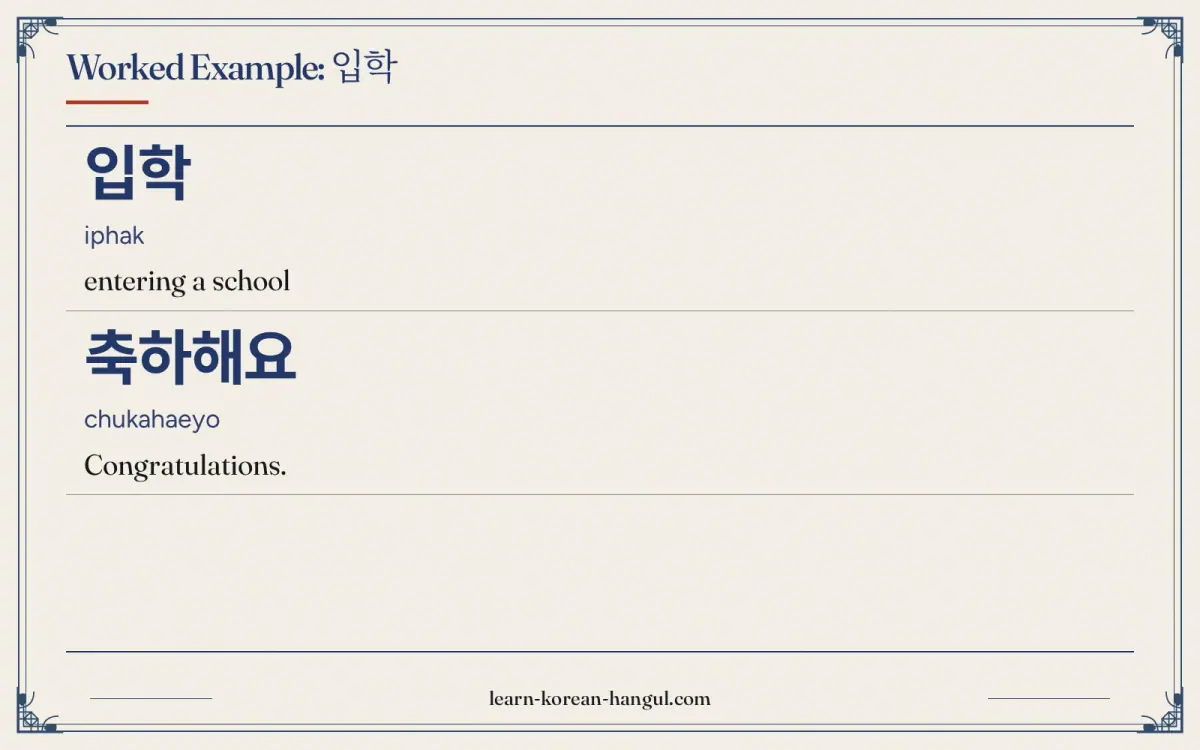
The worked example takes one word through every step of the rule.
- Look at the spelling. 입학 has two blocks, 입 and 학. Block 1 ends in ㅂ, and block 2 starts with ㅎ.
입학
iphak
entering a school
- Spot the pair. A final ㅂ followed by ㅎ is the trigger.
- Fuse them. ㅂ + ㅎ gives ㅍ, made at the lips with a puff of air.
- Rebuild the syllables. The first block loses its final consonant and becomes 이. The second block starts with the fused sound and becomes 팍. The final ㄱ of 학 stays as the end of the second block.
- Say it. Combine them: [이팍]. Hold a strip of paper to your lips. It should move on 팍.
- Compare with 입이. Say [이비] and then [이팍]. The first has a soft b, and the second has a strong p.
The same steps work for a celebration word. Take 축하해요, "congratulations", where the first 하 fuses with the final ㄱ of 축.
축하해요
chukahaeyo
Congratulations.
The result is [추카해요]: the ㄱ and ㅎ become ㅋ, and the second 해 starts with an ordinary ㅎ. After the examples, the most common learner mistakes come into focus.
Common Learner Mistakes
Learners often assume that the letters are read one by one, so 입학 comes out as "ip-hak". In fact the ㅂ and ㅎ fuse into one ㅍ, so the word is [이팍], because Korean combines them before the syllables are formed. Four more mistakes follow a similar pattern.
- Learners often assume the spelling shows the sound. Actually Korean spelling keeps the base letters (입학), and only the spoken form carries the fusion.
- Learners often assume Revised Romanization will show the aspiration. Actually for nouns RR keeps the written letters, so 입학 is iphak and 축하 is chukha, which look like two sounds. Use the bracketed forms on this site.
- Learners often treat 입이 and 입학 alike. Actually a vowel after ㅂ gives a plain [비], and ㅎ after ㅂ gives [팍]. The next letter decides the sound.
- Learners often drop the double-final consonant in 앉히다. Actually the ㄴ stays, so the word is [안치다], not [아치다].
A short drill follows, with an answer key at the end.
Practice and Answer Key
Use the audio first, then the written drill. Play each word, say it back, and write the spoken form.
Practice · 8
How is 입학 (entering a school) pronounced?
Show answer
[이팍]
The final ㅂ and the ㅎ of 학 fuse into one ㅍ, so 입학 is [이팍], with one puff of air.
A final ㄱ meets ㅎ at the start of the next block. What do they become?
Show answer
ㅋ
The stop and ㅎ merge into the aspirated stop at the same place: ㄱ gives ㅋ, as in 축하 [추카].
How is 앉히다 (to seat someone) pronounced?
Show answer
[안치다]
In the double final ㄵ, the ㄴ stays and the ㅈ fuses with ㅎ into ㅊ: [안치다]. Dropping the ㄴ gives the wrong [아치다].
How is 입이 pronounced?
Show answer
[이비]
A vowel follows the ㅂ, not ㅎ, so there is no fusion. The ㅂ links as a plain sound: [이비].
Why is 닫히다 said [다치다]?
Show answer
ㄷ and ㅎ fuse into ㅌ, then ㅌ before 이 becomes ㅊ
Two rules apply in sequence: aspiration (ㄷ + ㅎ → ㅌ), then palatalization (ㅌ + 이 → 치).
In 옷 한 벌, the final ㅅ comes before ㅎ. What sound results?
Show answer
ㅌ, because final ㅅ sounds like ㄷ
The rule works by sound: final ㅅ sounds like ㄷ, and ㄷ + ㅎ gives ㅌ, so 옷 한 벌 is [오탄벌].
In 축하해요 [추카해요], which ㅎ fuses with the consonant before it?
Show answer
Only the ㅎ of 하, which fuses with the final ㄱ of 축
The final ㄱ of 축 and the ㅎ of 하 become ㅋ. The ㅎ at the start of 해요 follows a vowel and stays an ordinary ㅎ.
What happens to the double final ㄺ in 밝히다 [발키다]?
Show answer
The ㄹ stays and the ㄱ fuses with ㅎ into ㅋ
A double final keeps its first consonant and passes the second one to the fusion: ㄹ stays, ㄱ + ㅎ → ㅋ.
Write the spoken form of each word.
- 입학
- 축하해요
- 먹히다
- 앉히다
- 국화
- 맏형
- 잡히다
- 밝히다
- 입이 (a vowel follows)
- 닫히다 (two steps)
Answer key: 1. [이팍]. 2. [추카해요]. 3. [머키다]. 4. [안치다]. 5. [구콰]. 6. [마텽]. 7. [자피다]. 8. [발키다]. 9. [이비] (plain, no fusion). 10. [다치다] (fusion, then palatalization).
For a listening task, play a clip first and write the word before looking. Hear [추카] and write 축하. Hear [이팍] and write 입학. Finally, say five of the words aloud and record yourself. Compare the recording with the audio, and listen for one puff, not two sounds. Common questions follow.
Frequently Asked Questions
How do you say 축하해요? Say [추카해요]. The final ㄱ of 축 meets the ㅎ of 하, and the two fuse into one ㅋ, so there is no separate "h" in the middle. The second ㅎ, at the start of 해요, is an ordinary ㅎ. The word means "congratulations" or "I congratulate you" in polite speech.
Is 입학 pronounced 이팍? Yes. The final ㅂ of 입 and the ㅎ of 학 fuse into one ㅍ, and the first block loses its final consonant, giving [이팍]. The final ㄱ of 학 stays at the end of the second block. A speaker who says [입학] with a clear ㅂ and ㅎ would sound careful but unnatural.
Why is 닫히다 pronounced 다치다? Two rules apply in sequence. First, the final ㄷ and the ㅎ fuse into ㅌ. Then ㅌ before the vowel 이 is spoken as ㅊ, which is palatalization. The result is [다치다], with 치 and not 티. A separate lesson on ㄷ + ㅎ + 이 palatalization explains the second step.
Does 잡히다 aspirate? Yes. The final ㅂ of 잡 meets the ㅎ of 히, and the two fuse into ㅍ, so the word is [자피다]. It is the passive form of 잡다, "to catch", so it means "to be caught". All verbs in the -히- family with a stop before the suffix follow the same pattern.
Where to Go Next
The lesson above covers Korean aspiration before ㅎ only. It does not cover the other direction, where ㅎ comes first (see the Aspiration section), and it does not test your pronunciation. For the explanation of 닫히다 in full, open the page on ㄷ + ㅎ + 이 palatalization.
Next in the series: Korean palatalization. To return to the full set of lessons, see Aspiration.