
Korean aspiration rules describe how ㅎ fuses with a neighbouring ㄱ, ㄷ, ㅂ or ㅈ into one aspirated consonant: ㅋ, ㅌ, ㅍ or ㅊ. The fusion works in both directions, so 좋다 is said [조타] and 축하 is said [추카]. After this lesson, you can apply the rule to any word, including 놓고, 입학 and 많다.
What you'll learn
- Predict the aspirated consonant for each pairing of ㅎ with ㄱ, ㄷ, ㅂ or ㅈ.
- Pronounce 좋다, 놓고, 입학, 축하 and 많다 correctly.
- Tell aspiration apart from three look-alike ㅎ cases: before ㅅ, before ㄴ and before a vowel.
- Explain why 못해요 is [모태요] although no ㄷ is written.
Prerequisites: Batchim Representative Sounds, because one case uses the reduced [ㄷ]. Knowing the aspirated letters ㅋ ㅌ ㅍ ㅊ helps. Estimated time: 25 minutes.
What Are the Korean Aspiration Rules?
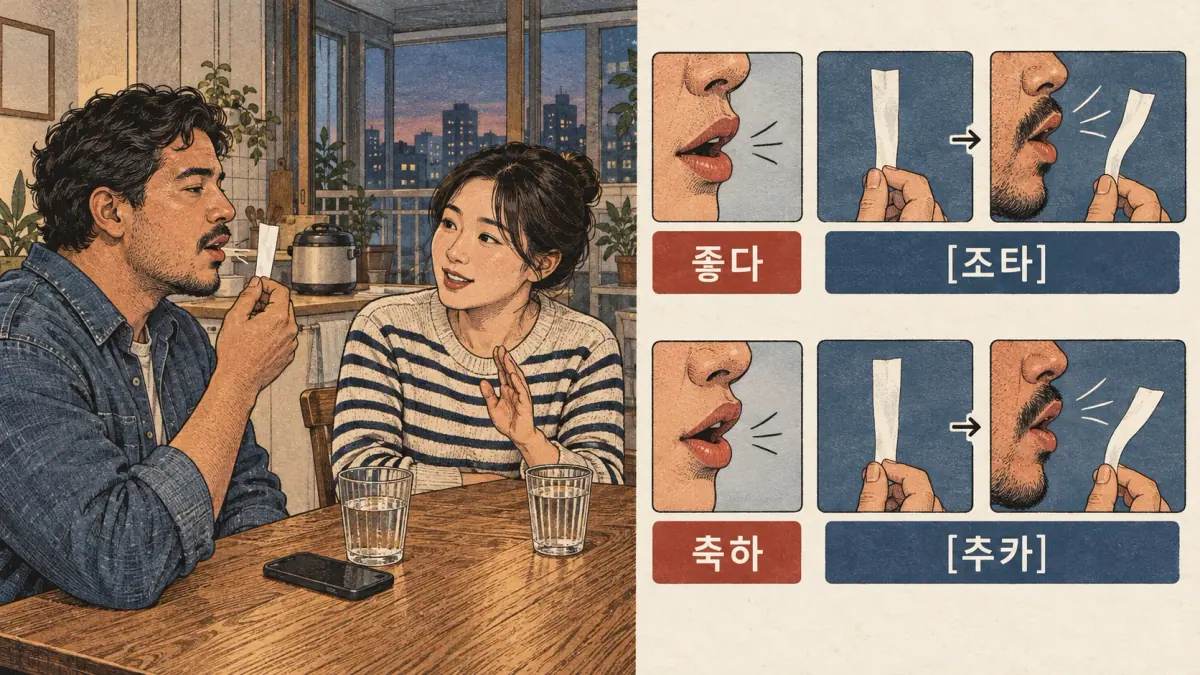
The Korean aspiration rules say that when ㅎ meets a plain ㄱ, ㄷ, ㅂ or ㅈ across a syllable boundary, the two sounds merge into the matching aspirated consonant. An aspirated consonant is one said with a strong puff of air, like the k in English "kit". Korean linguistics calls the process 격음화 (gyeogeumhwa), and Article 12 of the Standard Pronunciation Rules (표준 발음법) from the National Institute of Korean Language sets it out.
| Plain consonant | + ㅎ (either order) | Result |
|---|---|---|
| ㄱ | ㅎ | [ㅋ] |
| ㄷ | ㅎ | [ㅌ] |
| ㅂ | ㅎ | [ㅍ] (only with ㅂ before ㅎ) |
| ㅈ | ㅎ | [ㅊ] |
Why Does ㅎ Fuse Instead of Being Said Separately?
ㅎ fuses because it is pure breath. An aspirated consonant is, in effect, a plain consonant plus a burst of breath. When ㅎ sits right next to ㄱ, the breath of ㅎ and the closure of ㄱ happen together, and the listener hears a single ㅋ. This is why the rule produces exactly one consonant, not two: 좋다 has [ㅌ] in the middle, not [ㄷ] followed by an h.
Once you see aspiration as "plain consonant plus breath", the four results in the table need no memorizing. The breath simply lands on whichever plain consonant is next to ㅎ.
Why Do English Speakers Struggle with Aspiration?
English speakers struggle because English keeps h as a separate sound. In "backhand" or "hothouse", the k and h, or t and h, are both heard. A learner who carries this habit over says 축하 as "chuk-ha", with a closed ㄱ, a pause and then h. Koreans understand it, but it sounds slow and spelled-out.
A second problem is invisibility. Spelling keeps ㅎ and the plain letter, so a learner reading 좋다 sees no ㅌ at all. Romanization does not always help either. The only reliable clue is the letter ㅎ itself: whenever ㅎ touches ㄱ, ㄷ, ㅂ or ㅈ, expect an aspirated sound.
Which Direction Applies When?
Both directions apply, and the direction depends only on where ㅎ is written. If ㅎ is the batchim, the aspirated sound replaces the next syllable's first consonant. If ㅎ starts the next syllable, the batchim fuses with it and the aspirated sound moves forward.
| Direction | Pattern | Examples | Spoken |
|---|---|---|---|
| ㅎ first | ㅎ batchim + ㄱ, ㄷ, ㅈ | 좋고, 좋다, 좋지, 어떻게 | [조코], [조타], [조치], [어떠케] |
| ㅎ second | ㄱ, ㄷ, ㅂ, ㅈ batchim + ㅎ | 축하, 맏형, 입학, 맞히다 | [추카], [마텽], [이팍], [마치다] |
Direction 1: ㅎ Batchim before ㄱ, ㄷ, ㅈ
ㅎ appears as a batchim mainly at the end of verb and adjective stems, such as 좋- (good), 놓- (put), 넣- (put in), 낳- (give birth) and the -렇- in 그렇다 and 어떻다. When an ending beginning with ㄱ, ㄷ or ㅈ follows, aspiration applies:
- 놓고 (put and) → [노코]
- 넣다 (to put in) → [너타]
- 그렇지 (that's right) → [그러치]
- 빨갛게 (redly) → [빨가케]
No ㅂ appears in this direction, because no ending that starts with ㅂ attaches directly to an ㅎ stem.
Direction 2: ㄱ, ㄷ, ㅂ, ㅈ before ㅎ
This direction is frequent in Sino-Korean nouns, in -하다 verbs and adjectives, and in words built with the suffix -히- or the adverb ending -히:
- 입학 (school entrance) → [이팍]
- 백화점 (department store) → [배콰점]
- 생각해요 (I think) → [생가캐요]
- 급히 (hurriedly) → [그피]
- 잡히다 (to be caught) → [자피다]
You'll know you have direction 2 when the first syllable sounds open, 이 not 입, and the aspirated sound starts the next syllable: [이팍].
How Do Double Batchim ㄶ and ㅀ Aspirate?

Double batchim ㄶ and ㅀ aspirate exactly like a single ㅎ: the ㄴ or ㄹ stays in place and the ㅎ fuses with the next ㄱ, ㄷ or ㅈ. A double batchim is a pair of different consonants under one vowel. You can review the full set in the ㄶ and ㅀ lesson.
| Word | Meaning | Spoken |
|---|---|---|
| 많다 | to be many | [만타] |
| 않고 | not, and | [안코] |
| 싫다 | to dislike | [실타] |
| 끓지 | boil (with -지) | [끌치] |
Double batchim whose second letter is a plain stop also aspirate in direction 2, when a suffix with ㅎ follows: 밝히다 (to light up) is [발키다], 넓히다 (to widen) is [널피다] and 앉히다 (to seat) is [안치다]. The first letter, ㄹ or ㄴ, stays in place, and the second fuses with ㅎ.
What about ㅅ, ㄴ and Vowels after ㅎ?
After ㅎ, the consonant ㅅ becomes tense, ㄴ turns ㅎ into [ㄴ], and a vowel makes ㅎ silent; none of these three is aspiration. They come from the same Article 12, so learners often mix them up.
| ㅎ batchim before | What happens | Example | Spoken |
|---|---|---|---|
| ㅅ | ㅅ becomes tense [ㅆ] | 좋습니다, 많소 | [조씀니다], [만쏘] |
| ㄴ | ㅎ becomes [ㄴ] | 놓는, 쌓네 | [논는], [싼네] |
| vowel | ㅎ is silent | 좋아요, 많아 | [조아요], [마나] |
These three cases explain why 좋다 [조타], 좋은 [조은] and 좋네 [존네] sound so different, although all three start with the same stem. The ㅎ-before-ㅅ case is more common than it looks, because the polite ending -습니다 starts with ㅅ: 좋습니다 is [조씀니다] and 그렇습니다 is [그러씀니다]. The -소 ending in 많소 is old-fashioned and mostly appears in written dialogue.
Aspiration across Words and Suffixes

Aspiration also works when a word ending in a [ㄷ]-group consonant is followed by a word or suffix starting with ㅎ. Final ㅅ, ㅈ, ㅊ and ㅌ are first reduced to [ㄷ], and that [ㄷ] fuses with ㅎ into [ㅌ].
- 못해요 (I can't) → [모태요]
- 따뜻하다 (to be warm) → [따뜨타다]
- 옷 한 벌 (one set of clothes) → [오탄벌]
- 꽃 한 송이 (one flower) → [꼬탄송이]
This is the case where learners are most surprised, because no ㄷ or ㅌ is written anywhere in 못해요. The sequence is: reduce ㅅ to [ㄷ] (the representative sound), then aspirate [ㄷ] + ㅎ to [ㅌ].
Aspiration in Everyday Words
Aspiration is not a rare rule for advanced learners; it appears in many of the words beginners say every day. The table groups common words by the letter that meets ㅎ, so you can hear the pattern repeat.
| Word | Meaning | Meeting point | Spoken |
|---|---|---|---|
| 그렇게 | like that | ㅎ + ㄱ | [그러케] |
| 이렇게 | like this | ㅎ + ㄱ | [이러케] |
| 좋겠다 | that would be nice | ㅎ + ㄱ | [조켇따] |
| 생각하다 | to think | ㄱ + ㅎ | [생가카다] |
| 착하다 | to be kind | ㄱ + ㅎ | [차카다] |
| 국화 | chrysanthemum | ㄱ + ㅎ | [구콰] |
| 급하다 | to be urgent | ㅂ + ㅎ | [그파다] |
| 복잡하다 | to be complicated | ㅂ + ㅎ | [복짜파다] |
| 못하다 | to be unable | ㅅ → [ㄷ] + ㅎ | [모타다] |
| 깨끗하다 | to be clean | ㅅ → [ㄷ] + ㅎ | [깨끄타다] |
A useful rule of thumb follows from the table: any -하다 verb or adjective whose stem ends in ㄱ, ㅂ or a [ㄷ]-group letter is pronounced with an aspirated consonant in place of 하. 복잡하다 shows that two rules can meet in one word: tensification turns 잡 into [짜], then aspiration turns ㅂ + 하 into [파].
Where Are the Exceptions?
The main exception is ㄷ or ㅌ before 히, where palatalization wins and the result is [ㅊ], not [ㅌ]. 닫히다 (to be closed) is [다치다], and 묻히다 (to be buried) is [무치다]. The [ㅌ] forms happen first, but the high vowel ㅣ then pulls the sound forward to [ㅊ].
Two other points are worth knowing:
- ㅎ weakening is a separate process. Between a vowel or sonorant and a vowel, as in 전화 (phone) or 은행 (bank), ㅎ is often weakened or dropped in casual speech. That never produces ㅋ, ㅌ, ㅍ or ㅊ, and the standard pronunciation keeps the ㅎ. The ㅎ weakening rules lesson explains when the softer form is acceptable.
- Romanization treats nouns differently. Revised Romanization writes the aspirated result in verbs (좋고, joko) but keeps the h in nouns (축하, chukha). The pronunciation is aspirated in both.
The exceptions are few, so the rule holds for nearly every word you meet.
Worked Example: 좋다 and 축하해요

좋다 (to be good), direction 1.
- Find ㅎ: it is the batchim of 좋.
- Look at the next consonant: ㄷ in 다.
- Fuse: ㅎ + ㄷ → [ㅌ]. The ㅎ disappears from the first syllable.
- Say it: [조타], with a clear puff of air on 타.
축하해요 (congratulations), direction 2.
- Find ㅎ: it starts 하.
- Look at the batchim before it: ㄱ in 축.
- Fuse: ㄱ + ㅎ → [ㅋ]. The ㄱ leaves the first syllable.
- Say it: [추카해요]. The second ㅎ, in 해, follows a vowel and stays a light h.
You'll know you have both when 좋다 and 조타 sound identical to you, and 축하 has no pause between the syllables.
Common Mistakes with Korean Aspiration
Saying ㅎ separately. Learners often say 입학 as "ip-hak"; actually the two sounds fuse into [이팍]. Fix: open the first syllable and put the puff on the second.
Aspirating before a vowel. Learners who know the rule sometimes say 좋아요 as [조타요] or [조하요]; actually ㅎ before a vowel is silent: [조아요].
Forgetting the reduction step. Learners often say 못해요 as [모새요]; actually ㅅ first becomes [ㄷ], then fuses into [ㅌ]: [모태요].
Weak aspiration. Learners often produce the right letter but with too little air, so 좋다 sounds like 조다. Fix: hold a hand in front of your mouth and feel the puff on 타.
Practice: Aspiration in Eight Words

Exercise 1. Write the spoken form.
- 좋고
- 놓다
- 축하
- 많고
- 입학
- 깨끗해요 (it's clean)
Exercise 2. Aspiration or not? Write the spoken form.
- 놓아요
- 닫히다
Exercise 3. Read each sentence aloud and mark every place where aspiration applies.
- 어떻게 생각해요? (What do you think?)
- 생일 축하해요. (Happy birthday.)
- 오늘은 못 가요. (I can't go today.)
Answers.
Exercise 1: 1 [조코]. 2 [노타]. 3 [추카]. 4 [만코]. 5 [이팍]. 6 [깨끄태요]: ㅅ reduces to [ㄷ], then fuses with ㅎ into [ㅌ].
Exercise 2: 1 no aspiration, ㅎ is silent before a vowel: [노아요]. 2 aspiration followed by palatalization: [다치다].
Exercise 3: 1 two places: [어떠케 생가캐요]. 2 one place: [생일 추카해요]. 3 none: 못 is followed by 가, not ㅎ, so tensification applies instead: [몯까요]. If you marked a place in sentence 3, compare it with 못해요 [모태요] above.
Where to Go Next
Continue with Korean ㅎ Aspiration, which drills direction 1 with more stems and endings. Direction 2 has its own lesson, aspiration with ㅎ second, with Sino-Korean nouns and -하다 verbs.
This lesson does not cover ㅎ weakening in casual speech, palatalization in full, or dialect differences. Those topics sit in the wider Aspiration section and its neighbouring rule sections.
In short, the Korean aspiration rules come down to one idea: ㅎ is breath, and when it touches a plain ㄱ, ㄷ, ㅂ or ㅈ, the breath turns that consonant into ㅋ, ㅌ, ㅍ or ㅊ, in either order.
Frequently Asked Questions
Why is 입학 pronounced 이팍? 입학 (school entrance) has ㅂ at the end of 입 and ㅎ at the start of 학. Aspiration fuses the two into one aspirated sound, [ㅍ], which moves to the second syllable. The result is [이팍]. Saying 입 and 학 separately, with a closed ㅂ and then an h, sounds slow and foreign.
Is 어떻게 pronounced 어떠케? Yes. 어떻게 (how) ends its second block in ㅎ, and the third block starts with ㄱ. ㅎ before ㄱ fuses into [ㅋ], so the word is said [어떠케]. The same pattern gives 그렇게 [그러케] and 이렇게 [이러케], three words beginners hear constantly.
Is aspiration optional in fast speech? No. Aspiration is part of standard pronunciation at every speed, and Korean speakers apply it automatically. What changes in fast speech is ㅎ between a sonorant and a vowel, as in 전화 or 은행, which can weaken. That is a different process called ㅎ weakening, and it does not create ㅋ, ㅌ, ㅍ or ㅊ.
Does Revised Romanization show aspiration? Mostly yes. Revised Romanization writes the aspirated result in verb forms, so 좋고 is joko and 놓다 is nota. In nouns where ㅎ follows ㄱ, ㄷ or ㅂ, it keeps the h, so 축하 is written chukha and 입학 iphak. Read the Korean and apply the rule rather than trusting the letters.
What is 격음화? 격음화 (gyeogeumhwa) is the Korean linguistic term for aspiration, literally 'becoming an aspirated sound'. Korean school grammar also calls it 거센소리되기, using the native word 거센소리 for aspirated consonants. Both names describe the same rule: ㅎ and a plain ㄱ, ㄷ, ㅂ or ㅈ fuse into ㅋ, ㅌ, ㅍ or ㅊ.