
What you will learn
- Say 부엌이, 앞에, 옷이, 꽃이, 밖에 and 있어요 with the original consonant restored.
- Explain why 꽃 alone is [꼳] but 꽃이 is [꼬치].
- Sort the eight letters into three groups by the sound they keep: tense, aspirated, and plain ㅅ or ㅈ.
- Spot the cases where palatalization takes over, as in 밭이 [바치].
Before you start: read the liaison rule and the representative sounds of final consonants. Time: about 30 minutes with audio.
Key Facts
- The reduction of final consonants to seven sounds happens only when no vowel-initial particle, ending or suffix follows.
- Before a vowel, ㄲ ㅋ ㅍ ㅅ ㅆ ㅈ ㅊ ㅌ move to the next block with their own sound: 꽃이 is [꼬치].
- ㄲ and ㅆ stay tense: 밖에 is [바께] and 있어요 is [이써요].
- ㅋ ㅍ ㅌ ㅊ stay aspirated: 부엌이 is [부어키] and 앞에 is [아페].
- ㅅ and ㅈ appear as themselves: 옷이 is [오시] and 낮이 is [나지].
- 밭이 is [바치] because palatalization applies, and a full word after the batchim triggers reduction first: 꽃 위 is [꼬뒤].
Last updated: 2026-10-09. The Korean text, romanization and audio scripts on this page are generated drafts that still await review by a Korean specialist.
What Is Korean Liaison with Tense and Aspirated Batchim?
Korean liaison with tense and aspirated batchim is the linking of a final consonant to a following vowel when that final consonant is one of ㄲ, ㅋ, ㅍ, ㅅ, ㅆ, ㅈ, ㅊ or ㅌ. A batchim (받침) is a consonant written at the bottom of a block. Liaison (연음) is the move of that consonant to the empty ㅇ at the top of the next block, so the consonant is heard at the start of the new syllable.
A tense consonant is made with a tight throat and little breath (ㄲ, ㅆ). An aspirated consonant is made with a strong puff of air (ㅋ, ㅍ, ㅌ, ㅊ). In liaison, these letters keep their own sound. They are not first reduced to one of the seven final sounds.
| Written | Sound alone | Before a vowel | Spoken | Meaning |
|---|---|---|---|---|
| 부엌 | [부억] | 부엌이 | [부어키] | kitchen (with 이) |
| 앞 | [압] | 앞에 | [아페] | in front |
| 옷 | [옫] | 옷이 | [오시] | clothes (with 이) |
| 꽃 | [꼳] | 꽃이 | [꼬치] | flower (with 이) |
| 밖 | [박] | 밖에 | [바께] | outside |
| 있다 | [읻따] | 있어요 | [이써요] | there is |
Revised Romanization (RR) is the official Latin-letter system for Korean. It follows the spoken form here, so 꽃이 is kkochi and 앞에 is ape. RR is a learning aid on this page, and the Hangul and the bracketed forms are the reference. A first obstacle is the habit English speakers bring to final consonants.
Why Do English Speakers Struggle with This Liaison?
English speakers tend to apply the reduced sound everywhere, so they say 꽃이 as [꼬디] or [꼳이]. A learner who has just studied the seven final sounds learns that ㅊ at the end of a block is spoken as [ㄷ]. The learner then applies that rule even when a vowel follows, which is the one place it does not apply.
A second habit comes from reading one block at a time. Korean writes 꽃 and 이 as separate blocks, but speakers join them, and a learner who says each block separately misses the link.
The third problem is audible. A learner who has only heard 꽃 on its own hears [꼳], so the [치] in [꼬치] comes as a surprise. The next section explains why the sound reappears.
Why Is 꽃 [꼳] but 꽃이 [꼬치]?
The reduction to seven final sounds happens only when no vowel-initial particle, ending or suffix follows. Before such a vowel, the final letter moves to the next block untouched, and the original consonant is heard. The seven final sounds are ㄱ, ㄴ, ㄷ, ㄹ, ㅁ, ㅂ and ㅇ, and every other final letter is reduced to one of them when it stays at the end of a syllable.
Use these steps to see which case applies.
- Look at what follows the batchim. A vowel-initial particle or ending starts with the silent ㅇ, as in 이, 에, 을, 어요.
- If a vowel follows, link. The batchim moves into the empty ㅇ position. 꽃 + 이 becomes 꼬 + 치.
- Keep the full sound. Say ㅊ as ㅊ, with its puff of air. Do not reduce it to ㄷ.
- If nothing follows, or a consonant follows, reduce. 꽃 alone is [꼳], and 꽃도 is [꼳또].
You will know it worked when the first block ends in a vowel and the second block starts with the original consonant. In 꽃이, the first block 꼬 ends in ㅗ, and the second block 치 starts with ㅊ.
| Word alone | Reduced sound | With a vowel particle | Spoken |
|---|---|---|---|
| 꽃 | [꼳] | 꽃이 | [꼬치] |
| 옷 | [옫] | 옷이 | [오시] |
| 부엌 | [부억] | 부엌이 | [부어키] |
| 앞 | [압] | 앞에 | [아페] |
| 낮 | [낟] | 낮이 | [나지] |
| 밭 | [받] | 밭에 | [바테] |
The standard behind this is Article 13 of the Standard Pronunciation Rules (표준 발음법), published by the National Institute of Korean Language (국립국어원): a single or doubled final followed by a vowel-initial particle, ending or suffix moves to the next syllable. The underlying form, which is the form stored in the spelling, comes back to the surface. The next question is which letters this covers.
Which Letters Move with Their Own Sound?
Eight letters move with their own sound: ㄲ, ㅋ, ㅍ, ㅅ, ㅆ, ㅈ, ㅊ and ㅌ. They fall into three groups, according to what the speaker hears after the move.
| Group | Letters | Sound after the move | Example | Spoken |
|---|---|---|---|---|
| Tense | ㄲ, ㅆ | tense, tight throat | 밖에, 있어요 | [바께], [이써요] |
| Aspirated | ㅋ, ㅍ, ㅌ, ㅊ | puff of air | 부엌이, 앞에, 밭에, 꽃이 | [부어키], [아페], [바테], [꼬치] |
| Plain | ㅅ, ㅈ | plain s or j | 옷이, 낮이 | [오시], [나지] |
The letter ㅎ is not in the list because a final ㅎ is silent before a vowel, a separate topic in Korean ㅎ weakening. Double finals such as ㄺ and ㄼ also behave differently and have their own lesson on double batchim liaison. With the groups in view, the tense group deserves a closer look.
How Do Tense Finals Sound after the Link?
Tense finals ㄲ and ㅆ keep their tightness after the link, so the second syllable starts with a tense consonant. A tense consonant is not louder. It is spoken with a tight throat, a short closure and almost no breath.
The two letters appear in very common words. ㅆ is the past-tense marker in verbs, so almost every past form shows the rule: 있어요 [이써요], 갔어요 [가써요], 했어요 [해써요]. ㄲ appears in 밖에 [바께] and 닦아요 [다까요].
| Written | Spoken | RR | Meaning |
|---|---|---|---|
| 밖에 | [바께] | bakke | outside |
| 닦아요 | [다까요] | dakkayo | wipe, clean |
| 있어요 | [이써요] | isseoyo | there is |
| 갔어요 | [가써요] | gasseoyo | went |
The same spelling 밖에 is also a particle meaning "nothing but" when a negative follows, as in 하나밖에 없어요 [하나바께 업써요], "there is only one". The sound is the same in both uses. Aspirated finals follow the same logic, and a second source of confusion deserves attention.
Where Does Palatalization Overlap?
Palatalization overlaps when the final is ㅌ or ㄷ and the next block is 이. Then the link produces ㅊ or ㅈ, not ㅌ or ㄷ. Palatalization is a sound change in which a final ㄷ or ㅌ becomes ㅈ or ㅊ before the vowel 이 of a particle or suffix. It is Article 17 of the Standard Pronunciation Rules.
| Word | Expected from liaison alone | Spoken | Why |
|---|---|---|---|
| 밭에 | [바테] | [바테] | the vowel is 에, no palatalization |
| 밭을 | [바틀] | [바틀] | the vowel is 을, no palatalization |
| 밭이 | [바티] | [바치] | ㅌ + 이 becomes 치 |
| 같이 | [가티] | [가치] | ㅌ + 이 becomes 치 |
Only the vowel 이 triggers palatalization, so 밭에 and 밭을 keep ㅌ. The same test applies to ㅊ and ㅈ: 꽃이 [꼬치] and 낮이 [나지] look like palatalization but are plain liaison, because ㅊ and ㅈ were already the right sounds. The full rule is taught in Korean palatalization. There is a second boundary, set by the kind of word that follows.
When Does the Link Not Carry the Original Letter?
The original letter does not come back when the next word is a full word, not a particle or an ending. In that case Article 15 of the Standard Pronunciation Rules says to reduce the final first and then link the reduced sound.
| Written | Spoken | What happens | Compare |
|---|---|---|---|
| 꽃 위 | [꼬뒤] | ㅊ reduced to ㄷ, then linked | 꽃이 [꼬치] |
| 밭 아래 | [바다래] | ㅌ reduced to ㄷ, then linked | 밭에 [바테] |
| 맛없다 | [마덥따] | ㅅ reduced to ㄷ, then linked | 맛이 [마시] |
| 겉옷 | [거돋] | ㅌ reduced to ㄷ, then linked | 겉이 [거치] |
A full word is one with its own dictionary meaning, such as 위 (top), 아래 (below), 없다 (to lack) and 옷 (clothes). A particle or ending, such as 이, 에 or 어요, has no meaning on its own. The test for a learner is simple: if the second part could stand alone as a word, expect the reduced sound before the link. The exception is a second word starting with 이, 야, 여, 요 or 유, where Korean n insertion can add a [ㄴ] instead, as in 꽃잎 [꼰닙]. This lesson covers only particles, endings and suffixes. A worked example puts the main rule into one sequence.
Worked Example: 부엌이
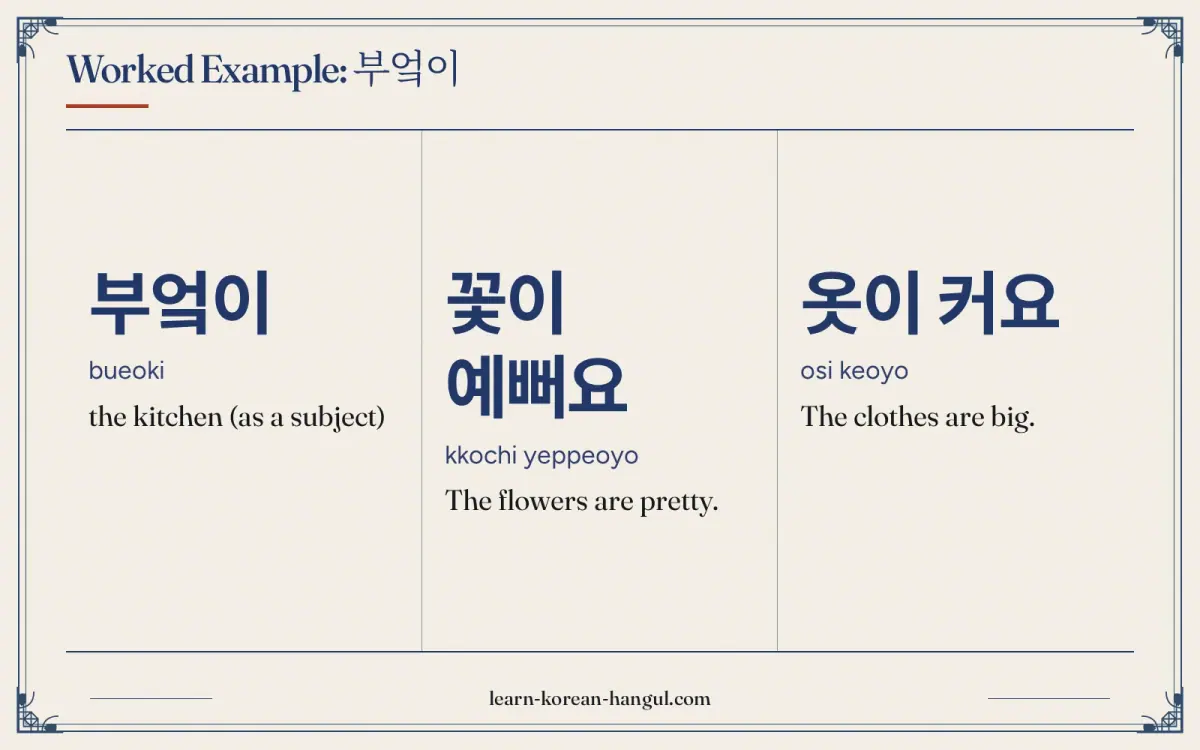
The worked example takes one word through every step. The word 부엌이 means "the kitchen" as the subject of a sentence.
- Read the spelling. 부엌이 has three blocks: 부, 엌 and 이. The block 엌 ends in ㅋ.
부엌이
bueoki
the kitchen (as a subject)
- Say the word alone. 부엌 is [부억]. The ㅋ reduces to ㄱ because nothing follows.
- Add the particle. 이 starts with the silent ㅇ, so a vowel follows.
- Link the consonant. ㅋ leaves 엌 and lands in the empty ㅇ of 이, which becomes 키.
- Rebuild the blocks. 부 + 어 + 키: the middle block is now 어, with no final consonant.
- Say it. [부어키], with a puff of air on 키. Hold a strip of paper to your lips and watch it move on the last syllable.
- Test the change. Say 부엌에 [부어케] and 부엌을 [부어클]. The ㅋ is present in all three.
Note that learners often say [부어기] by reducing ㅋ to ㄱ, which loses the puff. Six common phrases show the rule in context.
| In a phrase | Spoken | RR | Meaning |
|---|---|---|---|
| 꽃이 예뻐요 | [꼬치 예뻐요] | kkochi yeppeoyo | The flowers are pretty. |
| 옷이 커요 | [오시 커요] | osi keoyo | The clothes are big. |
| 밖에 나가요 | [바께 나가요] | bakke nagayo | I go outside. |
| 앞에 있어요 | [아페 이써요] | ape isseoyo | It is in front. |
| 부엌에 있어요 | [부어케 이써요] | bueoke isseoyo | It is in the kitchen. |
| 낮에 만나요 | [나제 만나요] | naje mannayo | We meet in the daytime. |
꽃이 예뻐요
kkochi yeppeoyo
The flowers are pretty.
옷이 커요
osi keoyo
The clothes are big.
밖에 나가요
bakke nagayo
I go outside.
앞에 있어요
ape isseoyo
It is in front.
부엌에 있어요
bueoke isseoyo
It is in the kitchen.
낮에 만나요
naje mannayo
We meet in the daytime.
These phrases mix particles and verb endings, so the rule is seen working in both. Next, the mistakes that appear most often.
Common Learner Mistakes
Learners often assume that the reduced sound is the real one, so they say 꽃이 as [꼬디]. In fact the reduced sound belongs only to syllable-final position, and the original letter returns whenever a vowel-initial particle or ending follows. Four more mistakes follow the same pattern.
- Learners often assume ㅅ always sounds like ㄷ. Actually ㅅ is [ㄷ] only at the end of a syllable. Before a vowel it is an ordinary s, as in 옷이 [오시]. Note that ㅅ before 이 is soft [시], not tense [씨].
- Learners often assume ㅆ weakens to ㅅ. Actually ㅆ stays tense, so 있어요 is [이써요], not [이서요]. The same tight throat is used.
- Learners often assume 밭이 is [바티]. Actually palatalization turns ㅌ + 이 into 치, so the word is [바치]. 밭에 and 밭을 keep ㅌ.
- Learners often drop the aspiration in 앞에. Actually ㅍ keeps its puff, so the word is [아페], not [아베]. A reduced ㅂ would sound softer.
Practise the full set with the drill below.
Practice and Answer Key
Use the audio first, then the drill. Play each clip, say it back, and write the spoken form.
Practice · 8
How is 부엌이 (the kitchen, as subject) pronounced?
Show answer
[부어키]
Before a vowel the final ㅋ moves to the next block with its own sound, so the word is [부어키] with a puff on 키. Reducing it to ㄱ gives the wrong [부어기].
How is 꽃이 pronounced?
Show answer
[꼬치]
The reduction to [꼳] happens only when no vowel follows. Before 이, the ㅊ returns with its own sound: [꼬치].
How is 있어요 pronounced?
Show answer
[이써요]
ㄲ and ㅆ stay tense after the link, so 있어요 is [이써요], not [이서요].
How is 앞에 pronounced?
Show answer
[아페]
ㅍ keeps its puff when it moves to the next block, so 앞에 is [아페]. [아베] drops the aspiration.
How is 밭이 pronounced?
Show answer
[바치]
Palatalization turns ㅌ + 이 into 치, so 밭이 is [바치]. Only 밭에 and 밭을 keep ㅌ.
How is 옷이 pronounced?
Show answer
[오시]
Before a vowel ㅅ moves forward as a soft s: 옷이 [오시]. It is not [ㄷ] and not tense [씨].
Which letters stay aspirated, with a puff of air, after the link?
Show answer
ㅋ, ㅍ, ㅌ and ㅊ
The aspirated group ㅋ ㅍ ㅌ ㅊ keeps its puff: 부엌이 [부어키], 앞에 [아페]. ㄲ and ㅆ stay tense, and ㅅ and ㅈ stay plain.
Why is 꽃 위 said [꼬뒤] and not with ㅊ?
Show answer
위 is a full word, so ㅊ is reduced to ㄷ first and then linked
When the next part is a full word, Article 15 says to reduce the final first and then link the reduced sound: 꽃 위 [꼬뒤], but 꽃이 [꼬치].
Write the spoken form of each phrase.
- 부엌이
- 앞에
- 옷이
- 꽃을
- 밖에
- 있어요
- 닦아요
- 낮이
- 밭이 (watch the vowel)
- 숲이
Answer key: 1. [부어키]. 2. [아페]. 3. [오시]. 4. [꼬츨]. 5. [바께]. 6. [이써요]. 7. [다까요]. 8. [나지]. 9. [바치] (palatalization). 10. [수피].
For a decode-by-ear task, play a clip before reading. Hear [꼬치] and write 꽃이. Hear [바께] and write 밖에. Last, say each word aloud, record yourself, and check that the first block ends in a vowel and the original consonant starts the next block. Common questions follow.
Frequently Asked Questions
How do I say 부엌이? Say [부어키]. The final ㅋ of 부엌 moves to the empty ㅇ of 이 with its own sound, so the word ends in a puff of air on 키. Do not reduce the ㅋ to ㄱ, which would give [부어기]. The same ㅋ is present in 부엌에 [부어케] and 부엌을 [부어클].
Why is 앞에 pronounced 아페? The final ㅍ of 앞 moves to the empty ㅇ of 에 with its own sound, so the word is [아페], with a puff of air. Standing alone, 앞 is [압], with a reduced ㅂ. The vowel of the particle 에 stops the reduction. The same pattern gives 앞으로 [아프로].
Is 옷이 pronounced 오시? Yes. The final ㅅ of 옷 is [ㄷ] when the word stands alone, [옫], but before the vowel of 이 it moves forward as ㅅ. So 옷이 is [오시], with a soft s. It is not [오디] and it is not tense [오씨]. The same pattern gives 옷을 [오슬].
What about ㅆ in 있어요? The ㅆ stays tense and moves to the next block, so 있어요 is [이써요]. Alone, 있 is [읻], but with the vowel of 어요 the full ㅆ returns. Every past-tense form with ㅆ works the same way: 갔어요 is [가써요] and 했어요 is [해써요].
Where to Go Next
The lesson above covers Korean liaison with tense and aspirated batchim only. It does not cover double finals such as ㄺ (읽어요), it does not cover linking before a full word, beyond the short comparison above, and it does not test your pronunciation. For double finals, continue with the next lesson in the series.
Next in the series: Korean Double Batchim Liaison. To return to the full set of lessons, see Liaison (Resyllabification).