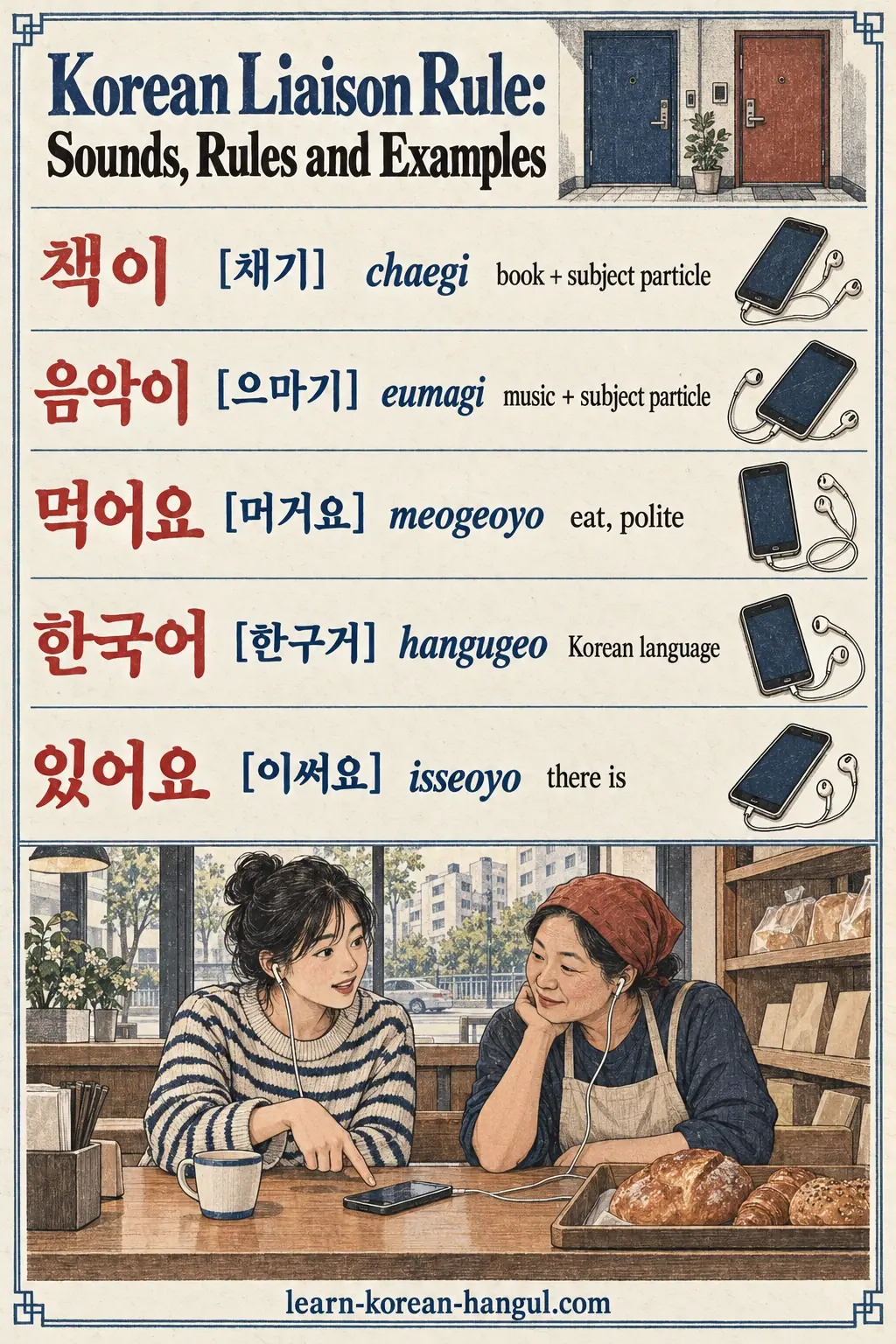
What you will learn
- Apply the liaison rule to 책이, 음악이, 먹어요, 한국어 and 있어요 and say each one correctly.
- Find the empty ㅇ in a written word and move the final consonant of the syllable before it.
- Name the final sounds that do not move or that behave differently.
- Write the spoken form of a word from hearing it, then restore the spelling.
Before you start: you can read Hangul syllable blocks and you know that a batchim is a final consonant. The lesson on batchim representative sounds is the best preparation. Time: about 25 minutes with audio.
Key Facts
- The next syllable must start with ㅇ followed by a vowel letter.
- The final consonant is pronounced at the start of that syllable.
- Tense and aspirated finals such as ㄲ, ㅋ, ㅊ and ㅍ move with their own sound in most cases.
- The final ㅇ (the "ng" sound) does not move.
- A final ㅎ does not link; it drops: 좋아요 is [조아요].
- The rule is set out in Articles 13 to 15 of the Standard Pronunciation Rules (표준 발음법) of the National Institute of Korean Language (국립국어원).
Last updated: 2026-10-08. The Korean text, romanization and audio scripts on this page are generated drafts that still await review by a Korean specialist.
What Is the Korean Liaison Rule?

The Korean liaison rule is a sound-change rule that makes a written final consonant sound like the first consonant of the next syllable. Korean writing puts a consonant at the bottom of one block, but Korean speech puts it at the start of the next. The word "liaison" comes from French and means "linking".
The key is the empty ㅇ. When a Korean syllable starts with a vowel, it is written with a ㅇ in front, as in 이 or 어. That ㅇ is silent at the start of a syllable. It is an empty seat, and the final consonant from the syllable before it takes that seat.
| Written | Syllable blocks | Spoken | Revised Romanization |
|---|---|---|---|
| 책이 (book + subject particle) | 책 + 이 | [채기] | chaegi |
| 음악이 (music + subject particle) | 음 + 악 + 이 | [으마기] | eumagi |
| 먹어요 (eat, polite) | 먹 + 어 + 요 | [머거요] | meogeoyo |
| 한국어 (Korean language) | 한 + 국 + 어 | [한구거] | hangugeo |
| 있어요 (there is) | 있 + 어 + 요 | [이써요] | isseoyo |
Revised Romanization (RR) is the official Korean system for writing Hangul in Latin letters. In this lesson it is a learning aid only, and the Hangul is always the main form. Once you see the empty ㅇ, the next question is why English speakers so often miss it.
Why Does the Spelling Hide the Real Sound?
Korean spelling follows word parts, but Korean speech follows syllables. The spelling 책이 shows the noun 책 and the particle 이 as two clean pieces. The speaker, however, says [채기], so the syllable break falls in a different place than the spelling suggests.
English speakers meet the same effect in their own language without noticing. Most people say "pick it up" as "pi-ki-tup", with the "k" attached to the next word. Korean does this every time a final consonant meets a vowel, and the rule has very few exceptions.
The problem for learners is that they read a block at a time. A learner who says "chaek... i" breaks the link, and the listener hears a pause where Korean has none. The fix is to read the written word as a chain of sounds, not as a row of separate blocks.
With the reason clear, the next step is the rule itself.
What Is the Basic Liaison Rule?

The basic liaison rule has three parts: a final consonant, a syllable that starts with ㅇ plus a vowel, and a move from one to the other. When both are present, the consonant leaves its own block and lands in the empty ㅇ of the next block.
- Find the pair. A syllable that ends in a consonant is followed by a syllable that starts with ㅇ and a vowel.
- Move the consonant. The final consonant leaves the first block and replaces the silent ㅇ in the second.
- Say it as one flow. The first syllable now ends in a vowel, and the second starts with the moved consonant.
The table shows the rule for each common final consonant. The moved consonant keeps its normal sound, not the shorter sound it has at the end of a word.
| Final consonant | Example | Spoken | Meaning |
|---|---|---|---|
| ㄱ | 먹어요 | [머거요] | eat (polite) |
| ㄴ | 신어요 | [시너요] | wear on the feet (polite) |
| ㄹ | 살아요 | [사라요] | live (polite) |
| ㅁ | 심어요 | [시머요] | plant (polite) |
| ㅂ | 입어요 | [이버요] | wear (polite) |
| ㅅ | 웃어요 | [우서요] | laugh (polite) |
| ㅈ | 낮이 | [나지] | daytime + subject particle |
The rule is the same for nouns and verbs. A noun plus particle like 책이 and a verb stem plus ending like 먹어요 follow the identical steps.
The basic rule applies to almost every final consonant, but a few finals break the pattern, and they come later in this lesson. First, here is how to apply the rule in practice.
How Do You Apply the Rule to a New Word?
To apply the rule, read the word from left to right, look for every empty ㅇ, and move the final consonant of the block before it. The method takes four steps and works on words you have never heard.
- Split the word into blocks. Write 한국어 as 한 / 국 / 어.
- Mark each block that starts with ㅇ and a vowel. In 한국어 that is 어.
- Look one block back. The block before 어 is 국, which ends in ㄱ.
- Move and say. Take ㄱ out of 국 and put it in front of 어. The word becomes 한 / 구 / 거, spoken [한구거].
You will know it worked when the spoken form has no consonant "stranded" at the end of a block that sits before a vowel. If you hear a pause after the consonant, the link is missing.
A common mistake at this stage is to move the consonant and then also keep it in the first block, which gives [한국거]. The consonant is moved, not copied. Another mistake is to look for the empty ㅇ in the wrong place. Only ㅇ at the start of a block counts, and the ㅇ at the bottom of a block is a different sound.
Now the exceptions: three kinds of final do not simply move.
Which Finals Behave Differently?

Three situations change the basic rule: a final ㅇ, a ㅎ, and a double batchim (two consonants in one final position). Each has a simple, learnable pattern.
| Situation | Example | Spoken | What happens |
|---|---|---|---|
| Final ㅇ (ng) | 사랑이 | [사랑이] | Does not move. The "ng" sound stays at the end of the block. |
| Final ㅎ | 좋아요 | [조아요] | ㅎ is silent, so nothing moves. |
| Final ㄶ | 많이 | [마니] | The ㅎ is silent and the ㄴ moves. |
| Double batchim ㄺ | 닭이 | [달기] | The first consonant stays and the second moves. |
| Double batchim ㄺ | 읽어요 | [일거요] | The first consonant stays and the second moves. |
| Double batchim ㄵ | 앉아요 | [안자요] | The first consonant stays and the second moves. |
Final ㅇ is the most common source of error. The word 사랑이 has the written shape of a liaison pair, but the ㅇ at the bottom of 랑 is the "ng" sound and it stays there. It is spoken [사랑이], with a clear "ng" and then a clean vowel.
Final ㅅ, ㅆ, ㅈ, ㅊ, ㅋ, ㅌ, ㅍ and ㄲ move with their full sound. The words 꽃이 [꼬치] and 앞에 [아페] show this. One exception: final ㄷ or ㅌ before 이 turns into ㅈ or ㅊ, so 밭이 is [바치], a rule called palatalization. The lesson on liaison with tense and aspirated finals gives the full list. The lesson on double batchim liaison covers the rest of the two-consonant finals.
Compound words add one more case. A noun plus a particle links directly, as in 옷이 [오시]. A word plus a separate word with its own meaning does not link in the same way, as in 옷 안 [오단], where the ㅅ first changes to ㄷ. The lesson on liaison with compound words covers it in detail.
The exceptions are small, and Romanization usually records the moved sound, so it is worth seeing how the two systems line up.
Liaison in Revised Romanization

Revised Romanization writes the sound you hear, so it shows liaison in most words. The word 한국어 is hangugeo and 책이 is chaegi, so the g in each romanization already shows the moved ㄱ. A learner who reads the Romanization aloud gets close to the spoken form for these words.
Romanization is still not a full guide. RR does not mark every sound change, and it uses the same letters for different Korean sounds in some positions. For example, 학교 is romanized hakgyo, but it is spoken with a tense [ㄲ] sound that RR does not record. For that reason this site treats Romanization as a learning aid and keeps Hangul as the reference. The page on Korean romanization explains the system in full.
A look at one word from start to finish will pull the steps together.
Worked Example: 음악이

The word 음악이 means "music" followed by the subject particle 이, and it is spoken [으마기]. It contains two links in a row, which makes it a good test of the method.
- Split into blocks: 음 / 악 / 이.
- Find the first empty ㅇ. The block 악 starts with ㅇ and the vowel ㅏ. The block before it, 음, ends in ㅁ.
- Move ㅁ. The ㅁ leaves 음 and replaces the silent ㅇ in 악. The result so far is 으 / 마ㄱ, and the ㄱ is still at the bottom of the second block.
- Find the second empty ㅇ. The block 이 starts with ㅇ and the vowel ㅣ. The block before it ends in ㄱ.
- Move ㄱ. The ㄱ leaves the second block and replaces the silent ㅇ in 이. The final result is 으 / 마 / 기.
- Say it as one flow: [으마기].
You will know it worked when your spoken version has three clean syllables, each ending in a vowel, and no pause between them. Replay the 음악이 clip under the first table, then say the word along with it.
Chain links like this are normal, not special. Two or three links in one word follow the same rule, applied from left to right. Mistakes at this step are common, so the next section lists the ones that matter most.
Common Learner Mistakes
Learners often assume that spelling shows how a word is divided in speech. The rule says otherwise, and each mistake below comes from trusting the written block over the spoken syllable.
- Mistake 1: pausing before the particle. Learners often say 책... 이. Actually the particle joins the noun, because the final consonant moves forward. Say [채기] as one word.
- Mistake 2: moving the "ng". Learners often assume that 사랑이 becomes [사라이]. Actually the final ㅇ is the "ng" sound and it stays, because it is a full consonant at the end of the block, not an empty one.
- Mistake 3: treating liaison as casual speech. Learners often assume that careful or formal speech skips the link. Actually the rule is part of the Standard Pronunciation Rules and applies in careful speech as well as in fast speech, because it follows from how Korean syllables are built.
- Mistake 4: sounding the silent ㅎ. Learners often say 좋아요 as [조하요]. Actually the ㅎ disappears before a vowel, so the word is [조아요].
- Mistake 5: writing what you hear. In dictation, learners often write 채기 for 책이. The spoken form is a guide to the sound, not to the spelling, so you must restore the final consonant when you write.
Expert tip: when you hear a Korean word and the vowel seems to start with a consonant, ask whether the previous block ended in a consonant. If it did, you are probably hearing liaison, and the spelling will show that consonant in the earlier block.
Rule of thumb for dictation: write the sounds you hear first, then split the consonant back into the block before. For [머거요], you hear 머 / 거 / 요, and you restore 먹 / 어 / 요.
With the mistakes in view, test yourself with the practice set.
Practice and Answer Key
Write the spoken form in Hangul brackets for each word. Say each one aloud before you check the answers.
- 책이
- 한국어
- 먹어요
- 음악이
- 있어요
- 사랑이
- 좋아요
- 꽃이
Answer key
- 책이 → [채기]
- 한국어 → [한구거]
- 먹어요 → [머거요]
- 음악이 → [으마기]
- 있어요 → [이써요]
- 사랑이 → [사랑이] (final ㅇ does not move)
- 좋아요 → [조아요] (ㅎ is silent)
- 꽃이 → [꼬치] (the ㅊ moves with its own sound)
A score of 7 or 8 out of 8 means you can move on. If you missed the answers to 6 and 7, re-read the section on finals that behave differently. After the drill, the next step is to apply the rule to particles.
Where to Go Next
The next lesson, Korean liaison with particles, applies the Korean liaison rule to the particles 이/가, 을/를, 은/는 and 에서. To review how any final consonant is pronounced before a link is made, use the batchim method. The full set of liaison lessons sits in the Liaison (Resyllabification) section.
This lesson does not cover double batchim in depth, compound words, or the tense and aspirated finals, because each has its own lesson. It also does not cover other sound changes such as nasalization, which has its own section. The audio shows one standard Seoul pronunciation, and individual speakers vary in speed and clarity.
Frequently Asked Questions
Why is 먹어요 pronounced 머거요? The final ㄱ of 먹 moves into the empty ㅇ of 어 under the liaison rule. The blocks are 먹 and 어, but the spoken syllables are 머 and 거. The ending 요 follows unchanged, so the word is [머거요] with no pause and no separate "k" sound at the end of 먹.
Is 책이 pronounced chaegi? Yes. The final ㄱ of 책 moves onto the empty ㅇ of 이, so the spoken form is [채기], and Revised Romanization writes it chaegi. Reading it as "chaek-i" with a pause is the usual learner error. Say 채 and 기 as one smooth word, with the ㄱ opening the second syllable.
What happens with ㅎ in liaison? A final ㅎ is silent before a vowel, so nothing moves. The word 좋아요 is spoken [조아요], not [조하요]. When ㅎ is part of ㄶ or ㅀ, the other consonant still moves: 많이 is [마니]. Before a consonant, ㅎ behaves differently, as the aspiration lessons explain.
Is liaison the same as resyllabification? Mostly yes. Resyllabification is the linguistic term for a sound moving across a syllable boundary, and 연음 (yeoneum) is the Korean name for the case where a final consonant moves to a following vowel. Textbooks and learner sites use "liaison", "linking" and "resyllabification" for the same pattern.