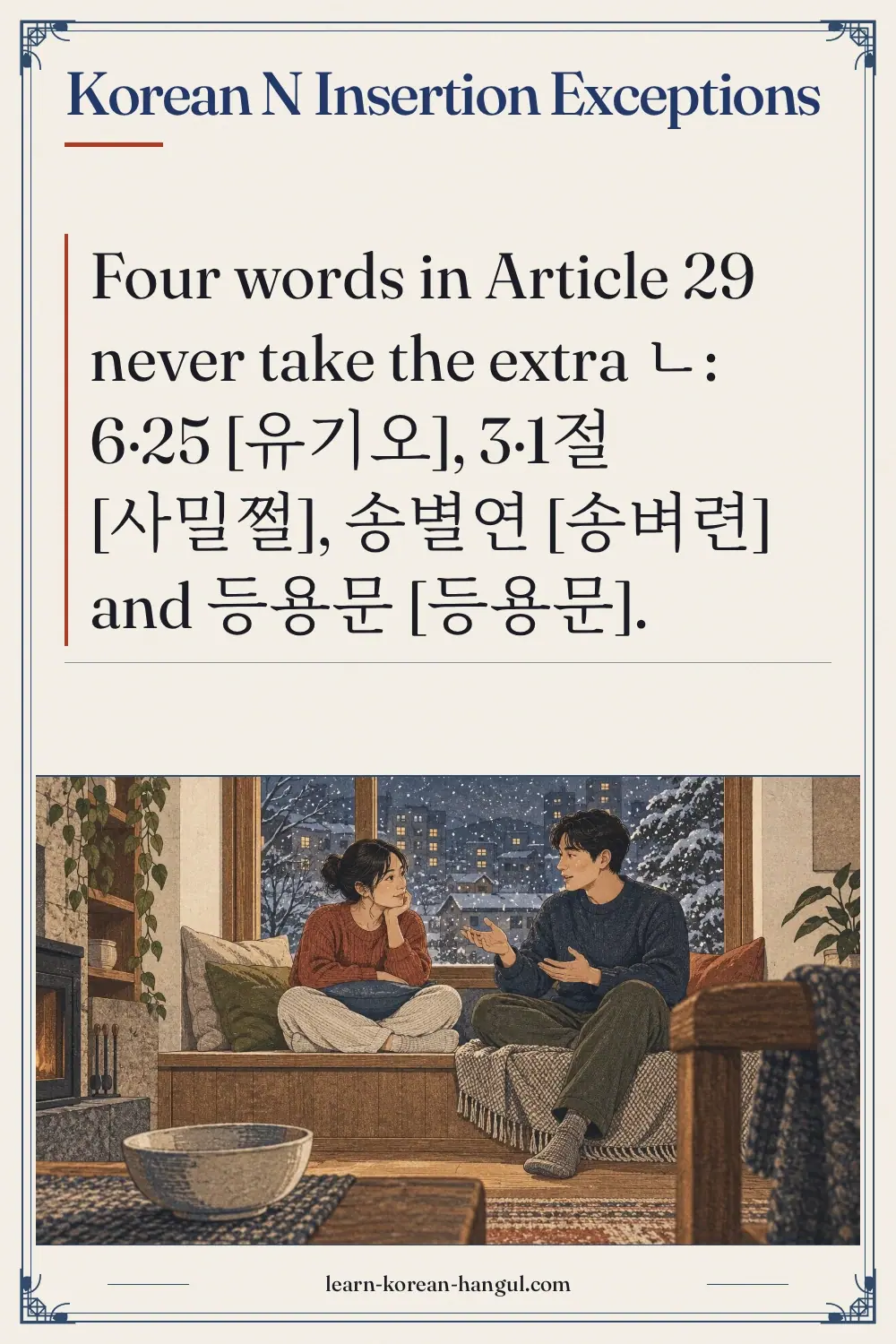
Korean n insertion exceptions are the words in which the extra ㄴ sound is not added, or may be left out, even though a consonant meets 이, 야, 여, 요 or 유. 6·25 (the Korean War) is [유기오], not [융니오], and 검열 (censorship) may be [검녈] or [거멸].
What you'll learn
- Say 금요일, 목요일, 6·25 and 검열 in their standard forms.
- Name the four words that never take the extra ㄴ and the two common words with two forms.
- Explain why the days of the week are not really exceptions.
- Decide when to check a dictionary before adding an [ㄴ].
Prerequisite: Korean N Insertion Rules, which teaches the main rule and the meaning test. Estimated time: 30 minutes.
What Are Korean N Insertion Exceptions?
Korean n insertion exceptions are words that do not follow the n-insertion rule in the expected way. The rule says that in a compound or derived word, when the first part ends in a consonant and the second part starts with 이, 야, 여, 요 or 유, an extra [ㄴ] is added: 한여름 (midsummer) is [한녀름], and 색연필 (colored pencil) is [생년필].
The exceptions fall into three groups:
- Never inserted: four words listed in Article 29, such as 6·25 [유기오].
- Two forms: five words that may be said with or without the [ㄴ], such as 검열.
- Outside the rule: one-piece Sino-Korean words such as 금요일 [그묘일], which are not compounds at all.
Article 29 of the Standard Pronunciation Rules (표준 발음법), published by the National Institute of Korean Language (국립국어원), lists the first two groups in its 다만 (however) clauses. The third group is the largest and the one learners meet first. Before sorting the groups, it helps to see why the exceptions cause trouble.
Why English Speakers Struggle Here
English speakers struggle here because the inserted [ㄴ] has no letter. A learner first has to learn to add a sound that is not written, as in 한여름 [한녀름]. Once that habit is built, the learner has to switch it off in words that look just the same on the page.
English offers no help, since English compounds never gain an unwritten [n] at the seam: "sun" plus "yard" is just "sunyard". So learners tend to swing between two errors: never inserting at all, or inserting everywhere, including in 금요일 (Friday), which then comes out as [금뇨일]. The cure is to know the three groups, starting with the four fixed words.
Which Words Never Take the Extra ㄴ?
Four words never take the extra ㄴ, and Article 29 lists them by name. In each, the final consonant simply moves onto the vowel by liaison.
| Written | Read as | Expected by the rule | Standard | Meaning |
|---|---|---|---|---|
| 6·25 | 육이오 | [융니오] | [유기오] | the Korean War (began 25 June 1950) |
| 3·1절 | 삼일절 | [삼닐쩔] | [사밀쩔] | Independence Movement Day, 1 March |
| 송별연 | 송별연 | [송별련] | [송벼련] | farewell party |
| 등용문 | 등용문 | [등뇽문] | [등용문] | gateway to success |
The two dates are names built from Sino-Korean numbers: 육 (six), 이 (two), 오 (five), and 삼 (three), 일 (one), 절 (holiday). In these two names the digits are read one after another with plain liaison, so 육 + 이 gives [유기]. In 3·1절, the 절 is also tense, [쩔], by Sino-Korean tensification, which tenses ㅈ after ㄹ.
송별연 is the ㄹ case: by n-insertion with ㄹ you would expect [송별련], but the standard is [송벼련]. 등용문, from a Chinese legend about a carp leaping a waterfall, keeps a plain [등용문]. Learn these four as fixed items.
Why Do the Days of the Week Have No Extra ㄴ?
The days of the week have no extra ㄴ because each is a single Sino-Korean word, not a compound of two words. 금요일 (金曜日, Friday) is felt as one unit, so the n-insertion rule never applies. The final consonant just links.
| Written | Spoken | Meaning | Note |
|---|---|---|---|
| 월요일 | [워료일] | Monday | ㄹ links onto 요 |
| 화요일 | [화요일] | Tuesday | no final consonant |
| 수요일 | [수요일] | Wednesday | no final consonant |
| 목요일 | [모교일] | Thursday | ㄱ links onto 요 |
| 금요일 | [그묘일] | Friday | ㅁ links onto 요 |
| 토요일 | [토요일] | Saturday | no final consonant |
| 일요일 | [이료일] | Sunday | ㄹ links onto 요 |
The table also explains why 월요일 and 화요일 behave differently on the surface. 월 ends in a consonant, so its ㄹ moves and you hear [워료일]. 화 ends in a vowel, so nothing moves and nothing could be inserted. Four weekdays show liaison, and three show no change at all. The vocabulary itself is taught in days of the week.
Many other one-piece Sino-Korean words behave the same way: 석유 (oil) [서규], 금연 (no smoking) [그면], 절약 (saving) [저략] and 활용 (use) [화룡]. They are not on any exception list, because the rule was never meant for them.
Which Words Have Two Accepted Forms?
Five words have two accepted forms, and Article 29 lists them. The form with the inserted [ㄴ] is given first, and the form said as written, with plain liaison, is also allowed.
| Written | First form | Also allowed | Meaning |
|---|---|---|---|
| 검열 | [검녈] | [거멸] | censorship, inspection |
| 금융 | [금늉] | [그뮹] | finance |
| 이죽이죽 | [이중니죽] | [이주기죽] | sneering, making snide remarks |
| 야금야금 | [야금냐금] | [야그먀금] | nibbling bit by bit |
| 욜랑욜랑 | [욜랑뇰랑] | [욜랑욜랑] | acting frivolously, fooling about |
The two useful words for learners are 검열 and 금융. 금융 appears in banking, news and TOPIK reading, in compounds such as 금융 위기 (financial crisis). The three repeated words are mimetic words, words that imitate a manner or movement, and you will rarely need to say them. For your own speech, pick one form of each word and use it consistently.
The Exceptions in Sentences
The exceptions keep their standard form inside sentences. Read these aloud, and watch the key word in each.
| Sentence | Key word spoken | Meaning |
|---|---|---|
| 금요일에 만나요. | [그묘이레] | Let's meet on Friday. |
| 6·25 전쟁은 1950년에 시작됐어요. | [유기오] | The Korean War began in 1950. |
| 3·1절은 공휴일이에요. | [사밀쩌른] | Independence Movement Day is a public holiday. |
| 오늘 송별연이 있어요. | [송벼려니] | There is a farewell party today. |
Notice that the particles after each word link normally: 금요일에 is [그묘이레], with the ㄹ of 일 moving onto 에. The exception affects only the seam that would have received the [ㄴ].
Across word spaces, the picture is different. Article 29 also applies n-insertion between two separate words said as one phrase, as in 한 일 (one task) [한닐] and 옷 입다 (to put on clothes) [온닙따]. If the speaker pauses between the words, no [ㄴ] appears: 한 | 일 is [한 일]. So a slow, careful speaker may sound as if a word is an exception when the real cause is the pause. Inside a single word such as 금요일, a pause never happens, and the form is always [그묘일]. With that in mind, the memory aid below sorts the groups.
How Do You Remember Them?
Remember the exceptions as four small boxes, each with its own test.
- Is it a date or number name? Read the digits as Sino-Korean numbers with liaison: 6·25 [유기오], 3·1절 [사밀쩔].
- Is it one of the two fixed words? 송별연 [송벼련] and 등용문 [등용문]: memorize them.
- Is it a single Sino-Korean word? Weekdays, 석유, 금연 and similar words only link.
- Is it 검열 or 금융? Either form is correct.
If a word passes none of these tests and is a clear compound, such as 한여름 or 색연필, insert the [ㄴ]. When you are unsure, check the bracketed pronunciation in the Standard Korean Language Dictionary (표준국어대사전), which records each word.
Do You Need Them Early?
Partly. The weekdays are A1 vocabulary, so you need [그묘일] and [모교일] from your first weeks of Korean. The listed exceptions and the two-form words can wait until intermediate level, when you study n-insertion itself and start reading news.
A practical order works well. Learn the weekday pronunciations with the weekday words. Learn 6·25 and 3·1절 when you first read about Korean history or holidays. Learn 검열 and 금융 when they appear in your reading. A worked example now shows the full decision for one word.
Worked Example: 금요일
Follow these steps to decide how to say 금요일 (Friday).
- Spot the trigger. 금 ends in ㅁ, and the next syllable is 요. A consonant before 요 can trigger n-insertion.
- Ask whether it is a compound. 금요일 is one Sino-Korean word (金曜日). 금 is not a word or prefix of its own here, so speakers do not split it off from 요일.
- Decide. Not a compound, so no [ㄴ] is inserted.
- Apply liaison. The ㅁ moves onto 요: 그 + 묘 + 일.
- Say it. [그묘일], three smooth syllables.
You will know it worked when the middle syllable sounds like 묘, the same syllable as at the start of 묘사 (description), and there is no [n] before it. If you hear [금뇨일], the rule has been over-applied. Compare once with 한여름 [한녀름], where the [ㄴ] belongs.
Common Learner Mistakes
Mistake 1: inserting ㄴ in the weekdays. Learners who have just learned the rule say 금요일 as [금뇨일]. Actually 금요일 is one word, so it is [그묘일].
Mistake 2: reading 6·25 with an inserted ㄴ. Learners often say [융니오]. Actually Article 29 lists 6·25 as an exception: [유기오].
Mistake 3: treating two-form words as errors. Learners sometimes correct a speaker who says [거멸]. Actually both [검녈] and [거멸] are standard.
Mistake 4: forgetting tensing in 3·1절. Learners often say [사밀절]. Actually 절 after ㄹ is tense in Sino-Korean words: [사밀쩔].
Mistake 5: assuming every exception is a weekday. Learners often think the list is only about days. Actually most one-piece Sino-Korean words, such as 석유 [서규], also take no [ㄴ].
The practice below rehearses each group.
Practice and Answer Key
Exercise 1. Write the standard spoken form.
- 목요일
- 6·25
- 송별연
- 일요일
- 석유
Exercise 2. Insert ㄴ, never insert, or two forms?
- 색연필 (colored pencil)
- 금융 (finance)
- 등용문 (gateway to success)
- 한여름 (midsummer)
Exercise 3. Why is there nothing to link in 화요일?
Answers.
Exercise 1: 1 [모교일], 2 [유기오], 3 [송벼련], 4 [이료일], 5 [서규].
Exercise 2: 1 insert, [생년필]. 2 two forms, [금늉] or [그뮹]. 3 never insert, [등용문]. 4 insert, [한녀름].
Exercise 3: 화 ends in a vowel, so there is no final consonant to move and no place for an inserted [ㄴ].
If you missed Exercise 1, item 1 or 4, replay the weekday audio and say all seven days in order.
Where to Go Next
The next lesson, Korean sai siot, shows a spelling that marks an inserted [ㄴ] in words such as 나뭇잎 [나문닙]. Review the n-insertion rule if the meaning test still feels uncertain. The full sequence is on the N-Insertion page.
This lesson covers the Article 29 exceptions and the weekday words in standard Seoul speech. It does not list every Sino-Korean word without insertion, cover regional speech, or treat loanwords. The audio gives one standard form per clip, and both forms for the two-form words.
In short, Korean n insertion exceptions come in three groups: four fixed words with no [ㄴ], five words with two forms, and one-piece Sino-Korean words such as 금요일 that only link.
Frequently Asked Questions
Is 금요일 [금뇨일]? No. The standard pronunciation of 금요일 (Friday) is [그묘일]. 금요일 is one Sino-Korean word, not a compound of two words, so n-insertion does not apply. The ㅁ of 금 simply moves onto 요 by liaison. 목요일 [모교일], 월요일 [워료일] and 일요일 [이료일] work the same way.
Why is 6·25 pronounced 유기오? 6·25 is read 육이오, the Sino-Korean numbers six, two and five, and names the start of the Korean War on 25 June 1950. Article 29 lists it as a word that takes no inserted ㄴ, so the ㄱ of 육 links onto 이: [유기오]. The form [융니오] is not standard.
Is 검열 optional? Yes. Article 29 gives 검열 (censorship, inspection) two standard forms. [검녈], with the inserted ㄴ, is listed first, and [거멸], said as written with liaison, is also allowed. Both are correct, so choose one for your own speech. 금융 (finance) works the same way: [금늉] or [그뮹].
What else is an exception? Besides 6·25, Article 29 lists 3·1절 [사밀쩔], 송별연 (farewell party) [송벼련] and 등용문 (gateway to success) [등용문] as words with no inserted ㄴ. Many one-piece Sino-Korean words, such as 석유 (oil) [서규], are not exceptions but fall outside the rule, because they are not compounds.
Should I insert ㄴ in a word I have never seen? Use the meaning test first. If the word is a clear compound whose second part is a word starting with 이, 야, 여, 요 or 유, as in 한여름, insert the [ㄴ]. If it is one Sino-Korean word, as in 석유, just link. When the test gives no clear answer, check the dictionary pronunciation.