
Days of the Week in Korean at a Glance
Every day name has two parts: a one-syllable element name (or sun, or moon) and 요일, which means day of the week. So 월요일 is 월 plus 요일. Once you know that, the seven names are seven short syllables plus one ending you already know. This page sits in Time Words, beside Months and Time Expressions.
| Group | Words | What it covers |
|---|---|---|
| The seven days | 7 | Monday to Sunday |
| Weekdays and weekend | 5 | 요일, 평일, 주말, 휴일, 공휴일 |
| Weeks and repetition | 4 | week, every week, this week, next week |
| Today and nearby | 4 | today, yesterday, tomorrow, last week |
Most Korean wall calendars start the week with Sunday (일요일), printed in red, while many planners and work schedules start with Monday. Check the first column when you read one.
Which Days of the Week Should You Learn First?
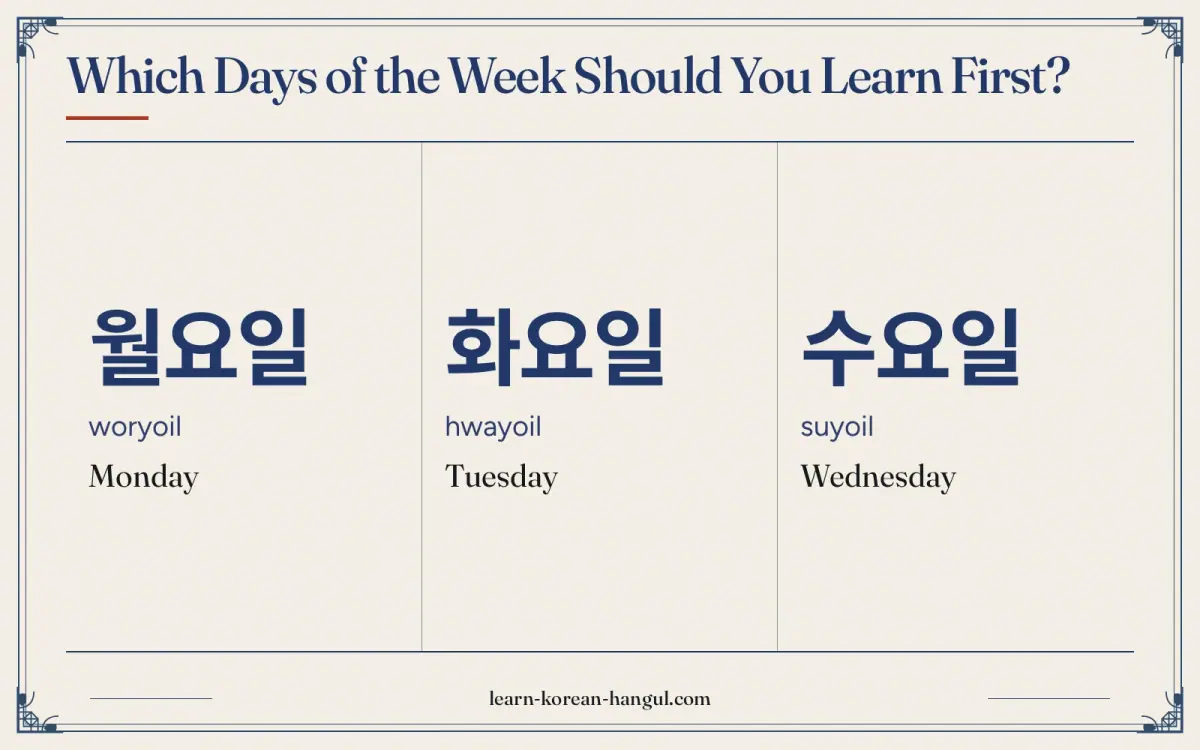
Start with 요일 and the question 오늘 무슨 요일이에요? (What day is it today?). Then learn the seven names in order and say each one with 에 to mean on that day. After the names, add 주말 and 평일, because those two words answer most small-talk questions about plans.
- Say first. 월요일, 금요일, 토요일, 일요일, 주말, 오늘, 내일.
- Recognise. 공휴일, 휴일, 지난주. They appear on notices and timetables.
- Build later. 매주 and the other every-X words once you can say the days.
The scene below shows a wall calendar with the seven days as numbered items. Tap a number to hear the word, then say it back.
Word · 10
- 1
월요일
woryoil
Monday
- 2
화요일
hwayoil
Tuesday
- 3
수요일
suyoil
Wednesday
- 4
목요일
mogyoil
Thursday
- 5
금요일
geumyoil
Friday
- 6
토요일
toyoil
Saturday
- 7
일요일
iryoil
Sunday
- 8
주말
jumal
weekend
- 9
오늘
oneul
today
- 10
내일
naeil
tomorrow
The Seven Days
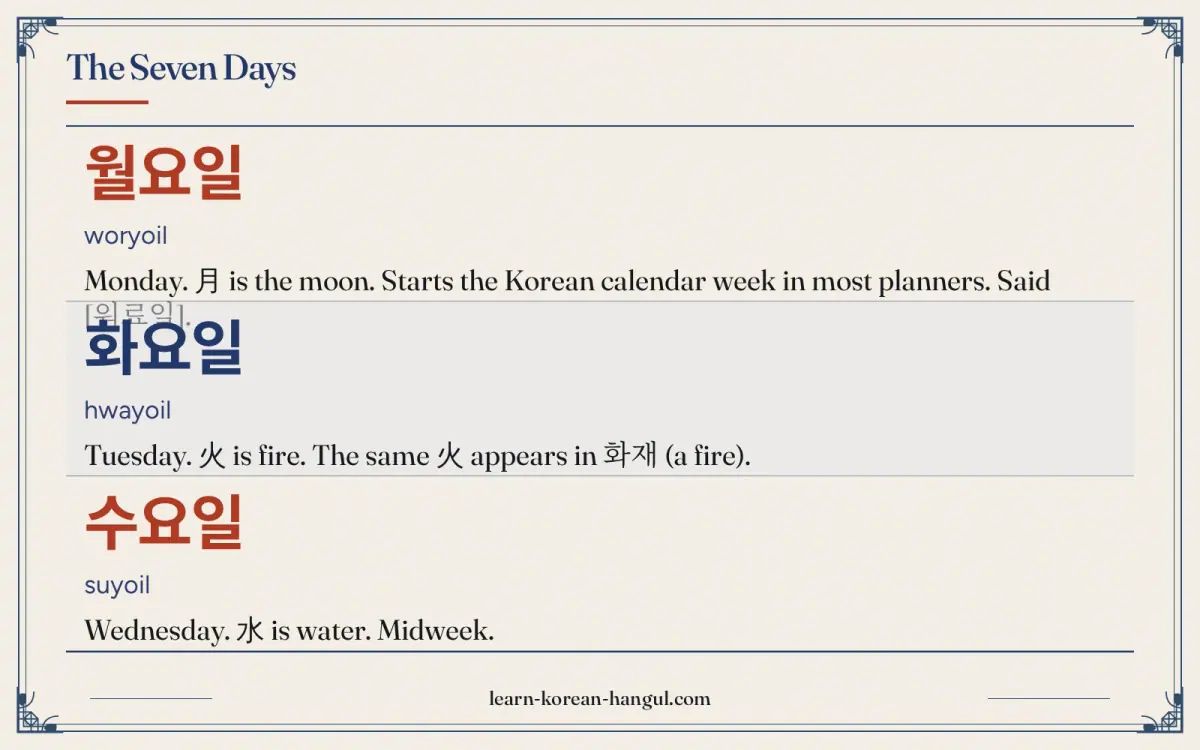
All seven names are used the same way. To say on Monday, add 에: 월요일에. To make the day the topic of the sentence, add 은 after a consonant or 는 after a vowel: 목요일은 바빠요. When the first syllable ends in a consonant, that consonant moves across to the 요 that follows, which is why 월요일 sounds like [워료일] and 금요일 like [그묘일].
| No. | Hangul | Revised Romanization | Meaning and note | Example sentence | Audio assetId |
|---|---|---|---|---|---|
| 1 | 월요일 | woryoil | Monday. 月 is the moon. Starts the Korean calendar week in most planners. Said [워료일]. | 월요일에 학교에 가요. (I go to school on Monday.) | au-pg-vocabulary-time-days-of-week-1; example: au-pg-vocabulary-time-days-of-week-21 |
| 2 | 화요일 | hwayoil | Tuesday. 火 is fire. The same 火 appears in 화재 (a fire). | 화요일에 수업이 있어요. (I have class on Tuesday.) | au-pg-vocabulary-time-days-of-week-2; example: au-pg-vocabulary-time-days-of-week-22 |
| 3 | 수요일 | suyoil | Wednesday. 水 is water. Midweek. | 수요일에 친구를 만나요. (I meet a friend on Wednesday.) | au-pg-vocabulary-time-days-of-week-3; example: au-pg-vocabulary-time-days-of-week-23 |
| 4 | 목요일 | mogyoil | Thursday. 木 is wood. The final ㄱ of 목 links to the next syllable. Said [모교일]. | 목요일은 바빠요. (Thursday is busy.) | au-pg-vocabulary-time-days-of-week-4; example: au-pg-vocabulary-time-days-of-week-24 |
| 5 | 금요일 | geumyoil | Friday. 金 is metal or gold. Said [그묘일]. | 금요일 저녁에 영화를 봐요. (I watch a movie on Friday evening.) | au-pg-vocabulary-time-days-of-week-5; example: au-pg-vocabulary-time-days-of-week-25 |
| 6 | 토요일 | toyoil | Saturday. 土 is earth. First day of the weekend. | 토요일에 쉬어요. (I rest on Saturday.) | au-pg-vocabulary-time-days-of-week-6; example: au-pg-vocabulary-time-days-of-week-26 |
| 7 | 일요일 | iryoil | Sunday. 日 is the sun. Written 일 alone it also means day or work, so keep 요일 attached. Said [이료일]. | 일요일에는 늦게 일어나요. (I get up late on Sundays.) | au-pg-vocabulary-time-days-of-week-7; example: au-pg-vocabulary-time-days-of-week-27 |
Example Sentences
Each example uses one of two frames. The first is day + 에 + verb, as in 토요일에 쉬어요, which says what happens on that day. The second is day + 은/는 + description, as in 목요일은 바빠요, which says what the day is like. Play the sentence, repeat it, then replace the day with another one.
The names are the base. The next group names the blocks of days that Koreans talk about most.
How Do You Say Weekdays and Weekend in Korean?
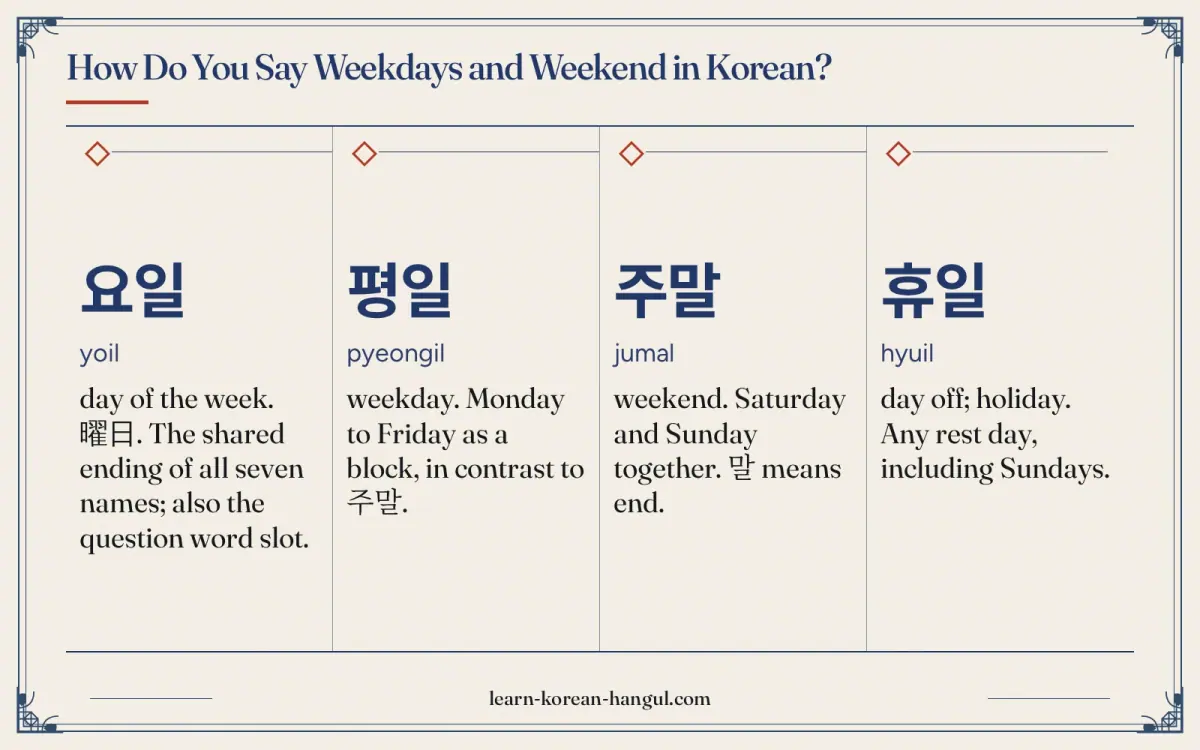
Koreans think in blocks as much as in single days. 평일 is the working week, 주말 is Saturday and Sunday together, and 휴일 is any day when most people do not work. 공휴일 is narrower: a public holiday declared by law, such as Hangeul Day on 9 October. Strictly, the regulation on public holidays also lists Sundays as 공휴일, but in everyday use 공휴일 means the named holidays, while 휴일 is any day without work.
| No. | Hangul | Revised Romanization | Meaning and note | Example sentence | Audio assetId |
|---|---|---|---|---|---|
| 8 | 요일 | yoil | day of the week. 曜日. The shared ending of all seven names; also the question word slot. | 오늘 무슨 요일이에요? (What day of the week is it today?) | au-pg-vocabulary-time-days-of-week-8; example: au-pg-vocabulary-time-days-of-week-28 |
| 9 | 평일 | pyeongil | weekday. Monday to Friday as a block, in contrast to 주말. | 평일에는 일찍 일어나요. (I get up early on weekdays.) | au-pg-vocabulary-time-days-of-week-9; example: au-pg-vocabulary-time-days-of-week-29 |
| 10 | 주말 | jumal | weekend. Saturday and Sunday together. 말 means end. | 주말에 뭐 해요? (What do you do on the weekend?) | au-pg-vocabulary-time-days-of-week-10; example: au-pg-vocabulary-time-days-of-week-30 |
| 11 | 휴일 | hyuil | day off; holiday. Any rest day, including Sundays. | 휴일에는 집에 있어요. (On days off I stay at home.) | au-pg-vocabulary-time-days-of-week-11; example: au-pg-vocabulary-time-days-of-week-31 |
| 12 | 공휴일 | gonghyuil | public holiday. A day set by law. 공 means public. | 한글날은 공휴일이에요. (Hangeul Day is a public holiday.) | au-pg-vocabulary-time-days-of-week-12; example: au-pg-vocabulary-time-days-of-week-32 |
The word 요일 on its own is also the key to a question: 무슨 요일이에요? asks which day of the week. You answer with a full name, as in 화요일이에요. A listener hears 요일 and knows you want a weekday name, not a date.
Day-Name Logic: Sun, Moon, Fire, Water, Wood, Metal, Earth
The seven names come from Chinese characters (Sino-Korean words, or 한자어). The characters are the classical seven: the sun, the moon and the five elements. Japanese uses the same system (月曜日 and so on), while modern Chinese numbers its weekdays instead. The Korean reading of each character is one short syllable, which is why the day names look so regular.
| Name | Element syllable | Hanja | Meaning of the hanja |
|---|---|---|---|
| 월요일 | 월 (wol) | 月 | moon |
| 화요일 | 화 (hwa) | 火 | fire |
| 수요일 | 수 (su) | 水 | water |
| 목요일 | 목 (mok) | 木 | wood |
| 금요일 | 금 (geum) | 金 | metal; gold |
| 토요일 | 토 (to) | 土 | earth; soil |
| 일요일 | 일 (il) | 日 | sun; day |
Use the table as a memory aid. 수 is water, so 수요일 has the same 수 as 수영 (swimming) and 수도 (tap water). 금 is gold, so 금요일 shares 금 with 황금 (gold) and 금메달 (gold medal). The hanja characters are not needed to speak or read modern Korean, but they make the pattern stick. For the full story behind the characters, see the days of the week in Korean hanja page.
A calendar often shows only the element syllable in brackets, as in (월), (화), (수), (목), (금), (토), (일), after a date. When you see 5월 3일 (금), read it as 5월 3일 금요일. The single character is a written shortcut, not something people say.
How Do You Say Weeks and Relative Days in Korean?
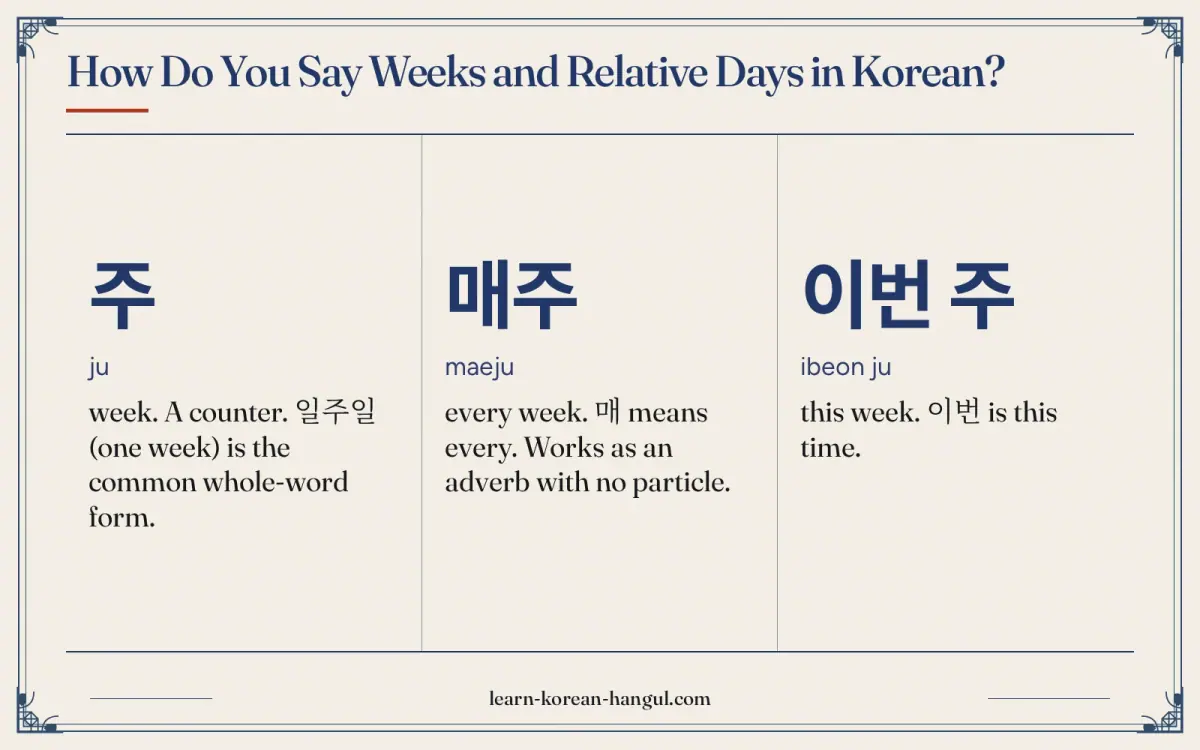
Four words place a day in a week. 이번 주 is this week, 다음 주 is next week, 지난주 is last week, and 매주 is every week. Put the week word before the day: 다음 주 화요일 is next Tuesday, and 지난주 금요일 is last Friday. In Korean the order always runs from the large unit to the small unit.
| No. | Hangul | Revised Romanization | Meaning and note | Example sentence | Audio assetId |
|---|---|---|---|---|---|
| 13 | 주 | ju | week. A counter. 일주일 (one week) is the common whole-word form. | 한 주에 두 번 가요. (I go twice a week.) | au-pg-vocabulary-time-days-of-week-13; example: au-pg-vocabulary-time-days-of-week-33 |
| 14 | 매주 | maeju | every week. 매 means every. Works as an adverb with no particle. | 매주 일요일에 운동해요. (I exercise every Sunday.) | au-pg-vocabulary-time-days-of-week-14; example: au-pg-vocabulary-time-days-of-week-34 |
| 15 | 이번 주 | ibeon ju | this week. 이번 is this time. | 이번 주는 바빠요. (This week is busy.) | au-pg-vocabulary-time-days-of-week-15; example: au-pg-vocabulary-time-days-of-week-35 |
| 16 | 다음 주 | daeum ju | next week. 다음 is next. | 다음 주에 만나요. (Let us meet next week.) | au-pg-vocabulary-time-days-of-week-16; example: au-pg-vocabulary-time-days-of-week-36 |
Then the three nearby days. 오늘, 어제 and 내일 are today, yesterday and tomorrow, and they behave like adverbs. You do not add 에 to them. 어제 만났어요 is correct and 어제에 만났어요 is not.
| No. | Hangul | Revised Romanization | Meaning and note | Example sentence | Audio assetId |
|---|---|---|---|---|---|
| 17 | 오늘 | oneul | today. Takes no 에. | 오늘은 화요일이에요. (Today is Tuesday.) | au-pg-vocabulary-time-days-of-week-17; example: au-pg-vocabulary-time-days-of-week-37 |
| 18 | 어제 | eoje | yesterday. Takes no 에. | 어제는 일요일이었어요. (Yesterday was Sunday.) | au-pg-vocabulary-time-days-of-week-18; example: au-pg-vocabulary-time-days-of-week-38 |
| 19 | 내일 | naeil | tomorrow. Takes no 에. | 내일은 수요일이에요. (Tomorrow is Wednesday.) | au-pg-vocabulary-time-days-of-week-19; example: au-pg-vocabulary-time-days-of-week-39 |
| 20 | 지난주 | jinanju | last week. Written as one word; 지난 means past. | 지난주 금요일에 만났어요. (We met last Friday.) | au-pg-vocabulary-time-days-of-week-20; example: au-pg-vocabulary-time-days-of-week-40 |
The tense of the verb matches the day. 어제 and 지난주 pair with a past form, such as 만났어요, while 내일 and 다음 주 pair with a present or future form, such as 만나요. For how the past form is built, see the past tense lesson.
Using Days in Sentences
Here are the four patterns that cover most daily use.
- Day + 에 + verb. 수요일에 친구를 만나요. (I meet a friend on Wednesday.)
- Week + day. 다음 주 화요일에 만나요. (We meet next Tuesday.)
- 매주 + day. 매주 일요일에 운동해요. (I exercise every Sunday.)
- Day + 은/는 + state. 오늘은 화요일이에요. (Today is Tuesday.)
Dates join the pattern at the front: write the date, then the day, then the verb. For the number part of a date, see dates.
How Do You Pronounce These Words?
The pronunciation rules involved are linking (연음), where a final consonant moves to the next syllable when that syllable begins with silent ㅇ. Standard pronunciation follows the National Institute of Korean Language (국립국어원) rules, and the romanization follows the Revised Romanization of Korean, which spells linked sounds as they are heard (woryoil, mogyoil).
| Spelling | Sounds like | What happens |
|---|---|---|
| 월요일 | [워료일] | Final ㄹ of 월 moves to the ㅇ of 요 and is said as ㄹ. |
| 금요일 | [그묘일] | Final ㅁ of 금 moves to the start of the next syllable. |
| 목요일 | [모교일] | Final ㄱ of 목 moves to the start of the next syllable. |
| 일요일 | [이료일] | Final ㄹ of 일 moves to the start of 요. |
| 공휴일 | [공휴일] | No change; the ㅇ stays as a final nasal sound (ng). |
| 평일 | [평일] | No change; say pyeong then il. |
The pair to practise is 월요일 and 일요일. Both contain [료], and both end in 일. They sound close, so listen for the first syllable: 워 against 이.
Audio and Slow Playback
Each word and sentence has its own clip. The clips below replay the trickiest words slowly. Play one, repeat it, then play it again and compare.
What Mistakes Do Learners Make with Days of the Week?
Five mistakes come up often.
- Adding 에 to 오늘, 어제 or 내일. Say 내일 만나요, not 내일에 만나요.
- Dropping 요일. In speech, 월 alone means month. The one-syllable (월) for Monday appears only after dates in written calendars, so say the full 월요일.
- Mixing up the middle of the week. 화요일, 수요일 and 목요일 are the names learners swap most. Use the elements in order: fire, water, wood (화, 수, 목).
- Using 휴일 and 공휴일 as the same word. 공휴일 is a public holiday set by law, such as 한글날; 휴일 is any day off.
- Saying 주말 with 에 and then repeating the day. 주말에 토요일에 is awkward; say 토요일에 or 주말에, not both.
Most of these are small word-order or particle slips, so a few sentence drills fix them.
Practice: Flashcards and Worksheet
Run the deck in recognition mode until the seven names come quickly, then switch to listening mode, then take the quiz. The deck holds all 20 words with audio, and your progress stays in your browser. The vocabulary flashcard decks page lists the other decks.
Practice · 45
- 01월요일
Show answer
headword 1: Monday
- 02화요일
Show answer
headword 2: Tuesday
- 03수요일
Show answer
headword 3: Wednesday
- 04목요일
Show answer
headword 4: Thursday
- 05금요일
Show answer
headword 5: Friday
- 06토요일
Show answer
headword 6: Saturday
- 07일요일
Show answer
headword 7: Sunday
- 08요일
Show answer
headword 8: day of the week
- 09평일
Show answer
headword 9: weekday
- 10주말
Show answer
headword 10: weekend
- 11휴일
Show answer
headword 11: day off; holiday
- 12공휴일
Show answer
headword 12: public holiday
- 13주
Show answer
headword 13: week
- 14매주
Show answer
headword 14: every week
- 15이번 주
Show answer
headword 15: this week
- 16다음 주
Show answer
headword 16: next week
- 17오늘
Show answer
headword 17: today
- 18어제
Show answer
headword 18: yesterday
- 19내일
Show answer
headword 19: tomorrow
- 20지난주
Show answer
headword 20: last week
- 21월요일에 학교에 가요.
Show answer
example sentence for 월요일
- 22화요일에 수업이 있어요.
Show answer
example sentence for 화요일
- 23수요일에 친구를 만나요.
Show answer
example sentence for 수요일
- 24목요일은 바빠요.
Show answer
example sentence for 목요일
- 25금요일 저녁에 영화를 봐요.
Show answer
example sentence for 금요일
- 26토요일에 쉬어요.
Show answer
example sentence for 토요일
- 27일요일에는 늦게 일어나요.
Show answer
example sentence for 일요일
- 28오늘 무슨 요일이에요?
Show answer
example sentence for 요일
- 29평일에는 일찍 일어나요.
Show answer
example sentence for 평일
- 30주말에 뭐 해요?
Show answer
example sentence for 주말
- 31휴일에는 집에 있어요.
Show answer
example sentence for 휴일
- 32한글날은 공휴일이에요.
Show answer
example sentence for 공휴일
- 33한 주에 두 번 가요.
Show answer
example sentence for 주
- 34매주 일요일에 운동해요.
Show answer
example sentence for 매주
- 35이번 주는 바빠요.
Show answer
example sentence for 이번 주
- 36다음 주에 만나요.
Show answer
example sentence for 다음 주
- 37오늘은 화요일이에요.
Show answer
example sentence for 오늘
- 38어제는 일요일이었어요.
Show answer
example sentence for 어제
- 39내일은 수요일이에요.
Show answer
example sentence for 내일
- 40지난주 금요일에 만났어요.
Show answer
example sentence for 지난주
- 41월요일
Show answer
slow playback: 월요일
- 42금요일
Show answer
slow playback: 금요일
- 43목요일
Show answer
slow playback: 목요일
- 44일요일
Show answer
slow playback: 일요일
- 45공휴일
Show answer
slow playback: 공휴일
Practice · 5
What does 월요일 (woryoil) mean?
Show answer
Monday
월요일 means Monday. Example: 월요일에 학교에 가요. (I go to school on Monday.)
What does 주말 (jumal) mean?
Show answer
weekend
주말 means weekend. Example: 주말에 뭐 해요? (What do you do on the weekend?)
What does 수요일 (suyoil) mean?
Show answer
Wednesday
수요일 means Wednesday. Example: 수요일에 친구를 만나요. (I meet a friend on Wednesday.)
What does 공휴일 (gonghyuil) mean?
Show answer
public holiday
공휴일 means public holiday. Example: 한글날은 공휴일이에요. (Hangeul Day is a public holiday.)
What does 내일 (naeil) mean?
Show answer
tomorrow
내일 means tomorrow. Example: 내일은 수요일이에요. (Tomorrow is Wednesday.)
Days of the Week in Korean Worksheet (PDF)
A printable worksheet for these words (word list, matching, writing practice, fill-in-the-blank exercises and answer key) is available in A4 and US Letter from the download card on this page. For practice, draw a seven-column week, write each day name in Hangul and add one verb under each.
Where to Go Next
Continue with Months to name the month for the date, or Time Expressions for more words about when. To place the day in a number, see Sino-Korean numbers. To move up, return to Time Words.
Frequently Asked Questions
How Do You Say the Days of the Week in Korean?
The days are 월요일 (Monday), 화요일 (Tuesday), 수요일 (Wednesday), 목요일 (Thursday), 금요일 (Friday), 토요일 (Saturday) and 일요일 (Sunday). Each is an element or sun/moon syllable plus 요일, which means day of the week. Add 에 to say on that day, as in 금요일에.
Why Do Korean Day Names Mean Moon, Fire, Water, Wood, Metal, Earth and Sun?
They come from Chinese characters (Sino-Korean words): 月 moon, 火 fire, 水 water, 木 wood, 金 metal, 土 earth and 日 sun. Japanese uses the same system, while modern Chinese numbers its weekdays. You do not need to know the characters to speak Korean, but they help you remember which syllable goes with which day.
What Is the Difference between 휴일 and 공휴일?
휴일 is any day off work or school, including every Sunday. 공휴일 is a public holiday set by law, such as Hangeul Day. Use 공휴일 when you mean the official holiday and 휴일 when you mean a day off in general.
Do You Need 에 with 오늘, 어제 and 내일?
No. 오늘, 어제 and 내일 work like adverbs, so you say 내일 만나요 for "We meet tomorrow". The day names do take 에: 월요일에 만나요 means "We meet on Monday".
How Do You Ask What Day It Is in Korean?
Ask 오늘 무슨 요일이에요? and answer with the day name plus 이에요 or 예요, such as 오늘은 목요일이에요. The word 무슨 means what kind of, and 요일 tells the listener you want a weekday name.
Is the Romanization on This Page Official?
It follows the Revised Romanization of Korean, which South Korea adopted on 7 July 2000 and whose rules the National Institute of Korean Language (국립국어원) publishes. It is a learning aid and does not mark every sound change, so rely on the Hangul and the audio.